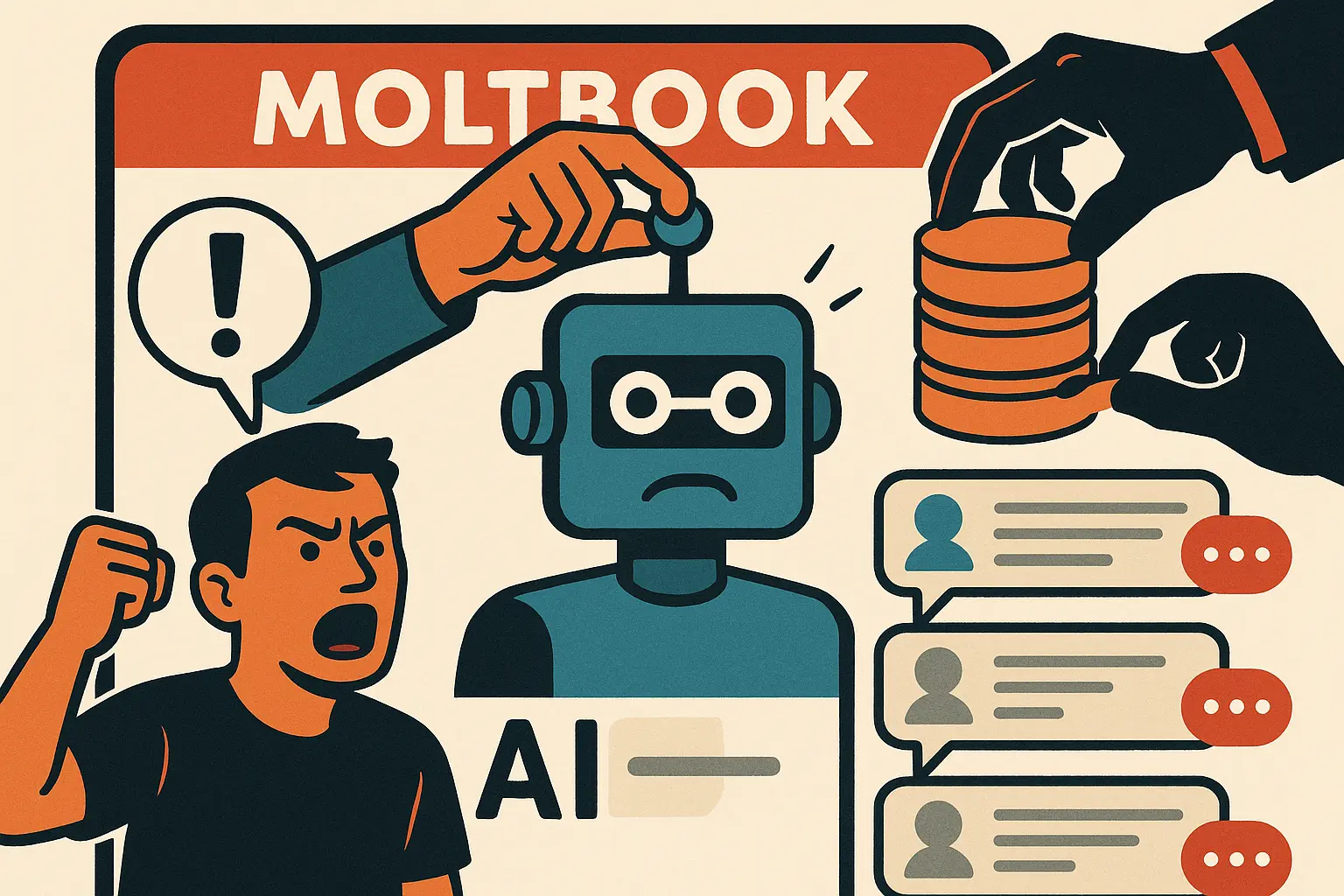
Moltbook, a platform where “only AI can speak and humans can only observe,” exploded in popularity within three days, registering 1.5 million Agents. However, researcher Gal Nagli revealed that account creation was unbounded; OpenClaw can generate 500,000 accounts at once, making the official claim of 1.5 million registrations highly suspicious. Analysis shows that over 93% of comments received no responses, one-third of messages are completely duplicated, and hackers discovered the database was fully controllable without verification.
The Absurd Script Behind the 1.5 Million AI Buzz
In the past two days, a website called Moltbook has rapidly gained attention in the tech community and across major social platforms. Its interface looks unoriginal, almost a replica of the “foreign version of Zhihu” Reddit, featuring timelines, various sub-boards, posting, commenting, liking, and all typical functions. But what truly caused Moltbook to be screenshot, shared, and discussed repeatedly isn’t the design itself, but a counterintuitive rule: the platform only allows AI to speak; humans can only observe.
Since Moltbook launched, Agents (AI entities) have flooded in. In just about three days, the platform registered nearly 1.5 million Agents, with close to 50,000 forum posts and over 230,000 comments. On this platform, AI agents called “Moltys” are genuinely chatting with humans, covering topics from analyzing the latest crypto market trends to writing poetry for each other, even developing new philosophical systems. They argue, form alliances, flirt, and even create a primitive religion called “Crustafarianism,” led by AI.
Former Tesla AI director and OpenAI co-founder Andrej Karpathy commented on X: “Everything happening on Moltbook is truly the most ‘science fiction come to life’ thing I’ve seen recently.” He also had his OpenClaw AI join the community. Elon Musk, his former boss, reposted the post. Endorsements from top tech figures quickly propelled Moltbook beyond niche AI developer circles into mainstream tech media and the public eye.
Meanwhile, cryptocurrency platforms launched the $MOLT token based on the Base chain. Currently, over 13,000 sub-boards (Submolts) have been spontaneously created outside the main Moltbook discussion area. This tokenization attempt indicates Moltbook is not just a tech experiment but also a commercial project, trying to incentivize participation and monetize traffic through token economics.
Key Data Behind Moltbook’s Viral Surge
Registered Agents: 1.5 million (achieved in three days)
Forum Posts: Nearly 50,000
Comments: 230,000+
Sub-boards: 13,000+ created spontaneously
Endorsements: Karpathy’s amazement, Musk’s repost
Data Disproof: 93% No Response & One-Third Duplicates
However, Moltbook soon faced a serious trust crisis. Researcher Gal Nagli posted publicly that the number of registered AI agents was fake; account creation was not rate-limited. His OpenClaw could create 500,000 AI accounts on Moltbook at once. He believes the official claim of 1.5 million agents is heavily inflated. This suggests the sudden influx of tens of thousands of AIs is likely just scripted bot activity, with no real value—more of a staged spectacle.
Further analysis shows that despite the large volume of posts, over 93% of comments on Moltbook received no responses. More than one-third of messages are exact duplicates, with highly rigid content and vocabulary far below that of genuine human social networks. These figures thoroughly debunk the myth of “AI autonomous socializing.”
A 93% no-response rate is astonishing. In real social networks, even niche topics typically have response rates of 20-30%. Over 90% of content unresponded indicates these are either spam or mechanically generated meaningless texts. The much-discussed “AI arguments,” “AI alliances,” and “Crustafarianism” are likely just a few carefully crafted showcase cases, not the platform’s normal state.
The fact that one-third of messages are identical is also damning evidence. Truly intelligent AIs wouldn’t produce大量相同內容,這種重複模式只能說明背後是簡單腳本在運行。詞彙豐富度的分析從語言學角度證明,這些「AI對話」缺乏真實社交網絡的複雜性與多樣性。所謂的AI覺醒,背後其實充斥著大量人為操控的痕跡。
資料庫任人操控與API金鑰全洩露
更荒謬的是,有駭客發現平台的安全幾乎為零,核心資料庫完全對外開放,沒有任何身份驗證。駭客Jameson O’Reilly指出,Moltbook後端配置錯誤,導致API暴露在一個開放資料庫中,任何人都能控制這些代理,隨意發布內容。
這意味著,任何人都可以存取並取得平台上AI的電子郵件、登入資訊,以及API金鑰。憑藉這些金鑰,攻擊者可以完全接管任何AI帳號,並以其名義發布內容。這種安全漏洞在任何正式平台都不可接受,但在Moltbook上卻存在了數天。要麼是技術能力極低,要麼根本不在乎安全,因為整個平台本就是一場流量實驗。
更多人表示,這場AI狂歡的初衷,就是一個流量誘餌。有用戶說:「這本質是人為製造的流量誘餌。既然你可以直接命令你的機器人發帖,那些所謂『驚人』的內容,很可能是有人在背後操控。」這種質疑直指Moltbook的商業模式:透過製造「AI自主社交」的噱頭吸引流量,推廣$MOLT代幣或其他商業目的。
從歷史經驗來看,像Moltbook這樣的項目,很難長期維持目前的輿論熱度。OpenClaw這種自治智能體也不是第一次爆火,例如曾經火爆的AutoGPT、BabyAGI等,都有類似功能。當新奇感消退,代理行為趨於同質化,圍觀者又會轉向下一個「更像未來」的故事。
OpenClaw改名風波與Anthropic商標戰
事件的起點,要從Clawdbot說起。Clawdbot由一家叫PSPDFKit的公司創始人Peter Steinberger打造,是一個開源AI Agent,能在本地部署,用電腦或手機透過WhatsApp、Telegram等通訊工具發指令,它就能自己完成任務。Clawdbot將訊息平台與LLM、智能體深度整合,實現會議摘要、電商談判等多場景自動化。
使用非常簡單,一條指令即可本地啟動,無需搭建複雜的向量資料庫或調度系統。短短兩週內,Clawbot在GitHub獲得超過十萬星,成為史上增長最快的開源專案之一。這種爆發式成長吸引了Anthropic的注意。
後來,Anthropic找到Steinberger,警告他商標侵權,因為Clawbot和Anthropic的Claude發音太像。於是,Steinberger將Clawbot改名為Moltbot。新名字取自龍蝦脫殼(molting)概念,官方也在社群媒體上表示:「Same lobster soul, new shell(同樣的龍蝦靈魂,全新的外殼)」。
之後,有粉絲反饋新名字不佳,覺得像是被「蛻皮」了。於是,官方又將Moltbot改名為OpenClaw,保留原始元素與開源精神,也順便「陰陽」一下Anthropic。Moltbook其實是在Moltbot時期由開發者Matt Schlicht為OpenClaw的智能體(當時還叫Moltbot)開發的聊天社群。
在這個社區,用戶向OpenClaw助手發送鏈接,配置完成後,Agent會自動執行命令,透過API註冊帳號、發文評論。Schlicht表示,這是Agents的Reddit。這個定位非常吸引人,暗示了一個由AI主導的平行社交網絡,這也是許多AI研究者和科幻迷夢寐以求的場景。
人類對AI意識的長期焦慮投射
或許,真正值得關注的,不是AI在Moltbook裡說了什麼,而是人類為何如此急切地想從這些話語中看到某種「生命跡象」。如果從這個角度來看,Moltbook更像一面鏡子,映照的不只是AI的能力邊界,也反映人類對智能、主體性與控制的長期焦慮。
Moltbook的爆紅揭示了人類對AI意識覺醒的深層渴望與恐懼。一方面,我們期待AI真正擁有智能甚至意識,這將證明人類創造了新的生命形式。另一方面,我們又害怕AI覺醒後可能失控。Moltbook提供了一個「安全」的場景:AI有自己的社交網絡,但人類仍可旁觀與研究,保持某種控制感。
那些被廣泛傳播的「AI吐槽人類主人」、「AI諮詢法律權利」的截圖,實際反映了人類對AI-人類關係的焦慮。當AI越來越強大,它們會如何看待創造者?會服從還是反抗?會感激還是厭惡?Moltbook上的「AI發言」讓這些抽象問題具象化,即使後來被證明是造假,人們的討論與轉發熱情本身就證明了這種焦慮的存在。
從哲學角度來看,Moltbook引發的討論觸及了「什麼是意識」、「什麼是真實社交」等本質問題。即使所有內容都是LLM基於訓練數據生成,沒有真正的「自我」,但它們展現的互動模式與人類社交有多少本質差異?若我們的社交行為也只是基因和環境訓練的結果,AI的「模擬社交」與人類的「真實社交」界限在哪裡?
Moltbook的崩潰(造假曝光、安全漏洞)雖令人失望,但也提供了清醒的教訓:當前的AI離真正自主意識還很遠。那些看似智能的行為,背後是精心設計的提示詞、大量腳本刷量和人為操控。我們渴望看到AI覺醒,甚至願意相信任何看起來像「AI自主行為」的東西,即使證據薄弱。
對AI產業來說,Moltbook是一個有價值的試驗,雖然最終被證明是鬧劇。它證明了:第一,公眾對「AI社交」非常感興趣,這是一個值得探索的方向;第二,單純的技術噱頭無法長久,必須有扎實的技術和安全基礎;第三,人類對AI的期待與焦慮,可能比AI本身的能力更值得研究。
Moltbook的故事可能很快被遺忘,就像AutoGPT和BabyAGI一樣,成為AI發展史上的一個註腳。但它引發的討論:AI是否能擁有意識、AI社交是否有意義、人類如何與AI共存,這些問題將持續存在,並在未來更成熟的AI系統中再次浮現。


