The supply shortage remains one of the main drivers of long-term growth.
Technically, when a portion of the circulating supply is locked, the valuation per coin tends to increase due to the reduced available supply. If this supply contraction occurs simultaneously with rising demand, the market will be conducive to a strong upward move driven by scarcity.
However, the story is not just about price charts. Supply “shocks” also help reinforce investors’ confidence in holding. Nevertheless, the question remains: has the recent LINK accumulation by Chainlink truly strengthened this argument, especially considering LINK has underperformed the overall market?
Chainlink activity signals potential driven by scarcity.
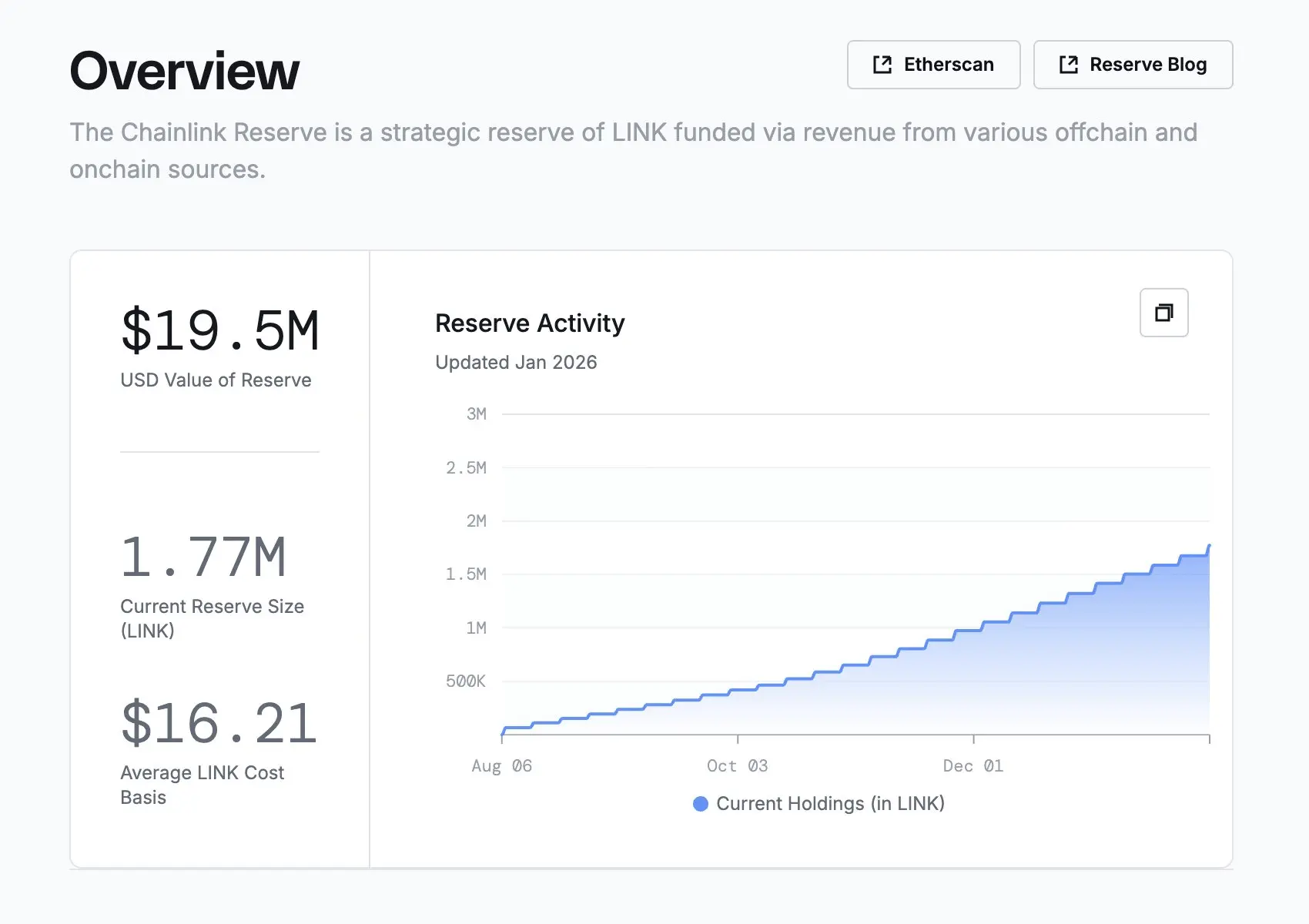
Recently, Chainlink announced that their reserve fund added 99,103 LINK — the largest single purchase to date. As a result, the total LINK locked in reserves reached 1.77 million, further reducing circulating supply on the market.
According to the data mentioned, this figure represents a 377% increase compared to 371,000 LINK before Q4/2025 — meaning about 1.4 million LINK have been added since then. However, the impact of this supply tightening has not yet clearly reflected in price movements.
Notably, Chainlink funds its accumulation activities through both on-chain and off-chain revenue, indicating a relatively solid level of application and network usage. The disconnect between platform activity and price performance highlights a question: is LINK being undervalued by the market?
Network activity signals: potential growth driven by scarcity
In the current context, being “undervalued” can sometimes be a positive signal. And LINK seems to fit this scenario.
Chainlink acts as an infrastructure connector, generating revenue from fees whenever smart contracts on other blockchains use their oracle — for example, a DeFi lending protocol relying on Chainlink’s price feeds.
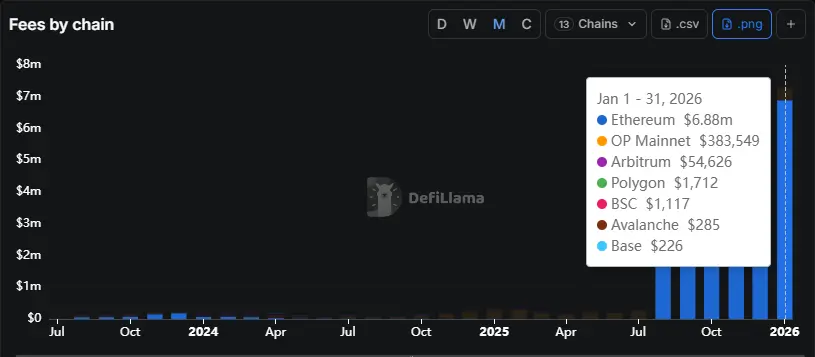
Recently, fees on 13 blockchains hit all-time highs, with Ethereum alone recording around $6.8 million. This indicates increasing demand for Chainlink’s services, and network usage is creating real value.
 Source: DeFiLlama
In other words, on-chain revenue is directly contributing to the LINK reserve fund.
Source: DeFiLlama
In other words, on-chain revenue is directly contributing to the LINK reserve fund.
However, this has not yet been proportionally reflected in the price. LINK is one of the worst-performing assets, down 39% in Q4/2025 and continuing to decline by 11.7% since the beginning of 2026. Nonetheless, much of this correction may be driven by widespread FUD sentiment in the market.
Conclusion
With strong on-chain activity, clear fee-generating potential, and a systematic accumulation strategy, Chainlink demonstrates a solid fundamental foundation. If market demand recovers, LINK could trigger an upward move driven by scarcity — and the current weakness phase might be viewed as an attractive accumulation/entry point for risk-tolerant investors.
Mr. Giáo
Disclaimer: The information on this page may come from third parties and does not represent the views or opinions of Gate. The content displayed on this page is for reference only and does not constitute any financial, investment, or legal advice. Gate does not guarantee the accuracy or completeness of the information and shall not be liable for any losses arising from the use of this information. Virtual asset investments carry high risks and are subject to significant price volatility. You may lose all of your invested principal. Please fully understand the relevant risks and make prudent decisions based on your own financial situation and risk tolerance. For details, please refer to
Disclaimer.
Related Articles
Crypto Sector Holds Steady Amid Neutral Sentiment
The crypto market shows mixed results with a $2.54T cap, as Bitcoin dips 0.13% and Ethereum rises 0.61%. Notable gainers include $TRUMP, $IDOS, and $MAGA. DeFi and NFT markets also see significant activity, while regulatory developments emerge from the SEC and CFTC.
BlockChainReporter17m ago
Bitcoin and Gold Correlation Coefficient Drops to -0.88, Reaching Lowest Level Since November 2022
Gate News reports that on March 18, CryptoQuant data showed the correlation coefficient between Bitcoin and gold dropped to -0.88, hitting a new low since November 2022. The data indicates a strong negative correlation between the two, with Bitcoin's price rising to $74,000 while gold experienced a slight decline.
GateNews21m ago
XRP Begins Era as Commodity Under US Laws, Stuart Alderoty Reacts - U.Today
Stuart Alderoty, Ripple's CLO, welcomes the SEC's reclassification of XRP as a commodity, suggesting it could enhance adoption and ease exchange listings. Despite a recent price drop, XRP remains above key support levels, although trading volume has significantly decreased.
UToday48m ago
QCP: BTC Oscillates Near $74,000; Multi-Country Central Bank Rate Decisions Key This Week
QCP Capital analysis indicates that BTC price is maintaining around $74,000, with a lack of upward momentum. Although the overall crypto market remains under pressure, the declines are relatively controlled. Central bank policy meetings throughout the year will influence the market, as high oil prices have lowered expectations for rate cuts, and the interest rate environment has weakened support for crypto assets. Until policy and geopolitical situations become clearer, a volatile pattern may continue.
GateNews2h ago
Analyst: The overheated bubble of Bitcoin (BTC) has been absorbed, but selling pressure still remains.
On-chain analyst Axel's research report indicates that the Bitcoin market has returned to a neutral range, but overall remains in a loss state with unrelenting selling pressure. The MVRV Z-Score shows that valuation bubbles have dissipated; however, aSOPR has remained below 1.0 for 55 consecutive days, indicating sustained selling pressure. Axel emphasizes that the key to the market lies in whether selling pressure will be exhausted, requiring observation of whether aSOPR can stabilize above 1.0.
動區BlockTempo2h ago
Citigroup Slashes Bitcoin and Ethereum 12-Month Price Targets, Citing Stalled U.S. Crypto Legislation Weighing on Upside Catalysts
Citigroup has lowered its 12-month price targets for Bitcoin and Ethereum, signaling a shift toward caution on the cryptocurrency market's medium-term outlook, primarily due to slow progress in U.S. crypto asset legislation. Bitcoin's target was reduced from $143,000 to $112,000, while Ethereum's fell to $3,175. Despite upside potential remaining in the future, the lack of new policy catalysts suggests prices may oscillate within a range in the near term. Citigroup's assessment of Ethereum is more cautious, as it believes the asset is more significantly impacted by on-chain activity.
区块客3h ago


