
On December 26, approximately $6 billion worth of Ethereum options contracts will expire, with Deribit holding about $3.8 billion, making it the largest derivatives event of the week. The number of call options is 2.2 times that of put options, but the $3,100 “pain point” price level becomes a key battleground for bulls and bears. If Ethereum fails to effectively break through this level, a large number of call options will become worthless. Currently, the price remains above $2,900, but the market structure is fragile.
Ethereum $6 Billion Options Expiration and the Battle at the Pain Point
Derivatives platform Laevitas states that among the contracts nearing expiration, the number of call options exceeds put options by more than 2.2 times. This structure suggests market sentiment is leaning optimistic, but this optimism could be a trap. The key is the $3,100 “pain point” (Max Pain), which is the price level where options sellers maximize their profits. At this level, the value of most options will decline, causing losses for both call and put option buyers.
Options sellers are usually large market makers and institutions with substantial capital and hedging tools. As expiration approaches, these entities are motivated and capable of pushing the price toward the “pain point” to maximize their gains. Currently, Ethereum is trading around $2,900, about 7% below the pain point at $3,100. If the price cannot break through $3,100 before expiration, many call option holders will face full losses.
The world’s largest cryptocurrency options exchange, Deribit, holds about $3.8 billion in options contracts. Additionally, $23.6 billion worth of Bitcoin options will also expire on Friday, which could increase market volatility. The simultaneous expiration of Bitcoin and Ethereum options will create significant hedging demand and liquidation pressure. Traders often adjust spot positions before expiration to hedge options risks, which can trigger sharp price swings in a short period.
Three Price Scenarios for Options Expiration
Break through $3,100: Call options go in-the-money, short covering pushes the price short-term to $3,300–$3,500
Hold above $2,900: Price oscillates near the pain point, most options expire worthless, volatility decreases
Drop below $2,900: Accelerated decline to support zones at $2,700–$2,800, profit-taking on puts triggers more short selling
Crypto expert Ted Pillows describes the current price range as a “non-trading zone,” meaning significant volatility will only occur if ETH price effectively breaks above $3,000 or revisits support levels between $2,700 and $2,800. This small fluctuation reflects market uncertainty, with traders waiting for Friday’s contract expiration.
Three Reasons for Pessimistic Forecast in 2026
Renowned crypto analyst Benjamin Cowen states that even after options contracts expire, Ethereum may not reach new highs by 2026. Cowen pointed out on the Bankless podcast that Bitcoin’s current weakness makes it difficult for Ethereum to appreciate long-term. He believes that even if Ethereum returns to the August high of $4,878, it could be a “bull trap,” with prices quickly falling back to $2,000 afterward.
Cowen is also bearish on the entire altcoin market. He believes only Ethereum has a chance to hit new all-time highs in this cycle, but a rebound from the current around $2,900 to August’s high would require a 40% increase. Given current market conditions, such a large rally seems increasingly unlikely. After a sharp decline in November, the current market structure appears weak, contradicting earlier expectations of a strong year-end rebound.
This pessimistic view aligns with Fundstrat Global Advisors, which suggests investors should be cautious, as Ethereum’s price could fall to between $1,800 and $2,000 by 2026. Additionally, veteran trader Peter Brandt predicts Bitcoin could drop to $60,000 by Q3 2026, intensifying concerns about a prolonged bear market. These chain reactions of pessimism indicate that most professional analysts see 2026 as either a bear market or a year of deep volatility.
The core logic of this bearish outlook is that Ethereum lacks independent catalysts for growth outside of Bitcoin. Bitcoin benefits from ETF capital inflows and strategic reserve narratives, while Ethereum’s Layer-2 scaling solutions dilute the mainnet’s value capture. DeFi lock-up volumes have stagnated, and institutional adoption is far below expectations. Against this weak fundamental backdrop, technical rebounds are often unsustainable.
Volatility Before Year-End, Will 2026 Fall Below $2,000?
(Source: Trading View)
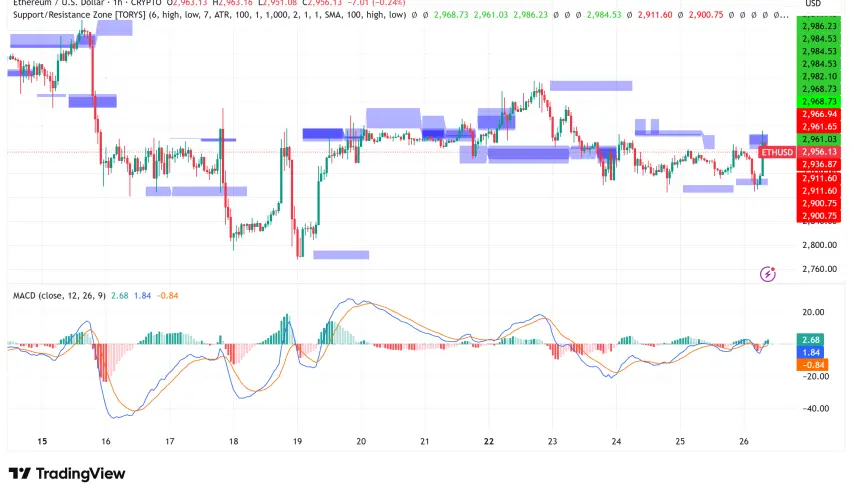
Due to current market dynamics and differing analyst opinions, Ethereum’s price is expected to fluctuate between $2,700 and $3,100 before the end of the year. Friday’s options expiration will be a key event. If the price breaks above $3,100, short covering could trigger a short-term rebound to $3,300–$3,500. However, if the price fails to stay above $2,900, it may accelerate downward toward the $2,700–$2,800 support zone predicted by analysts.
Looking ahead to 2026, overall bearish sentiment suggests limited upside. Without major catalysts, the price is most likely to fluctuate within the $2,000 to $3,500 range. Fundstrat’s forecast of $1,800–$2,000 is not impossible but would require systemic risk events such as a Fed rate hike, major hacking incidents, or regulatory crackdowns. Conversely, if Layer-2 ecosystems explode, ETF capital inflows accelerate, or DeFi recovers, Ethereum could hold the $2,500 bottom and rebound above $3,500.
Disclaimer: The information on this page may come from third parties and does not represent the views or opinions of Gate. The content displayed on this page is for reference only and does not constitute any financial, investment, or legal advice. Gate does not guarantee the accuracy or completeness of the information and shall not be liable for any losses arising from the use of this information. Virtual asset investments carry high risks and are subject to significant price volatility. You may lose all of your invested principal. Please fully understand the relevant risks and make prudent decisions based on your own financial situation and risk tolerance. For details, please refer to
Disclaimer.


