Entering Christmas week, the global market's initial response does not belong to the Crypto Assets market. Against the backdrop of a weakening dollar and a retreat in U.S. Treasury yields, risk aversion sentiment has rapidly intensified, with gold and silver taking the lead in the market, their prices continuously breaking historical highs, becoming the hottest destination for funds.
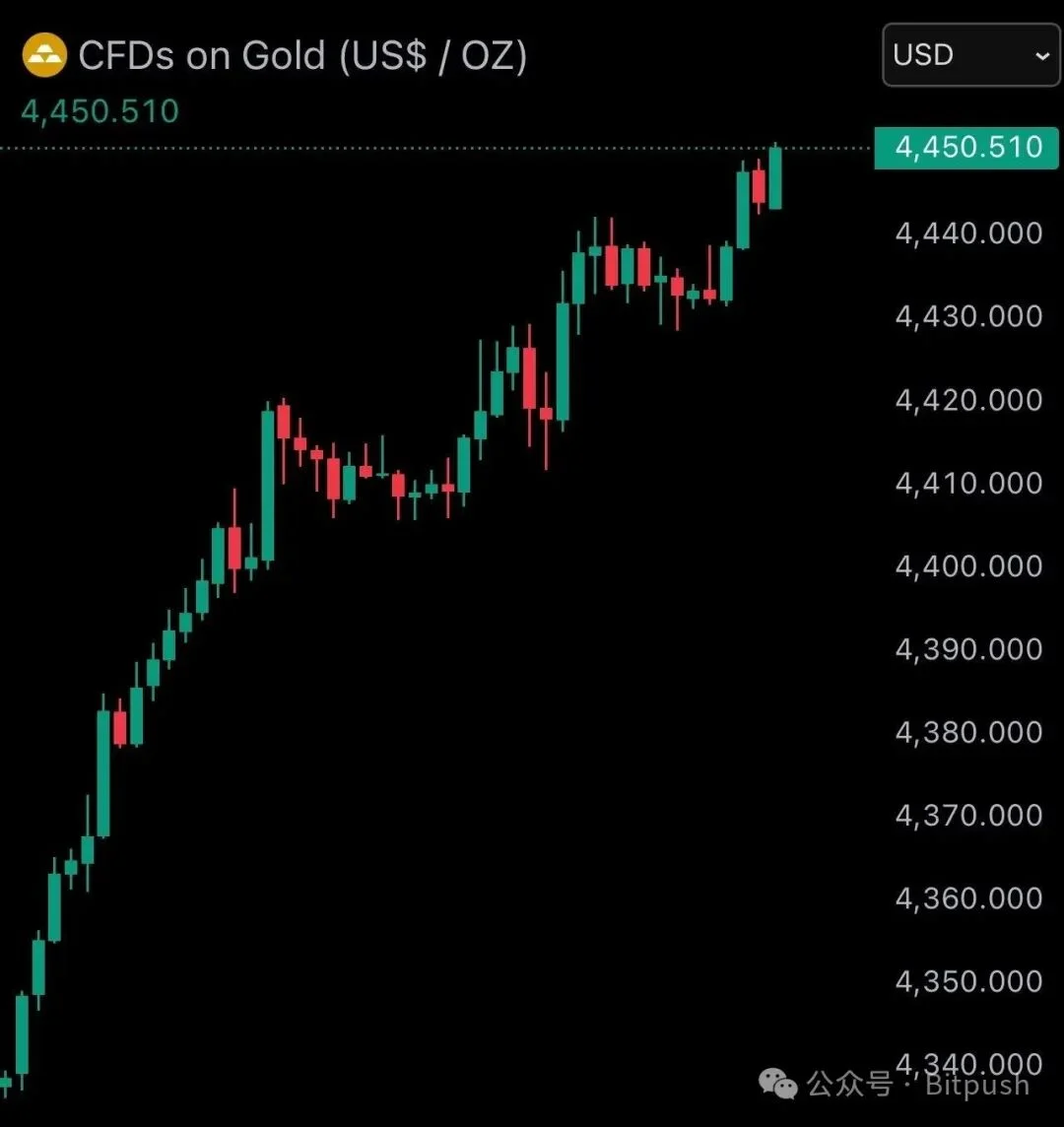
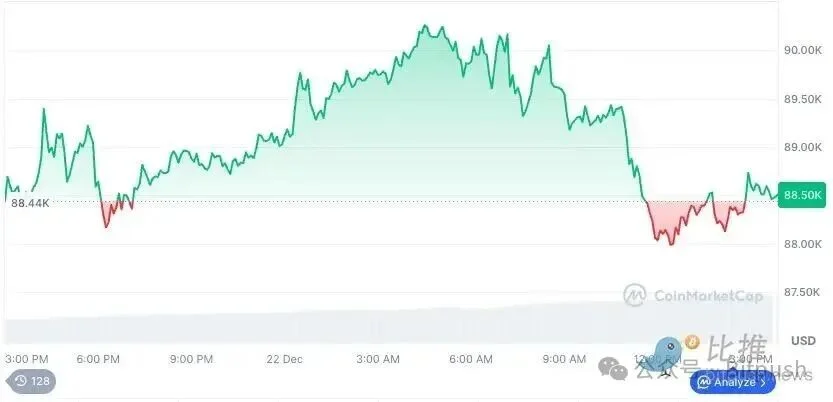
In contrast, the encryption market appears unusually quiet, with Bitcoin not soaring along with the macro tailwinds, but rather continuing to linger in the 88,000-89,000 fluctuation range, lacking the offensive posture one would expect before the holiday.
It is precisely against such a contrast that the question of whether Bitcoin will迎來聖誕行情 (Santa Rally) has once again become a topic of repeated discussion in the market. The so-called Santa Rally is originally a seasonal phenomenon in traditional financial markets, referring to the phase of rising risk assets driven by improved sentiment and changes in liquidity around Christmas. However, in the crypto market, this pattern has never been stable. This year, is Bitcoin “falling behind” amid a warming of risk aversion, or quietly building strength within a high range? We still need to return to real price actions and capital structures to find the answer.
The macro environment is in a “wait for verification” phase, with risks of capital flowing out of risk assets.
Gabriel Selby, the research director at CF Benchmarks, pointed out that market participants are unlikely to significantly increase their allocation to risk assets like Bitcoin until the Federal Reserve receives clear data pointing to a continuous decline in inflation for several months. In his view, the current macro environment is still in a “wait for validation” phase.
This cautious sentiment is closely related to investors' heightened attention to a series of upcoming U.S. economic data. The GDP data for the third quarter will be announced soon, with the market generally expecting an annualized growth rate of about 3.5%, slightly lower than the 3.8% in the second quarter; at the same time, indicators such as the consumer confidence index and the number of initial jobless claims will also provide more clues about the state of the labor market. The results of this data will directly affect the market's judgment on the Federal Reserve's policy path and further influence overall risk appetite.
From other macro factors, the weakening of the dollar and the decline in U.S. bond yields have indeed provided a theoretically favorable environment for risk assets. However, the reality of capital choices presents a completely different answer.
According to statistics from SoSoValue, there has been a clear divergence in the ETF space recently: Bitcoin ETFs recorded a net outflow of approximately $158.3 million, while Ethereum ETFs saw outflows of about $76 million; in contrast, XRP and Solana ETFs recorded slight inflows of approximately $13 million and $4 million respectively, indicating a gradual adjustment of funds within the internal market, as well as an overall structural adjustment.
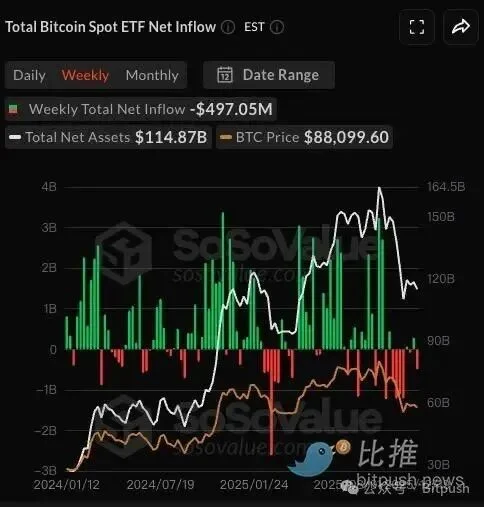
From a broader perspective on digital asset investment products, CoinShares pointed out in its latest weekly fund flow report that there was a net outflow of approximately $952 million from digital asset investment products last week, marking the first shift to net redemptions after four consecutive weeks of inflows. CoinShares attributes part of this outflow to regulatory uncertainty caused by the slowdown in the advancement of the Clarity Act in the United States, leading institutional investors to tend to reduce risk exposure in the short term.
Technical Structure: Mainly Sideways
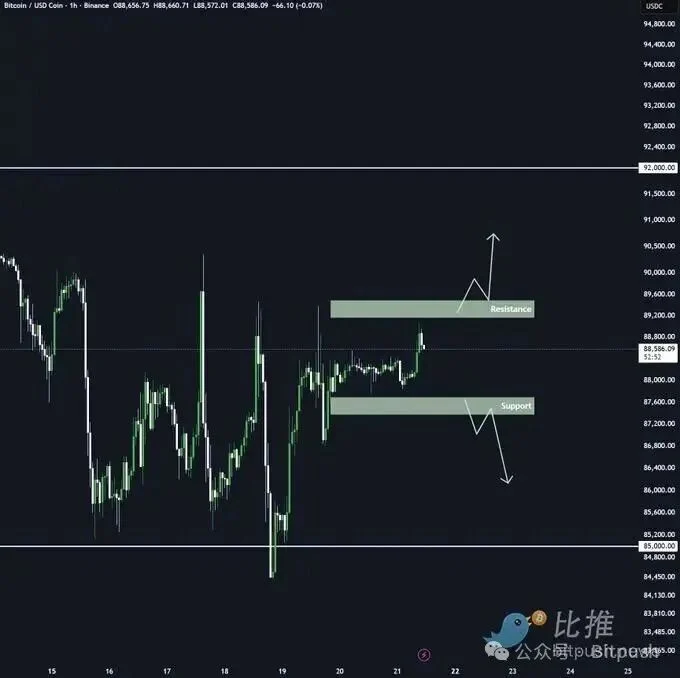
From a technical structure perspective, the current trend of Bitcoin is not obviously bearish, but it is also difficult to call it strong. The range of 88,000 to 89,000 USD has become the core oscillation zone that has been repeatedly verified in the short term, while the area of 93,000 to 95,000 USD constitutes the key resistance that the bulls must break through.
Multiple traders pointed out that if Bitcoin cannot effectively break through this resistance zone within the Christmas week, even if a short-term rebound occurs, it is more likely to be seen as a technical correction rather than a trend reversal. Conversely, if the price continues to maintain a high-level consolidation, it indicates that the market is waiting for new driving factors rather than actively choosing a direction.
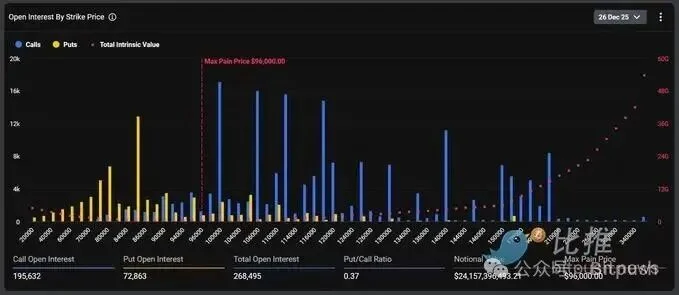
The structure of the derivatives market also explains to some extent why Bitcoin appears particularly restrained during Christmas week. This Friday, the Bitcoin market will face the largest options settlement in history, with a total value of up to $24 billion. Currently, both bulls and bears are engaged in intense battles at key price levels:
- Bullish: Betting that BTC will break through the 100,000 USD mark;
- Bears: Defending the 85,000 USD level with full force;
- Winning Hand: $96,000 is seen as the watershed of this round's trend. If it holds here, it can maintain the rebound momentum; otherwise, the market will continue to face pressure.
How analysts see it
Multiple market observers have pointed out that this year's Christmas week resembles more of a “structural test” rather than a sentiment-driven one-sided market window.
CF Benchmarks Head of Research Gabriel Selby recently stated in an interview that the current price behavior of Bitcoin does not align with the typical characteristics of a Santa Rally. In his view, a true holiday market is often accompanied by sustained buying pressure and trend continuation, rather than repeated tug-of-war within a high range. “What we are seeing now looks more like the market digesting previous gains rather than building momentum for the next upward move.” This judgment is also corroborated by the ongoing reality of consistently low trading volumes.
Crypto Assets analyst DrBullZeus stated that BTC continues to fluctuate between the same support and resistance levels, with no significant breakthroughs observed yet. Until a clear breakthrough occurs, prices will remain within a range-bound trend. A breakthrough of the resistance level will open up the path to the 92,000 dollars level, while a fall below the support level may lead to a price pullback to the 85,000 dollars region.
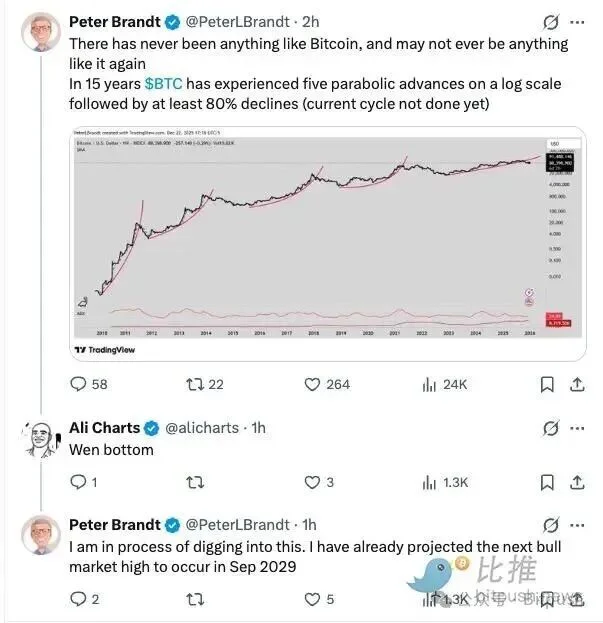
Legendary trader Peter Brandt's latest review points out that Bitcoin has experienced 5 cycles of “parabolic growth followed by an 80% retracement” in the past 15 years, and the adjustment in this cycle has yet to find a bottom. Despite the harsh short-term patterns, he predicts through cyclical analysis that the next bull market peak will arrive in September 2029.
Brandt emphasized that assets like BTC are destined to reach new highs in extreme washouts.
Overall, Bitcoin's “Christmas market” has always been elusive. Looking back at history, there have been dazzling performances such as a 33% and 46% surge during the festive periods in 2012 and 2016, as well as years of dullness or even decline. Statistically, since 2011, Bitcoin's average increase during the Christmas period has been about 7.9%.
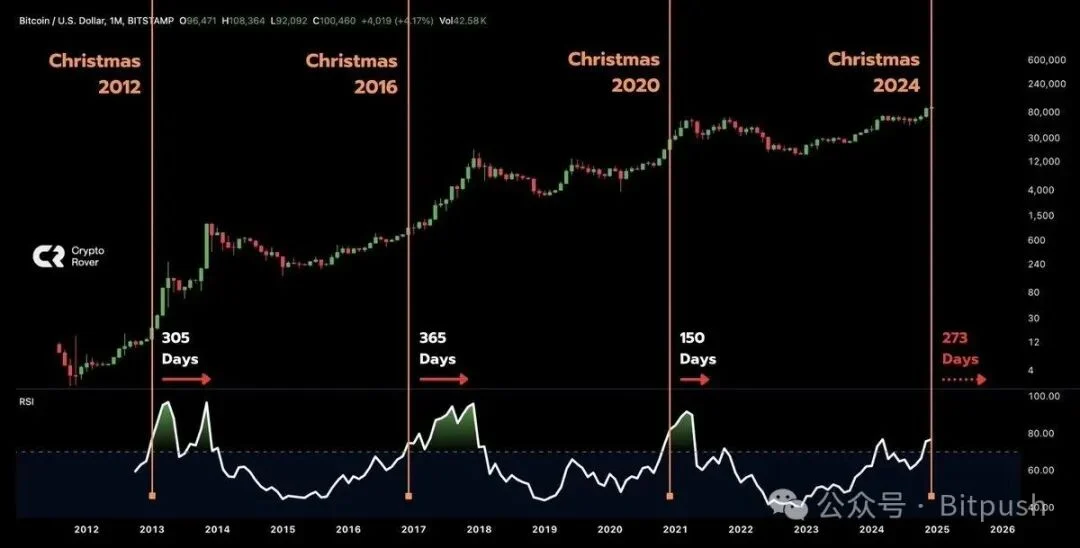
However, from the current market landscape, it seems difficult to replicate the typical “Christmas rally” this year. The strength of gold and silver more reflects the concentrated release of market risk aversion; in contrast, Bitcoin's relative “calmness” once again highlights its current perception as a risk asset in global asset allocation.
Therefore, rather than simply attributing Bitcoin's current performance to “lagging behind”, it is more accurate to say that it is in a critical and delicate position: on one hand, there is a lack of sufficient macro tailwinds to directly propel it onto a new upward trajectory; on the other hand, there have not yet been any clear signals of a breakdown and weakening.
What truly determines whether Bitcoin can emerge with an independent market trend by the end of the year is not the time label “Christmas,” but whether the market capital is willing to re-bet at the current position. Until this point is clearly confirmed, narrow fluctuations may still be the main theme of this Christmas week.
(The above content is excerpted and reproduced with the authorization of our partner PANews, original link | Source: BitPush__)
_
Disclaimer: This article is intended to provide market information. All content and opinions are for reference only and do not constitute investment advice, nor do they represent the views and positions of Blockchain. Investors should make their own decisions and trades; the author and Blockchain will not bear any responsibility for any direct or indirect losses incurred by investors' transactions.
_
Tags: Analyzing Crypto Assets Market Coin Price Investment Bitcoin Silver Christmas Market Trends Gold


