Bitcoin tested the key support level of $88,000 today, with the largest buyer MicroStrategy (MSTR) suddenly hitting the brakes. The company cashed out $747.8 million last week by selling 4.535 million shares of common stock, raising its cash reserves to $2.19 billion, but paused its Bitcoin purchase plan that had been ongoing for several years. This is the first time since 2020 that MicroStrategy has chosen to hoard cash instead of buying the dip during a downturn in the crypto market.
MicroStrategy Suddenly Shifts: From Frenzied Buying to Hoarding Cash

MicroStrategy Executive Chairman Michael Saylor revealed in a recent announcement that the company currently holds 671,268 Bitcoins, with a total value of 50.33 billion USD and an average purchase cost of 74,972 USD. However, since purchasing 10,645 BTC at an average price of 92,098 USD on December 15, the company has taken no further action. In contrast, during the period from December 15 to 21, MicroStrategy sold MSTR common stock through a market issuance plan, cashing out a net gain of 747.8 million USD, increasing its cash reserves from 1.44 billion USD to 2.19 billion USD.
This type of operation is extremely rare in MicroStrategy's history. Over the past four years, regardless of Bitcoin's price fluctuations, Saylor has adhered to the “buy the dip” strategy, even doubling down during market panic. However, this time is different; MicroStrategy explicitly stated in the 8-K form submitted to the U.S. Securities and Exchange Commission (SEC) that the company is establishing a “dollar reserve,” prioritized for paying preferred stock dividends and interest on outstanding debt, and plans to extend the reserve coverage period from 12 months to 24 months.
This shift in strategy conceals a deep-seated crisis. MicroStrategy's common stock has plummeted nearly 50% over the past 12 months, severely undermining investor confidence. Company management is clearly aware that in an environment of continuously declining stock prices, continuing to buy Bitcoin in large amounts without a cash buffer could trigger the risk of debt default or shareholder lawsuits. Accumulating cash has become a necessary choice for self-preservation, but this also means the absence of the market's largest buyer, directly weakening the demand support for Bitcoin.
Why did Bitcoin drop today? The behavioral change of MicroStrategy provides the most direct answer: when even the most steadfast bulls choose to stand by, the market naturally loses its upward momentum.
Warning signs of the collective collapse of the Bitcoin treasury model
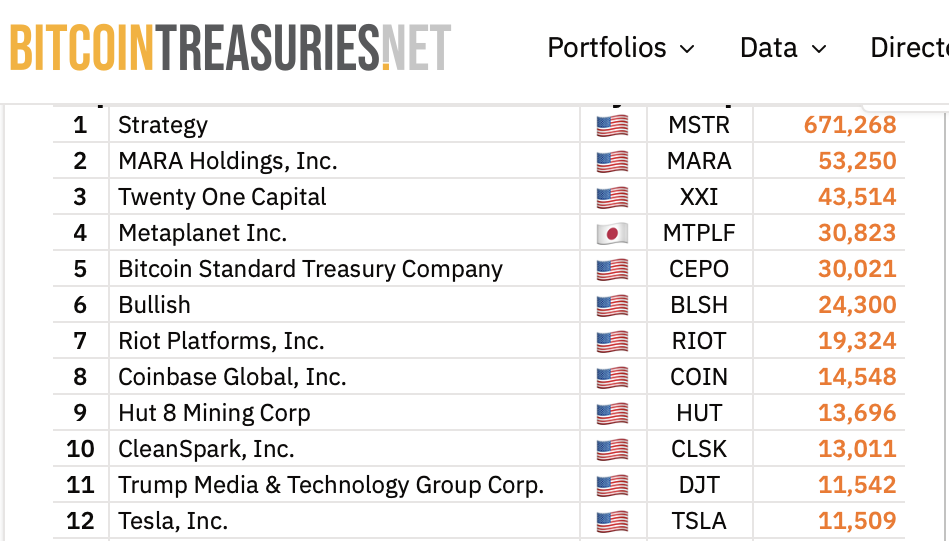
(Source: BitcoinTreasuries)
MicroStrategy's dilemma is not an isolated case; companies that follow suit in adopting the Bitcoin treasury model from 2024 to 2025 are experiencing a collective collapse. These companies initially saw their stock prices soar upon announcing their Bitcoin purchases, but as the crypto market entered a correction phase, their stock prices fell far more than Bitcoin itself, exposing the fatal flaw in the “Bitcoin treasury strategy.”
Bitcoin Treasury Company's Stock Price Plight
Metaplanet (MTPLF)
Position: 30,823 BTC (the fourth largest corporate holder globally)
Stock Performance: Plummeted 75% in the past six months, despite a 26% increase so far this year, but the recent downtrend is severe.
Question: Highly leveraged buying strategies amplify losses in bear markets.
MARA Holdings (MARA)
Position: 53,250 BTC (the second largest corporate holder in the world)
Stock Price Expectation: It is expected to drop by about 38% in 2025.
Problem: Mining business and Bitcoin price under dual pressure, cash flow worsens.
MicroStrategy (Strategy Inc / MSTR)
Position: 671,268 coins BTC (the largest corporate holder globally)
Stock Performance: Plummeted nearly 50% in the past 12 months.
Question: Severe stock dilution, heavy debt burden, forced to shift to defensive strategies
This collective collapse reveals the structural risks of the Bitcoin treasury model. These companies are essentially “leveraged Bitcoin bulls,” raising funds by issuing stocks or bonds to buy BTC, enjoying double-leverage returns in a bull market, but also bearing double blows in a bear market. When the price of Bitcoin falls, the BTC assets held by the companies shrink, while stock prices drop even more due to investor panic, forming a death spiral.
Why did Bitcoin drop today? These treasury companies have turned from buyers into potential sellers, and the market is worried that if the downtrend continues, they may be forced to sell BTC to pay off debts, further exacerbating the selling pressure.
Technical Analysis: Can the $88,000 support hold?
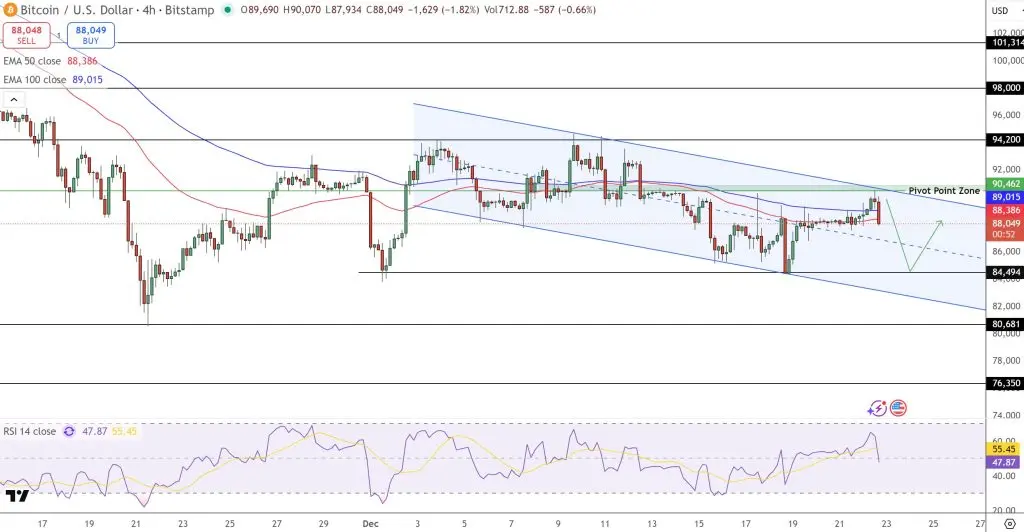
(Source: Trading View)
From a technical perspective, Bitcoin's trading price today is close to $89,433, currently in a key technical sensitive area. The 4-hour chart shows that BTC has been operating within a clear descending channel since late November, and although the selling pressure has eased, the bulls have yet to regain dominance.
The 50-day Exponential Moving Average (EMA) has turned into a resistance level around $88,400, while the 100-day EMA further limits the rebound space at $89,000. The compression of these moving averages within a descending channel usually indicates that volatility is about to expand. The recent candlestick bodies are smaller, with complex wicks, and even show spinning top patterns, reflecting that the market is in a state of balance rather than strength.
The support level remains solid near $84,500, overlapping with the lower boundary of the channel. Each test of this level has resulted in stronger rebounds, indicating that demand is absorbing supply. The Relative Strength Index (RSI) hovers below 50 but has stopped making new lows, suggesting potential momentum is building.
Key Situation Analysis: If the price breaks through the range of 90,500 to 91,000 USD, the price structure will move towards 94,200 USD or even 98,000 USD. Conversely, if it falls below the 84,500 USD support, it may reopen downward space, probing down to 80,600 USD.
Why did Bitcoin drop today? The technical indicators show that the market is still in the middle of a descending channel, lacking clear breakthrough signals, and the absence of major buyers like MicroStrategy has significantly increased the difficulty of breaking through the upper boundary. In this context, it is a natural outcome for BTC to test the support level below.
Triple bearish resonance drags BTC
Why did Bitcoin drop today? The answer is the result of multiple factors resonating together. First, MicroStrategy has shifted from aggressive buyers to a defensive cash hoarding stance, leaving the market's largest demand side absent. Second, the stock prices of Bitcoin treasury model companies have collectively collapsed, raising questions about the sustainability of this business model and concerns about forced selling risks. Third, the technical descending channel has not yet broken through, and the $88,000 support level is facing a test.
In the short term, investors should closely monitor whether the $84,500 support level is broken, and whether MicroStrategy will restart its buying plan. If Saylor chooses to wait when BTC drops below $85,000, it may further undermine market confidence. On the contrary, if MicroStrategy announces the use of some cash reserves to buy the dip, it could become a catalyst for a reversal.


