The coordination mechanism meeting held by the central bank to combat virtual currency trading and speculation marked the beginning of a large-scale cleanup of mining farms in Xinjiang in half a month.
Overnight, Xinjiang, once regarded by miners as a power paradise, fell into silence. Between December 14 and 15, a large number of mining farms in major mining gathering areas such as Changji and Hami were suddenly cut off from power, forcing approximately 400,000 mining machines offline.
The total network hash rate of Bitcoin plummeted by about 10% within 24 hours, with the largest single-day decline reaching 18%, the biggest weekly drop since June 2022, causing unusual tremors in the heart of the cryptocurrency market.
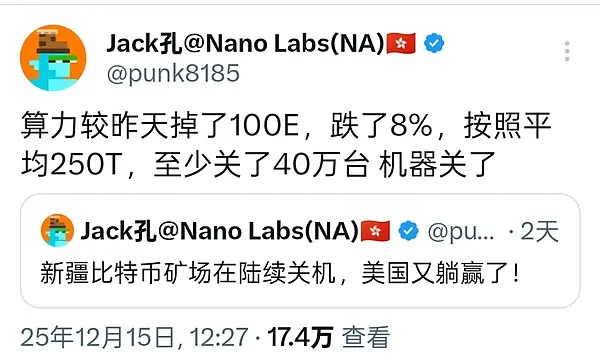
400,000 mining machines shut down
It is understood that many mining farms had already received official notices forwarded by the National Development and Reform Commission (NDRC) at the beginning of the month, requiring them to “report mining activities to the NDRC as per the central bank’s requirements.”
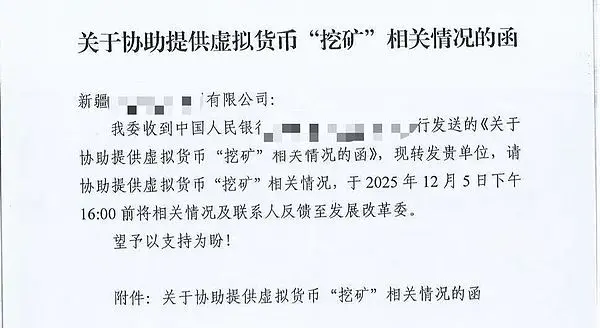
Multiple sources confirm that during December 14 to 15, mining farms in major gathering areas such as Changji and Hami in Xinjiang were asked to suspend operations. Reports indicate that most mining machines were suddenly powered off.
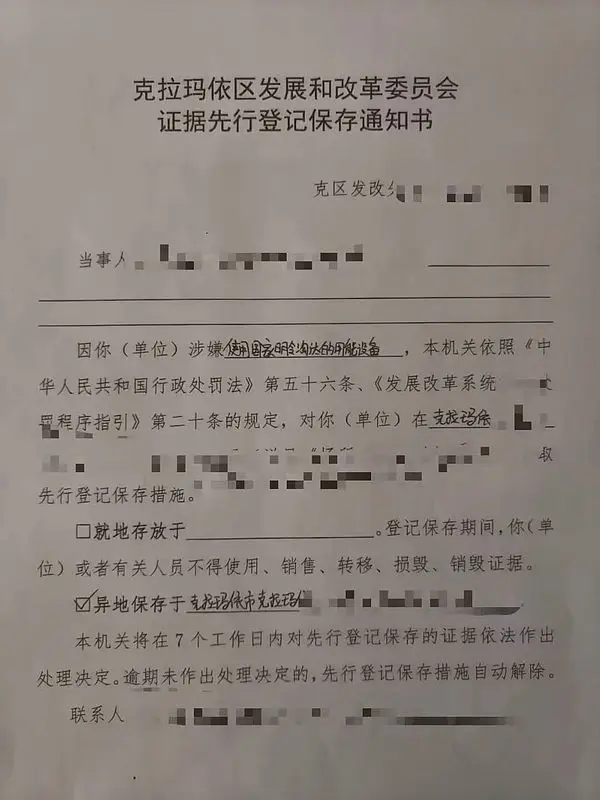
According to Kong Jianping, founder of Nano Labs, considering the recent significant decline in total network hash rate (a 17.25% drop last week), it is estimated that about 400,000 Bitcoin mining machines in Xinjiang, China, have been shut down recently.
Regulatory Storm Approaching
Unlike previous temporary power restrictions caused by electricity shortages, this shutdown is an organized regulatory action.
There are rumors that “it’s not just power restrictions, but direct power cuts, even preventing backup power sources from being turned on.” This all-or-nothing approach demonstrates the determination behind this operation.
The regulatory stance has escalated from the central bank acting alone to a joint effort involving the central bank, the NDRC, and the Central Financial Office. On November 28, the People’s Bank of China held a meeting of the virtual currency trading and speculation crackdown coordination mechanism, attended by responsible officials from 13 departments, including the Ministry of Public Security, the Cyberspace Administration, and the Central Financial Office.
The lineup of this meeting sends an important signal. Compared to the ten-department notice in 2021, two heavyweight departments— the Central Financial Office and the National Development and Reform Commission— were added. The Central Financial Office, as China’s highest authority in financial management, indicates that virtual currency issues have been elevated to the level of national financial security.
The involvement of the NDRC directly hits the core of the mining industry. As the authority controlling industrial development directions, energy consumption, and economic security, its participation signifies that the original sin of virtual currencies is now explicitly recognized as a systemic risk threatening national economic security, energy security, and industrial security.
The meeting communiqué also explicitly states: “Stablecoins are a form of virtual currency that currently cannot effectively meet requirements for customer identification, anti-money laundering, and other aspects, and pose risks of being used for money laundering, fundraising scams, and illegal cross-border fund transfers.”
Signals of normalized regulation
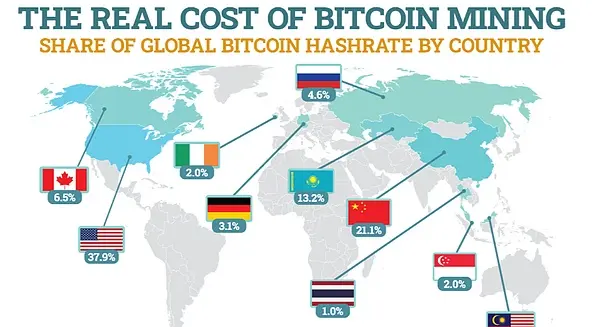
This regulatory action particularly targets Xinjiang, due to its special status in China’s Bitcoin mining landscape. Although mining was fully banned in 2021, China’s Bitcoin hash rate and costs have quietly rebounded to about 21% of the global total, ranking among the top in the world, with Xinjiang contributing significantly.
Xinjiang’s status as a “mining hub” benefits from its energy advantages: abundant coal power, wind power, and photovoltaic resources, as well as local electricity surpluses caused by high transmission costs, allowing electricity prices as low as 0.1-0.15 yuan per kWh. These energy conditions have attracted many mining farms to operate disguised as data centers or supercomputing centers.
Compared to the cleanup in 2021, this time’s action is more mechanized and normalized. The 2021 cleanup was mainly based on phased requirements from the State Council, whereas this time a cross-departmental coordination mechanism has been established, indicating that regulation will become a norm.
Another key difference is the depth of regulation. After 2021, some mining farms continued operations by disguising themselves as big data centers, but after this meeting, the scope of regulation has been fully expanded—from financial transactions to energy use—forming a comprehensive chain of oversight.
As the meeting pointed out, “Recently, influenced by multiple factors, virtual currency speculation and trading have shown signs of resurgence, and related illegal activities occur from time to time, posing new risks and challenges for risk prevention and control.”
For Chinese miners, this means the next wave of migration will be more dispersed, more covert, and more socketed. When truly clean energy technologies and energy internet breakthroughs are achieved, Bitcoin mining may finally realize true decentralization.
Disclaimer: The information on this page may come from third parties and does not represent the views or opinions of Gate. The content displayed on this page is for reference only and does not constitute any financial, investment, or legal advice. Gate does not guarantee the accuracy or completeness of the information and shall not be liable for any losses arising from the use of this information. Virtual asset investments carry high risks and are subject to significant price volatility. You may lose all of your invested principal. Please fully understand the relevant risks and make prudent decisions based on your own financial situation and risk tolerance. For details, please refer to
Disclaimer.
Related Articles
South Korea plans to regulate real-world assets and stablecoins, pushing for the legalization of digital assets
The Democratic Party of Korea plans to regulate tokenized real-world assets and stablecoins in the soon-to-be enacted “Framework Act on Digital Assets.” The proposal would require issuers to deposit assets with a trustee-managed trust institution, and classify stablecoins as a means of payment, subject to oversight by foreign exchange regulators. The bill bans earnings from idle stablecoins and calls for the development of interoperable technical standards, aiming to improve market transparency and safety. This marks an important step forward for South Korea’s digital asset regulation.
GateNews1m ago
Bitcoin Reclaims Prices Above $70,000 at $72,000, Will it Reclaim $76,000 or Hit $60,000 Next?
Bitcoin reclaims prices above $70,000 at $72,000.
Will the price of BTC go bullish and surge above $76,000 next?
There is also a bearish possibility for BTC to drop to $60,000 next instead.
The crypto community is pleased to see the price of Bitcoin (BTC), the pioneer crypto asset, recla
CryptoNewsLand4m ago
Strategy: In 2026, it accumulated an additional 94,470 BTC, far exceeding miners’ production
In 2026, the Bitcoin market’s supply and demand imbalance is severe. The institutional firm Strategy has purchased 94,470 Bitcoins, far exceeding the 43,000 Bitcoins produced by miners. This reduces the number of available Bitcoins, intensifies market scarcity, increases upward pressure on prices, and strengthens investors’ confidence in Bitcoin’s long-term value. Institutional buyers’ behavior dominates market dynamics; tight supply and demand may persist, and it’s important to monitor how it affects prices.
GateNews5m ago
Bitcoin breaks through $72,000; the ascending triangle pattern suggests a target of $80,000
Bitcoin’s price rose 6.7% on Wednesday to $72,379, influenced by easing tensions between the US and Iran and falling oil prices. Investor risk-avoidance sentiment eased, driving crypto and traditional assets to rise in tandem. Technical indicators show strong upward momentum for Bitcoin; if it breaks through $74,500, it could further test the $76,000 or $80,000 targets.
GateNews8m ago
SEC report disclosure: In the Gary Gensler era, crypto cases “did not bring benefits to investors”
The U.S. Securities and Exchange Commission (SEC) acknowledged in its FY 2025 enforcement report that crypto registration cases under the leadership of the former chair did not effectively protect investors. The current chair, Paul Atkins, emphasized that the focus will be on fraud and market manipulation that directly affect investors’ interests, and has already withdrawn enforcement actions against several crypto companies, which is expected to improve the compliance environment for crypto businesses. This indicates that the SEC is re-evaluating its regulatory strategy, with an emphasis on market health and investor protection.
GateNews12m ago


