Fighting in the Middle East has escalated, and a reshuffling of the global safe-haven map is already underway. JPMorgan Chase says that during the period of geopolitical conflict erupting in Iran, bitcoin—known as “digital gold”—saw large inflows of capital and rising trading activity, demonstrating far stronger downside resilience than gold and silver; by contrast, precious metals have been facing a predicament of massive capital outflows and brutal liquidations of long positions.
Why did the traditional “safe-haven instrument” fail in this crisis? A JPMorgan Chase analysis team led by Nikolaos Panigirtzoglou said in a report released on Wednesday that gold prices have fallen by about 15% since this month, mainly due to the continuously rising interest-rate environment and a strong U.S. dollar, which put pressure on “previously overly crowded positions.”
Analysts say that earlier this year, both gold and silver surged to record highs; with gold approaching $5,500 per ounce and silver climbing to $120, once market sentiment turns, both are easily affected by profit-taking and position liquidations.
Data show that in the first three weeks of March this year, gold ETF assets bled nearly $11 billion; meanwhile, silver ETF inflows accumulated since last summer have already been entirely given back. By comparison, in the same period, bitcoin saw net capital inflows, forming a stark contrast with traditional safe-haven assets.
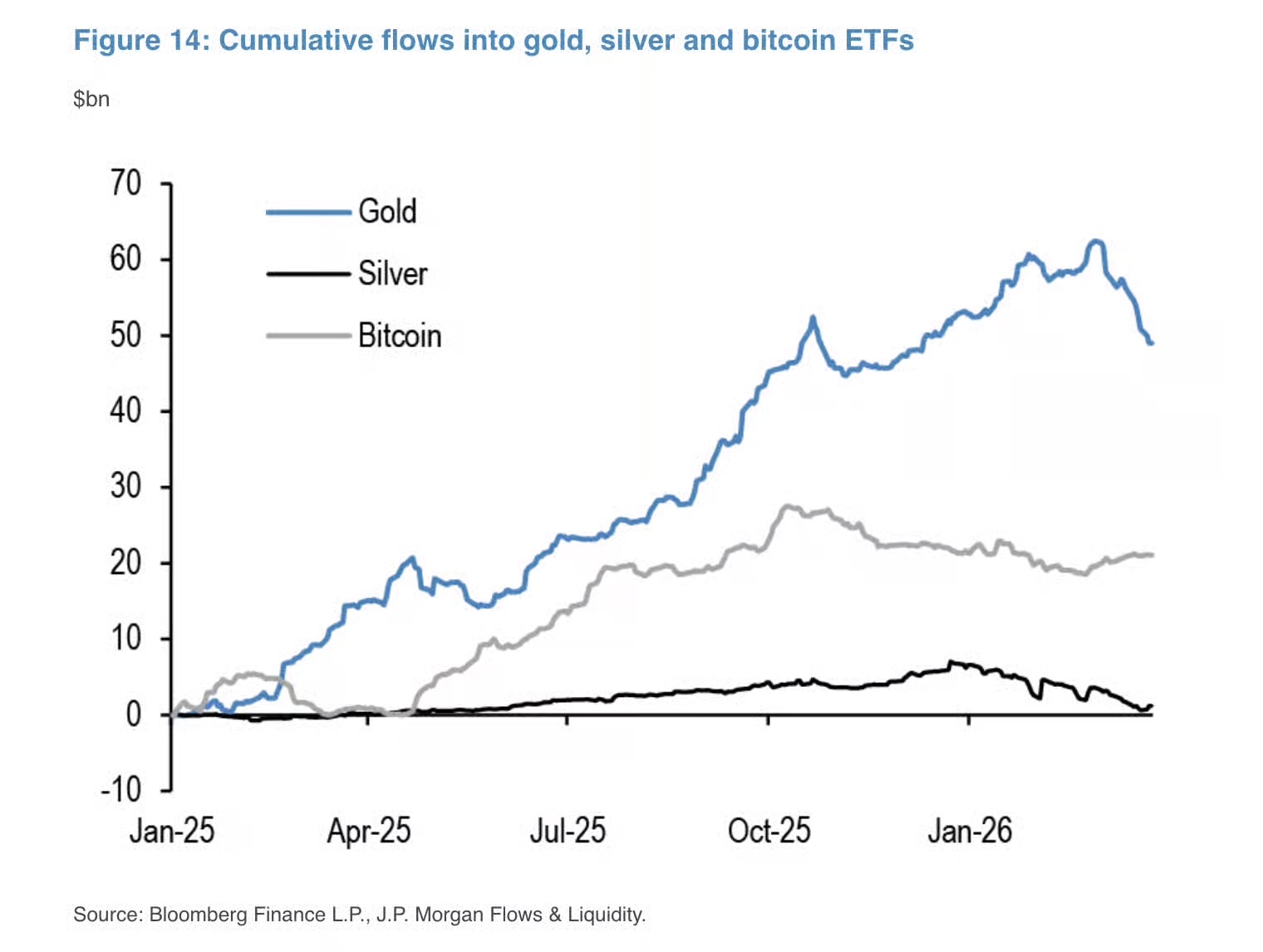 Citing Chainalysis data, analysts say that as the fighting intensified, crypto-asset activity in Iran surged explosively, with people transferring funds from local exchanges to self-custody wallets and international platforms. Analysts believe bitcoin’s borderless nature, its ability to be self-custodied, and its advantage of 24/7 uninterrupted trading have clearly made it the go-to tool for people in war-torn areas to shift and safeguard their assets when they face economic collapse, currency depreciation, and threats of national capital controls.
Changes in institutional positioning are also worth paying attention to. Citing CME open interest data, JPMorgan Chase says that positions in gold and silver continued accumulating from late last year into early this year, but have sharply declined since January this year, indicating that institutional investors are taking profits. By contrast, bitcoin futures positions have remained relatively stable over the past few weeks.
Momentum traders also appear to be amplifying this round of asset rotation. Analysts point out that indicators tied to momentum strategies (such as commodity trading advisors) show that gold and silver have fallen from “overbought levels” to “below neutral,” suggesting that forced liquidation is the culprit behind the recent plunge in metal prices; at the same time, bitcoin’s momentum signals have gradually recovered from “oversold levels” back to neutral, reflecting improving market sentiment.
Liquidity conditions across different assets have also changed. Analysts say that, according to the “Hui-Heubel Ratio,” a metric used to gauge market breadth and liquidity, gold has historically been more liquid than silver and bitcoin. However, this trend has recently reversed: gold’s liquidity conditions have continued steadily, bitcoin has instead shown better market breadth, and silver’s liquidity has shrunk sharply.
Citing Chainalysis data, analysts say that as the fighting intensified, crypto-asset activity in Iran surged explosively, with people transferring funds from local exchanges to self-custody wallets and international platforms. Analysts believe bitcoin’s borderless nature, its ability to be self-custodied, and its advantage of 24/7 uninterrupted trading have clearly made it the go-to tool for people in war-torn areas to shift and safeguard their assets when they face economic collapse, currency depreciation, and threats of national capital controls.
Changes in institutional positioning are also worth paying attention to. Citing CME open interest data, JPMorgan Chase says that positions in gold and silver continued accumulating from late last year into early this year, but have sharply declined since January this year, indicating that institutional investors are taking profits. By contrast, bitcoin futures positions have remained relatively stable over the past few weeks.
Momentum traders also appear to be amplifying this round of asset rotation. Analysts point out that indicators tied to momentum strategies (such as commodity trading advisors) show that gold and silver have fallen from “overbought levels” to “below neutral,” suggesting that forced liquidation is the culprit behind the recent plunge in metal prices; at the same time, bitcoin’s momentum signals have gradually recovered from “oversold levels” back to neutral, reflecting improving market sentiment.
Liquidity conditions across different assets have also changed. Analysts say that, according to the “Hui-Heubel Ratio,” a metric used to gauge market breadth and liquidity, gold has historically been more liquid than silver and bitcoin. However, this trend has recently reversed: gold’s liquidity conditions have continued steadily, bitcoin has instead shown better market breadth, and silver’s liquidity has shrunk sharply.
Disclaimer: The information on this page may come from third parties and does not represent the views or opinions of Gate. The content displayed on this page is for reference only and does not constitute any financial, investment, or legal advice. Gate does not guarantee the accuracy or completeness of the information and shall not be liable for any losses arising from the use of this information. Virtual asset investments carry high risks and are subject to significant price volatility. You may lose all of your invested principal. Please fully understand the relevant risks and make prudent decisions based on your own financial situation and risk tolerance. For details, please refer to
Disclaimer.


