The Financial Times reports that Iran urgently issued a new banknote with a face value of 10 million rials this week—its highest denomination ever—yet it is only worth about $7 USD. The outline of a currency collapse is now clearly visible.
(Background: Iran launched medium-range missiles targeting U.S. and British bases, missing but with a range of 4,000 km—twice the intelligence estimate)
(Additional context: Weekly gold prices fell below $4,500! Crude oil surged past $110, while Bitcoin continued to rise, outperforming gold)
The Financial Times states that Iran issued a new banknote with a denomination of 10 million rials this week, breaking the country’s record for the highest denomination. However, despite its beautiful printing, its actual purchasing power is only about $7 USD (roughly NT$224). This figure alone demonstrates how severe Iran’s inflation problem has become.
After the outbreak of war, cash withdrawals from banks across the country were exhausted in a short period. Although the government promised to ensure cash supply, the reality was very different: many people waiting in long lines were told that banks simply did not have enough cash to dispense.
Unable to Stop the Run on Banks
In the report, 80-year-old Tehran resident Maryam personally describes the chaos: “I waited in line at the bank for a whole hour, and the clerk told me I could only withdraw 10 million rials. I insisted on needing cash, and finally I got 30 million rials.” Her experience vividly illustrates the severity of the local inflation crisis.
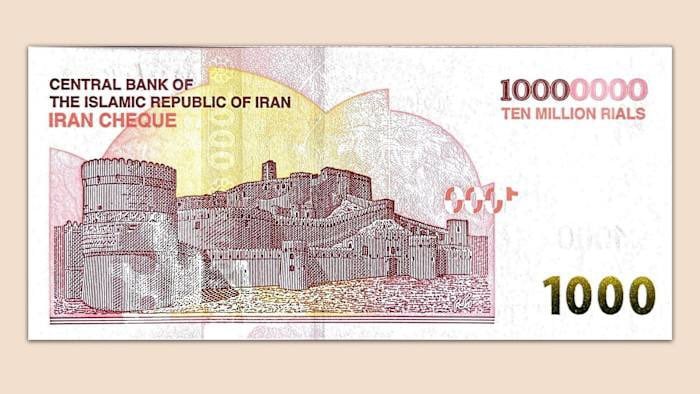
The FT notes that the design of this 10 million rial banknote is historically significant: the front features the Yazd Jameh Mosque built in the 9th century, and the back depicts the Bam Citadel in southeastern Iran, which is listed as a UNESCO World Heritage Site.
Sanctions, War, Corruption: Triple Blows to the Rial
The FT analyzes that Iran’s rial crisis did not happen overnight. Years of U.S. sanctions have continued to squeeze Iran’s oil revenues, coupled with systemic government corruption, leading to long-term economic weakness; after a 12-day war with Israel last June, the rial depreciated by 40% in a single instance.
Before the recent outbreak of new U.S.-Israeli military strikes at the end of February, the rial-to-USD exchange rate had already fallen to a record low: 1 USD required 1.66 million rials. Although it has recently rebounded slightly, as of March 20, the rate was still 1.5 million rials per dollar.
According to Iran’s Statistical Center, from the beginning of this year to February 19, the annual inflation rate reached 47.5%, with food and beverage prices soaring over 105% during the same period.

Disclaimer: The information on this page may come from third parties and does not represent the views or opinions of Gate. The content displayed on this page is for reference only and does not constitute any financial, investment, or legal advice. Gate does not guarantee the accuracy or completeness of the information and shall not be liable for any losses arising from the use of this information. Virtual asset investments carry high risks and are subject to significant price volatility. You may lose all of your invested principal. Please fully understand the relevant risks and make prudent decisions based on your own financial situation and risk tolerance. For details, please refer to
Disclaimer.


