February 27 News: Vitalik Buterin announced the Ethereum quantum resistance roadmap, clearly proposing upgrades across four key areas: validator signatures, data storage, user account signatures, and zero-knowledge proofs, to enhance network security in the era of quantum computing. As the potential threat of quantum supercomputers becomes an industry focus, Ethereum’s quantum security solutions are attracting close attention from developers and investors.
At the consensus layer, Buterin recommends replacing the current BLS signature scheme with a “lightweight” quantum-safe hash signature. He emphasizes that the choice of hash function is critical, as this could be Ethereum’s long-term or even “last” core hash algorithm upgrade. Previously, Justin Drake proposed the “Lite Ethereum” concept in 2025, aiming to strengthen the network’s resistance to quantum attacks.
In terms of data availability, Ethereum currently relies on KZG commitments for storing and verifying data. According to the new roadmap, future plans may involve replacing this with a quantum-resistant STARK proof system, though this transition involves extensive engineering optimization and protocol restructuring. On the user account layer, there are potential risks with ECDSA signatures; the solution is to promote account abstraction upgrades, allowing addresses to adopt quantum-safe signature algorithms based on lattices. However, these new signatures are more computationally complex, which will increase gas costs.
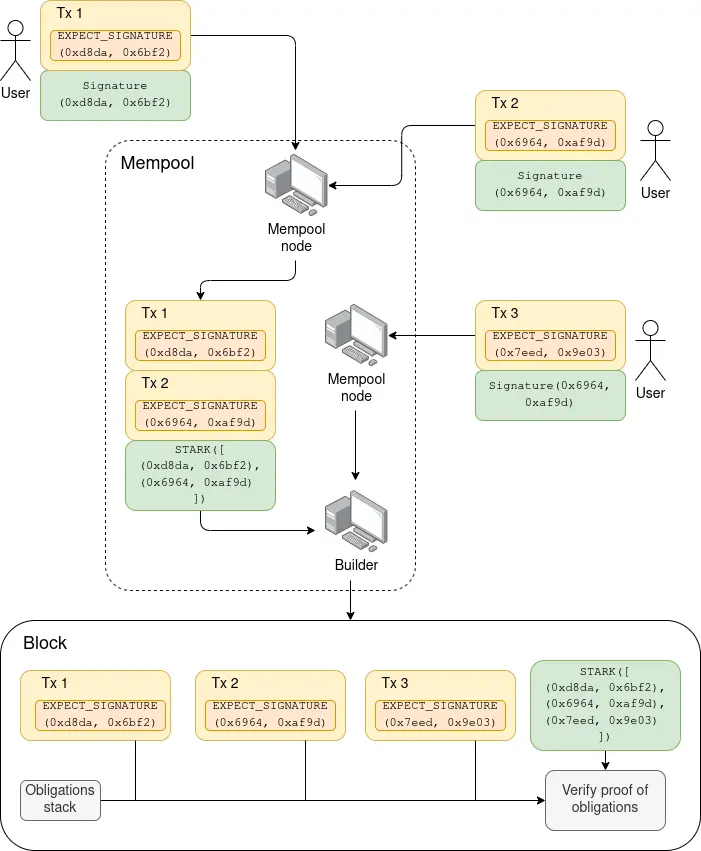 (Source: ETHresearch) To address on-chain verification costs, Buterin proposes recursive signature and proof aggregation at the protocol layer, consolidating thousands of signatures into a single main proof, significantly reducing computational burden. This “verification frame” mechanism can accommodate numerous signatures and proof data within a single block, maintaining security redundancy while controlling costs.
Additionally, Buterin mentioned the Ethereum Foundation’s Strawman plan, which aims to gradually shorten block slot times and final confirmation times in the future. As the path to quantum resistance becomes clearer, the security architecture of the Ethereum network and its long-term technical evolution are becoming key topics of market discussion.
Disclaimer: The information on this page may come from third parties and does not represent the views or opinions of Gate. The content displayed on this page is for reference only and does not constitute any financial, investment, or legal advice. Gate does not guarantee the accuracy or completeness of the information and shall not be liable for any losses arising from the use of this information. Virtual asset investments carry high risks and are subject to significant price volatility. You may lose all of your invested principal. Please fully understand the relevant risks and make prudent decisions based on your own financial situation and risk tolerance. For details, please refer to
Disclaimer.
Related Articles
Why do large banks refuse to use public ledgers and instead build their own blockchains?
Large banks have a low acceptance of public ledgers because their transparency conflicts with trust responsibilities, which could trigger market volatility. DRW founder Don Wilson pointed out that private blockchains better align with financial regulations and privacy needs. Even though public blockchains offer significant transformation opportunities, future financial infrastructure will still prioritize systems that protect privacy.
ChainNewsAbmedia1h ago
ETH drops 0.85% in 15 minutes: liquidity tightening and leveraged liquidations resonate, causing a short-term pullback
From 17:45 to 18:00 (UTC) on March 26, 2026, ETH prices briefly declined within the range of 2045.86 to 2066.97 USDT. The 15-minute return was -0.85%, with a volatility of 1.02%. This fluctuation drew market attention, as the volatility was significantly higher than usual, indicating increased uncertainty about ETH's short-term trend.
The main drivers of this movement were liquidity tightening, characterized by a sharp drop in active addresses and large institutional staking. On March 25, the number of on-chain active addresses for ETH decreased by 10%.
GateNews1h ago
ETH 跌破 2050 USDT
Gate News bot 消息,Gate 行情显示,ETH 跌破 2050 USDT,现价 2048.8 USDT。
CryptoRadar1h ago
A certain Ethereum OG whale sold 7,302 ETH at an average price of $2,073 in the past 2 hours.
A major Ethereum whale, after holding for 4 years, unstaked and sold 7,302 ETH at $2,073 each, making a profit of $5.33 million. Previously, they deposited 6,442 ETH at $1,522 each and earned 860 ETH in staking rewards.
BlockBeatNews3h ago


