On February 21, 2026, the world’s largest stablecoin issuer, Tether, officially announced the termination of all support for the offshore Chinese yuan stablecoin CNHT (CNH₮). Starting immediately, new tokens will no longer be minted, and February 2027 has been set as the final redemption deadline. Existing holders will have a one-year transition period to convert their assets.
CNHT Delisting Mechanism: Detailed Two-Phase Timeline
The delisting process for CNHT is divided into two clear phases. The first phase took effect immediately upon announcement (February 21), with Tether fully halting the minting and issuance of CNHT. Market supply will no longer increase, and existing circulating tokens will enter a one-year transition period. The second phase is set for February 2027, at which point Tether will completely cease support for CNHT redemptions. After this date, holders will no longer be able to exchange their tokens for any assets.
Before the final deadline, current holders can still redeem tokens according to Tether’s terms of service. The company has stated that reminders will be sent, and it is advised that holders arrange their asset conversions early to avoid issues related to liquidity or technical problems.
Tether admits that demand for CNHT has been weak over the long term, with community adoption far below expectations. CNHT was initially designed to track the offshore RMB (CNH) exchange rate for transactions outside mainland China, providing international investors with a non-USD stablecoin option. However, its trading volume has never been sufficient to sustain ongoing technical maintenance costs, ultimately leading Tether to streamline its product line and reallocate resources to core business areas.
Stablecoin Market Landscape: USDT Under Pressure and USDC Gaining Strength
(Source: Artemis Analytics)
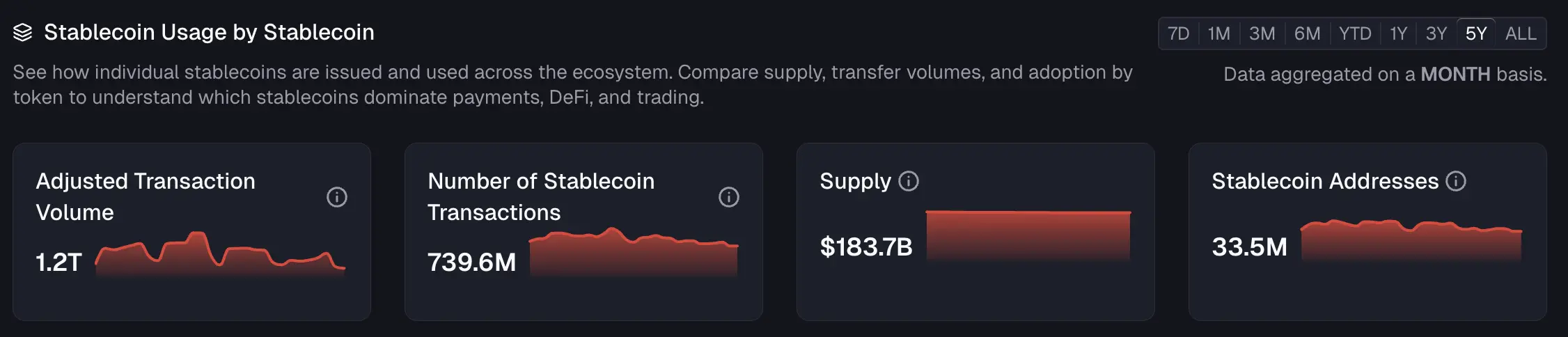
The delisting of CNHT occurs amid a broader restructuring of the stablecoin market. According to Artemis Analytics data, the supply of Tether’s flagship USDT saw a significant contraction in February 2026, dropping below 184 billion USD as of February 22, down from a peak of about 187 billion USD in early January—a decrease of over 3 billion USD. If this trend continues, February could mark the largest monthly decline since the FTX collapse at the end of 2022.
Meanwhile, Circle’s USDC supply grew to 76.4 billion USD in February, with a monthly increase of nearly 5%. Application data shows that in 2025, total global stablecoin transfer volume grew by 72%, reaching 33 trillion USD. USDC accounted for 18.3 trillion USD of this volume, while USDT handled 13.3 trillion USD. In transfer applications, USDC is gaining a clear competitive advantage over USDT, prompting Tether to manage its token portfolio more cautiously.
Recent Key Financial and Expansion Data for Tether
Q4 2025 Reserve Report: As of September 30, 2025, reserve assets totaled 181.2 billion USD, exceeding total liabilities of 174.4 billion USD by about 6.8 billion USD, indicating a high asset coverage ratio.
CNHT Delisting Timeline: Minting stopped on February 21, 2026; redemptions will cease in February 2027.
Personnel Expansion Plans: Currently 300 employees, with plans to add 150 engineering and technical staff within 18 months.
Diversification Strategy: Actively developing gold tokens (Tether Gold, XAU₮) and stablecoin infrastructure, with headquarters in El Salvador and offices in Switzerland.
Frequently Asked Questions
What is CNHT, and what is the core reason for Tether’s termination?
CNHT (CNH₮) is a stablecoin issued by Tether, pegged 1:1 to offshore Chinese yuan (CNH). It aims to provide a digital liquidity tool for international investors holding yuan-denominated assets. The main reasons for Tether’s termination include long-term low market demand, insufficient community adoption, and ongoing maintenance costs exceeding business benefits, leading the company to streamline its product offerings.
How should current CNHT holders handle their assets, and what is the deadline?
Existing CNHT holders can redeem their tokens before February 2027, following Tether’s terms of service. Tether will send reminders before the final deadline, and it is recommended that holders arrange their asset conversions early to avoid issues related to liquidity or technical difficulties near the deadline. After February 2027, redemption services will be fully discontinued.
Is the CNHT delisting directly related to USDT facing competition from USDC?
There is a temporal correlation. USDT’s supply significantly contracted in February 2026, while USDC’s supply grew by nearly 5% in the same month. Additionally, in 2025, USDC’s total transaction volume surpassed USDT’s, with USDC handling 18.3 trillion USD compared to USDT’s 13.3 trillion USD. Tether’s decision to streamline low-demand products and focus resources on core operations is viewed by analysts as a strategic product portfolio optimization in response to market competition, rather than an isolated decision.
Disclaimer: The information on this page may come from third parties and does not represent the views or opinions of Gate. The content displayed on this page is for reference only and does not constitute any financial, investment, or legal advice. Gate does not guarantee the accuracy or completeness of the information and shall not be liable for any losses arising from the use of this information. Virtual asset investments carry high risks and are subject to significant price volatility. You may lose all of your invested principal. Please fully understand the relevant risks and make prudent decisions based on your own financial situation and risk tolerance. For details, please refer to
Disclaimer.
Related Articles
Tether Launches World's First Billion-Level AI Training Framework for Mobile, Compatible with iPhone and Samsung LoRA
Tether's QVAC division launched the world's first LoRA fine-tuning framework supporting Microsoft's BitNet architecture on March 17, significantly reducing AI model memory and computational requirements and enabling localized training on mobile phones. The technology allows users to perform personalized learning without uploading data, safeguarding privacy. Testing shows that modern smartphones can effectively fine-tune billion-parameter models, advancing the application potential of edge computing.
動區BlockTempo1h ago
Tether introduces the BitNet LoRA framework, supporting large model training on mobile devices
Gate News report: On March 17, Tether's QVAC Fabric launched the world's first cross-platform LoRA fine-tuning framework for Microsoft BitNet (1-bit LLM), significantly lowering the VRAM and computational thresholds for large model training. The framework supports LoRA fine-tuning and inference acceleration on Intel, AMD, Apple Silicon M series, and mobile GPUs (including Adreno, Mali, and Apple Bionic).
GateNews2h ago
Tether CEO Paolo Ardoino will attend the Mar-a-Lago Trump luncheon and deliver a speech
Gate News reported that on March 17, according to official sources, Tether CEO Paolo Ardoino will attend and speak at a Trump luncheon held at Mar-a-Lago.
GateNews2h ago
Tether CEO Paolo Ardoino to Attend Trump TRUMP Token Luncheon and Deliver Speech
TrumpMeme official announcement: Tether CEO Paolo Ardoino will attend and speak at the Trump TRUMP token luncheon. Trump will have lunch with 18 "superstars" and the top 297 holders on April 25 at Mar-a-Lago. The top 29 holders can also attend a special VIP reception.
GateNews2h ago
Delphi Digital: Sufficient collateral backing for stablecoins does not mean immunity from bank runs; the risk has shifted to the issuer level
Delphi Digital analysis points out that although Tether and Circle's stablecoins are backed by short-term Treasury bills and cash equivalents, they are not completely safe and still face bank run risks. The USDC depegging event in early 2023 demonstrated that stablecoin risks have shifted to issuers, highlighting the dangers posed by their centralization.
GateNews03-16 04:21
Boris Johnson criticizes Bitcoin as a Ponzi scheme, with crypto industry leaders collectively refuting the claim
Former British Prime Minister Boris Johnson characterized Bitcoin as a "Ponzi scheme" and warned investors, particularly elderly individuals, to exercise caution using personal examples. Industry figures such as Michael Saylor quickly refuted the claim, pointing out that Bitcoin lacks a centralized operator, which is a key characteristic of Ponzi schemes. These remarks sparked widespread discussion and reignited controversy over the definition of Bitcoin.
MarketWhisper03-16 03:58


