Bitcoin retains stable institutional demand as Ethereum ETF flows remain thin and volatile.
Spot Bitcoin ETFs recorded solid inflows on Feb. 20, while Ethereum products drew little new capital. Data shows most demand remains concentrated in a few major issuers. At the same time, monthly trends indicate momentum has slowed since mid-2025. Flow patterns continue to favor Bitcoin over Ethereum in both scale and stability.
IBIT Leads $88M Bitcoin ETF Inflow While Growth Momentum Slows
Bitcoin spot ETFs pulled in $88.04 million in net inflows on Friday, with capital once again clustered around two issuers. BlackRock’s IBIT absorbed $64.46 million, accounting for roughly 73% of daily flows. Fidelity Investments’s FBTC added $23.59 million. All other Bitcoin funds finished flat.
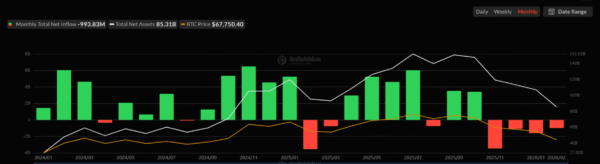
_Image Source: _SoSoValue
IBIT’s cumulative net inflows now stand at $61.30 billion, reinforcing its dominance within the Bitcoin ETF market. No competing product approaches that scale.
Mid-last year, BTC investment vehicles delivered several strong months with $5 billion to $8 billion in inflows. However, the trend flipped to a sharp multi-billion dollar outflow in November. And this trend continued in the two months that followed. In the current month, these funds continue to run well below earlier expansion phases.
Although cumulative assets remain near record levels, on-chain data shows that growth has cooled. Even so, recent inflows suggest stabilization rather than a fresh wave of acceleration.
Ethereum ETFs Stall as Daily Inflows Barely Reach $17K
While its Bitcoin counterparts posted positive flows, Ethereum spot ETFs painted a weaker picture. Total net inflows on Feb. 20 came in at just $17,210, a fraction of Bitcoin’s $88 million haul.
BlackRock’s ETHA added $1.78 million, while Fidelity Investments’s FETH saw a $2.45 million outflow. 21Shares’s TETH gained $687,000, and other funds were flat. ETHA’s cumulative net inflows now stand at $11.88 billion.
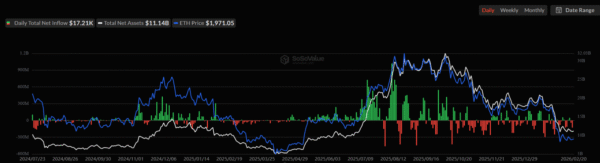
_Image Source: _SoSoValue
In contrast, Grayscale Investments’s ETHE still carries a historical net outflow of $5.19 billion, showing continued capital rotation away from older structures.
Daily data also points to higher volatility in Ethereum flows. Jan. 30 recorded $252.9 million in outflows. Feb. 11 and Feb. 12 saw $129.2 million and $113.1 million in redemptions, followed by another $130.2 million exit on Feb. 19. A few rebound sessions near $50 million offered relief, but swings remain sharp.
Cumulative Ethereum ETF inflows sit near $11.52 billion, with total net assets around $11.14 billion. By comparison, IBIT alone exceeds $60 billion in cumulative inflows.
Bitcoin Consolidates Institutional Lead as ETH Flows Lack Depth
Bitcoin continues to hold a larger and more stable institutional base, while Ethereum flows remain more reactive to short-term price moves and macro headlines. Recent data shows momentum has cooled for both assets, but volatility in Ethereum ETFs remains noticeably higher.
ETF flows act as a real-time signal of institutional risk appetite. Friday’s inflows confirm capital is still entering Bitcoin products in meaningful size. Ethereum figures, by contrast, point to thinner demand and less consistent allocation. Without steady multi-week accumulation in ETH funds, the gap in institutional adoption between Bitcoin and Ethereum could widen further.
Disclaimer: The information on this page may come from third parties and does not represent the views or opinions of Gate. The content displayed on this page is for reference only and does not constitute any financial, investment, or legal advice. Gate does not guarantee the accuracy or completeness of the information and shall not be liable for any losses arising from the use of this information. Virtual asset investments carry high risks and are subject to significant price volatility. You may lose all of your invested principal. Please fully understand the relevant risks and make prudent decisions based on your own financial situation and risk tolerance. For details, please refer to
Disclaimer.
Related Articles
Complete Guide to Using Bitcoin Blockchain Explorer
Bitcoin is developed on the concept of transparency, permitting everyone to verify transfers directly via the public ledger. One of the convenient methods to check this transparency is via a blockchain explorer, an instrument that lets users view transfer details, network activity, and wallet
BlockChainReporter9m ago
Michael Saylor’s Strategy Buys 22,337 BTC in $1.57B Weekly Purchase
Strategy has acquired 22,337 BTC for $1.57 billion, raising its total to 761,068 Bitcoin. This marks the firm's 12th consecutive week of accumulation, funded through the sale of STRC and MSTR shares.
CryptoFrontNews10m ago
Bitcoin Everlight: Why Skip Dogecoin for 21% APY Nodes?
Dogecoin has one of the most recognizable brands in the entire crypto industry. It has celebrity endorsements, a decade of community loyalty, and a market cap that most projects would envy. What it doesn’t have is a native way to earn passive income from holding it.
That’s not an opinion — it’s a t
BlockChainReporter12m ago
Bitcoin Treasury Company Genius Group Founder Cumulatively Repurchases 5.5 Million Company Shares, Total Investment of $2.9 Million
Gate News reports that on March 17, NYSE American-listed bitcoin treasury company Genius Group disclosed that the company's founder and CEO Roger Hamilton repurchased 300,000 shares of the company at an average price of $0.37 per share in the open market last week. To date, Roger Hamilton has spent $2.9 million across seven separate transactions to repurchase a total of 5.5 million company shares.
GateNews40m ago
BTC broke through $74,000 this week, with short-term holders' profits surging to $18.4 million per hour.
Gate News reported that on March 17, according to Glassnode data, Bitcoin price made a modest breakthrough above $74,000 this week, with short-term holder realized profit (STH-Realized Profit, 12-hour simple moving average) surging to $18.4 million per hour. This is consistent with the pattern observed in February: short-term holders continuously drain momentum from each bounce at the $70,000 level, absorbing upward momentum before any real breakout can form.
GateNews45m ago


