
Open-source project Tldraw announces suspension of accepting external contributions due to overwhelming AI-generated junk code. Such “AI Slop” severely drains maintainers’ energy, and the community is exploring the establishment of reputation systems or escrow mechanisms to address this issue.
Overwhelmed by AI-generated content, open-source project Tldraw suspends external PRs
A popular open-source web drawing project on GitHub with over 40,000 stars, Tldraw, recently announced that it will suspend accepting pull requests (PRs) from external contributors.
Developer steveruizok pointed out that, like many open-source projects on GitHub, the team has recently observed a significant increase in contributions generated entirely by AI tools. Although some submissions are correct in form, most lack complete context, misunderstand the codebase, and the submitters rarely participate in discussions afterward.
steveruizok emphasized that an open PR represents a commitment from maintainers, meaning the contribution will be carefully reviewed and seriously considered for inclusion. To keep this promise meaningful, the team must implement stricter filtering.
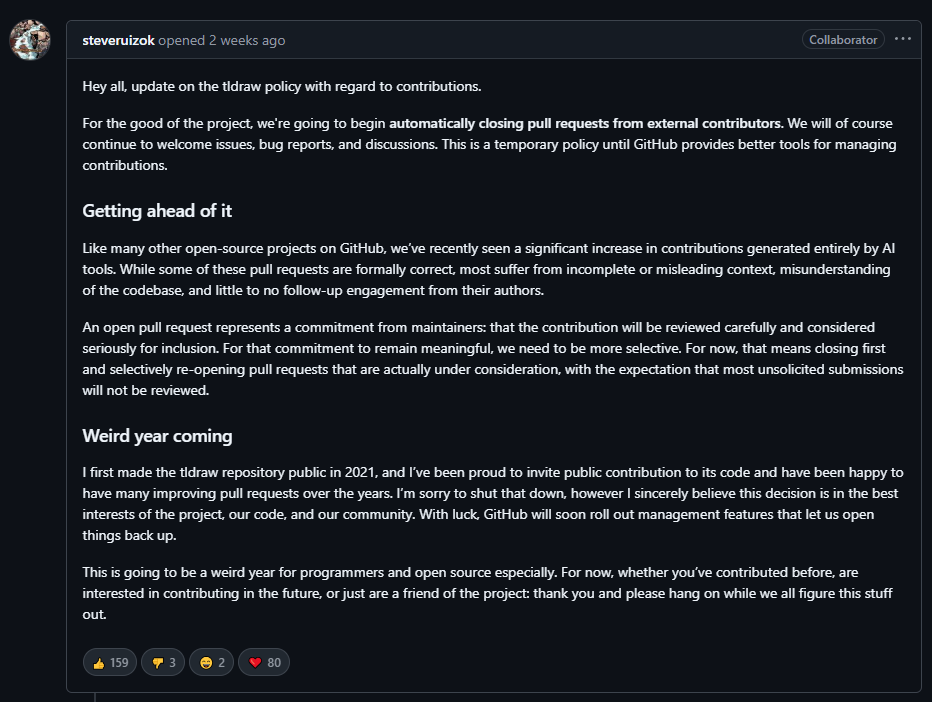
Currently, Tldraw’s policy is to close all external PRs first, only reopening those that are genuinely considered. This is in the best interest of the project and code quality. Although it’s regrettable to close public contributions, steveruizok stated that they will only consider reopening once GitHub introduces better management tools.
Curl and OCaml also affected, AI Slop rampant
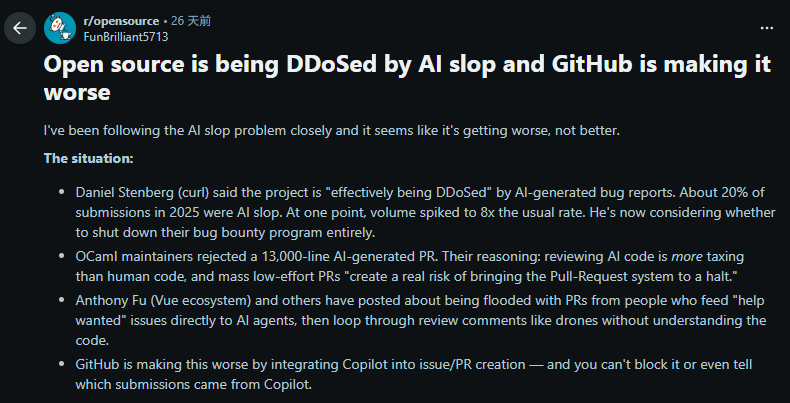
The decision to suspend pull requests at Tldraw is just one recent example of AI Slop (AI garbage) impacting the open-source community. Similar discussions have been heating up on Reddit and Hacker News forums.
A Reddit discussion pointed out that, Daniel Stenberg, maintainer of the well-known transfer tool Curl, revealed that the project is suffering from AI-generated erroneous reports being used in a “DDoS attack.” Approximately 20% of submissions in 2025 are AI garbage content, severely consuming volunteer maintainers’ time.
Additionally, OCaml maintainers have rejected a 13,000-line pull request generated by AI, citing that reviewing AI-produced code is more laborious than manually written code, and a flood of low-quality PRs could lead to system crashes.
Discussions on Hacker News focus on issues with GitHub’s mechanisms.
Some users believe that making PR counts prominent on the page encourages a culture of submitting for the sake of data.
The current dilemma with generative AI in open-source communities stems from many inexperienced developers using AI tools to generate worthless code, expecting maintainers to merge quickly. This behavior is damaging the collaborative trust within open-source communities.
Possible solutions: whitelist or reputation systems
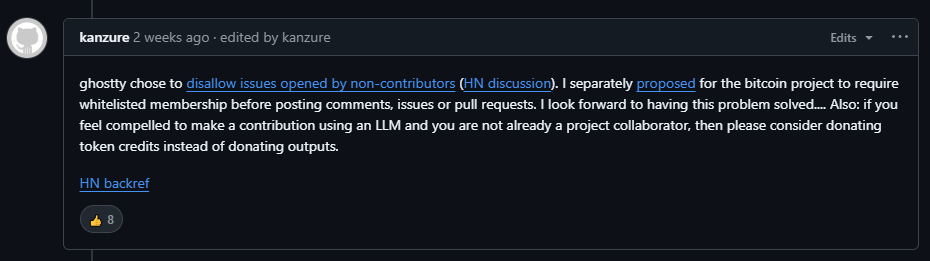
In response to the harassment of garbage code (Shitcode) in open-source communities, Bitcoin developer Bryan Bishop (kanzure) responded on Tldraw’s GitHub page that he had proposed to the Bitcoin Core development team to “privatize” the development process, shifting to a model limited to invited members or requiring whitelist inclusion to post comments and PRs.
Although this might violate the spirit of Bitcoin’s openness, Bryan Bishop believes that it can effectively reduce noise and useless debates caused by non-contributors, allowing developers to focus on the technical aspects and prevent valuable attention from being diverted by malicious or invalid interactions.
Besides privatization, software engineer Steve Rodrigue also suggests establishing cross-project contributor reputation systems, verifying account value through trust networks.
Another developer is working on a blockchain-based “Stake-to-PR” protocol, requiring submitters to pay a small deposit, which is forfeited if the content is deemed AI garbage, and fully refunded if it is a valid contribution. The goal is to raise the barrier to curb AI abuse.
Further reading:
AI content flood! Web3 Dictionary names “Slop” as the 2025 Word of the Year, sparking heated discussions in the tech community
Disclaimer: The information on this page may come from third parties and does not represent the views or opinions of Gate. The content displayed on this page is for reference only and does not constitute any financial, investment, or legal advice. Gate does not guarantee the accuracy or completeness of the information and shall not be liable for any losses arising from the use of this information. Virtual asset investments carry high risks and are subject to significant price volatility. You may lose all of your invested principal. Please fully understand the relevant risks and make prudent decisions based on your own financial situation and risk tolerance. For details, please refer to
Disclaimer.
Related Articles
FBI: Fake TRC20 FBI Token Scam Emerges, User Privacy and Security Sound New Alarms
The US FBI's New York office warned blockchain users to be vigilant if they receive TRC-20 tokens claiming to be associated with the FBI, and to avoid disclosing personal information. This scam uses a fake FBI identity to pressure victims into submitting data and directs them to phishing websites in order to commit asset fraud.
区块客4h ago
NFT Whale Under Attack Continues Moving Funds
Arkham reported that stolen funds were moved for the first time since March 6, 2026, with nearly $1 million DAI transferred. The theft stemmed from a violent attack on Ethereum NFT whale Sillytuna, resulting in $23.6 million stolen. Over $7 million remains traceable, illustrating a rise in real-world crypto thefts.
TapChiBitcoin5h ago
South Korea's National Tax Service Plans to Complete Selection of Virtual Asset Custodian Service Providers in the First Half of the Year
Gate News - On March 21, South Korea's National Tax Service plans to complete the selection of virtual asset custodian service providers in the first half of this year. This initiative stems from a virtual asset theft incident that occurred last month, when the National Tax Service accidentally leaked mnemonic phrase information while announcing the results of an on-site investigation, resulting in the seized virtual assets being stolen twice.
GateNews6h ago
Quantum Risk with Bitcoin: Real Threat but Not Yet Comprehensive
The risk from quantum computing to Bitcoin investors is real, but not every wallet is vulnerable — and those with the capacity to address this issue are taking proactive steps, according to Galaxy Digital analyst Will Owens.
Owens believes that in theory, quantum computers could potentially break the cryptographic security that underpins Bitcoin.
TapChiBitcoin8h ago
Korea Tax Agency Moves to Secure Seized Crypto Assets
South Korea's National Tax Service plans to hire private custody providers for seized cryptocurrencies after a security breach revealed flaws in its storage system. This shift aims to enhance security and streamline asset management in light of increasing digital asset regulations.
TodayqNews17h ago
0x Report: Certain propAMM on Base Network Vulnerable to Quote Manipulation, Trades May Result in 5-10 Basis Point Loss
0x report indicates that certain propAMM on the Base network exhibits quote fraud behavior, with operators publishing false prices using Flashblock structures, resulting in trader losses. Potentially causing $500,000 monthly losses. 0x will monitor and cut off non-compliant liquidity to protect users.
GateNews17h ago


