Kevin O’Leary states that he currently controls approximately 26,000 acres of land to develop low-cost infrastructure, ready to connect utilities for bitcoin mining operations as well as future AI data centers and cloud computing facilities. After completing licensing procedures, these lands will be leased back to businesses to implement their projects.
According to O’Leary, new electrical and infrastructure contracts are real assets, even more important than tokens. He predicts that about half of the data centers announced recently will never be built. Regarding institutional cash flow, he believes major institutions are only truly interested in Bitcoin and Ethereum.
The famous Shark Tank investor also emphasizes that widespread acceptance of crypto by organizations heavily depends on the US legal framework, especially regulations allowing stablecoin accounts to earn yields. Currently, about 19% of his investment portfolio is allocated to crypto-related assets and infrastructure.
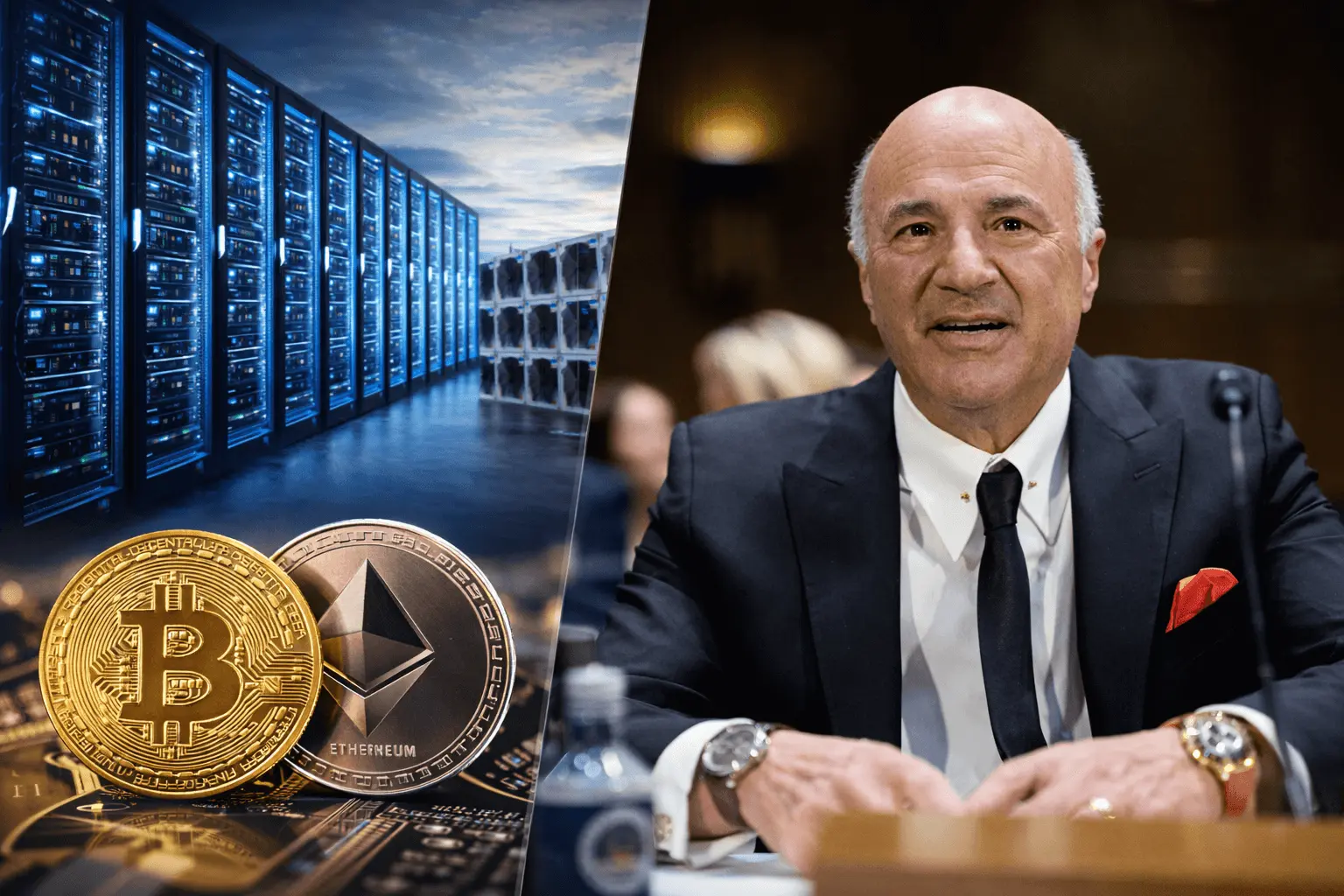
In an interview with CoinDesk, O’Leary affirms that infrastructure will be the future of both crypto and artificial intelligence, and he is heavily betting on this trend. The total land area of 26,000 acres under his control spans multiple regions, including 13,000 acres in Alberta, Canada, previously announced, and another 13,000 acres at undisclosed locations, currently in the licensing process.
O’Leary states that crypto-related investments now account for over 19% of his portfolio, including digital assets, infrastructure, and land. Previously, he invested in the Bitcoin mining company BitZero in Norway and views bitcoin mining operations as a “real estate play,” since both mining and data centers require large land plots and abundant power from the early stages.
However, O’Leary has no intention of building data centers himself. His strategy is to buy land, secure access to electricity and infrastructure, then lease it to companies to develop their projects.
“My task is not necessarily to build data centers,” O’Leary says. “It’s to prepare everything in a ready-to-build state, from land to permits.”
He believes that without owning land from the start, most of the data center projects announced in the past three years would not materialize. He estimates that about half of them “will never be built,” as the wave of interest in this field resembles a land grab driven by ignorance of actual requirements.
The lands owned by O’Leary are being prepared to serve high energy-consuming infrastructure, initially for bitcoin mining, and in the long term for hyperscalers and government data centers. These sites are fully equipped with utilities such as electricity, water, fiber optic cables, and air rights, ready for leasing once permits are obtained.
Notably, O’Leary claims that electrical contracts at some locations—especially those with prices below 6 cents/kWh—are worth more than bitcoin. He argues that this makes infrastructure more important than tokens in the long run.
Regarding the overall crypto market, O’Leary is increasingly skeptical of most projects. He states that institutional capital is focused only on two core assets: bitcoin and ether. While newly launched crypto ETFs may attract more retail investors, he believes they are almost meaningless for large institutions.
“In the context of asset allocation in the financial market, crypto ETFs are insignificant,” he says, criticizing smaller coins. According to O’Leary, holding only bitcoin and ethereum covers about 97.2% of the volatility of the entire crypto market since its inception.
On the legal front, O’Leary considers this a key factor in attracting major financial institutions. He is closely monitoring the draft legislation on crypto market structure in the US Senate but criticizes the clause banning interest payments on stablecoin accounts, arguing that this regulation creates an unfair advantage for traditional banks and is the reason Coinbase withdrew support for the bill.
“That’s an uneven playing field,” O’Leary says. “As long as stablecoins are not allowed to pay interest to users, this bill will be very difficult to pass.”
Nevertheless, he remains optimistic that the bill will be reasonably amended, paving the way for a large-scale institutional capital influx into bitcoin.
Disclaimer: The information on this page may come from third parties and does not represent the views or opinions of Gate. The content displayed on this page is for reference only and does not constitute any financial, investment, or legal advice. Gate does not guarantee the accuracy or completeness of the information and shall not be liable for any losses arising from the use of this information. Virtual asset investments carry high risks and are subject to significant price volatility. You may lose all of your invested principal. Please fully understand the relevant risks and make prudent decisions based on your own financial situation and risk tolerance. For details, please refer to
Disclaimer.
Related Articles
European Bitcoin Treasury H100 Aims to Triple BTC Stash by Acquiring Two Firms
H100 Group aims to acquire Norwegian firms Moonshot AS and Never Say Die AS in an all-stock deal, increasing its Bitcoin holdings from 1,051 to 3,500 BTC. This move would position H100 as Europe's second-largest listed Bitcoin treasury firm.
Decrypt1m ago
'How Did You Manage That?': Peter Schiff Trolls Michael Saylor Over 4.5% Bitcoin Loss and $44 Billion Plans - U.Today
Michael Saylor continues to invest heavily in Bitcoin, purchasing $76.6 million worth despite facing criticism from Peter Schiff about recent losses. Saylor aims to acquire one million BTC, supported by a new $44.1 billion funding plan, while Schiff highlights the ongoing portfolio drawdown.
UToday7m ago
Bitcoin Decouples From S&P 500 as Retail Demand Weakens
Bitcoin retail activity has decreased by 10%, the lowest since January 2025, indicating weaker market participation. The advent of ETFs has shifted retail access off-chain, while Bitcoin has diverged from the S&P 500, marking its longest decoupling since 2020 amid a correction phase.
CryptoFrontNews40m ago
In the past 24 hours, $836 million in liquidations occurred across the network, with long position liquidations accounting for 52%.
Over the past 24 hours, the cryptocurrency market saw liquidations totaling $836 million, with long positions accounting for $438 million and short positions $398 million. BTC and ETH were liquidated for $261 million and $209 million respectively, affecting a total of 202,130 traders. The largest single liquidation occurred on ETHUSDT_UMCBL, valued at $16.275 million.
GateNews50m ago
Bitcoin Reacts to Shifting U.S.-Iran Signals
KEY HIGHLIGHTS
Bitcoin jumps above $70K as U.S.-Iran talks signal easing tensions
BTC rallies after Trump pauses strikes, but Iran denies any talks
Crypto spikes as ceasefire hopes rise amid mixed global signals
Bitcoin crosses $71K before pullback on conflicting Iran reports
Markets swing as p
CryptoBreaking56m ago


