Bitcoin approaches $91,400 today. Trump announces immediate implementation of a 25% tariff increase on trade with Iran, with protests in Iran resulting in nearly 600 deaths and over ten thousand arrests. On the technical side, BTC is forming a symmetrical triangle resistance at $91,900, similar to the pattern before a breakout in early 2025 (when it surged over 40%). The trendline support is at $90,200, and RSI remains steady at 50, indicating stored momentum.
The hedging logic and capital flow behind Trump’s 25% tariff
The primary reason for Bitcoin’s rise today is geopolitical hedging demand. U.S. President Trump announced on Monday that a 25% tariff will be levied immediately on all countries and regions trading with Iran. This policy aims to pressure Tehran amid two weeks of ongoing protests and violent suppression within Iran. External reports indicate nearly 600 deaths and over ten thousand arrests due to the unrest.
Trump posted on Truth Social about the tariff decision, which could impact economies with trade relations with Iran, such as China, Brazil, Turkey, and Russia. Market participants generally see this as an escalation of “pressure on third parties”: by increasing costs and uncertainty in dealings with Iran, it further constrains Iran’s external trade and foreign exchange access, forcing Iranian authorities to make concessions domestically and diplomatically.
This tariff policy creates multiple layers of market uncertainty. First, there is the risk of retaliation from trade partners like China and Russia, potentially escalating trade wars. Second, supply chain disruptions are possible, as Iran is a major energy exporter; increased sanctions could push oil prices higher. Third, financial market volatility may spike, as sudden shifts in trade policies often lead to stock sell-offs.
In this context, Bitcoin’s narrative as “digital gold” is reaffirmed. Similar to traditional safe-haven assets like gold, Bitcoin’s features—decentralization, unconfiscability, and 24/7 global trading—are especially valuable during geopolitical crises. When investors worry about fiat currency devaluation, banking system risks, or asset freezes, Bitcoin offers a decentralized alternative.
The triple hedging logic triggered by tariff policies
Trade war risk: China, Russia may retaliate, undermining dollar confidence and boosting Bitcoin
Inflation expectations: Disrupted energy supply chains push oil prices higher, decreasing fiat purchasing power
Asset security concerns: Frequent sanctions raise fears of asset freezes, highlighting Bitcoin’s unconfiscability
However, it’s important to note that the sustainability of this hedging logic is uncertain. Bitcoin’s performance during past geopolitical crises has been inconsistent; for example, during the initial phase of the Russia-Ukraine conflict in 2022, it briefly surged then quickly retreated. Therefore, while today’s rise points to hedging demand, whether this demand can translate into sustained buying remains to be seen.
Technical triangle compression hints at a 40% breakout?
(Source: Trading View)
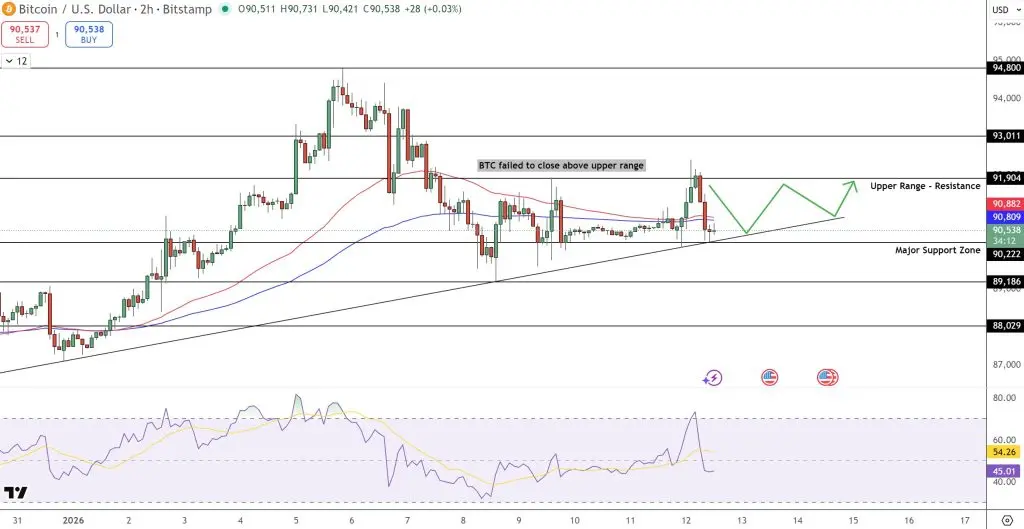
The second reason for Bitcoin’s rise today comes from structural compression on the technical chart. Currently trading near $91,400, Bitcoin’s price appears calm on the surface, but a familiar pattern is quietly forming. The current consolidation resembles the pattern seen in early 2025, just before a significant breakout. Back then, Bitcoin was in a similar position before a major surge. This time, the pattern is forming at a much higher level.
In recent days, Bitcoin has fluctuated between the high $80,000s and low $90,000s, repeatedly stalling near resistance at $91,900. This behavior is similar to the period from March to May 2025, when Bitcoin lacked clear direction but was consolidating before breaking above $86,000 and accelerating upward. The key isn’t a lack of momentum but the structure itself. Buyers keep accumulating on dips, while sellers hold firm at the same support level, creating a narrowing range that increasingly resembles a symmetrical triangle.
From a technical perspective, Bitcoin’s price appears relatively neutral. BTC continues to make new lows but is supported by a clear upward trendline since January. The current price hovers around the 50-day and 200-day moving averages, both of which are flattening, indicating a market in balance rather than under downward pressure. Momentum indicators support this view. The Relative Strength Index (RSI) remains around 50, rebounding from earlier weakness but not overextended. This suggests that if buyers regain control near resistance levels, Bitcoin still has room to rise.
Key technical levels include: the ascending trendline support at above $90,200, multiple rejections near resistance but no failure at $91,900, and the RSI’s neutral stance indicating stored momentum. The flat EMA indicators suggest a sideways market rather than a reversal. The critical zone remains between $91,900 and $92,000. A daily close above this zone could confirm the triangle pattern, opening the door to $93,000 and potentially further to $94,800.
A similar breakout in 2025 led to over 40% gains in the following months. While history doesn’t repeat exactly, this similarity suggests Bitcoin could be gearing up again rather than topping out. This structural pattern, resonating with fundamental factors, offers a deeper explanation for today’s rally.
Disclaimer: The information on this page may come from third parties and does not represent the views or opinions of Gate. The content displayed on this page is for reference only and does not constitute any financial, investment, or legal advice. Gate does not guarantee the accuracy or completeness of the information and shall not be liable for any losses arising from the use of this information. Virtual asset investments carry high risks and are subject to significant price volatility. You may lose all of your invested principal. Please fully understand the relevant risks and make prudent decisions based on your own financial situation and risk tolerance. For details, please refer to
Disclaimer.
Related Articles
BitGo reported a loss of $50 million in the fourth quarter, and its stock price fell more than 8% on Thursday.
Gate News report, on March 27, cryptocurrency infrastructure company BitGo announced its first earnings report since the IPO, showing a loss of $50 million in the fourth quarter, primarily due to the decline in digital asset prices at the end of last year which affected the value of its Bitcoin holdings. As a result, BitGo's stock price fell more than 8% on Thursday, closing at an all-time low. In after-hours trading, the stock price rebounded slightly, rising about 2.2%.
GateNews5m ago
MARA Sells 15,133 BTC, Drops to #3 in Bitcoin Treasury Rankings
_MARA sold 15,133 BTC for $1.1B to cut debt by 30%. The move cost them the 2 Bitcoin treasury spot. See what changed and who took over._
Bitcoin miner MARA Holdings has made a bold financial move. The company sold 15,133 BTC between March 4 and March 25, 2026.
The sale raised roughly $1.1
LiveBTCNews15m ago
Data: If BTC breaks through $72,073, the short liquidation intensity on mainstream CEX will reach $1.954 billion.
Gate News message. On March 27, according to Coinglass data, if BTC breaks through $72,073, the cumulative liquidation strength of short positions on major CEXs will reach $1.954 billion. Conversely, if BTC falls below $65,430, the cumulative liquidation strength of long positions on major CEXs will reach $1.282 billion.
GateNews47m ago
Yesterday, the net outflow of Bitcoin spot ETFs in the United States was $171.44 million.
On March 26, the U.S. Bitcoin spot ETF experienced a net outflow of $171.44 million, with BlackRock's IBIT seeing an outflow of $42.15 million, Fidelity's FBTC seeing an outflow of $32.81 million, and Grayscale's GBTC seeing an outflow of $25.06 million, among several other funds that also experienced varying degrees of outflows.
GateNews50m ago
Yesterday, Bitcoin spot ETFs saw a net outflow of $171.3 million, while Ethereum ETFs experienced a net outflow of $189.3 million.
BlockBeats news, on March 27, according to Farside Investors monitoring, yesterday the net outflow of Bitcoin spot ETFs in the United States was $171.3 million, including: IBIT net outflow of $41.9 million, FBTC net outflow of $32.8 million, BITB net outflow of $33.1 million, ARKB net outflow of $30.5 million.
Ethereum ETFs had a net outflow of $189.3 million, with ETHA having a net outflow of $140.2 million.
BlockBeatNews58m ago


