
MicroStrategy purchased 1,229 Bitcoins last week for $108.8 million, with an average cost of $88,568 per Bitcoin, bringing total holdings to 672,497 Bitcoins. The total investment has reached $50.44 billion, with an overall average cost of $74,997. Following the announcement, MSTR’s stock price fell 1% to $157, and Bitcoin also dropped to around $87,000.
$88,568 Buy-In Price Exposes Market Timing
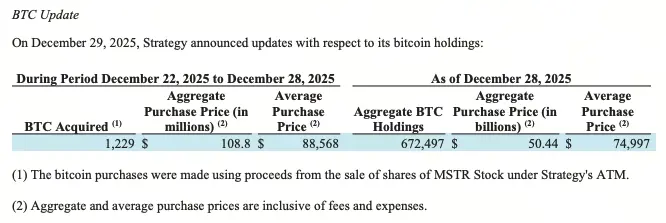
(Source: MicroStrategy)
The latest purchase by MicroStrategy has an average cost of $88,568, reflecting Bitcoin’s market state at the end of 2025. Compared to its overall average cost of $74,997, this buy-in price is about 18% higher. This cost inversion is not the first occurrence, indicating that MicroStrategy adopts a “continue buying regardless of price cycles” strategy rather than a buy low, sell high trading approach.
A single investment of $108.8 million is relatively moderate. In Q4 2024, MicroStrategy made multiple single purchases exceeding $500 million, with peak weekly purchases surpassing $2 billion. This time, with only $109 million spent, it may reflect the company’s cautious attitude after evaluating market conditions, or it could be a natural fluctuation in capital raising pace. Funds were sourced from the sale of Class A common stock, consistent with MicroStrategy’s usual financing method—diluting equity to increase Bitcoin holdings.
The timing of this purchase occurred after Bitcoin’s price retreated from a high of $100,000. Market analysts believe MicroStrategy may consider around $88,000 a relatively reasonable entry point. However, following the news, Bitcoin fell to about $87,000, meaning this batch of purchases nearly immediately incurred unrealized losses. Such situations are not uncommon in MicroStrategy’s buying history; Executive Chairman Michael Saylor has repeatedly stated, “Timing doesn’t matter; long-term holding is key.”
The Astonishing Data of 670,000 Bitcoins
Key Figures of MicroStrategy’s Bitcoin Holdings
Total holdings: 672,497 Bitcoins: accounting for about 3.2% of Bitcoin’s total supply of 21 million. If Bitcoin were a country, MicroStrategy would be the third-largest holder, behind only Satoshi’s wallet and the U.S. government confiscated Bitcoins.
Total investment: $50.44 billion: this exceeds the annual GDP of many small countries and surpasses the market value of most S&P 500 companies, transforming a business intelligence software company originally valued in hundreds of millions into a crypto investment giant.
Average cost: $74,997: with Bitcoin currently around $87,000, MicroStrategy’s overall holdings are approximately 16% in unrealized gains. Based on current prices, its Bitcoin assets are worth about $58.5 billion, with a profit of roughly $8 billion over cost.
Purchase timeline: 2020-2025: since the first buy in August 2020, MicroStrategy has accumulated Bitcoin at various price points—$10,000, $30,000, $50,000, $60,000, $100,000—demonstrating a dollar-cost averaging strategy rather than market timing.
Such a large holding makes MicroStrategy a systemic force in the Bitcoin market. When the company announces purchases, it often influences market sentiment, and its financing activities (issuing bonds, secondary offerings) also impact capital markets. Critics argue this influence has distorted the market, while supporters see it as a milestone for institutional adoption of Bitcoin.
Stock Price Drop Reveals Market Confidence Crisis
Following the announcement, MSTR’s stock traded down 1% pre-market to $157 per share, while Bitcoin dropped to about $87,000. This negative reaction reveals the market’s complex attitude toward MicroStrategy’s model. MSTR stock has long traded at a premium, with investors effectively paying well above the net asset value of its Bitcoin holdings, driven by confidence in Saylor’s continuous buying strategy.
However, when Bitcoin’s price declines, MSTR’s stock often falls even more, exhibiting a “double leverage effect.” This is because investors worry not only about the shrinking Bitcoin assets but also about the company’s financing capacity. MicroStrategy’s business model heavily relies on continuous financing (issuing bonds or secondary stock offerings) to buy more Bitcoin. If the stock price drops significantly, issuing more shares would lead to greater dilution, weakening per-share Bitcoin holdings.
From its November 2024 peak of $543, MSTR’s stock has fallen to the current $157, a 71% decline. This drop far exceeds Bitcoin’s approximately 13% decline in the same period, reflecting a reassessment of leveraged Bitcoin investment strategies. Some analysts warn that if Bitcoin prices remain depressed, MicroStrategy could face debt pressures, although its current debt structure remains healthy.
Questions on the Long-term Sustainability of MicroStrategy’s Model
MicroStrategy’s core strategy is essentially a financial engineering approach of “converting shareholder funds into Bitcoin positions.” Its original business intelligence software operations have become secondary, with revenues far insufficient to support its Bitcoin purchasing plans. This transformation has sparked governance controversy; shareholders are effectively buying into a leveraged Bitcoin ETF rather than a traditional tech company.
Critics argue this model is only sustainable if Bitcoin appreciates long-term. If Bitcoin enters a multi-year bear market, MicroStrategy would be unable to raise funds through stock issuance (as a collapsing stock price would make dilution unprofitable) or debt issuance (as shrinking assets would weaken credit ratings). In extreme cases, the company might be forced to sell Bitcoin to repay debts, triggering a vicious cycle.
Supporters believe Saylor has created an innovative “corporate Bitcoin adoption” model. Through MicroStrategy, traditional investors can gain Bitcoin exposure within brokerage accounts without dealing with wallets or private keys. As more publicly listed companies emulate this strategy, institutional adoption of Bitcoin will accelerate, ultimately validating Saylor’s foresight.
Currently, MicroStrategy holds 672,497 Bitcoins. If Bitcoin reaches $500,000 in 2030 (a target Saylor has mentioned multiple times), its Bitcoin assets would be worth about $3.36 trillion, nearly 29 times its $5.04 billion cost, with a profit of nearly $2.9 trillion. The outcome of this high-stakes gamble will be revealed over the coming years.
Related Articles
BTC rises 0.77% in 15 minutes: rebound driven by active buyers overlapping with safe-haven fund resonance
From 2026-03-19 19:00 to 19:15 (UTC), BTC price fluctuated within the range of 69802.0 to 70547.9 USDT, with volatility reaching 1.07%, recording a return rate of +0.77%. Short-term trading activity drove increased market attention, with volatility strength exceeding the daily average, attracting rapid capital participation.
The main driver of this price movement was concentrated active buy orders in the spot market, pushing BTC price up sharply in the short term. On-chain data shows that transfer volume during the 19:00-19:15 interval exhibited no extreme changes, and there were no large whale transfers. Weighing spot market and
GateNews3m ago
Ethereum Continues to Recover, Analysts Discuss Whether It Can Return to $4000 in Q2
Gate News reported that on March 19, Ethereum (ETH) continues to recover following recent market volatility. Analysts are discussing whether Ethereum can climb back to the $4,000 mark in Q2 2026.
GateNews13m ago
Bitcoin Rejects $76K as War and PPI Rock Markets
_ Bitcoin rejected $76,000 resistance as US strikes on Iran, hot PPI at 3.4%, and Powell’s FOMC tone sent crypto and risk assets into a sell-off._
Bitcoin hit $76,000 and turned back around. The rejection was clean. Sellers were waiting right at the level that traders had marked for
LiveBTCNews50m ago
ZANO 4.6% gains 11.2% to $7.25, technical chart shows bullish rectangle pattern
Gate News reports that on March 19, ZANO token price surged rapidly to $7.25, up 11.2%, with trading volume rising in sync. Technical analysis shows ZANO exhibits a bullish rectangle pattern, with price entering a consolidation phase after the rapid surge, and market signs of buyer entry appearing.
GateNews1h ago
This Friday Traditional Financial Markets Welcome 'Quadruple Witching Day,' Bitcoin Volatility May Rise Accordingly
This Friday will see the quarterly derivatives event "Quadruple Witching Day," which may lead to increased market volatility. The current market environment is highly volatile, with the VIX index breaking through 35, and Bitcoin volatility is also likely to rise. Additionally, on March 27th, there is a large-scale derivatives expiration, which will intensify market volatility risks.
GateNews2h ago
XRP trading price is $1.43, and the RSI indicator shows oscillation in the neutral zone.
Gate News reported that on March 19, XRP is currently trading at $1.43, with a Relative Strength Index (RSI) of 49.65, sitting in the neutral zone. Technical analysis shows XRP price oscillating between the $1.40 support level and the $1.50 resistance level.
GateNews2h ago


