What cryptocurrency ETFs are there in 2025? There are currently 30 cryptocurrency ETFs in the US market, with total assets under management exceeding $100 billion. BlackRock’s iShares Bitcoin Trust (IBIT) leads the pack with $71.76 billion, followed closely by Fidelity and Grayscale. These ETFs are divided into two main types: spot and futures.
BlackRock IBIT Leads the Market with $71.76 Billion
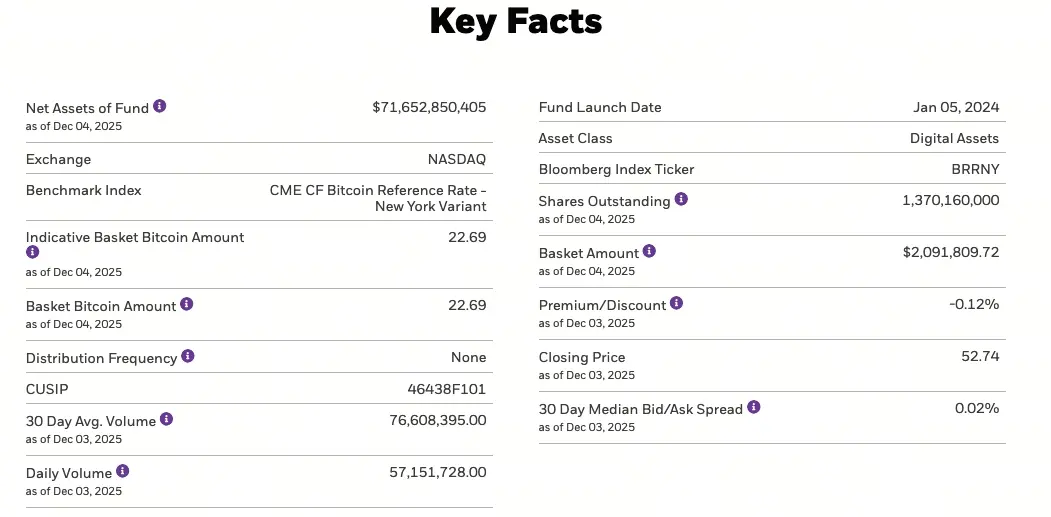
Which are the largest and most prominent cryptocurrency ETFs in 2025? BlackRock’s iShares Bitcoin Trust (IBIT) holds the top spot with $71.76 billion in assets under management and an average daily trading volume of $2.03 billion, with a fee of just 0.25%. Since its launch in January 2024, IBIT has become one of the fastest-growing ETFs in history—a record-breaking achievement in the ETF industry.
IBIT’s success comes from multiple factors. First, BlackRock’s brand reputation. As the world’s largest asset manager with over $10 trillion in assets, BlackRock’s products naturally win institutional investors’ trust. Second, its competitive fee—at 0.25%, IBIT’s fee is among the lowest among Bitcoin ETFs, much lower than Grayscale’s 1.50%. Third, liquidity—IBIT’s daily trading volume exceeds $2 billion, allowing large trades to be executed with minimal slippage.
Fidelity Wise Origin Bitcoin Fund (FBTC) ranks second with $21.35 billion, also employing a low-fee strategy at 0.25%. As one of the largest mutual fund managers in the US, Fidelity’s client base is mainly conservative retirement savers, who have historically been cautious about cryptocurrency. FBTC’s success shows that even the most conservative investors are beginning to accept Bitcoin as a legitimate asset class.
Grayscale Bitcoin Trust ETF (GBTC), despite its high 1.50% fee, still manages $15.5 billion in assets thanks to its first-mover advantage as the first Bitcoin trust product. In 2024, GBTC converted from a trust to an ETF structure, greatly improving its liquidity and accessibility. However, the high fee has become its biggest competitive disadvantage, with funds slowly flowing to lower-fee competitors.
Top 5 Largest Cryptocurrency ETFs in 2025
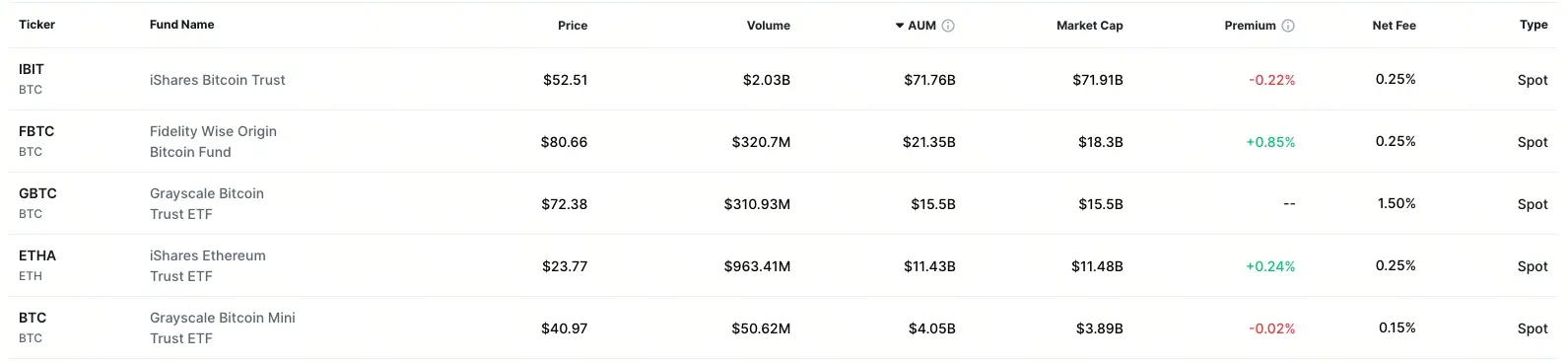
IBIT (BlackRock Bitcoin): $71.76 billion, fee 0.25%
FBTC (Fidelity Bitcoin): $21.35 billion, fee 0.25%
GBTC (Grayscale Bitcoin): $15.5 billion, fee 1.50%
ETHA (BlackRock Ethereum): $11.43 billion, fee 0.25%
BTC (Grayscale Bitcoin Mini Trust): $4.05 billion, fee 0.15%
These five ETFs collectively manage over $124 billion, accounting for the vast majority of the cryptocurrency ETF market. This concentration shows that investors prefer low-fee products launched by well-known asset managers.
Spot ETF vs Futures ETF: Key Differences Explained
What types of cryptocurrency ETFs are there in 2025? They are mainly divided into two types: spot and futures. Spot ETFs track the price of a specific cryptocurrency by holding the actual coins—making them ideal for investors seeking simple crypto exposure without the complexity of holding or storing coins. Futures ETFs do not directly hold cryptocurrencies—the price exposure comes via futures contracts, with values based on speculation of the asset’s future price.
The core advantage of spot ETFs is precise price tracking. Since the ETF directly holds Bitcoin or Ethereum, its net asset value (NAV) moves closely in sync with the crypto’s market price. When investors buy shares of IBIT, they indirectly own a corresponding amount of Bitcoin. This direct holding structure eliminates the roll costs and basis risk associated with futures contracts.
Futures ETFs, on the other hand, suffer from tracking error. Futures contracts have expiration dates; ETF managers must regularly sell expiring contracts and buy longer-dated ones—a process called “rolling.” In normal markets, longer-dated contracts usually trade at a premium (known as contango), meaning each roll incurs a cost. Over time, these costs cause futures ETFs to underperform spot prices.
ProShares Bitcoin ETF (BITO) is the largest Bitcoin futures ETF, with $2.76 billion under management, but it is much smaller than the spot ETFs. When BITO launched in 2021, it was the only option, but after spot ETFs were approved in 2024, a large amount of capital flowed out of BITO into spot products. This capital shift clearly shows investors’ preference for spot ETFs.
Core Differences: Spot vs Futures ETFs
Holding Structure: Spot directly holds cryptocurrency vs. Futures hold contracts
Price Tracking: Spot tightly tracks market price vs. Futures have basis risk
Roll Cost: None for spot vs. Monthly cost for futures
Suitable Investors: Long-term investors for spot vs. Short-term traders for futures
For most investors, spot ETFs are the better choice—unless a specific trading strategy requires the leverage characteristics of futures ETFs.
Must-Know: 3 Major Advantages of Investing in Crypto ETFs
What are the core advantages that attract investors to cryptocurrency ETFs in 2025? First is ease of trading. Unlike cryptocurrencies, which are only traded on crypto exchanges, crypto ETFs can be traded just like stocks. Investors can place orders via their existing brokerage accounts, with no need to register for a crypto exchange, complete KYC, or learn how to use a crypto wallet.
Second is account flexibility. In some jurisdictions (like Canada), crypto ETFs can be bought in registered accounts (such as TFSA or RRSP), enjoying tax advantages. In contrast, directly holding crypto usually doesn’t qualify for such tax benefits. For investors focused on tax planning, this is a key consideration.
Third is security and convenience. Crypto ETFs eliminate the need for investors to manage wallets, private keys, or public keys. Holding crypto directly carries risks of lost keys, hacking, or exchange failure. The ETF structure shifts these risks to professional custodians, who employ military-grade security measures and insurance.
However, risks must still be acknowledged. Cryptocurrency is inherently volatile, and ETFs cannot eliminate this risk. Regulation is still evolving, and policy changes may impact ETF operations. In addition, ETF performance may deviate from the actual crypto market, resulting in tracking error and differences between expected and actual returns. Liquidity risk can also appear in extreme market conditions, affecting the ability to buy or sell ETFs at optimal prices.
Top 10 Recommended Cryptocurrency ETFs for 2025
What cryptocurrency ETFs are worth allocating to in 2025? Based on size, liquidity, and fees, here are the top 10 recommendations:
Top 5 Bitcoin Spot ETFs
IBIT (BlackRock Bitcoin): $71.76 billion, fee 0.25%, daily trading volume $2.03 billion (as of Dec 5, 2026)
FBTC (Fidelity Bitcoin): $21.35 billion, fee 0.25%, daily trading volume $320 million (as of Dec 5, 2026)
GBTC (Grayscale Bitcoin): $15.5 billion, fee 1.50%, daily trading volume $310 million (as of Dec 5, 2026)
BTC (Grayscale Bitcoin Mini): $4.05 billion, fee 0.15%, daily trading volume $50.6 million (as of Dec 5, 2026)
BITB (Bitwise Bitcoin): $3.73 billion, fee 0.20%, daily trading volume $110 million (as of Dec 5, 2026)
Top 5 Ethereum Spot ETFs
ETHA (BlackRock Ethereum): $11.43 billion, fee 0.25%, daily trading volume $960 million
ETHE (Grayscale Ethereum): $3.46 billion, fee 2.50%, daily trading volume $210 million
FETH (Fidelity Ethereum): $1.34 billion, fee 0.25%, daily trading volume $200 million
ETH (Grayscale Ethereum Mini): $1.27 billion, fee 0.15%, daily trading volume $290 million
ETHW (Bitwise Ethereum): $374 million, fee 0.20%, daily trading volume $31.2 million
From a fee perspective, Grayscale’s products, although large in scale, charge much higher fees than competitors. GBTC’s 1.50% and ETHE’s 2.50% fees will eat into long-term returns. In contrast, BlackRock and Fidelity’s 0.25% fees, and Grayscale mini-versions’ 0.15% fees, are more cost-competitive. For long-term investors, choosing low-fee products is crucial, as even a 0.5% fee difference can have a significant compounding effect over a decade.
In terms of trading volume, IBIT and ETHA are far ahead in liquidity, allowing large traders to enter and exit positions quickly without significantly affecting prices. For those needing frequent trades or holding large positions, liquidity is the second most important consideration after fees.
Frequently Asked Questions (FAQ)
What is a cryptocurrency ETF?
A cryptocurrency exchange-traded fund (ETF) is a convenient way to invest in crypto via a regular brokerage account, without directly holding or storing crypto. They trade on stock exchanges and track the price of cryptocurrencies like Bitcoin or Ethereum. Just like traditional ETFs, investors buy ETF shares to gain exposure to crypto prices, without having to manage digital wallets or private keys.
How do I buy a cryptocurrency ETF?
You can buy them through any regular brokerage account, just like buying stocks. Search for the ticker symbol (such as IBIT, FBTC) in your broker’s app or website, enter the amount you want to buy, and place your order. No need to register on a crypto exchange or manage digital wallets.
Should I choose a spot ETF or a futures ETF?
Long-term investors are advised to choose spot ETFs (such as IBIT, FBTC) for precise price tracking and no roll costs. Futures ETFs (like BITO) have tracking error and are only suitable for short-term trades or specific strategies.
How much money do I need to start investing?
One share of IBIT is about $52, one share of FBTC is about $80. Some brokers support fractional shares, so you can theoretically start with $50. It’s recommended to invest at least $1,000 to diversify your purchase.
How are crypto ETFs taxed?
In the US, they are treated as securities and subject to capital gains tax (long-term rate 0%-20% for holdings over a year, short-term taxed as ordinary income). Taiwanese investors buying through overseas brokers must report overseas income.
Are ETFs safer than buying Bitcoin directly?
Safety differs: ETFs have no private key loss or hacking risk but require trust in custodians; direct ownership gives you full control but you’re responsible for your own security. ETFs are regulated by the SEC for extra protection, but can only be traded during business hours, while Bitcoin trades 24/7.


