Trade
Basic
Futures
Futures
Hundreds of contracts settled in USDT or BTC
TradFi
Gold
Trade global traditional assets with USDT in one place
Options
Hot
Trade European-style vanilla options
Unified Account
Maximize your capital efficiency
Demo Trading
Futures Kickoff
Get prepared for your futures trading
Futures Events
Participate in events to win generous rewards
Demo Trading
Use virtual funds to experience risk-free trading
Earn
Launch
CandyDrop
Collect candies to earn airdrops
Launchpool
Quick staking, earn potential new tokens
HODLer Airdrop
Hold GT and get massive airdrops for free
Launchpad
Be early to the next big token project
Alpha Points
Trade on-chain assets and enjoy airdrop rewards!
Futures Points
Earn futures points and claim airdrop rewards
Investment
Simple Earn
Earn interests with idle tokens
Auto-Invest
Auto-invest on a regular basis
Dual Investment
Buy low and sell high to take profits from price fluctuations
Soft Staking
Earn rewards with flexible staking
Crypto Loan
0 Fees
Pledge one crypto to borrow another
Lending Center
One-stop lending hub
VIP Wealth Hub
Customized wealth management empowers your assets growth
Private Wealth Management
Customized asset management to grow your digital assets
Quant Fund
Top asset management team helps you profit without hassle
Staking
Stake cryptos to earn in PoS products
Smart Leverage
New
No forced liquidation before maturity, worry-free leveraged gains
GUSD Minting
Use USDT/USDC to mint GUSD for treasury-level yields

More


Xiaominweb3

No content yet
xiaominweb3
Many privacy projects start by discussing cryptography, curves, and proof systems.
But @0xMiden's approach is quite counterintuitive—
It doesn't force users to understand privacy.
Privacy is inherently present,
rather than a feature that requires active learning or configuration.
I think this is a very important shift:
Truly mature privacy must be "seamless."
@KaitoAI
View OriginalBut @0xMiden's approach is quite counterintuitive—
It doesn't force users to understand privacy.
Privacy is inherently present,
rather than a feature that requires active learning or configuration.
I think this is a very important shift:
Truly mature privacy must be "seamless."
@KaitoAI

- Reward
- like
- Comment
- Repost
- Share
Many privacy chains are solving the problem of "how to hide things,"
but @0xMiden is more like addressing an old question:
Why must all computations be done on-chain?
Miden chooses to delegate the heavy lifting to the client:
🔹 Local execution
🔹 Only verify STARK proof on-chain
🔹 State is private by default but can be selectively made public
The result is:
Gas costs are significantly reduced, privacy is not a black box, and compliance requirements can still be met.
This is not "more privacy," but a more rational way of execution.
View Originalbut @0xMiden is more like addressing an old question:
Why must all computations be done on-chain?
Miden chooses to delegate the heavy lifting to the client:
🔹 Local execution
🔹 Only verify STARK proof on-chain
🔹 State is private by default but can be selectively made public
The result is:
Gas costs are significantly reduced, privacy is not a black box, and compliance requirements can still be met.
This is not "more privacy," but a more rational way of execution.

- Reward
- like
- Comment
- Repost
- Share
Looking back at @spaace_io's development pace, it is actually very restrained.
From early small-scale testing, to gradually opening up user scale, and then to the official launch of XP and gamification mechanisms, each step is laying a foundation rather than chasing hot trends.
There are no shortcuts through paid acquisition, only genuine users, real transactions, and authentic engagement.
This is also why many early users who kept completing tasks, placing orders, and participating in bidding are now in a very advantageous position.
2025 is the year to lay the groundwork,
and now is the criti
From early small-scale testing, to gradually opening up user scale, and then to the official launch of XP and gamification mechanisms, each step is laying a foundation rather than chasing hot trends.
There are no shortcuts through paid acquisition, only genuine users, real transactions, and authentic engagement.
This is also why many early users who kept completing tasks, placing orders, and participating in bidding are now in a very advantageous position.
2025 is the year to lay the groundwork,
and now is the criti
View Original

- Reward
- 1
- Comment
- Repost
- Share
Ongoing @spaace_io Tournament, like an interesting social experiment
After a significant increase in the prize pool, I observed some subtle changes:
Many previously dormant collectibles are now trading frequently, and the leaderboard is refreshing every minute.
More importantly, player behavior has evolved — everyone is no longer solely pursuing massive single trades to climb the ranks, but is more inclined to maintain a stable, continuous "trading rhythm."
This is thanks to its clever "dual-driven" mechanism:
Every trade you make simultaneously advances your "Battle Pass" level and your "Tour
View OriginalAfter a significant increase in the prize pool, I observed some subtle changes:
Many previously dormant collectibles are now trading frequently, and the leaderboard is refreshing every minute.
More importantly, player behavior has evolved — everyone is no longer solely pursuing massive single trades to climb the ranks, but is more inclined to maintain a stable, continuous "trading rhythm."
This is thanks to its clever "dual-driven" mechanism:
Every trade you make simultaneously advances your "Battle Pass" level and your "Tour

- Reward
- like
- Comment
- Repost
- Share
Some projects' privacy is like adding a layer of fog to transactions.
@0xMiden's privacy is more like:
The lights were never turned on from the start
The default state is not broadcast,
but you can choose to whom and under what conditions to disclose
This is an important dividing line for me:
🔹 Obscure privacy → Easier to regulate, performance drag
🔹 Design-level privacy → Closer to real financial needs
Miden's design is clearly more durable
View Original@0xMiden's privacy is more like:
The lights were never turned on from the start
The default state is not broadcast,
but you can choose to whom and under what conditions to disclose
This is an important dividing line for me:
🔹 Obscure privacy → Easier to regulate, performance drag
🔹 Design-level privacy → Closer to real financial needs
Miden's design is clearly more durable

- Reward
- like
- Comment
- Repost
- Share
Miden gives me the feeling of a project that "won't go viral overnight, but can be used for many years."
It doesn't rely on narrative hype, but focuses on a few things:
🔹Programmable Privacy
🔹User Self-Custody
🔹Targeting Institutions and Real Financial Scenarios
The ecosystem is still in testnet, but some directions are already visible:
Private DEX, dark pools, anonymous OTC, privacy identities...
If privacy truly becomes a necessity by 2026,
then the chains that natively support privacy at the execution layer will be the ultimate winners @0xMiden
View OriginalIt doesn't rely on narrative hype, but focuses on a few things:
🔹Programmable Privacy
🔹User Self-Custody
🔹Targeting Institutions and Real Financial Scenarios
The ecosystem is still in testnet, but some directions are already visible:
Private DEX, dark pools, anonymous OTC, privacy identities...
If privacy truly becomes a necessity by 2026,
then the chains that natively support privacy at the execution layer will be the ultimate winners @0xMiden

- Reward
- like
- Comment
- Repost
- Share
From an architectural design perspective, @0xMiden does not choose to compete directly with mainstream L2 solutions in performance metrics.
Its design premise is very clear:
Blockchains do not need to execute all computations themselves, but must be able to strictly verify the legality of each state change.
Therefore, @0xMiden moves the complex execution process to the user's local environment, with the chain only responsible for minimal verification duties—this is essentially a redefinition of the "chain's responsibility boundary" and constitutes a fundamental difference from most execution-b
View OriginalIts design premise is very clear:
Blockchains do not need to execute all computations themselves, but must be able to strictly verify the legality of each state change.
Therefore, @0xMiden moves the complex execution process to the user's local environment, with the chain only responsible for minimal verification duties—this is essentially a redefinition of the "chain's responsibility boundary" and constitutes a fundamental difference from most execution-b

- Reward
- like
- Comment
- Repost
- Share
We all know Blur and OpenSea.
One pushes transaction volume to the extreme, the other steadily and reliably.
But recently I’ve been looking at @spaace_io, and it seems to be trying a third way.
Blur’s incentives are strong, but the logic is straightforward:
Transaction volume is everything.
As a result, everyone is just volume farming—gas wars, mutual listings.
The real beneficiaries are often the scientists and whales.
Ordinary users are easily discouraged by repeated costs.
@spaace_io’s approach is different.
It also values transaction volume but emphasizes genuine, sustained parti
One pushes transaction volume to the extreme, the other steadily and reliably.
But recently I’ve been looking at @spaace_io, and it seems to be trying a third way.
Blur’s incentives are strong, but the logic is straightforward:
Transaction volume is everything.
As a result, everyone is just volume farming—gas wars, mutual listings.
The real beneficiaries are often the scientists and whales.
Ordinary users are easily discouraged by repeated costs.
@spaace_io’s approach is different.
It also values transaction volume but emphasizes genuine, sustained parti
BLUR-5,86%

- Reward
- like
- Comment
- Repost
- Share
What truly traps institutional funds is never performance, but the conflict between verifiability and privacy.
Traditional OTC relies on black boxes to exchange privacy,
On-chain relies on transparency to exchange trust,
Both are long-term incompatible.
@0xMiden's interesting aspect is that it shifts the "object of trust" from intermediaries to the execution itself.
Whether a transaction occurs and whether it settles as agreed can be verified,
but the identity of traders, fund flow, and strategy details remain untraceable.
This is not a privacy narrative, but a reconstruction of the trust mode
View OriginalTraditional OTC relies on black boxes to exchange privacy,
On-chain relies on transparency to exchange trust,
Both are long-term incompatible.
@0xMiden's interesting aspect is that it shifts the "object of trust" from intermediaries to the execution itself.
Whether a transaction occurs and whether it settles as agreed can be verified,
but the identity of traders, fund flow, and strategy details remain untraceable.
This is not a privacy narrative, but a reconstruction of the trust mode

- Reward
- like
- Comment
- Repost
- Share
Most Meme projects discuss:
Which coin, which meme, who goes all-in first.
But I think @MemeMax_Fi is doing something different:
It’s dealing with emotions themselves.
The essence of Meme is not assets, but volatility, consensus, and emotional density.
And Perp happens to be the most suitable structure to carry this.
Putting emotions scattered across different chains and pools into one engine,
Allowing both longs and shorts to be amplified, hedged, and expressed—
This is much more fundamental than simply "posting another Meme."
Which coin, which meme, who goes all-in first.
But I think @MemeMax_Fi is doing something different:
It’s dealing with emotions themselves.
The essence of Meme is not assets, but volatility, consensus, and emotional density.
And Perp happens to be the most suitable structure to carry this.
Putting emotions scattered across different chains and pools into one engine,
Allowing both longs and shorts to be amplified, hedged, and expressed—
This is much more fundamental than simply "posting another Meme."
PERP-1,51%
- Reward
- 1
- Comment
- Repost
- Share
Many systems treat on-chain state as a "shared database,"
all computations revolve around this public state.
@0xMiden's account model is distinctly different.
Here, accounts are more like constrained state machines,
each state change itself is a computational process that needs to be proven.
This leads to an important result:
State growth no longer necessarily means verification costs spiral out of control,
because state changes are inherently verifiable units by design.
This doesn't make development easier,
but it makes the long-term operation of complex systems more managea
View Originalall computations revolve around this public state.
@0xMiden's account model is distinctly different.
Here, accounts are more like constrained state machines,
each state change itself is a computational process that needs to be proven.
This leads to an important result:
State growth no longer necessarily means verification costs spiral out of control,
because state changes are inherently verifiable units by design.
This doesn't make development easier,
but it makes the long-term operation of complex systems more managea

- Reward
- like
- Comment
- Repost
- Share
2026 is called the "Year of NFT Revival" by its team.
@spaace_io's entire design seems to be tailored precisely for this narrative cycle.
The previous NFT bull market was driven by "avatar JPEGs" and social identities. The next phase's core narrative is likely to shift toward "practicality and composability."
@spaace_io's mechanism happens to resonate with this:
Its "reputation badges" and "community cards" serve as practical identity credentials;
"Squad mode" empowers collaborative organizations;
In the future, based on these credit and identity data, a variety of applications such as leasing
View Original@spaace_io's entire design seems to be tailored precisely for this narrative cycle.
The previous NFT bull market was driven by "avatar JPEGs" and social identities. The next phase's core narrative is likely to shift toward "practicality and composability."
@spaace_io's mechanism happens to resonate with this:
Its "reputation badges" and "community cards" serve as practical identity credentials;
"Squad mode" empowers collaborative organizations;
In the future, based on these credit and identity data, a variety of applications such as leasing

- Reward
- like
- Comment
- Repost
- Share
On the surface, @0xMiden uses a mature ZK toolchain,
but its true barrier is not in cryptography itself.
What is difficult to replicate is the path it has taken from the very beginning, centered around "provable execution"
reverse designing virtual machines, instruction sets, and account models.
This means it is not simply "plugging in ZK" onto an existing execution model,
but rather making ZK a prerequisite for the execution model.
Once this choice is made, it is difficult to adjust midway,
which also explains why this route seems to progress slowly but has a complete structure.
View Originalbut its true barrier is not in cryptography itself.
What is difficult to replicate is the path it has taken from the very beginning, centered around "provable execution"
reverse designing virtual machines, instruction sets, and account models.
This means it is not simply "plugging in ZK" onto an existing execution model,
but rather making ZK a prerequisite for the execution model.
Once this choice is made, it is difficult to adjust midway,
which also explains why this route seems to progress slowly but has a complete structure.

- Reward
- like
- Comment
- Repost
- Share
Most blockchain systems make very simple assumptions about users:
Users are only responsible for submitting transactions; execution and proof are handled at the system layer.
@0xMiden's assumptions about users are clearly more advanced.
In its model, users are not passive request initiators,
but the primary responsible party for execution.
Logic runs locally on the user,
proofs are generated on the user side,
and the chain is only responsible for verifying whether the state is reasonable.
This means the system does not aim to "reduce all complexity,"
but rather hands the complexity back to the
View OriginalUsers are only responsible for submitting transactions; execution and proof are handled at the system layer.
@0xMiden's assumptions about users are clearly more advanced.
In its model, users are not passive request initiators,
but the primary responsible party for execution.
Logic runs locally on the user,
proofs are generated on the user side,
and the chain is only responsible for verifying whether the state is reasonable.
This means the system does not aim to "reduce all complexity,"
but rather hands the complexity back to the

- Reward
- like
- Comment
- Repost
- Share
Happy Friday! The weekend is just around the corner.
After a busy week, my mind is actually more easily attracted to some truly interesting things.
Recently, what made me stop and think seriously is a core idea from @0xMiden:
It doesn't insist on a TPS number race, but instead chooses to return to a more fundamental question—where should computation actually happen?
Through local execution, on-chain verification, and the "proof as the result" design, it shifts the source of scalability from simply node performance to user-side computational power.
The changes brought about by this approach are
View OriginalAfter a busy week, my mind is actually more easily attracted to some truly interesting things.
Recently, what made me stop and think seriously is a core idea from @0xMiden:
It doesn't insist on a TPS number race, but instead chooses to return to a more fundamental question—where should computation actually happen?
Through local execution, on-chain verification, and the "proof as the result" design, it shifts the source of scalability from simply node performance to user-side computational power.
The changes brought about by this approach are

- Reward
- like
- Comment
- Repost
- Share
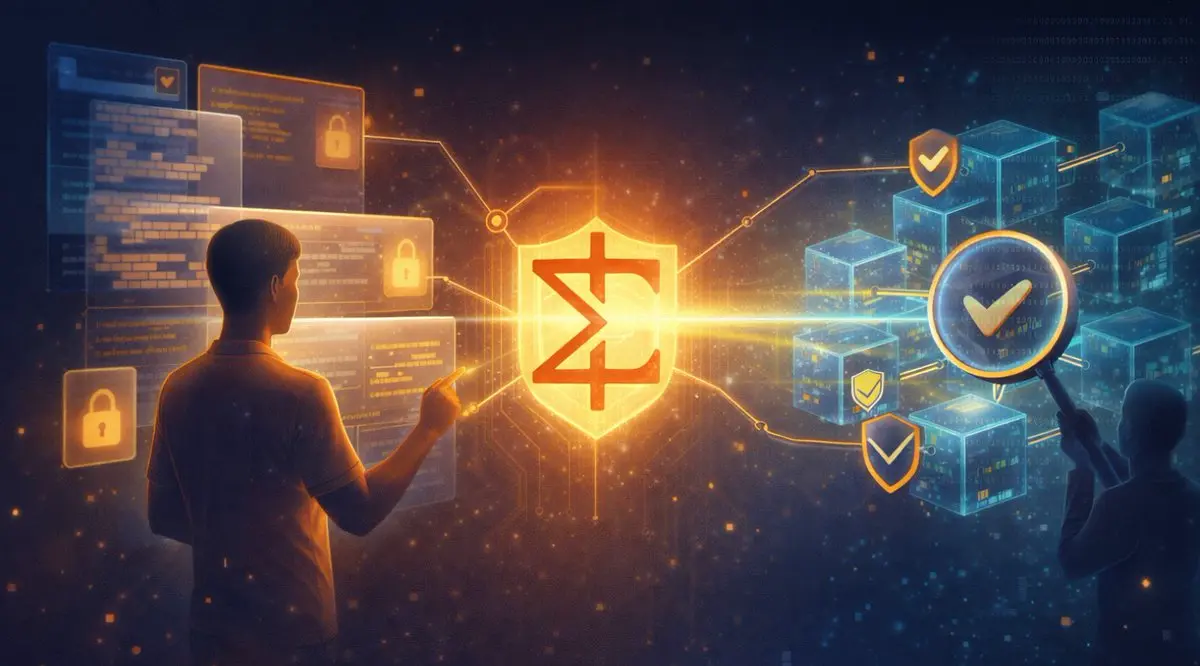
Privacy is not about "hiding data," but:
Others can verify that you are correct, but cannot see what you have done.
@0xMiden's local execution + zero-knowledge proof model naturally supports this.
The logic runs on your device, and the proof is verified on the chain.
It's not about adding privacy as an afterthought, but making privacy the default and optional.
View OriginalOthers can verify that you are correct, but cannot see what you have done.
@0xMiden's local execution + zero-knowledge proof model naturally supports this.
The logic runs on your device, and the proof is verified on the chain.
It's not about adding privacy as an afterthought, but making privacy the default and optional.
- Reward
- like
- Comment
- Repost
- Share