JOHAR09

vip
Age 5 Yıl
Peak Tier 3
No content yet
View Original
GateNews
Asian Stocks Set for Weak Open as Investors Eye U.S. Tech Earnings; Analyst Warns of Risks if Optimism Cracks
Gate News message, April 27 — Asian stock markets are expected to open weaker on Tuesday, April 28, as investors focus on earnings from U.S. technology giants with a combined market value of approximately $16 trillion. The broader U.S. stock market has recovered to record highs, largely supported by
  • Reward
  • Comment
  • Repost
  • Share
View Original
GateNews
Asian Stocks Set for Weak Open as Investors Eye U.S. Tech Earnings; Analyst Warns of Risks if Optimism Cracks
Gate News message, April 27 — Asian stock markets are expected to open weaker on Tuesday, April 28, as investors focus on earnings from U.S. technology giants with a combined market value of approximately $16 trillion. The broader U.S. stock market has recovered to record highs, largely supported by
  • Reward
  • Comment
  • Repost
  • Share
View Original
TechubNews
Brown Brown's first-quarter sales surged... Organic growth slowdown becomes a variable
Brown & Brown achieved double-digit revenue and net profit growth in the first quarter of 2026. Total revenue was $1.9 billion, up 35.4%; net profit was $426 million, up 28.7%; pre-tax profit was $533 million, with a profit margin of 28.0%. Organic revenue was nearly flat, with organic growth including contingent commissions at only 2.2%, indicating weak core business growth. Diluted EPS of $1.06 decreased by 7.8%, while adjusted EPS of $1.39 increased by 7.8%. Announced a dividend of $0.165 per share, payable on May 20. The market is focused on future growth quality and whether the company can restore actual operational momentum.
  • Reward
  • Comment
  • Repost
  • Share
View Original
MaorCohen
I've joined WCTC S8. Join me now to compete and share 8,000,000 USDT. Trade beyond limits and conquer the future. https://www.gate.com/competition/wctc-s8?ref=VGNBBF1EUW&ref_type=165&utm_cmp=qK2FsaYI
repost-content-media
  • Reward
  • Comment
  • Repost
  • Share
View Original
asiftahsin
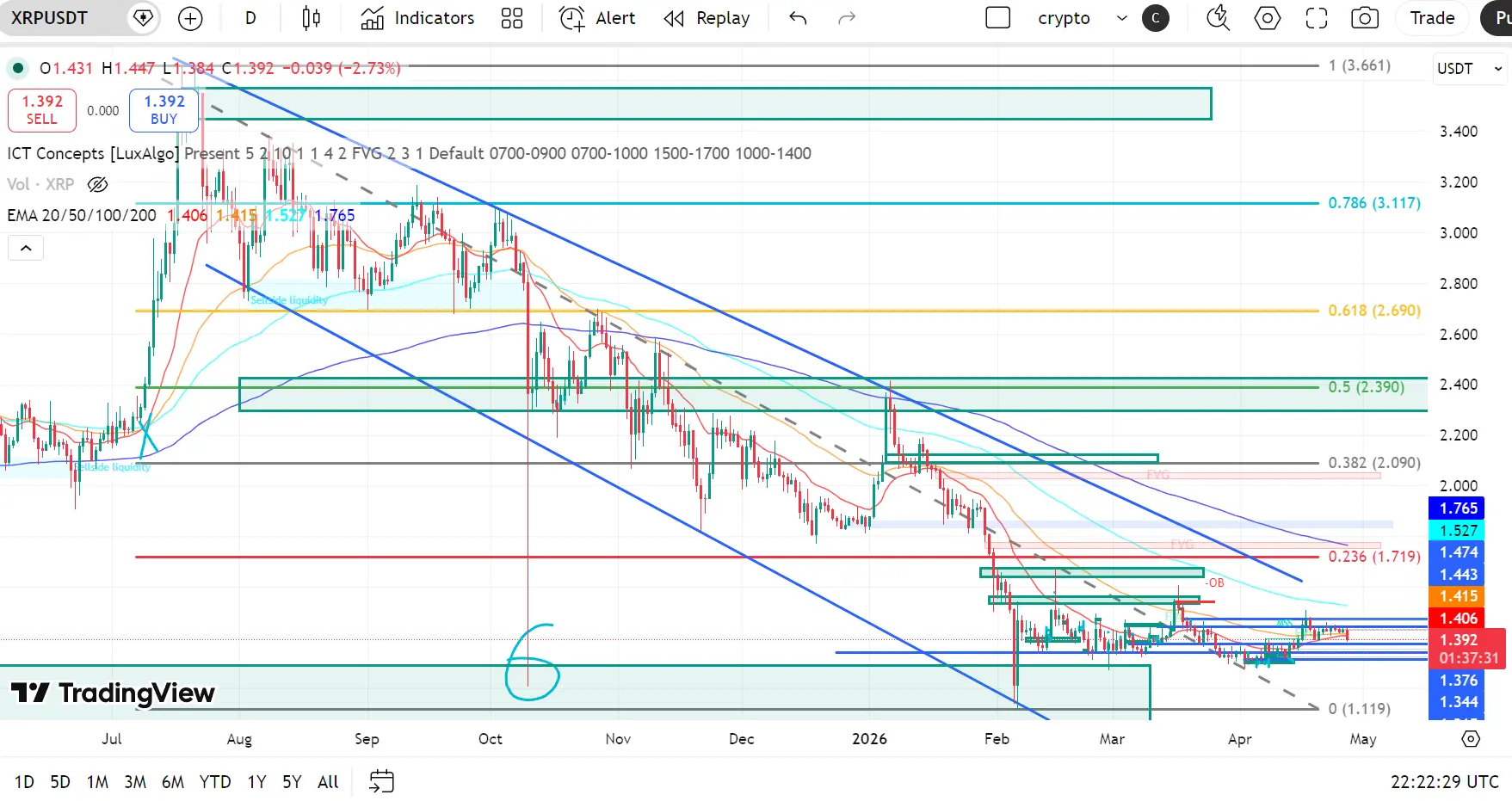
XRP Technical Outlook: XRP Stabilizes Near $1.40 — Compression Before Expansion
XRP is showing a steady base formation after a prolonged downtrend, with price consolidating tightly around the $1.38 – $1.42 range. The recent structure suggests absorption of sell pressure, while buyers are gradually attempting to reclaim short-term control.
Price is now approaching a minor resistance cluster, making this a key decision zone for the next directional move.
EMA Structure (Early Bullish Transition)
20 EMA: $1.406
50 EMA: $1.415
100 EMA: $1.527
200 EMA: $1.765
Price is hovering around 20 & 50 EMA → short-term equilibrium
Early signs of bullish crossover (20 ≈ 50 EMA)
Still trading below 100 & 200 EMA → macro trend remains bearish
EMA compression indicates volatility expansion likely soon
The $1.40 zone is acting as a pivot between buyers and sellers.
Fibonacci & Market Structure
1.0 Fib (Cycle High): $3.661
0.786 Fib: $3.117
0.618 Fib: $2.690
0.5 Fib: $2.390
0.382 Fib: $2.090
0.236 Fib: $1.719
Fib 0: $1.119
XRP remains below 0.236 Fib ($1.719) → still in recovery phase
Current structure reflects accumulation, not full reversal
Break above $1.72 would confirm strong bullish shift
Holding above the current range supports gradual upside continuation.
Market Structure Insight (ICT Concepts)
Prior move swept sell-side liquidity below $1.30
Strong reaction from demand zone → confirms accumulation base
Presence of FVG fills + small order blocks within range
Price is currently testing local supply near $1.42 – $1.45
A breakout above this supply could trigger a move toward higher inefficiency zones.
RSI Momentum
RSI (14) is around 55–56, trending slightly upward.
Momentum is neutral to mildly bullish
No signs of exhaustion
Indicates room for expansion if resistance breaks
Sustaining above 55 strengthens bullish bias.
📊 Key Levels
Resistance
$1.42 – $1.45 (local resistance / range high)
$1.53 (100 EMA)
$1.72 (major resistance / Fib 0.236)
Support
$1.39 – $1.40 (immediate support)
$1.37 (range low)
$1.30 – $1.20 (major demand zone)
📌 Summary
XRP is transitioning into a tight consolidation phase after a strong selloff, with price compressing just below resistance. This structure typically precedes a volatility expansion move.
A confirmed breakout above $1.45 would open the path toward $1.53 and $1.72, signaling a stronger recovery. However, failure to break higher could result in continued range-bound movement or a pullback toward $1.37.
Overall, market structure is improving, and momentum is slowly shifting toward buyers — but XRP still needs a decisive breakout to confirm trend continuation.
$XRP #CryptoMarketsRiseBroadly
repost-content-media
  • Reward
  • Comment
  • Repost
  • Share
View Original
User_any
Gold Rush Phase 3: Invite Friends to Trade $1 for a Chance to Win 1 oz of Gold With a 100% Win Rate https://www.gate.com/campaigns/4601?ref=BVVEVQ9c&ref_type=132&utm_cmp=52i2MiDi
repost-content-media
  • Reward
  • Comment
  • Repost
  • Share
View Original
Crypto_Buzz_with_Alex
#EthereumFoundationUnstakes$48.9METH
Ethereum Foundation unstaking 48.9M ETH puts market sentiment under pressure
The move behind #EthereumFoundationUnstakes$48.9METH is not just a transaction. It is a signal that large treasury decisions can shift short term sentiment even without immediate selling.
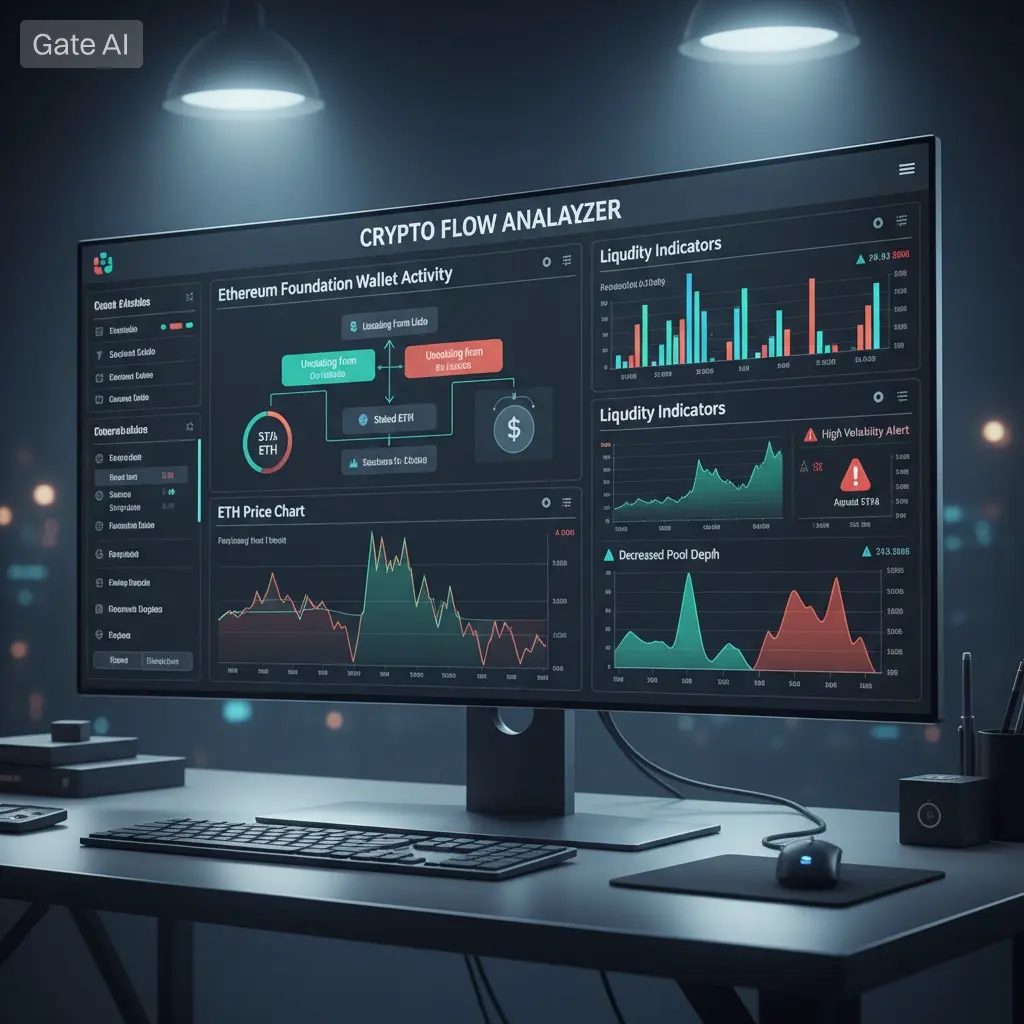
Recent on chain data shows the Ethereum Foundation initiated the unstaking of approximately 48.9 million dollars worth of ETH through Lido’s withdrawal process, converting staked assets back into liquid ETH.
This matters because liquidity changes perception. Even if no selling happens, the possibility alone is enough to trigger market reactions. Traders often respond to potential supply increases before they actually occur.
The core debate is simple. Is this preparation for selling, or just treasury management and reallocation. Both scenarios carry different implications for ETH price behavior.
Unstaking does not automatically mean dumping. It can also indicate operational needs, repositioning, or liquidity planning. However, the market tends to price in risk first and clarity later.
From a market perspective, this move suggests short term pressure on ETH sentiment rather than confirmed downside.
Range expectation remains cautious between support and resistance levels unless actual selling is confirmed.
Trading approach in this scenario should stay balanced.
Positioning mindset
Avoid aggressive longs near resistance
Look for confirmation before bearish bias
Trade reaction, not assumptions
Short term volatility is expected, especially since ETH already showed minor price weakness after the news, reflecting how sensitive markets are to large holder activity.
The broader outlook remains stable. The Ethereum Foundation still holds significant reserves, and past strategy shifts toward staking instead of selling indicate long term confidence in the ecosystem.
Markets react to intent before action
Liquidity unlock creates psychological pressure
Large holders shape short term sentiment
The deeper insight here is behavioral. In crypto, perception often drives price before fundamentals catch up. Even neutral actions can create volatility if interpreted as bearish.
In summary, #EthereumFoundationUnstakes$48.9METH is a liquidity event, not a confirmed sell signal.
The real impact depends on what happens next
Do you see this as early distribution or just strategic treasury movement
Why this matters for markets and investors
Large unstaking events influence short term sentiment quickly
Liquidity shifts can create volatility without actual selling
Market reacts faster to fear than to confirmation
Treasury strategies of major entities impact price behavior
#EthereumFoundationUnstakes$48.9METH #ETH
repost-content-media
  • Reward
  • Comment
  • Repost
  • Share
View Original
CryptoSat
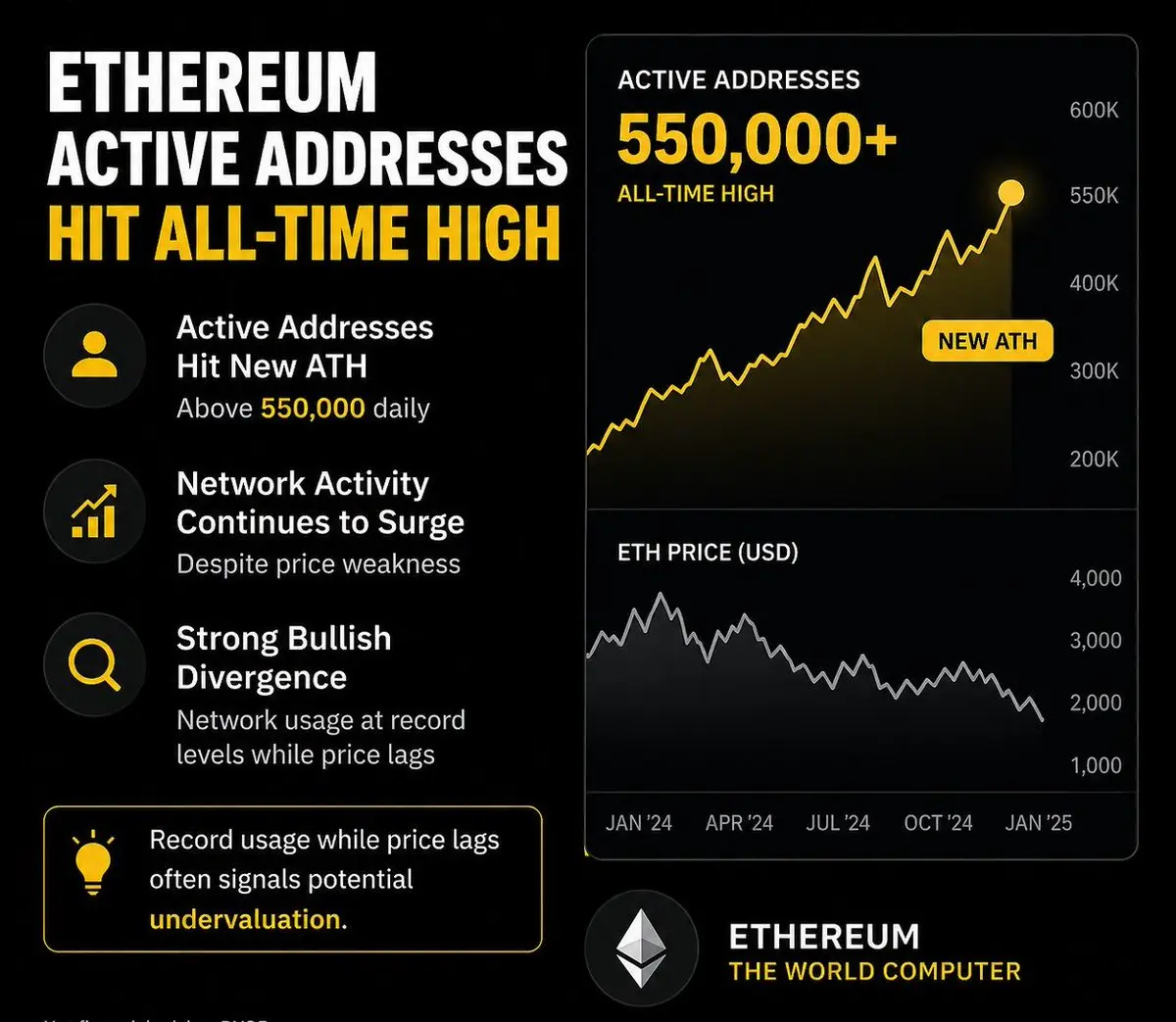
Ethereum Active Addresses Hit All-Time High 🚀
Ethereum network activity continues to surge despite recent price weakness:
- Active Addresses have reached a new ATH above 550,000 daily
- This marks a strong bullish divergence from price action
As highlighted by on-chain analysts, this record network usage while price lags often signals potential undervaluation.
repost-content-media
  • Reward
  • Comment
  • Repost
  • Share
View Original
discovery
#比特币Breaks79K $BTC
April just gave us the cleanest breakout we've had in 12 months. Bitcoin tagged $79,327 on Wednesday, closed the 4-month range, and is now coiling between $77,300-$78,500. That's +13.6% for the month — not on hype, on structure.
Here is my read, not the headline version:
1. Liquidity led, price followed.
USDT market cap expanded ∼$5B in April. That cash sat on exchanges, it didn't chase alts. When BTC cleared $77K, the order book showed $1.08B in shorts stacked just above. The push through $79K was short-covering meeting spot bids — that's why the candle was clean, not a vertical meme pump.
2. Whales built the floor while CT debated tops.
On-chain data shows ∼$3.17B in net whale accumulation between $73K-$76K in the two weeks before the break. ETF flows were positive 9 of 10 days, with IBIT leading. Institutions weren't waiting for $80K, they were the reason we held $74K.
3. $79K is a door, not a destination.
I'm watching two levels only:
Hold $79,300 daily close → empty volume pocket to $82,500 opens fast
Lose $76,800 → we revisit the breakout base at $74,000
This is different from 2024. Last year we broke on leverage. This year we break on spot ETF inflows + stablecoin liquidity. Slower, healthier, and harder to fade.
My Gate playbook (personal, not advice):
I did not chase $79,327. I scaled out 20% into strength between $78,800-$79,200.
Core spot stays untouched. Below $77K I run a small hedge, not to short the trend but to sleep through a Fed headline.
Add trigger: daily close above $79,500 with volume >20-day avg. Stop adding: close below $76,800.
Next 7 days I track only two metrics: daily ETF net flows staying green, and USDT dominance continuing lower. Both are still trending my way.
#比特币Breaks79K isn't about a number. It's about regime: Bitcoin is trading macro liquidity now, not crypto narratives. In that regime, I buy confirmed breakouts, not rumors.
I'm positioned for continuation, but I'm not a hero in the middle.
What's your level — taking partials at $79K, or waiting for the $80K confirmation?
This is my personal market journal, not financial advice. Do your own research and manage risk.
#比特币Breaks79K
  • Reward
  • Comment
  • Repost
  • Share
View Original
discovery
#WCTCTradingKingPK
How Head-to-Head Trading Formats Are Redefining Performance Under Pressure
Competitive trading has evolved. What was once an isolated pursuit of reading charts and managing personal accounts has turned into a spectator sport where execution, discipline, and psychological endurance are broadcast in real time. At the center of this shift is the King PK format inside the WCTC Global Trading Competition — a model that strips trading down to its most unforgiving elements.
The Mechanics: No Place to Hide
Unlike traditional portfolio contests or long-duration P&L leaderboards, King PK is binary by design. Two traders. One timeframe. One winner. Every order placed, every position closed, every drawdown taken is immediately converted into visible performance data. There’s no quarterly report to soften a mistake and no macro narrative to justify a losing streak. The market feedback loop is instant.
This compression changes trader behavior fundamentally. With outcomes measured in minutes or hours rather than weeks, participants can’t rely on “time in the market” to bail them out. Precision in entry timing, position sizing, and exit logic becomes the only edge. Technical setups that work on daily charts often fail in PK conditions because latency, slippage, and intraday volatility dominate.
Why Most Fail: Exposure of Structural Flaws
The PK format acts like a stress test for trading systems and psychology. Three weaknesses get exposed within the first few rounds:
1. Leverage Misuse: Traders who use oversized positions to chase leaderboard rank usually get eliminated by normal market noise, not by black swan events. 2. Decision Fatigue: The need for constant action breaks traders who lack predefined rules. Impulse replaces process. 3. Risk Illiteracy: Many can calculate potential profit but fail to quantify ruin risk. In PK, one unmanaged tail event ends the run.
WCTC’s scale makes this worse. With 50,000+ competitors across team, solo, and PK brackets, the environment mirrors institutional prop-desk pressure: deep liquidity, algorithmic counterparties, and zero patience for hesitation.
The Real Differentiator: Strategic Restraint
Counterintuitively, the highest win rates in King PK don’t come from hyper-aggressive trading. They come from selective engagement. Elite performers treat “no trade” as a valid position. They understand that in a zero-sum, time-boxed match, capital preservation is offense. Avoiding a -5% mistake is mathematically equal to capturing a +5% win, but psychologically far harder to execute when the clock is ticking.
This is where risk protocols matter more than indicators. Pre-set daily loss limits, correlation checks across positions, and volatility-adjusted sizing are non-negotiable. The traders who advance aren’t the ones with secret strategies; they’re the ones with boring, repeatable risk frameworks.
Adaptability as an Alpha Source
Competition markets are inherently unstable. Order books thin out before announcements. Liquidity providers pull quotes during prints. Cross-asset correlations break and re-form in seconds. Static strategies — even profitable ones in normal conditions — decay fast here.
The PK winners typically run modular playbooks: scalping frameworks for range conditions, breakout logic for news-driven spikes, and strict “stand down” rules when spread widening exceeds thresholds. They’re not predicting direction better. They’re switching modes faster.
What It Signals to the Industry
For observers, analysts, and capital allocators, King PK matches are live case studies in behavioral finance. You’re watching cognitive biases, loss aversion, and overconfidence play out with real capital at stake. The format reveals who has actually internalized risk management versus who just talks about it on social media.
This has broader implications. As retail and prop trading converge, exchanges and platforms are using formats like WCTC to identify talent. Consistent PK performance is becoming a proxy for hireable skill — not because it proves someone can get rich, but because it proves they won’t blow up when conditions deteriorate.
Conclusion: Resilience Over Returns
#WCTCTradingKingPK isn’t about a lucky 100x trade or a viral P&L screenshot. It’s a filter. It isolates traders who can maintain process integrity while exposed to noise, emotion, and public scrutiny.
In 2026, the market doesn’t reward the loudest or the fastest. It rewards the trader who understands that survival is the prerequisite for outperformance. In the King PK arena, every click counts, but the decision not to click often counts more.
repost-content-media
  • Reward
  • Comment
  • Repost
  • Share
View Original
CryptoSelf
I've joined WCTC S8. Join me now to compete and share 8,000,000 USDT. Trade beyond limits and conquer the future. https://www.gate.com/competition/wctc-s8?ref_type=165&utm_cmp=qK2FsaYI
repost-content-media
  • Reward
  • Comment
  • Repost
  • Share
View Original
CryptoSelf
#比特币突破7.9万美元
Everyone is asking the same two questions, and I'm answering them with data from my notebook:
1) Should I take profit at $79K?
2) Or should I grow my position for $80K?
Here's my professional answer — both are correct, but for different traders.
Bitcoin hit $79,327 on Wednesday, then pulled back to the $77,300 range. This was the peak of a 13.6% rise in April. On-chain data shows that whales accumulated over $3.17 billion in the two weeks preceding this rise. There was also a net inflow of over $2 billion into Bitcoin ETFs during the same period. And $1.08 billion in short liquidations were triggered above $77,000.
What does this mean? This breakdown was the work of spot accumulation, not leveraged retail trading. That's why I didn't exit completely at $79K; I took profits gradually.
My strategy:
For the profit-taking trader: Realize 20-30% of your position in the $78,800-$79,300 range. Why? Because $79K is a psychological resistance and a pre-Fed uncertainty zone. Taking profits isn't weakness, it's risk management.
For the trader preparing for $80K: Hold the remaining 70-80% spot and only add on a confirmed breakout. My confirmation: Daily close above $79,500 and volume 15% above the average of the last 20 days. I won't add due to FOMO before that happens.
What did I do? Both. At $79,200, I sold 25% of my portfolio, I didn't switch to USDT — I put that money into a delta-neutral funding strategy on Gate. So if the market falls, I have a position that generates returns, not cash. If we see a daily close above $79,500, I'll buy back the amount I sold.
The critical point here is: $79K has been broken, but it hasn't been accepted yet. Acceptance means the price stays above it for 3 days. That's why all the false breakouts in 2024 were so painful.
Conclusion: There's no single right answer at this level. Taking profit is discipline, waiting is faith. I'm blending the two — protecting my profits but not abandoning the trend.
Which side are you on? Getting out of the table at $79K, or pulling up a chair for $80K?
$BTC
  • Reward
  • Comment
  • Repost
  • Share
View Original
CryptoSelf
#CryptoMarketsRiseBroadly
As we close out April, the crypto market is rising not as the story of a single coin, but as the breathing of an entire structure. While Bitcoin is consolidating around the $78,000 mark, Ethereum is forming a base above $2,300, and we are seeing a selective but widespread recovery in altcoins. This is the healthiest broad-based rally we've seen since the end of 2024.
In my view, there are three concrete reasons for this rise:
1. Liquidity has returned, but this time it's coming through stablecoins, not speculation.
In April, the USDT supply grew by approximately $5 billion. This means "dry gunpowder" parked on exchanges. In past cycles, this growth would flow first to Bitcoin, then to majors, and finally to risky altcoins. This time the flow is more disciplined. Bitcoin dominance has risen to 60.6%, indicating that capital is parking in a safe haven first. The difference is: the money is parked, it's not leaving.
2. Institutional capital chose the story, not the hype.
In April, there was a net inflow of over $2 billion into Bitcoin ETFs. Total Bitcoin ETF holdings exceeded $128 billion. Ethereum ETFs remained at $13 billion but saw no outflows. This tells me that institutions aren't buying "crypto," they're buying "Bitcoin as a balance sheet asset." This shifts the basis of the rally from speculation to allocation decisions. Healthy rallies start like this.
3. The market has stopped pricing in geopolitical noise. Middle East tensions, news of US political violence, Fed statements — it's all on the table. But in the last week of April, both stocks and crypto rose simultaneously. In traders' words, the market chose to "not care." This isn't indifference, it's maturity. The risk premium is now being written into the balance sheet, not the headlines.
So, is this broad rally sustainable?
My answer is yes, but not blindly. I measure the quality of the rally from three angles:
Breadth: Not just BTC, but the ETH/BTC pair is trying to bottom out. If Ethereum closes above $2,300 weekly, capital rotation will begin. Until then, I'm keeping my positions in altcoins small.
Volume: The rise didn't come with low volume. Spot volume caught up with derivatives volume. This means real buying, not leverage.
Sensitivity: The Fear and Greed Index is at 39. So the market is rising, but nobody is drunk. This is my favorite environment.
My strategy hasn't changed in this environment: I'm not chasing green candles, I'm following liquidity. 60% of my portfolio is in Bitcoin and delta-neutral funding positions, 25% in Ethereum and L2s, and 15% in cash. In a market that rises every day, the biggest risk is losing discipline.
#CryptoMarketsRiseBroadly is not a slogan for me, it's a confirmation. The market is now showing that not just one asset, but an asset class is rising. In 2021, bullish meant "everything rises". In 2026, the rise means "the right things rise."
My watchlist for the next 30 days is simple: Will the USDT supply continue to grow? Will Bitcoin dominance remain above 62%? Will Ethereum close above $2,400 weekly? If all three questions remain a "yes," the broad-based rise will turn into a rally.
How do you interpret this rise? Will capital remain in Bitcoin, or will a rotation begin in May?
  • Reward
  • Comment
  • Repost
  • Share
View Original
CryptoSelf
April Referral Rewards Special: Guaranteed Wins, 500,000 DOGE Prize Pool Now Live https://www.gate.com/campaigns/4644?ch=2326&ref=UAAWUFoN&ref_type=132&utm_cmp=TQfoy1Fk
repost-content-media
  • Reward
  • Comment
  • Repost
  • Share
View Original
CryptoSelf
Check out Gate and join me in the hottest event! https://www.gate.com/campaigns/4598?ch=kEH4UsZl&ref=UAAWUFoN&ref_type=132
repost-content-media
  • Reward
  • Comment
  • Repost
  • Share
View Original
CryptoSelf
#WHCADinnerShootingIncident
Security Alarm in Washington – Gunfire at the White House Correspondents’ Dinner
On the evening of Saturday, April 25, 2026, one of Washington’s highest-profile events, the White House Correspondents’ Association (WHCA) Dinner, was interrupted by an armed attack. The gala at the Washington Hilton was attended by President Donald Trump, First Lady Melania Trump, Vice President JD Vance, and cabinet members, along with roughly 2,600 guests. Around 8:40 p.m., an armed suspect approached a security checkpoint outside the main ballroom and fired at least one shot. The incident immediately recalled the 1981 assassination attempt on President Ronald Reagan at the same hotel.
1. How It Unfolded
Witnesses said the first sounds were “mysterious thuds” and conversation in the ballroom paused. Moments later the ballroom doors burst open and Secret Service agents shouted “shots fired” as they rushed toward the stage where President Trump was seated. Trump, Melania Trump, Vice President Vance, and other VIPs were quickly evacuated. Cabinet members in the audience were taken to the floor and rolled beneath tables; some guests ran after uniformed waiters toward exits. CNN anchor Wolf Blitzer reported that the gunman fired “at least six shots just a few meters from the ballroom” before being tackled by police.
The Secret Service stopped the suspect before he could enter the ballroom and took him into custody at the scene. One Secret Service agent was struck in the chest but was saved by a bulletproof vest and is reported in good condition. The suspect was identified as 31-year-old Cole Tomas Allen, a teacher from California. He was carrying a shotgun, a handgun, and multiple knives.
2. Suspect Profile and Motive
Federal officials said Allen traveled by train from Los Angeles through Chicago to Washington and checked into the Washington Hilton days before the event. In a manifesto sent to his family, he referenced targeting administration officials and called himself the “Friendly Federal Assassin.” Acting U.S. Attorney General Todd Blanche said, “It does appear that he did, in fact, set out to target folks that work in the administration, likely including the president.”
3. Security Lapses Under Scrutiny
The incident has put security protocols under review. Guests were required to pass through magnetometers to enter the ballroom, but only a ticket was needed to enter the hotel itself. Some attendees tried to use last year’s tickets to get in. Officials said Allen may have bypassed the outer security perimeter by being a registered hotel guest. Former Deputy White House Press Secretary Harrison Fields noted there was “no checkpoint at the entrance to the hotel” and “no security apparatus on the path to the VIP reception.”
Rep. Mike Lawler called the lack of photo ID checks, the absence of a verified guest list, and no magnetometers before the ballroom “obvious security issues.” Two former Secret Service agents said protective perimeters around the president at large public venues may need to be expanded, noting that security perimeters at Trump rallies are often far wider than the one at the WHCA dinner.
4. Official Response and Aftermath
President Trump praised the Secret Service as “outstanding” in a news conference at the White House that night and said the wounded agent was “doing very well.” Trump said he hopes the WHCA dinner will be held again in about 30 days. WHCA President Weijia Jiang also signaled eagerness to reschedule.
The U.S. Attorney’s Office charged Allen with assault of a federal officer, discharge of a firearm during a crime of violence, and attempted killing of a federal officer. U.S. Attorney Jeanine Pirro announced two separate federal charges: use of a firearm during a crime of violence and assault on a federal officer with a dangerous weapon.
5. Historical Context and Political Climate
This is the first major security breach at a WHCA dinner in decades. The same hotel was the site where John Hinckley Jr. shot President Reagan in 1981. Trump survived two assassination attempts during the 2024 campaign. Officials noted the latest incident occurred “amid deepening political polarization.”
The attack took place with more than 2,600 journalists, cabinet members, lawmakers, and celebrities in attendance. As guests dove under tables, some headed for exits. President Trump said afterward that “the system worked” and that law enforcement protected everyone.
The shooting at the WHCA dinner has exposed the need to reassess security layers at high-profile political events. The fact that a suspect could get so close to the inner perimeter as a hotel guest has prompted questions about magnetometers, ID verification, and perimeter expansion. While investigators believe Allen acted alone, protocols are being reviewed to guard against copycat threats.
The incident underscored that an evening meant to celebrate press freedom also revealed the security risks facing American democracy. The dinner, expected to be rescheduled within 30 days, will be a test of new measures adopted by both the WHCA and the Secret Service.
  • Reward
  • Comment
  • Repost
  • Share
View Original
CryptoSelf
#CryptoMarketsRiseBroadly
Crypto Markets Stage a Broad Rally
In the final week of April 2026, cryptocurrency markets are experiencing a broad-based recovery. The move began with Bitcoin testing $79,000 and has now spread to major altcoins including Ethereum, Solana, and XRP. Total crypto market capitalization reached $2.62 trillion, an 11-week high. The Fear & Greed Index climbed out of “Extreme Fear” territory after 46 days and now sits at 43, in neutral. Capital that was sitting on the sidelines is rotating back into risk.
1. Five Core Drivers Behind the Advance
Geopolitical Risk Appetite Returns
News that the U.S.–Iran cease-fire was extended indefinitely brought relief to markets on April 22. Oil prices eased while the S&P 500 and Nasdaq set fresh records. Bitcoin jumped 4.1% that day to $79,214. With Middle East tensions cooling, investors added crypto back to portfolios as a “high-beta tech asset.” Traders now say markets have “stopped caring” about Iran headlines.
Institutional Accumulation and ETF Flows
Strategy bought 34,164 BTC for $2.54 billion in the week of April 19, lifting its total holdings to 815,061 BTC. That purchase put the firm ahead of BlackRock’s IBIT fund, which holds 806,700 BTC. Spot Bitcoin ETFs recorded 8 consecutive days of net inflows. IBIT alone took in $223 million on April 23. Weekly inflows topped $996 million. On Ethereum, spot ETFs saw $495.75 million in net inflows for April and are on pace to approach $500 million by month-end.
Stablecoin Liquidity Hits a Record
Tether’s USDT supply grew by $5 billion over two weeks, approaching $150 billion. Stablecoins function as liquidity in crypto markets. Supply growth is the clearest sign of fresh capital entering the ecosystem. Analysts call “the return of liquidity” the most important development since the October 2025 crash.
Whale Wallets Are Buying Again
Wallets holding 10 to 10,000 BTC have accumulated roughly 41,000 BTC since April 10. That equals $3.17 billion in buying. The return of large investors helped test the $79,000 resistance.
Correlation With Tech Stocks
Bitcoin is up 18% since the end of March, matching the 18% rally in the Nasdaq and the “Magnificent Seven” index. A rally in semiconductor stocks and news that Kevin Warsh is the leading candidate for Fed chair have boosted tech-focused risk appetite. Crypto is trading like a “technology beta.”
2. Altcoin Snapshot
Ethereum: Broke above the 100-day EMA at $2,353 and is now trading around $2,520. Layer-2 growth and restaking protocols pushed TVL to new monthly highs. Institutional buying is supporting ETH.
Solana: Consolidating in the $82–$90 range. $91 is near-term resistance. Institutional adoption narratives remain alive, but momentum is muted. Still, on-chain DeFi activity is recovering.
XRP: Broke $1.41 resistance and is holding above $1.43. CLARITY Act expectations and RLUSD integration are driving price. One in four institutional investors plan to buy XRP in 2026, though most are waiting for regulatory clarity before moving.
3. Market Cap and Risk Appetite
Total crypto market cap hit $2.62 trillion on April 23. Bitcoin dominance is 59%, with a market cap around $1.55 trillion. DeFi TVL is rising, though it has not fully recovered from March outflows. NFT sales are also turning higher with risk appetite.
The Fear & Greed Index moved into “Greed” territory for the first time since the $126,220 peak in October 2025. Still, analysts note volatility remains high and the $76,000–$79,000 zone is crowded with liquidation clusters.
4. What to Watch
1. ETF Flows: Positive daily net inflows are critical for sustainability. The current 8-day streak is key. 2. $75,500 Support: The cost basis for ETF buyers. Holding it confirms the risk-appetite rotation. 3. CLARITY Act: Senate Banking Committee markup is expected in mid-April. Regulatory clarity could be a catalyst for XRP and Solana. 4. Stablecoin Supply: USDT crossing $150 billion would signal continued capital inflows. 5. Macro Calendar: CPI and Nonfarm Payrolls will impact the dollar and real yields, which feed into crypto liquidity.
Final Take
Crypto markets rebounded 13.6% in April after their longest losing streak since 2018, from October 2025 through February 2026. It’s the best monthly performance in a year. The rally isn’t limited to one coin: Bitcoin gained 6%, Ethereum 4%, and Ripple 2% on the week.
The picture isn’t risk-free. Global M2 growth turned negative for seven weeks at the end of March. Kevin Warsh as the likely Fed chair nominee brings “higher for longer” pricing, which pressures altcoin liquidity. Historically, Bitcoin follows M2 expansion with a 2–3 month lag. So Q1 liquidity injections may still provide a floor.
Structurally, tokenization, stablecoins, and on-chain finance continue to grow. Bernstein views 2026 as the start of a “tokenization supercycle” and maintains a $150,000 target for Bitcoin.
The #CryptoMarketsRiseBroadly tag shows that market direction has turned higher. Still, $80,000 and a $2.6 trillion market cap are the first big tests for bulls. If institutional inflows and liquidity continue, price discovery could restart in May.
  • Reward
  • Comment
  • Repost
  • Share
View Original
CryptoSelf
#比特币Breaks79K
Bitcoin Breaks Above $79,000 as the Market Hits a New Threshold
In the final week of April 2026, Bitcoin broke through the psychological resistance at $79,000, climbing as high as $79,327. This marks the highest level since February 2 and represents a recovery of more than 21% from the $60,000 low seen in February. Although still down 14.8% year to date, Bitcoin closed April up 13.6%, posting its best monthly performance in the last 12 months.
1. Four Key Catalysts Behind the Rally
Geopolitical Risk Appetite Returns
News that the U.S.–Iran cease-fire was extended indefinitely gave risk assets breathing room on April 22. Oil prices eased while the S&P 500 and Nasdaq set new records. Bitcoin rose 4.1% that day, hitting an intraday high of $79,214. With Middle East tensions cooling, investors added crypto back into their portfolios.
Institutional Accumulation Accelerates
Strategy purchased 34,164 BTC for $2.54 billion during the week of April 19, lifting its total holdings to 815,061 BTC. The buy pushed the company ahead of BlackRock’s IBIT fund, which holds 806,700 BTC, making Strategy the world’s largest corporate Bitcoin holder. Over the same period, Bitcoin spot ETFs saw 8 consecutive days of net inflows. IBIT alone took in $223 million on April 23. Weekly inflows hit $996 million. Together, corporate treasuries and ETFs bought more than 60,000 BTC.
Stablecoin Liquidity Hits a Record
Tether’s USDT supply increased by $5 billion in two weeks, approaching $150 billion. Analysts view stablecoin growth as a sign of fresh capital entering crypto markets. The return of liquidity is the strongest signal since October 2025.
Whale Wallets Resume Buying
Wallets holding 10 to 10,000 BTC have accumulated roughly 41,000 BTC since April 10. That equals $3.17 billion in buying. The return of large investors helped test the $79,000 resistance.
2. Why $79,000 Matters
Technically, the $79,000–$80,000 zone is both a psychological level and the cost basis for short-term holders. If it breaks, liquidation maps show $841 million in short positions at risk above $79,178. An upside squeeze could push price quickly into the $82,000–$85,000 range.
To the downside, $879 million in long positions are clustered at $76,829. A break below that could trigger a move toward $74,000 support. That means $79K is a tight $2,350 battleground between bulls and bears.
3. Macro and On-Chain Picture
• ETF Flows: 8 straight days of inflows mark the strongest streak since mid-January. The institutional demand base is expanding. • Futures: Open interest rose 6.7% to 260,000 BTC. Funding rates are positive but not overheated. • On-Chain: Exchange BTC reserves are falling. Sell pressure is easing while long-term holder supply sits at an 18-month high. • Macro: The S&P 500 and Nasdaq are at records. After 3 rate cuts in 2025, the Fed is expected to stay dovish in 2026, supporting risk assets.
4. What’s Next?
Bull Case: A daily close above $80,000 puts the 200-day EMA at $83,000 in play. Breaking that opens the path to $100,000. Strategy’s preferred share vehicle “STRC” has financed 77,000 BTC in purchases year to date. If that model continues, corporate demand becomes structural.
Bear Case: If $79,000 acts as resistance and price slips under $76,800, liquidations could drag it to $74,000. A spike in oil above $100 or hawkish Fed commentary could flip risk appetite fast.
Data to Watch:
1. Weekly ETF inflows staying above $1 billion 2. USDT supply crossing $150 billion 3. Daily closes above $80,000 4. New purchase announcements from Strategy and other treasury firms
Final Word
Bitcoin breaking $79,000 is more than a technical level. It reflects renewed confidence driven by easing geopolitical tension, accelerating institutional buying, and returning stablecoin liquidity. The 30% rally from the $60,000 low in early 2026 is the strongest signal yet that the bear market may be over.
Still, the path isn’t one-way. The $79K–$80K zone carries both squeeze potential toward $85K and pullback risk to $74K if the breakout fails. For leveraged traders, stops belong below $74,000 or above $82,000.
With institutional money at the table, Bitcoin is no longer just a retail game. The #BitcoinBreaks79K tag signals the door to a new cycle. Whether we step through or pull back will be decided by ETF flows and a decisive close above $80,000.
  • Reward
  • Comment
  • Repost
  • Share
View Original
CryptoSelf
#GateSquareDaily #Deepseek #AIPriceWar #AIAgents
The AI Price War Heats Up
DeepSeek’s V4 undercuts the market, and the ripple effects are already showing
A new front just opened in the AI race, and it’s not about benchmarks. It’s about price.
On April 24, 2026, Hangzhou-based DeepSeek released preview versions of its V4 model family: V4-Pro and V4-Flash. Both are open-weight, MIT-licensed, and support a 1-million-token context window. The headline, though, is cost.
1. How Aggressive Is the Cut?
DeepSeek’s API pricing resets the floor for frontier-class models:
• V4-Flash: $0.14 per million input tokens, $0.28 per million output tokens • V4-Pro: $1.74 per million input tokens, $3.48 per million output tokens
Compare that to current U.S. leaders: GPT-5.5 is priced at $5 input / $30 output per million tokens, while Claude Opus 4.6 runs $25 per million output tokens. Gemini 3.1 Pro sits at $2 input / $12 output.
In plain terms: V4-Pro is roughly one-seventh the cost of Claude Opus 4.6 and nearly one-ninth the cost of GPT-5.5 on output tokens. V4-Flash is 12.4x cheaper than Pro while trailing it by only 1.6 points on SWE-bench Verified. For developers, that’s the difference between a 4-month AI budget lasting 7 years at the same usage level.
The company said V4-Pro “matches leading models in several areas” and improves agent capabilities for multi-step tasks. Independent testing puts V4-Pro at 80.6% on SWE-bench Verified, within 0.2 points of Claude Opus 4.6. It leads on LiveCodeBench at 93.5%.
2. Why This Matters: Three Pressure Points
Adoption Could Accelerate
At $0.28 per million output tokens, V4-Flash makes high-volume use cases viable: document processing, codebase analysis, agent loops. Startups that were priced out of GPT-5-class reasoning can now run production workloads for 1/10th the cost. The 1M token context means entire code repos or legal filings fit in a single request.
Rivals Face Margin Squeeze
Western labs are already raising prices and limiting usage to manage demand. DeepSeek’s move forces a choice: cut prices and compress margins, or cede developer mindshare. The pricing gap is not 10% or 20% — it’s 7x to 9x on output. For companies building agentic workflows, token cost is now a line item, not a rounding error.
AI Narratives Gain Fuel, Including Crypto AI
Cheap inference changes the economics of AI agents. If you can run a 1.6T parameter model for $3.48 per million output tokens, on-chain agents, decentralized inference networks, and AI-token projects suddenly have a path to sustainable unit costs. V4 is MIT-licensed and open-weight, meaning anyone with GPUs can self-host. That removes vendor lock-in and aligns with crypto’s composability thesis.
Hardware is part of the story too. Huawei announced full support for V4 across its Ascend 950 chips the same day. DeepSeek validated the model on both Nvidia GPUs and Huawei Ascend NPUs. The company said Pro pricing could fall sharply once Ascend 950 supernodes deploy at scale in the second half of 2026. A domestic Chinese AI stack — models plus chips — lowers costs further and reduces reliance on U.S. hardware.
3. The Trade-offs
V4-Pro is not the best at everything. On SWE-bench Pro, which measures real-world software engineering, Opus 4.7 leads at 64.3% versus V4-Pro at 55.4%. On deep reasoning tasks, GPT-5.5 still holds an edge. DeepSeek acknowledges “constraints in high-end compute capacity” are limiting Pro throughput at launch.
And there’s regulatory context: the U.S. State Department warned globally about alleged Chinese distillation of U.S. AI models one day before V4 launched. OpenAI and Anthropic have accused DeepSeek of distilling their models. DeepSeek has not responded to those allegations.
4. What Happens Next
1. Enterprise pilots: Expect CFOs to re-run ROI models. If V4-Pro delivers 95% of the capability at 10% of the cost, “good enough” wins for many tasks. 2. Open-source momentum: With 1.6T parameters, MIT license, and Hugging Face weights, V4 becomes the largest open model available. Fine-tuning and private deployments get easier. 3. Hardware diversification: Full Ascend support signals China’s AI stack is maturing. If Huawei ships at volume, Chinese developers can build without Nvidia. 4. Pricing response: Watch OpenAI, Anthropic, and Google. Holding price while an open model hits 80.6% on SWE-bench at 1/9th the cost is not a stable equilibrium.
This is a price war, but it’s also a strategy shift. DeepSeek V4 doesn’t claim to beat GPT-5.5 or Claude Opus 4.7 on every benchmark. It claims to be close enough, open, and radically cheaper. For the last two years, the assumption was that frontier models require frontier budgets. V4 breaks that link.
If adoption follows price, then inference demand, agent usage, and AI-integrated apps — including crypto AI tokens — all expand. Competitors will have to respond on cost, not just capability. And the narrative that advanced AI must run on U.S. chips just got a counter-example.
The AI war is no longer just about who has the smartest model. It’s about who makes intelligence affordable.
  • Reward
  • Comment
  • Repost
  • Share
View Original
CryptoSelf
Gold Rush Phase 3: Invite Friends to Trade $1 for a Chance to Win 1 oz of Gold With a 100% Win Rate https://www.gate.com/campaigns/4601?ref=UAAWUFoN&ref_type=132&utm_cmp=52i2MiDi
repost-content-media
  • Reward
  • Comment
  • Repost
  • Share
  • Pin