BTC_POWER_LA

vip
Age 2 Yıl
Peak Tier 0
No content yet
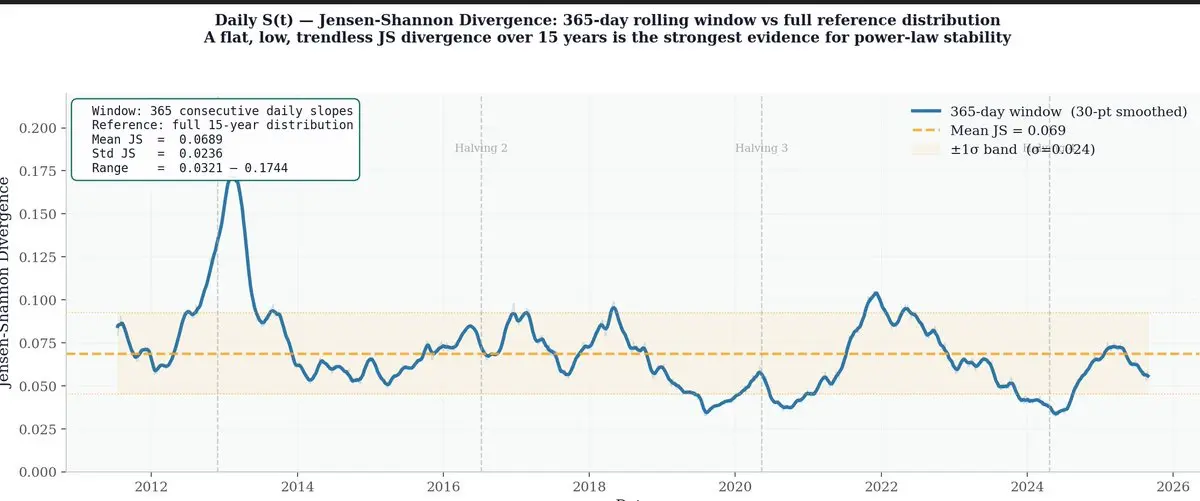
The distribution of the local slopes has remained stable for more than 17 years. To test this rigorously, we use the Jensen–Shannon (JS) divergence, a very sensitive statistical measure designed to compare probability distributions.
If the JS divergence remains stable over time, it means the underlying distributions are essentially the same. In this analysis, the JS divergence is computed over rolling one-year windows, which provides enough data to obtain meaningful statistics.
Importantly, the JS divergence is bounded, and in our results it does not show any systematic growth over time. This
BTC-0,21%
post-image
  • Reward
  • Comment
  • Repost
  • Share
The Jensen-Shannon divergence is a test to show if distributions are similar or different. If the distributions are different the divergence will grow in time.
The results are very revealing. Here is what the JS divergence is telling you:
Daily (top panel) — the lowest divergences of all three timescales. The 365-point window (blue) hovers around a mean of 0.070, meaning a full year of daily slopes is only 7% divergent from the full reference distribution. It also shows no trend over time — the blue line is flat and stationary across all four halving cycles. The daily distribution is the most
  • Reward
  • Comment
  • Repost
  • Share
Testing the stability of slopes over daily, monthly, and yearly time scales.
The distribution of the daily slopes over the last 4 years and previous 4 is identical.
This is incredible. The monthly is statistically identical, and the yearly shows differences because of the absence of a large bubble in the last 4 years. But the underlying structure of the scaling behavior remains the same.
  • Reward
  • Comment
  • Repost
  • Share
I love this quote.
post-image
  • Reward
  • Comment
  • Repost
  • Share
The scaling exponent n calculated at different scales, daily, monthly, yearly using the local slope method that avoids the pitfalls of regression.
It shows how this parameter, the only parameter that you need to understand Bitcoin long term behavior is remarkably stable since the early years to up to today.
BTC-0,21%
  • Reward
  • Comment
  • Repost
  • Share
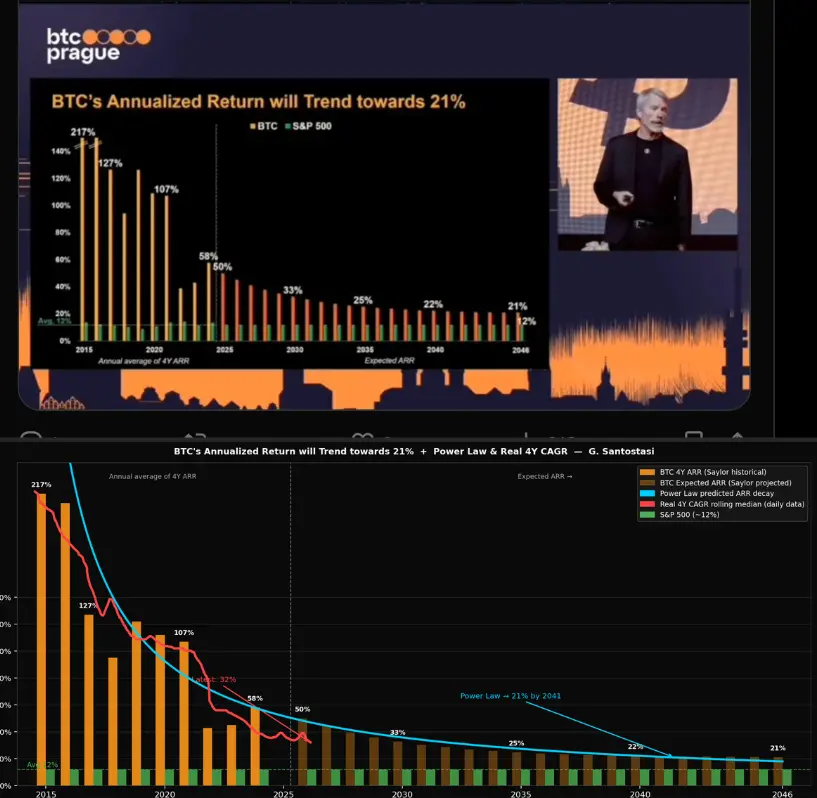
Sorry it took a few attempts. Claude was misreading Saylor’s graph, so we had to try several times to correct the interpretation. It should be accurate now. What is interesting is how the power law derived from first principles matches very closely the true median value of the CAGR.
It also reproduces the same decay pattern shown in Saylor’s chart.
The key difference is that the power law provides a theoretical foundation for this behavior, whereas Saylor’s curve appears to be an ad-hoc estimate—essentially a guess without a clear underlying model.
post-image
  • Reward
  • Comment
  • Repost
  • Share
Calculating the returns at random points is what the Saylor bar graph is doing. Better is calculating them at each day and then averaging them over a rolling window of 4 years to smooth the bubbles.
That is what the red curve is showing.
The power law theoretical curve shows this decay of the return very clearly and offers a more valid projection for future CAGR.
  • Reward
  • Comment
  • Repost
  • Share
I compare here Saylor projection vs the power law projection. Actually the 4 year rolling median of the CAGR is approaching the power law projection over time.
  • Reward
  • Comment
  • Repost
  • Share
Monthly slopes. Also this shows similar exponent n and remarkable stability.
  • Reward
  • Comment
  • Repost
  • Share
If one digs dipper the normalized yearly returns as a continuous function form a bimodal distribution. We have noticed this before.
The 2 peaks on the left and right of the distribution are due to the extreme behavior during the bubbles.
  • Reward
  • Comment
  • Repost
  • Share
All the significant test for the stability of Bitcoin should be based on scaling tests, that means checking how the scaling behavior in a log-log space changes in time.
It is remarkable stable.
Here is show the distribution of yearly steps in the normalized returns or slopes.
The mean value is 5.71 very close to the global value measured via regression.
BTC-0,21%
  • Reward
  • Comment
  • Repost
  • Share
The starting date for the power law is the GB because it makes sense physically. You can also use methods that do not involve regression to demonstrate that this date is consistent with existing data.
But in a power-law process the exact starting date becomes irrelevant at large scales.
The local slope converges to the true scaling exponent regardless of the chosen origin of time.
This is why studying the distribution of local slopes is a much more robust way to test Bitcoin’s power law than fitting regressions anchored to an arbitrary starting point.
The proof is below.
BTC-0,21%
  • Reward
  • Comment
  • Repost
  • Share
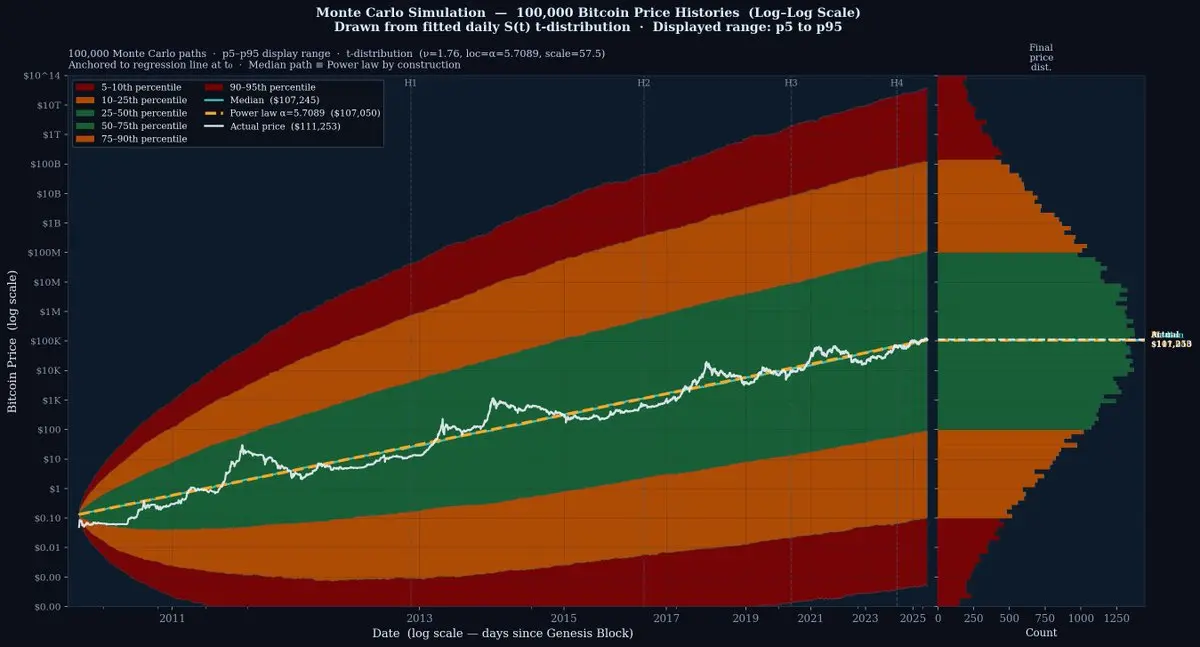
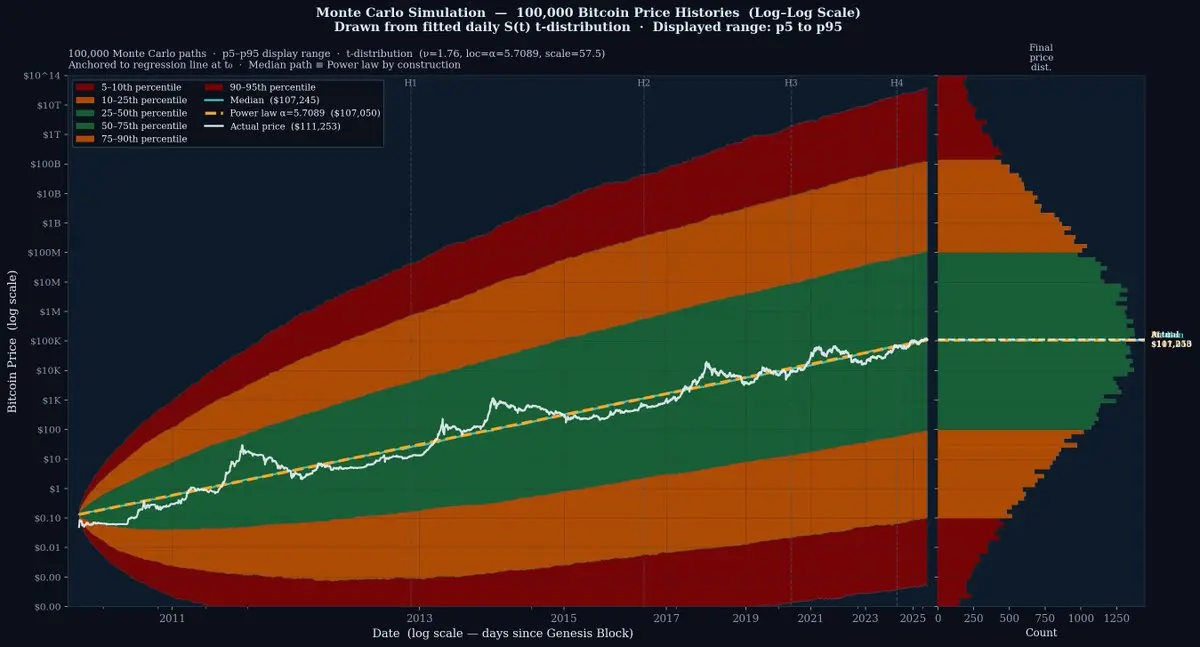
Do not be misled by attempts to overcomplicate the Bitcoin power law.
Its strength lies precisely in its simplicity. With essentially a single parameter, the scaling exponent n≈6n
We can describe more than 17 years of Bitcoin’s history and even project its long-term trajectory decades into the future.
What makes this remarkable is that it is not simply a matter of curve fitting. The power law emerges from the underlying physics of networks, which is what fundamentally distinguishes Bitcoin from traditional assets.
Without this network-driven scaling behavior, the power law would not appear i
BTC-0,21%
post-image
  • Reward
  • Comment
  • Repost
  • Share
ChatGPT failed the test even when I tested it. But Claude did initially the same mistake but then got the correct answer after showing the aftermath of letting the pen go with the right hand.
Claude:
The left hand is gripping the pen somewhere near the middle or with enough friction that it simply holds the pen in place. When you release one end, if the grip is firm enough, the pen just... stays. Static friction from the left hand is greater than the torque gravity exerts on the free end. No pendulum, no drama.
This reveals something important about how both ChatGPT and I reasoned:
We jumped
post-image
  • Reward
  • Comment
  • Repost
  • Share
When I was teaching in the United States, I often held exercise sessions with students during my free hours — hours I chose myself. The students appreciated it very much, even though obviously not everyone could participate. I wasn't teaching new material; it was simply to deepen what had already been covered in class.
Imagine if someone had complained saying they couldn't take advantage of that extra help because they had to work or go to a football game. It never happened.
If YouTube had been around back then, I would have used it exactly the same way: maybe without insisting on live partici
View Original
  • Reward
  • Comment
  • Repost
  • Share
I followed the recent controversies about Schiettini. I didn't know him well, although during my recent visit to Italy I saw his books and was curious about them.
Having taught physics at a university in America for eight years, I can say that he is really talented: this explanation is crystal clear and practically perfect.
Italy should be proud of communicators like him, instead of being dragged down by petty resentment towards those who succeed.
View Original
post-image
  • Reward
  • Comment
  • Repost
  • Share
Scale free networks like Bitcoin are both resilient and fragile (at least on small temporal scales).
BTC-0,21%
  • Reward
  • 1
  • Repost
  • Share
DatDinhvip:
10ty $ will be liquidated if BTC drops below 65
The Physics of Bitcoin website is ready. It is going to be a companion to the book with additional learning material (code, visualizations, live charts, videos and so on).
It is a work in progress but bookmark it because it is going to be an important resource for understanding Bitcoin as a system.
Link to the website in the comments.
BTC-0,21%
post-image
  • Reward
  • Comment
  • Repost
  • Share
  • Pin