# USSECPushesCryptoReform

47.86K
#USSECPushesCryptoReform
#USSECPushesCryptoReform 🇺🇸💥
The U.S. Securities and Exchange Commission (SEC) is making big changes to crypto rules in 2025–2026. The old “enforcement-first” approach is being replaced with clearer, innovation-friendly rules while still protecting investors.
🔹 Big Picture Shift
New leadership: Paul Atkins replaces Gary Gensler as SEC Chair.
Focus moves from heavy lawsuits → practical, clear frameworks.
Part of the U.S. goal to become the “crypto capital of the world”.
🔹 Key SEC Initiatives
1. Crypto Task Force (2025)
Led by Commissioner Hester Peirce.
Clarifies
DEFI2,71%
HighAmbitionvip
#USSECPushesCryptoReform
#USSECPushesCryptoReform 🇺🇸💥
The U.S. Securities and Exchange Commission (SEC) is making big changes to crypto rules in 2025–2026. The old “enforcement-first” approach is being replaced with clearer, innovation-friendly rules while still protecting investors.
🔹 Big Picture Shift
New leadership: Paul Atkins replaces Gary Gensler as SEC Chair.
Focus moves from heavy lawsuits → practical, clear frameworks.
Part of the U.S. goal to become the “crypto capital of the world”.
🔹 Key SEC Initiatives
1. Crypto Task Force (2025)
Led by Commissioner Hester Peirce.
Clarifies what counts as a security vs. non-security.
Provides realistic registration paths for projects & exchanges.
Works with public & other agencies to encourage safe innovation.
2. Project Crypto (2025)
Modernizes rules for digital assets.
Sets categories for crypto tokens.
Explains when tokens stop being securities.
Introduces innovation exemptions for DeFi & tokenized assets.
Updates rules for wallets, custody, super-app platforms.
Supports on-chain trading & automated market makers.
🔹 Recent Wins (Stablecoins & Capital Rules)
Feb 2026: SEC allows broker-dealers to apply only 2% haircut on qualifying stablecoins instead of 100%.
Treats stablecoins like cash or money market funds → easier for firms to hold & use.
Helps Wall Street & crypto companies operate with fewer restrictions.
🔹 Supporting Laws & Coordination
GENIUS Act (2025) → first federal framework for payment stablecoins: reserves, reporting, redemption, licensing.
CLARITY Act (2025–2026) → clarifies SEC vs. CFTC roles, trading rules, maturity certifications.
SEC & CFTC collaborating on mixed products, portfolio margining, cross-market rules.
🔹 What’s Coming in 2026
More guidance, no-action letters, proposed rules, and exemptions.
Clear rules for exchanges, tokens, stablecoins, staking, and tokenized real-world assets.
Balance innovation with investor protection.
Allow banks, broker-dealers, and traditional finance to participate safely.
💡 Bottom Line
The SEC is moving to a pro-innovation, transparent environment for crypto.
Clearer rules = less guesswork for projects, exchanges, and investors.
This could help the U.S. lead the world in digital assets.
🚀 Stay updated — big changes are happening fast!

repost-content-media
  • Reward
  • Comment
  • Repost
  • Share
📢🇺🇸 #USSECPushesCryptoReform – Regulatory Shift in the U.S.
The U.S. Securities and Exchange Commission (SEC) is accelerating efforts to clarify crypto regulations, aiming for clearer, rule-based oversight that supports innovation while protecting investors. ⚖️💡
🔹 Key Developments:
• Project Crypto: Framework to classify digital assets and reduce legal uncertainty
• Stablecoin Guidelines: New rules for broker-dealers and crypto custody
• Regulatory Coordination: SEC working with CFTC and Treasury to streamline oversight
• Modernized Enforcement: Focus on rules clarity rather than purely p
  • Reward
  • Comment
  • Repost
  • Share
📢🇺🇸 #USSECPushesCryptoReform – A Big Step Toward Clearer Crypto Rules
The U.S. Securities and Exchange Commission (SEC) is pushing forward with major initiatives to clarify how digital assets are regulated, signaling a shift from enforcement-heavy approaches toward rules-based transparency. ⚖️💡
🔹 Detailed Highlights:
• Project Crypto: A framework to clearly classify digital assets, helping investors and companies understand what counts as a security and what doesn’t.
• Stablecoin Guidelines: New guidance for broker-dealers and custody services, which may influence how stablecoins can be h
  • Reward
  • 1
  • Repost
  • Share
EagleEyevip:
Truly remarkable! Love the quality and effort
#USSECPushesCryptoReform
The crypto industry has moved from a fringe experiment to a major force in global finance — and with that growth comes regulation. The U.S. Securities and Exchange Commission is leading a strong push for crypto reform, signaling the end of largely unregulated expansion and the start of structured, accountable innovation.
For years, digital assets grew rapidly with limited oversight. While this fueled innovation, it also led to fraud, weak projects, and market instability. The SEC’s focus now centers on clear token classification — determining which assets qualify as se
GT-0,77%
  • Reward
  • Comment
  • Repost
  • Share
📢🇺🇸 #USSECPushesCryptoReform – A Step Toward Clearer Regulations
The U.S. Securities and Exchange Commission (SEC) is intensifying efforts to clarify crypto regulations, aiming to provide a transparent framework that balances innovation with investor protection. ⚖️💡
🔹 Key Highlights:
• Project Crypto: Establishes clearer classification rules for digital assets
• Stablecoin Guidance: Updated rules for broker-dealers and custody services
• Regulatory Coordination: SEC collaborating with the CFTC and Treasury to streamline oversight
• Modernized Approach: Shift from enforcement-heavy policie
  • Reward
  • Comment
  • Repost
  • Share
#USSECPushesCryptoReform
US Regulators Move to Modernize Crypto Rules
The U.S. Securities and Exchange Commission (SEC) is taking decisive steps to update and clarify its approach to cryptocurrency oversight. After years of enforcement-heavy regulation, the agency is now focusing on reforming outdated policies, providing clearer compliance guidelines, and creating a regulatory framework that balances investor protection with innovation. These changes are expected to shape how crypto firms operate and how institutional and retail investors participate in digital markets moving forward.
A Moder
Falcon_Officialvip
#USSECPushesCryptoReform
US Regulators Move to Modernize Crypto Rules
The U.S. Securities and Exchange Commission (SEC) is taking decisive steps to update and clarify its approach to cryptocurrency oversight. After years of enforcement-heavy regulation, the agency is now focusing on reforming outdated policies, providing clearer compliance guidelines, and creating a regulatory framework that balances investor protection with innovation. These changes are expected to shape how crypto firms operate and how institutional and retail investors participate in digital markets moving forward.
A Modernization Agenda Under New Leadership
Under the direction of the SEC’s current leadership, senior regulators have publicly articulated an agenda to update the agency’s rulebook to better align with digital innovation. This includes moves to lower listing thresholds, rationalize compliance burdens for companies, encourage responsible growth, and ensure investors have transparent, essential information. These reforms are part of a broader push to make the U.S. regulatory environment more competitive and adaptive to new technology.
Project Crypto and Disclosure Reform Initiatives
As part of the reform effort, the SEC has launched initiatives aimed at integrating blockchain technologies and modernizing securities laws to support digital trading and on‑chain markets. Known internally as Project Crypto and similar policy efforts, the goal is to create frameworks that enable blockchain use within regulated markets rather than suppress innovation. These reforms would offer clearer standards for token classification, disclosures, and the treatment of blockchain‑based financial products.
Shift From Enforcement to Clear Rules
In recent months, the SEC has stepped back from aggressive enforcement actions that defined previous years. While enforcement still plays an important role in protecting investors, the focus appears to be shifting toward clarifying regulations before litigating compliance violations. This transition reflects regulatory acknowledgment that a rules‑based environment rather than punitive enforcement alone is necessary for sustainable market growth.
Coordination With Other Financial Agencies
Crypto reform is not happening in isolation. The SEC is increasingly coordinating with other federal regulators — including the Commodity Futures Trading Commission (CFTC) and banking authorities to align jurisdiction, regulatory clarity, and oversight frameworks. This cooperative approach aims to minimize gaps and conflicting rules that previously hindered institutional participation and innovation in digital asset markets.
Implications for Investors and Crypto Firms
The movement toward reform has several implications:
Greater regulatory clarity may reduce uncertainty for institutional capital.
Modernized disclosure rules could encourage more publicly listed companies to integrate blockchain technologies.
Clearer token classifications may make it easier for products like ETFs and custody services to operate with confidence under defined rules.
Overall, these developments capture optimism among stakeholders that America’s financial watchdogs are working to create a balanced regulatory regime one that protects investors without stifling innovation.
Conclusion Reform as a Path Forward
This shift in U.S. digital asset policy marks a transition from enforcement‑centric oversight to thoughtful, structured reform. As regulators update rules, streamline compliance requirements, and work with other agencies, the aim is to build a regulatory foundation that sustains innovation, protects markets, and integrates digital assets into mainstream financial infrastructure. This evolution of policy could be one of the defining developments for crypto markets in the United States in the coming years.
repost-content-media
  • Reward
  • 12
  • Repost
  • Share
MissCryptovip:
2026 GOGOGO 👊
View More
#USSECPushesCryptoReform
#USSECPushesCryptoReform: A Deep Dive into What’s Coming and Why It Matters
The U.S. Securities and Exchange Commission (SEC) is making one of its most significant moves in years to bring comprehensive reform to the cryptocurrency industry. As digital assets continue to grow in adoption — from retail investors to institutional portfolios — regulators are signaling that the era of ambiguity in crypto oversight is coming to an end.
What Is the SEC Trying to Do?
At the core of the reform agenda is a push for clearer regulatory frameworks that define how different types
DEFI2,71%
  • Reward
  • Comment
  • Repost
  • Share
#USSECPushesCryptoReform The regulatory evolution unfolding under #USSECPushesCryptoReform reflects a structural recalibration of how digital assets integrate into U.S. financial law. The U.S. Securities and Exchange Commission is not redesigning securities law from scratch; rather, it is refining how long-standing statutory principles apply to blockchain-based assets, token issuance models, and crypto market infrastructure. This signals movement away from enforcement-led ambiguity toward codified compliance pathways.
At the center of reform discussions is asset classification clarity. Determi
MrFlower_XingChenvip
#USSECPushesCryptoReform The regulatory evolution unfolding under #USSECPushesCryptoReform reflects a structural recalibration of how digital assets integrate into U.S. financial law. The U.S. Securities and Exchange Commission is not redesigning securities law from scratch; rather, it is refining how long-standing statutory principles apply to blockchain-based assets, token issuance models, and crypto market infrastructure. This signals movement away from enforcement-led ambiguity toward codified compliance pathways.
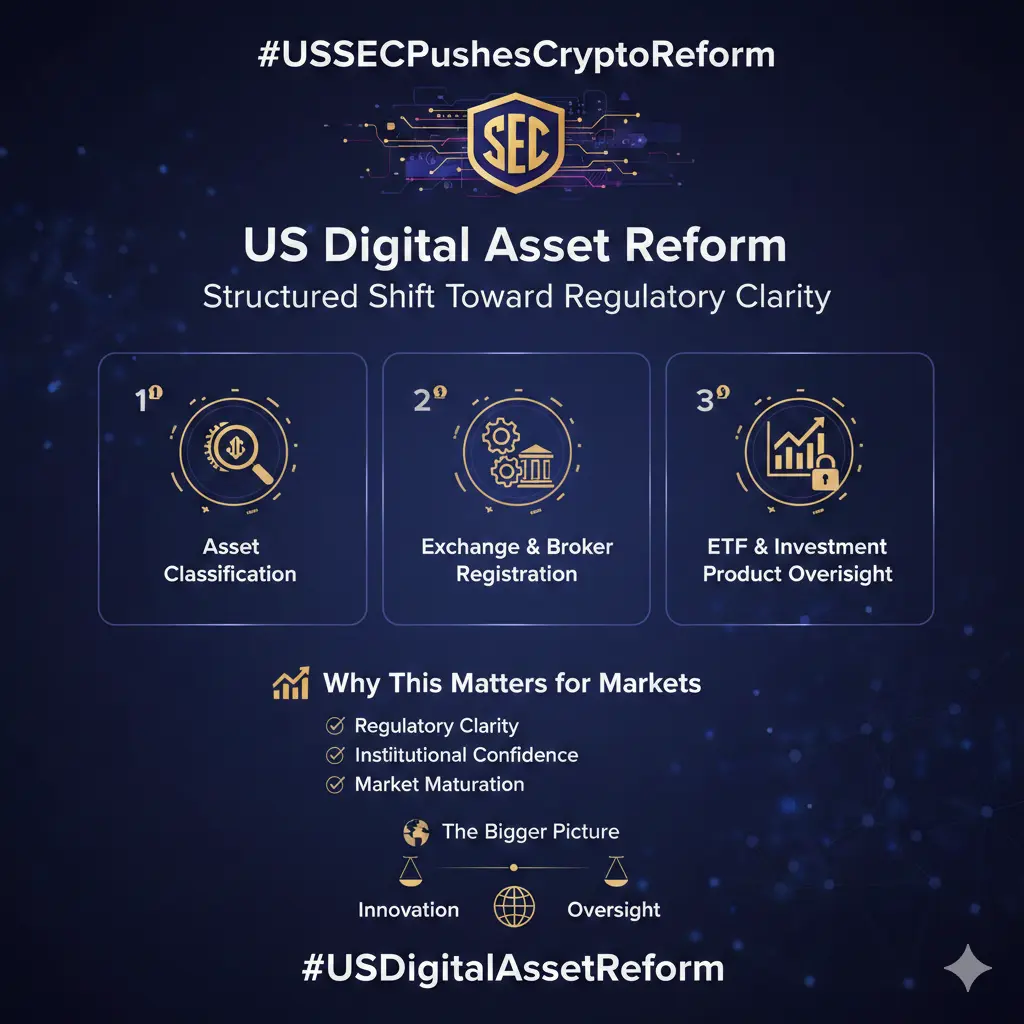
At the center of reform discussions is asset classification clarity. Determining when a token constitutes a security under existing legal tests directly affects disclosure obligations, issuer liability, and trading venue requirements. Clearer classification standards could reduce prolonged litigation cycles and provide builders with defined regulatory blueprints before launching products. For institutional capital allocators, predictability is often more important than permissiveness.
Exchange and broker registration frameworks are another focal point. Digital trading platforms may increasingly align with regulatory structures similar to alternative trading systems and national securities exchanges. This includes strengthened custody segregation, enhanced market surveillance, capital adequacy requirements, and transparent order-handling practices. Rather than isolating crypto markets, the likely direction is integration into traditional supervisory architecture.
Investment product oversight remains a key bridge between crypto-native markets and Wall Street. The approval and supervision of spot crypto exchange-traded products have demonstrated how blockchain-based assets can be packaged within regulated vehicles. Expanded ETF clarity could encourage pension funds, asset managers, and registered investment advisors to allocate through familiar structures while maintaining compliance discipline.
Enforcement priorities are also evolving from reactive case-by-case actions toward broader rulemaking guidance. While fraud prevention and unregistered offering scrutiny remain central, the tone of reform suggests a desire to replace uncertainty with procedural pathways. Regulatory clarity can reduce the adversarial dynamic that previously characterized parts of the crypto-policy relationship.
From a market perspective, regulatory structure typically introduces short-term adjustment volatility but long-term stability. Clear frameworks can reduce headline-driven speculation and redirect capital toward compliant innovation. Institutional participants often require legal certainty before deploying significant balance sheet exposure, making reform a prerequisite for deeper integration.
On the macro level, the United States is competing globally to define digital asset governance standards. Jurisdictional clarity influences where companies domicile, where capital flows, and where financial infrastructure develops. If reform successfully balances innovation with investor protection, the U.S. could reinforce its position as a leading hub for regulated blockchain finance.
Ultimately, #USDigitalAssetReform represents maturation rather than restriction. Markets transition from experimentation to institutionalization through rule formation. The long-term signal is not contraction, but normalization — where digital assets become a recognized component of regulated financial architecture rather than an external alternative.
repost-content-media
  • Reward
  • Comment
  • Repost
  • Share
🔥
🚨🇺🇸 #USSECPushesCryptoReform 🚀
Big moves could be coming for the crypto market! 👀
The U.S. SEC pushing for crypto reform means regulation discussions are heating up again. This could reshape the future of digital assets like Bitcoin and the entire crypto space. 💼📊
What does this mean for investors?
🔹 Clearer rules could bring more institutional adoption 🏦
🔹 Stronger regulations may reduce uncertainty ⚖️
🔹 Short-term volatility is possible 📉📈
🔹 Long-term stability could improve 🌍
Whenever regulatory news hits the market, we often see strong reactions. Smart investors don’t pan
BTC0,43%
GT-0,77%
ETH-0,05%
  • Reward
  • 2
  • Repost
  • Share
discoveryvip:
To The Moon 🌕
View More
#USSECPushesCryptoReform
🚀 U.S. SEC Crypto Reforms 2026
The global crypto landscape is witnessing a historic shift in 2026, and major industry platforms like Gate.io are actively covering what many are calling a regulatory watershed moment in the United States. Under the leadership of SEC Chairman Paul Atkins, the U.S. Securities and Exchange Commission is moving away from an enforcement-dominated stance toward a clearer, rule-based digital asset framework.
🔥 From “Regulation by Enforcement” to Structured Clarity
For years, the crypto market operated under uncertainty, with enforcement act
HighAmbitionvip
#USSECPushesCryptoReform
🚀 U.S. SEC Crypto Reforms 2026
The global crypto landscape is witnessing a historic shift in 2026, and major industry platforms like Gate.io are actively covering what many are calling a regulatory watershed moment in the United States. Under the leadership of SEC Chairman Paul Atkins, the U.S. Securities and Exchange Commission is moving away from an enforcement-dominated stance toward a clearer, rule-based digital asset framework.
🔥 From “Regulation by Enforcement” to Structured Clarity
For years, the crypto market operated under uncertainty, with enforcement actions often defining regulatory boundaries. Now, the SEC appears focused on:
• Establishing a formal federal digital asset framework
• Coordinating with the CFTC through initiatives like Project Crypto
• Refining token classification standards
• Supporting innovation while maintaining investor protections
Gate.io’s coverage highlights how this approach aims to replace ambiguity with defined rules for custody, issuance, trading, staking, and tokenized assets.
📜 Key Regulatory Developments Being Discussed
Gate.io reports have referenced:
• Rescinding SAB 121 and replacing it with SAB 122
• Potential no-action letters for stablecoins, staking, and utility tokens
• Lighter capital treatment for certain stablecoin activities
• Exploration of token taxonomy updates (including Howey Test refinements)
• Innovation exemptions to encourage U.S.-based blockchain growth
These reforms are framed as positioning the United States to regain global leadership in digital asset innovation rather than pushing activity offshore.
📊 Market & Industry Impact
Gate.io articles such as “The Regulatory Watershed of 2026” and “SEC Chair Details Cryptocurrency Policy Priorities for 2026” describe:
• Dropped enforcement cases against major platforms
• Increased inter-agency collaboration
• Support for tokenized real-world assets (RWAs)
• Expansion of exchange-traded crypto products
• Clearer paths for capital formation
The narrative across Gate.io’s reporting suggests that clarity reduces institutional hesitation. With regulatory uncertainty easing, innovation, liquidity, and on-chain finance could accelerate.
🌍 Why This Matters Globally
Although these reforms are U.S.-centric, the ripple effects extend worldwide. When the world’s largest financial market adopts structured crypto regulations:
• Institutional confidence rises
• Global exchanges adjust compliance strategies
• Tokenized asset adoption increases
• Cross-border digital finance becomes more standardized
Gate.io positions this as a “new day” for the industry — one where innovation and compliance coexist instead of conflict.
🎯 Strategic Takeaway for Traders & Investors
Regulatory clarity often acts as a long-term bullish structural catalyst. However:
• Policy implementation takes time
• Market reactions may be gradual
• Volatility remains part of crypto cycles
Smart participants follow official SEC releases while using exchange research portals like Gate.io’s news and learning sections to track developments in real time.
📌 Final Perspective
The 2026 SEC reform push represents more than policy adjustments — it signals maturation of the crypto sector. Clear frameworks around token issuance, custody, stablecoins, and digital asset trading could mark the transition from regulatory uncertainty to structured growth.
Gate.io’s consistent reporting reinforces one core theme:
Clarity drives confidence. Confidence drives capital. Capital drives adoption.
The next phase of crypto may not be defined by speculation alone — but by integration into mainstream financial systems under clearer rules.
repost-content-media
  • Reward
  • Comment
  • Repost
  • Share
Load More

Join 40M users in our growing community

⚡️ Join 40M users in the crypto craze discussion
💬 Engage with your favorite top creators
👍 See what interests you
  • Pin