# US-IranTalksStall

29.72K
📢 Gate Plaza | 4/24 Hot Topics: #美伊谈判陷入僵局
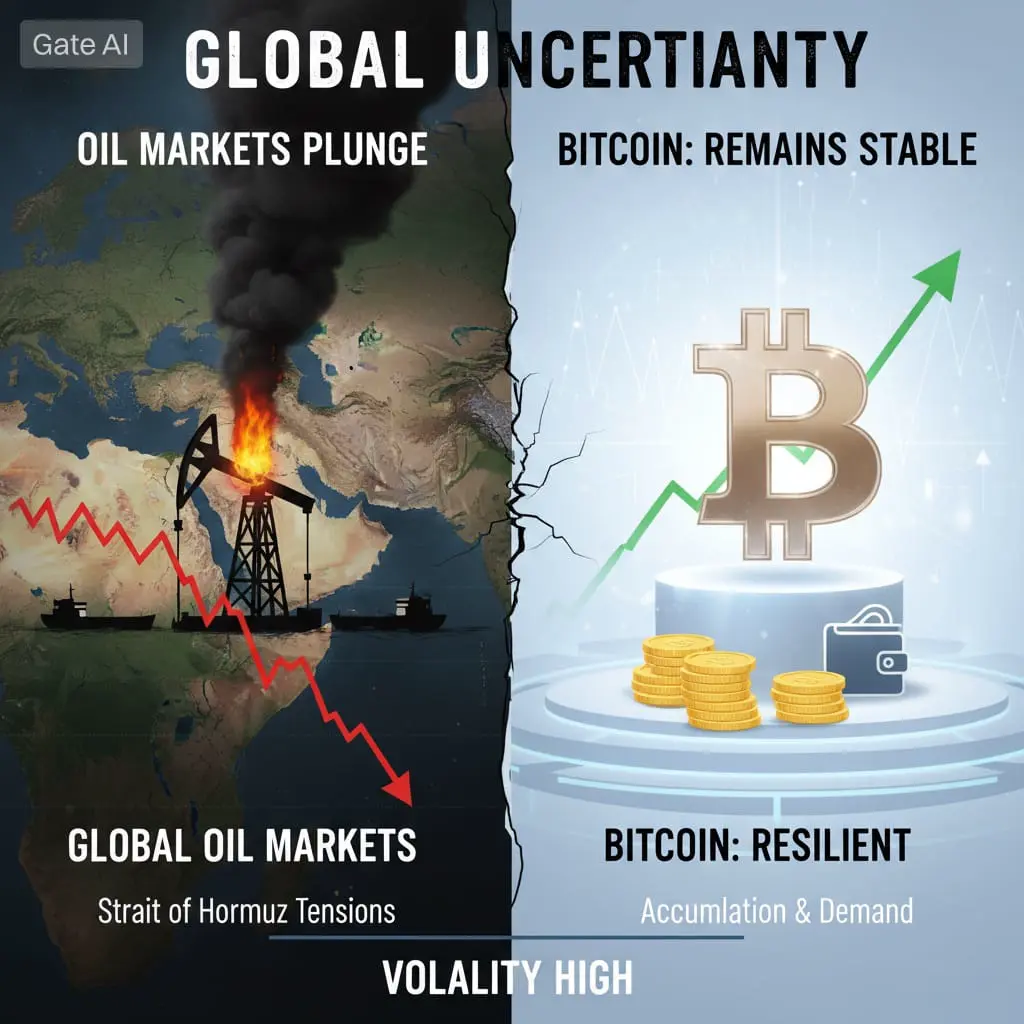
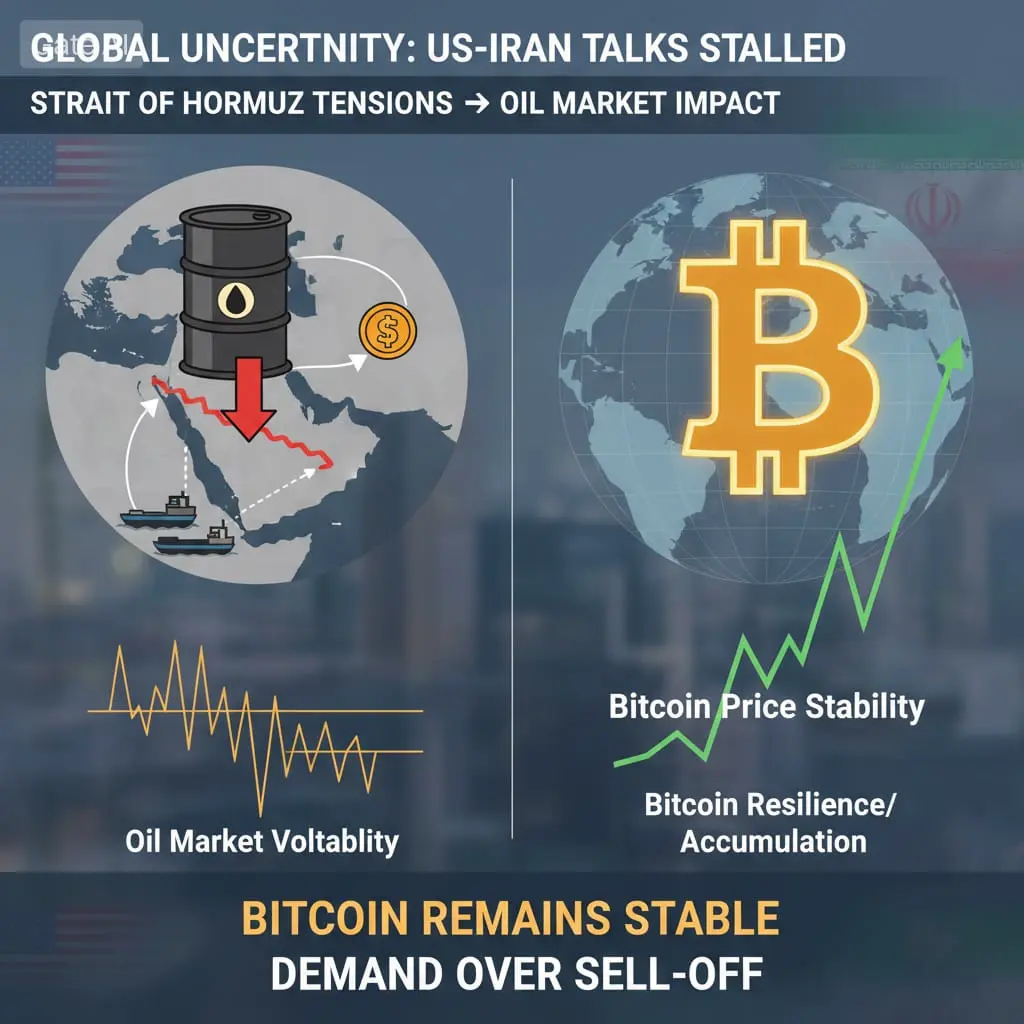
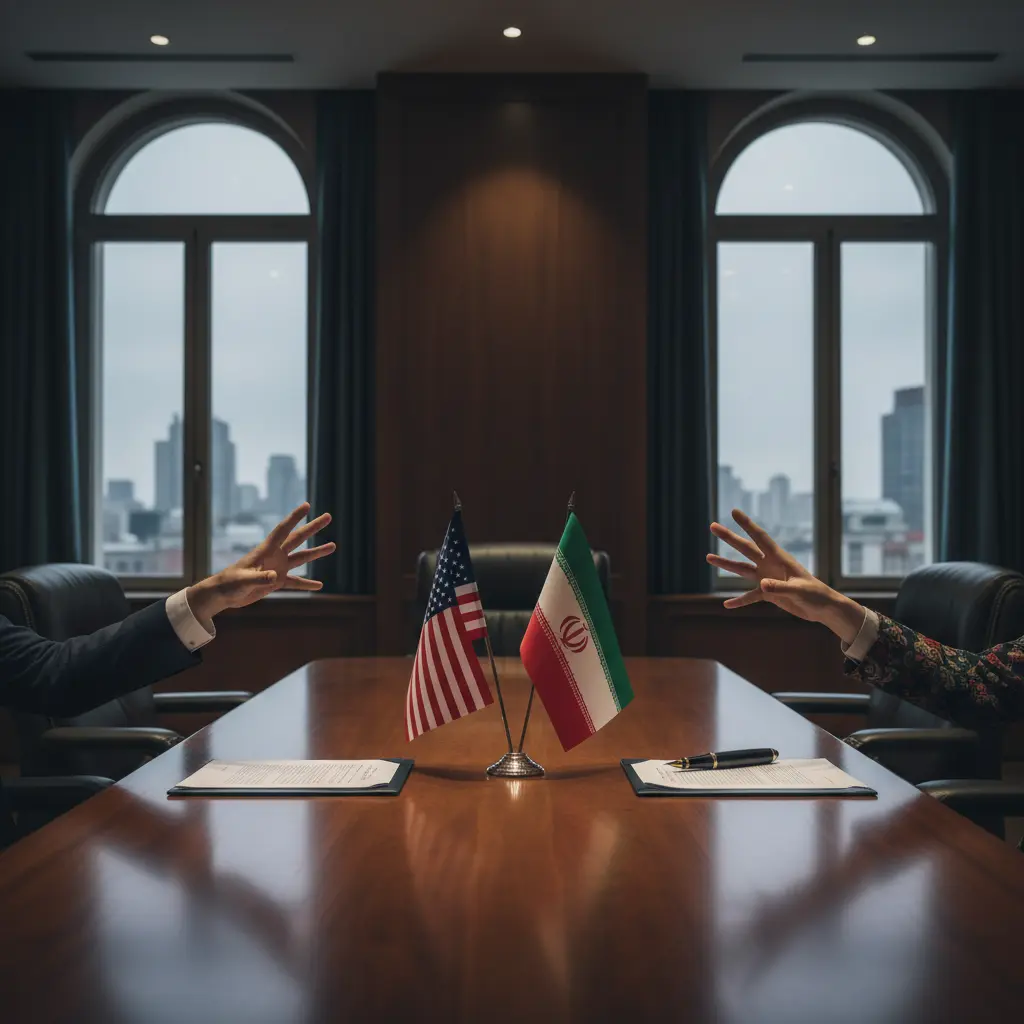
The Middle East situation heats up again, with the US-Iran game intensifying. Iran sends strong signals and accelerates military buildup, while the US simultaneously enhances deployments and initiates citizen evacuations. Tensions in the Strait of Hormuz escalate, with increased risks of oil tanker interception and blockade. Disagreements in negotiations continue to widen; whether a ceasefire will break down has become a key variable affecting oil prices and the global market.
🎁 Market analysis, pick 5 lucky winners to share $1,000 in position exper
View Original
post-image
  • Reward
  • 26
  • Repost
  • Share
Ciau:
oil prices could raise above $120–$150 ... 😢😢😢
View More
#US-IranTalksStall
The negotiations between the United States and Iran have reached a critical deadlock, with President Trump extending the ceasefire indefinitely while diplomatic progress remains frozen. This prolonged uncertainty is sending ripple effects across global financial markets—especially oil and cryptocurrency.
Current Status of US-Iran Negotiations
Talks between Washington and Tehran have stalled after multiple failed rounds. A planned diplomatic meeting in Pakistan was canceled, signaling deeper friction behind the scenes. While the ceasefire remains in place, both sides have op
BTC-0,37%
HighAmbition
#US-IranTalksStall
The negotiations between the United States and Iran have reached a critical deadlock, with President Trump extending the ceasefire indefinitely while diplomatic progress remains frozen. This prolonged uncertainty is sending ripple effects across global financial markets—especially oil and cryptocurrency.
Current Status of US-Iran Negotiations
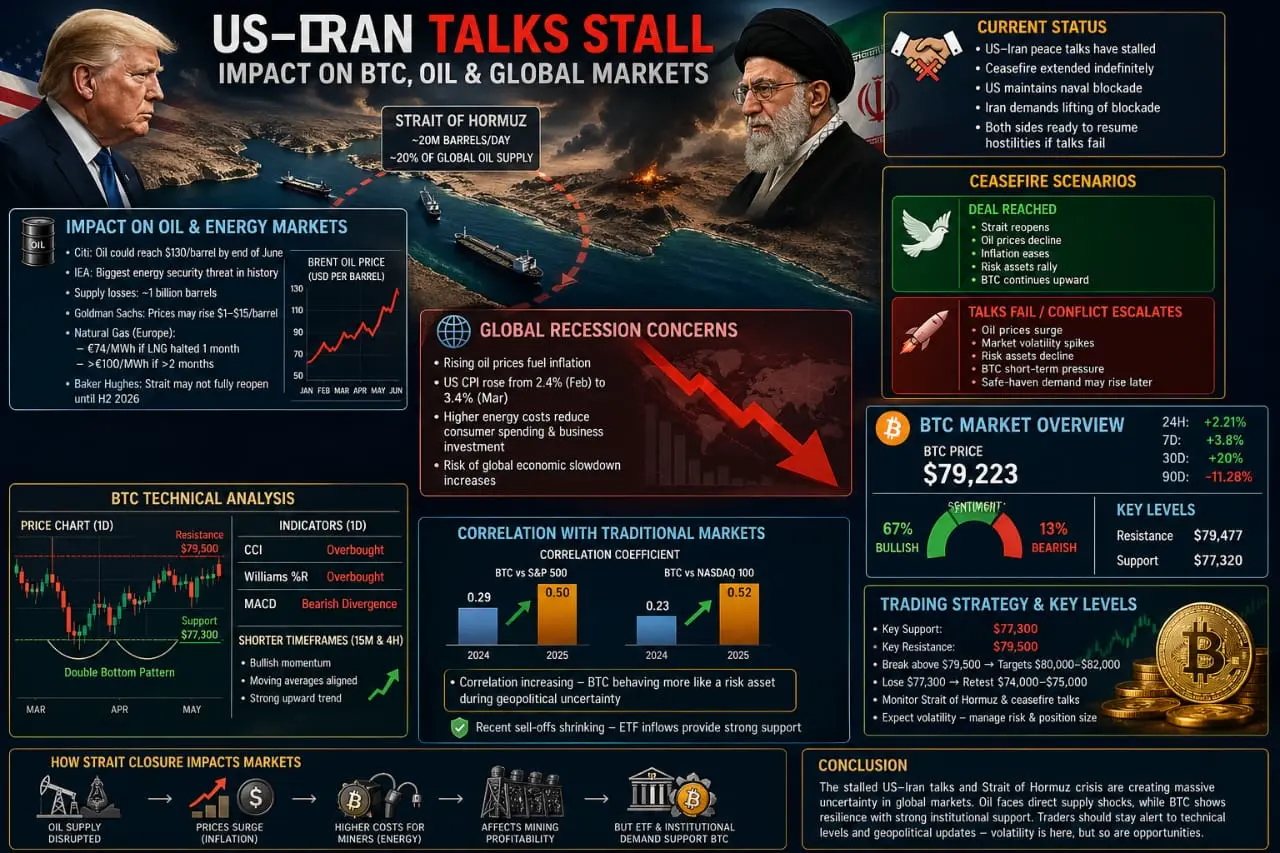
Talks between Washington and Tehran have stalled after multiple failed rounds. A planned diplomatic meeting in Pakistan was canceled, signaling deeper friction behind the scenes. While the ceasefire remains in place, both sides have openly hinted that military escalation is still on the table.
At the core of the dispute are Iran’s nuclear limitations and US demands that Tehran considers unacceptable. Meanwhile, the US naval blockade in the Strait of Hormuz continues to be a major flashpoint. Iran views this as a violation of the ceasefire, while the US maintains it as a strategic necessity following Iran’s earlier closure of the Strait in February 2025.
Oil Market Shock: A Global Energy Crisis
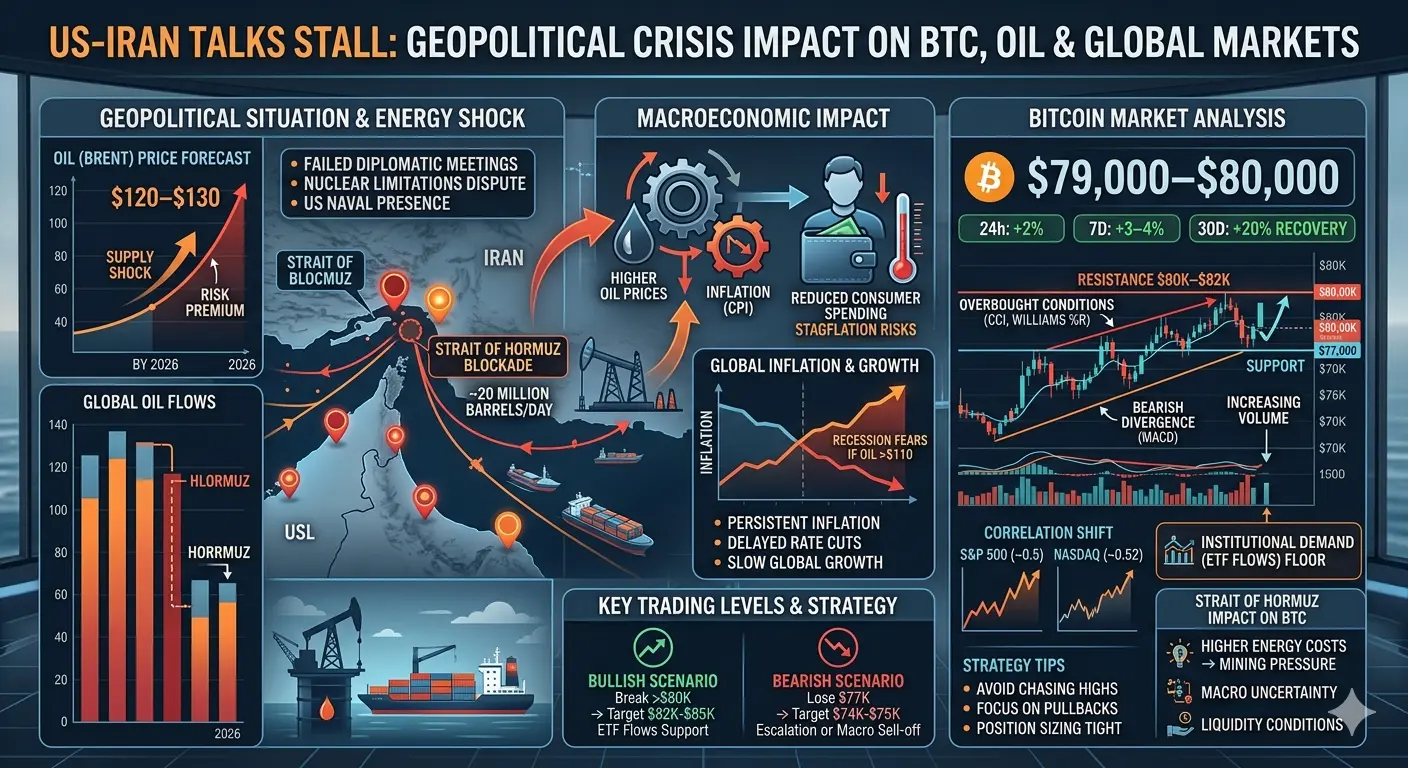
The Strait of Hormuz handles nearly 20 million barrels of oil per day, making it one of the most critical chokepoints in the global energy system. Its disruption has triggered one of the largest supply shocks in modern history.
Oil could surge toward $120–$130 per barrel if disruptions persist
Short-term spikes already pricing in risk premium
LNG markets under pressure with Europe potentially hitting €100/MWh
Energy firms are preparing for a prolonged disruption, with some forecasts suggesting normalization may not occur until late 2026.
Inflation & Recession Risk Rising
Higher oil prices directly feed into inflation. Fuel costs are already pushing CPI upward, tightening financial conditions globally.
Key risks:
Persistent inflation → delayed rate cuts
Reduced consumer spending
Slower global growth
Increased probability of stagflation scenario
If oil sustains above $110+, global recession fears will intensify significantly.
Bitcoin Market Overview
Bitcoin is currently trading around $79,000–$80,000, showing resilience despite macro uncertainty.
Performance snapshot:
24h: +2%
7D: +3–4%
30D: +20% recovery
Key support: $77,000
Resistance: $80,000–$82,000
Momentum remains bullish on lower
timeframes, but daily indicators signal caution:
Overbought conditions (CCI, Williams %R)
Bearish divergence on MACD
Increasing volume suggests strong participation
BTC vs Traditional Markets: Correlation Shift
Bitcoin’s correlation with equities has increased significantly:
S&P 500 correlation ~0.5
Nasdaq correlation ~0.52
This shows BTC is behaving more like a risk asset rather than a traditional safe haven during geopolitical stress.
However, an important shift is visible:
Each geopolitical shock triggers smaller BTC sell-offs
Institutional demand (ETF flows) is acting as a price floor
Market is increasingly absorbing bad news faster
Strait of Hormuz Impact on BTC
The oil crisis affects Bitcoin indirectly:
Higher energy costs → mining pressure
Macro uncertainty → risk-off sentiment
Liquidity conditions → dominant driver of BTC price
Despite this, BTC is holding strong due to:
Institutional accumulation
Reduced panic selling
Strong spot demand
This suggests Bitcoin is evolving—not purely as a hedge, but as a liquidity-driven macro asset.
Key Trading Levels & Strategy
Short-term outlook:
Bullish Scenario
Break above $80K → targets $82K–$85K
Strong ETF inflows support continuation
Bearish Scenario
Lose $77K → downside toward $74K–$75K
Triggered by escalation or macro sell-off
Strategy insights:
Avoid chasing highs (overbought conditions)
Focus on pullbacks for entries
Keep position sizing tight due to volatility
Scenario Analysis
1. Diplomatic Breakthrough
Strait reopens
Oil drops below $100
Inflation eases
Risk assets rally
BTC likely pushes toward $85K+
2. Conflict Escalation
Oil spikes toward $130
Markets enter risk-off mode
BTC may dip short-term
But downside likely limited due to strong structural demand
Big Picture Insight
This crisis is reshaping how Bitcoin reacts to global events.
Previously:
BTC = panic sell asset
Now:
BTC = liquidity + institutional flow driven
The shrinking sell-offs show one thing clearly:
weak hands are already out.
Conclusion
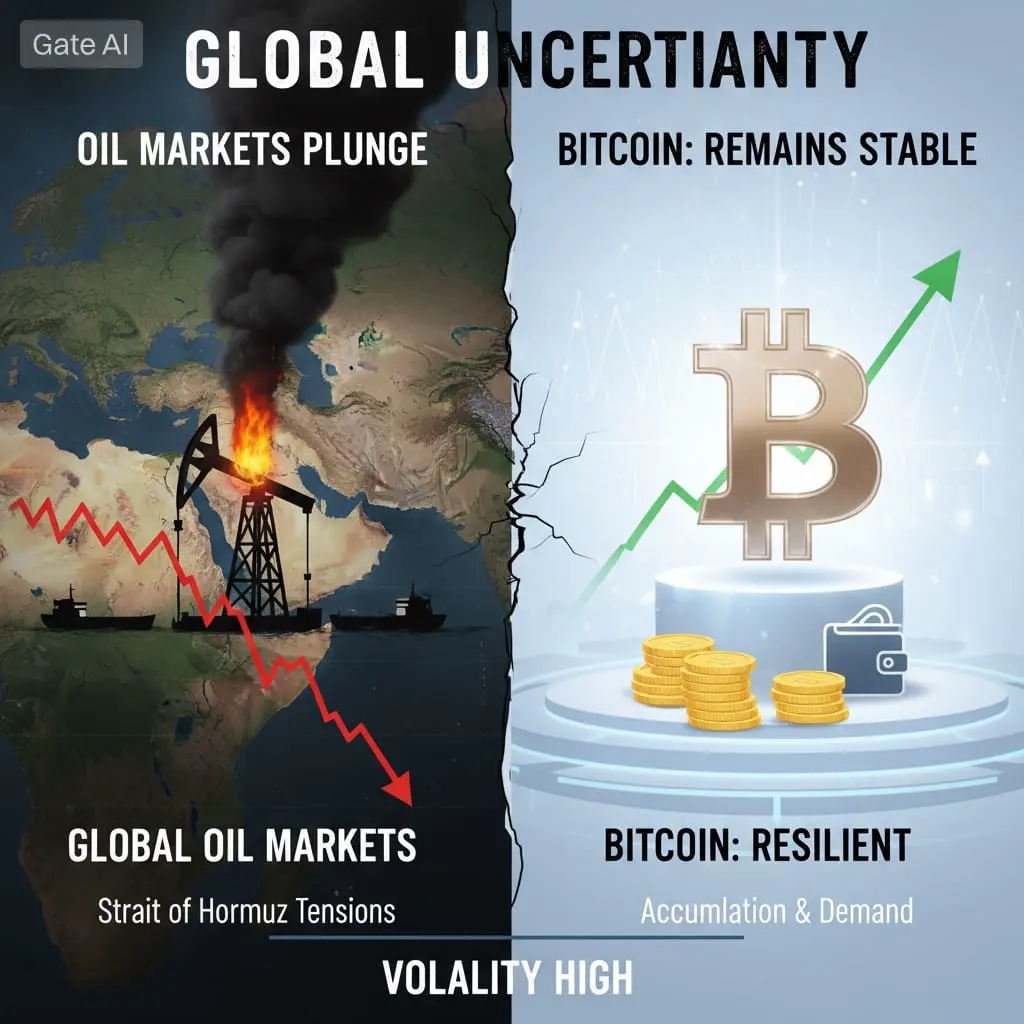
The US-Iran stalemate is more than a geopolitical issue—it’s a macro catalyst affecting oil, inflation, and global markets simultaneously
Oil faces direct supply shock
Global economy faces inflation pressure
Bitcoin shows surprising resilience
While uncertainty remains high, one trend is becoming clear:
Bitcoin is maturing into a more stable, institutionally supported asset.
Traders should stay alert, manage risk carefully, and watch both geopolitical headlines + key BTC levels closely—because the next move could be fast and decisive.
repost-content-media
  • Reward
  • Comment
  • Repost
  • Share
#US-IranTalksStall
The negotiations between the United States and Iran have reached a critical deadlock, with President Trump extending the ceasefire indefinitely while diplomatic progress remains frozen. This prolonged uncertainty is sending ripple effects across global financial markets—especially oil and cryptocurrency.
Current Status of US-Iran Negotiations
Talks between Washington and Tehran have stalled after multiple failed rounds. A planned diplomatic meeting in Pakistan was canceled, signaling deeper friction behind the scenes. While the ceasefire remains in place, both sides have op
BTC-0,37%
HighAmbition
#US-IranTalksStall
The negotiations between the United States and Iran have reached a critical deadlock, with President Trump extending the ceasefire indefinitely while diplomatic progress remains frozen. This prolonged uncertainty is sending ripple effects across global financial markets—especially oil and cryptocurrency.
Current Status of US-Iran Negotiations
Talks between Washington and Tehran have stalled after multiple failed rounds. A planned diplomatic meeting in Pakistan was canceled, signaling deeper friction behind the scenes. While the ceasefire remains in place, both sides have openly hinted that military escalation is still on the table.
At the core of the dispute are Iran’s nuclear limitations and US demands that Tehran considers unacceptable. Meanwhile, the US naval blockade in the Strait of Hormuz continues to be a major flashpoint. Iran views this as a violation of the ceasefire, while the US maintains it as a strategic necessity following Iran’s earlier closure of the Strait in February 2025.
Oil Market Shock: A Global Energy Crisis
The Strait of Hormuz handles nearly 20 million barrels of oil per day, making it one of the most critical chokepoints in the global energy system. Its disruption has triggered one of the largest supply shocks in modern history.
Oil could surge toward $120–$130 per barrel if disruptions persist
Short-term spikes already pricing in risk premium
LNG markets under pressure with Europe potentially hitting €100/MWh
Energy firms are preparing for a prolonged disruption, with some forecasts suggesting normalization may not occur until late 2026.
Inflation & Recession Risk Rising
Higher oil prices directly feed into inflation. Fuel costs are already pushing CPI upward, tightening financial conditions globally.
Key risks:
Persistent inflation → delayed rate cuts
Reduced consumer spending
Slower global growth
Increased probability of stagflation scenario
If oil sustains above $110+, global recession fears will intensify significantly.
Bitcoin Market Overview
Bitcoin is currently trading around $79,000–$80,000, showing resilience despite macro uncertainty.
Performance snapshot:
24h: +2%
7D: +3–4%
30D: +20% recovery
Key support: $77,000
Resistance: $80,000–$82,000
Momentum remains bullish on lower
timeframes, but daily indicators signal caution:
Overbought conditions (CCI, Williams %R)
Bearish divergence on MACD
Increasing volume suggests strong participation
BTC vs Traditional Markets: Correlation Shift
Bitcoin’s correlation with equities has increased significantly:
S&P 500 correlation ~0.5
Nasdaq correlation ~0.52
This shows BTC is behaving more like a risk asset rather than a traditional safe haven during geopolitical stress.
However, an important shift is visible:
Each geopolitical shock triggers smaller BTC sell-offs
Institutional demand (ETF flows) is acting as a price floor
Market is increasingly absorbing bad news faster
Strait of Hormuz Impact on BTC
The oil crisis affects Bitcoin indirectly:
Higher energy costs → mining pressure
Macro uncertainty → risk-off sentiment
Liquidity conditions → dominant driver of BTC price
Despite this, BTC is holding strong due to:
Institutional accumulation
Reduced panic selling
Strong spot demand
This suggests Bitcoin is evolving—not purely as a hedge, but as a liquidity-driven macro asset.
Key Trading Levels & Strategy
Short-term outlook:
Bullish Scenario
Break above $80K → targets $82K–$85K
Strong ETF inflows support continuation
Bearish Scenario
Lose $77K → downside toward $74K–$75K
Triggered by escalation or macro sell-off
Strategy insights:
Avoid chasing highs (overbought conditions)
Focus on pullbacks for entries
Keep position sizing tight due to volatility
Scenario Analysis
1. Diplomatic Breakthrough
Strait reopens
Oil drops below $100
Inflation eases
Risk assets rally
BTC likely pushes toward $85K+
2. Conflict Escalation
Oil spikes toward $130
Markets enter risk-off mode
BTC may dip short-term
But downside likely limited due to strong structural demand
Big Picture Insight
This crisis is reshaping how Bitcoin reacts to global events.
Previously:
BTC = panic sell asset
Now:
BTC = liquidity + institutional flow driven
The shrinking sell-offs show one thing clearly:
weak hands are already out.
Conclusion
The US-Iran stalemate is more than a geopolitical issue—it’s a macro catalyst affecting oil, inflation, and global markets simultaneously
Oil faces direct supply shock
Global economy faces inflation pressure
Bitcoin shows surprising resilience
While uncertainty remains high, one trend is becoming clear:
Bitcoin is maturing into a more stable, institutionally supported asset.
Traders should stay alert, manage risk carefully, and watch both geopolitical headlines + key BTC levels closely—because the next move could be fast and decisive.
repost-content-media
  • Reward
  • Comment
  • Repost
  • Share
#US-IranTalksStall
US-Iran Nuclear Talks Stall:
Why Are The Talks Stalled?
The negotiations between the United States and Iran have reached a complete deadlock due to multiple interconnected factors:
1. Fundamental Disagreement on Nuclear Enrichment
The core sticking point centers on the duration of Iran's nuclear enrichment freeze. Iran insists on maintaining its nuclear program sovereignty while the US demands comprehensive dismantling. Iranian hardliners, particularly within the IRGC (Islamic Revolutionary Guard Corps), view any negotiations under current conditions as granting the US a "
HighAmbition
#US-IranTalksStall
US-Iran Nuclear Talks Stall:
Why Are The Talks Stalled?
The negotiations between the United States and Iran have reached a complete deadlock due to multiple interconnected factors:
1. Fundamental Disagreement on Nuclear Enrichment
The core sticking point centers on the duration of Iran's nuclear enrichment freeze. Iran insists on maintaining its nuclear program sovereignty while the US demands comprehensive dismantling. Iranian hardliners, particularly within the IRGC (Islamic Revolutionary Guard Corps), view any negotiations under current conditions as granting the US a "low-cost victory" that violates Iran's declared red lines.
2. US Naval Blockade of Iranian Ports
President Trump ordered a naval blockade of Iran's ports in response to Iran's closure of the Strait of Hormuz since February 28, 2026. Iran considers this blockade a violation of the ceasefire agreement, while the US maintains it as necessary pressure. This blockade has hardened Iranian negotiating positions significantly.
3. Internal Iranian Power Struggle
There is reported infighting within Iran's leadership. Hardline elements led by figures like Vahidi oppose negotiations entirely, viewing them as having "no present value." IRGC-affiliated outlets argue that discussing the Strait of Hormuz would signal doubt over Iranian sovereignty. Meanwhile, Foreign Minister Araghchi reportedly believes participation offers little benefit and amounts to a "death sentence" for the talks under current Supreme Leader orders.
4. The "No Deal-No War" Limbo
Tehran has warned that talks may stall in a dangerous limbo where neither war nor peace prevails. The fragile two-week ceasefire expired recently, with both sides expressing readiness to resume hostilities. Pakistan-mediated talks failed to materialize after Iran pulled out of the second round.
5. Trump's Hardline Stance
President Trump cancelled a planned trip to Pakistan for negotiations, stating "we have all the cards, they have none." He has refused to lift the Hormuz blockade until a comprehensive deal is agreed, creating a chicken-and-egg situation where neither side will move first.
The Strait of Hormuz Crisis
The Strait of Hormuz represents the world's most critical oil chokepoint:
Global Significance: Approximately one-fifth of global oil supply and LNG flows through this narrow waterway
Current Status: Effectively closed due to the standoff, with tankers blocked from passage
Iran's Position: Claims full sovereignty over the strait and opposes any negotiations that would question this
US Response: Naval blockade preventing Iranian shipping, creating a counter-blockade situation
According to Baker Hughes and Dallas Fed surveys, nearly 80% of oil executives believe the strait will not reopen until August 2026 or later. This prolonged closure scenario is driving persistent risk premiums in oil markets.
Oil Market Impact and Price Forecasts
Current Oil Prices:
Brent Crude: Trading above $104-107 per barrel
WTI Crude: Around $101-102 per barrel
Price Increase: Oil has climbed roughly 12% recently, on pace for the biggest weekly gain since early March 2026
Why Oil Prices Are Surging:
1. Supply Disruption Risk: The Strait of Hormuz closure threatens nearly 20% of global oil supply
2. Shipping Cost Explosion: The Breakwave Tanker Shipping ETF has surged over 600% year-to-date as freight rates skyrocket
3. Refined Fuel Crisis: Diesel and jet fuel prices have rocketed to over $200 at times, showing demand destruction in Asian markets
4. Geopolitical Risk Premium: Markets pricing in sustained uncertainty
Price Forecasts:
Goldman Sachs: Estimates oil price increases ranging from $1-15 per barrel depending on disruption duration; warns prices can rise significantly above fair-value during high geopolitical uncertainty
EIA Forecast: Brent to fall below $90/b in Q4 2026 and average $76/b in 2027 (highly dependent on Hormuz reopening)
J.P. Morgan: Expects Brent averaging around $60/b in 2026 (bearish scenario assuming resolution)
Bloomberg Economics: For oil around $110/barrel, projects marked boost to inflation and blow to growth
ANZ: Expects Brent above $90/barrel in 2026, ending year at $88 due to supply loss
Key Risk: If Iran escalates and oil pushes toward $75-80 (currently already above $100), institutions will likely flip into full risk-off mode, triggering broader market selloffs.
Bitcoin Market Volatility Analysis
Current BTC Status:
Price: $77,517 (as of latest data)
24-hour change: +0.08%
7-day performance: +2.21%
30-day performance: +16.78%
How Geopolitical Tensions Are Affecting BTC:
1. Correlation with Oil
Bitcoin has shown a notable inverse correlation with oil price spikes. When oil started ripping higher in early 2026, BTC dropped fast from above $105K into the mid-$90Ks. The pattern is clear: oil moves first, BTC reacts second.
2. Resilience Factor
Interestingly, Bitcoin has proven more resilient than oil and equities to recent Iran-related flare-ups. The modest 1.6% pullback in BTC during the latest escalation stood against a 5.7% jump in Brent and 1.2% drop in European equity futures. Shrinking BTC sell-offs with each Iran shock suggest crypto may have largely priced in geopolitical tail risk.
3. Institutional Flows Support
US spot Bitcoin ETFs have seen 8 consecutive days of inflows exceeding $2 billion total, with weekly inflows near $1 billion - the highest since mid-January. Strategy (MicroStrategy) purchased 34,164 BTC for approximately $254 million at an average price of $74,395, bringing total holdings to 815,061 BTC. This institutional demand provides a floor.
4. Fear and Greed Index
Current reading of 33 indicates fear territory, but with 66% positive sentiment versus 17% negative, there is underlying bullish conviction.
Technical Levels to Watch:
Support: $74,000 - $73,000 range
Resistance: $78,000 (recently breached), next target $80,000
Daily SAR indicates bearish trend but 15-minute and 4-hour charts show mixed signals with MACD底背离 (bottom divergence) suggesting potential reversal
BTC Forecast:
If oil stays contained below $110, BTC can stabilize and potentially rally toward $80K-$88K. However, if oil breaks above $110-120 on full Hormuz closure, expect BTC to retest $70K-$73K support. The ETF bid has become a more reliable floor than futures-driven weekend gaps.
Trading Strategy Recommendations
For Conservative Traders:
1. Risk Management Priority
Reduce position sizes by 20-30% during high geopolitical uncertainty
Maintain 40-50% cash reserves for dip-buying opportunities
Set stop-losses at $72,000 for long BTC positions
2. Hedging Approach
Consider put options on BTC at $70K strike for protection
Allocate 10-15% to gold as traditional safe haven (currently $4,713/oz)
Dollar-cost average rather than lump sum entries
For Aggressive Traders:
1. Volatility Plays
Trade range-bound strategies between $73K-$78K
Use grid trading bots to capture oscillations
Consider longing oil proxies (energy ETFs) while shorting risk assets if tensions escalate
2. Breakout Strategies
Long BTC on confirmed break above $78,500 with target $82K
Short BTC on break below $73,000 with target $68K
Monitor oil price as leading indicator for crypto moves
Key Levels to Watch:
Oil:
Bullish above $110 (Hormuz closure extended)
Bearish below $95 (talks progress)
Bitcoin:
Critical support: $73,000-$74,000
Major resistance: $78,000-$80,000
Breakout target: $88,000 (probability currently low at 1% for April 20-26 window)
General Tips:
1. Watch Oil First: Oil prices lead, BTC follows. Monitor Brent crude as your primary geopolitical risk gauge.
2. ETF Flows Matter: Track US spot Bitcoin ETF daily flows. Sustained inflows above $200M/day support price floors.
3. Avoid Weekend Gaps: Geopolitical developments often occur weekends when crypto trades but traditional markets closed. Be cautious holding large positions over weekends.
4. Dollar Strength: Geopolitical instability drives dollar strength (DXY), which typically pressures BTC. Monitor DXY above 104 as bearish for crypto.
5. Time Horizon: If you're a long-term holder, these dips below $75K present accumulation opportunities. If trading short-term, respect the volatility and use tight stops.
6. News Sensitivity: Any headline about "Hormuz reopening" or "talks resume" will cause immediate moves. Have alerts set for major news sources.
Summary: The Complete Picture
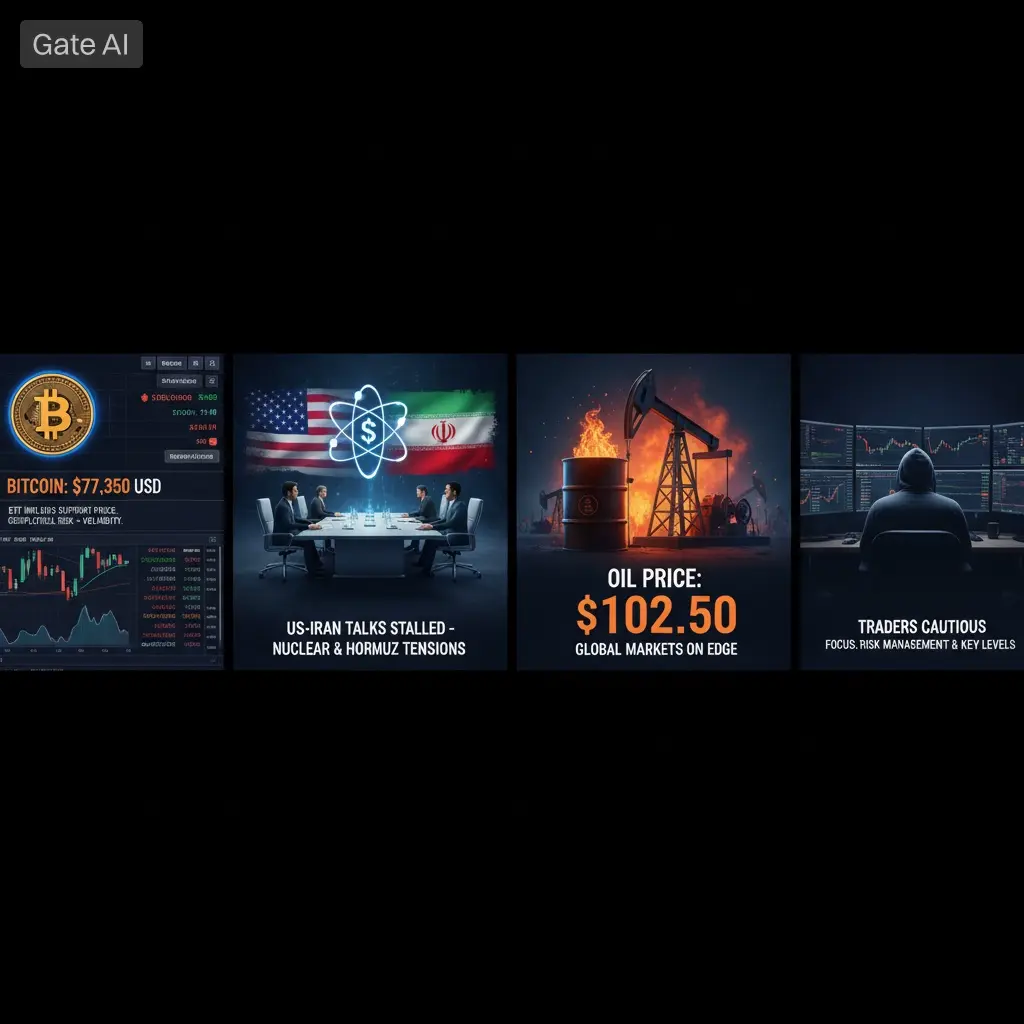
The US-Iran talks are stalled due to irreconcilable differences on nuclear enrichment, compounded by the US naval blockade and internal Iranian power struggles. The Strait of Hormuz remains effectively closed, with 80% of industry experts expecting no reopening before August 2026. This is driving oil prices above $104-107 with forecasts ranging from $76-$110 depending on resolution timeline.
Bitcoin has shown surprising resilience, trading around $77,500 with institutional ETF inflows providing support. However, the correlation with oil means that if crude breaks significantly higher on escalation, BTC will likely face pressure toward $70K-$73K support.
Traders should prioritize risk management, maintain cash reserves for opportunities, use oil as a leading indicator, and set alerts for any breakthrough in negotiations. The current environment favors patient, defensive positioning with readiness to act quickly on any resolution news.
repost-content-media
  • Reward
  • 1
  • Repost
  • Share
discovery:
2026 GOGOGO 👊
#US-IranTalksStall
The negotiations between the United States and Iran have reached a critical deadlock, with President Trump extending the ceasefire indefinitely while diplomatic progress remains frozen. This prolonged uncertainty is sending ripple effects across global financial markets—especially oil and cryptocurrency.
Current Status of US-Iran Negotiations
Talks between Washington and Tehran have stalled after multiple failed rounds. A planned diplomatic meeting in Pakistan was canceled, signaling deeper friction behind the scenes. While the ceasefire remains in place, both sides have op
BTC-0,37%
post-image
post-image
post-image
post-image
  • Reward
  • 13
  • Repost
  • Share
discovery:
2026 GOGOGO 👊
View More
#CryptoMarketSeesVolatility #US-IranTalksStall 🪙 BTC Weekly Strategy: The Calm Before the Storm
Current Price: ~$77,926 | Sentiment: Neutral/Cautious Bullish
🌍 Macro Context
Geopolitics: Tensions rising following stalled US-Iran nuclear talks.
Liquidity: Cautious and thin; volatility is compressed, signaling a massive move is brewing.
Technicals: BTC is hugging resistance but lacks the volume for a definitive "god candle."🟢 Scenario 1: The Bullish Breakout
Trigger: Daily candle close above $80,000 with high volume.
Behavior: Impulsive moves, FOMO-driven price action, and massive liquidation
BTC-0,37%
APE-6,57%
post-image
post-image
post-image
  • Reward
  • 4
  • Repost
  • Share
MrFlower_XingChen:
To The Moon 🌕
View More
#US-IranTalksStall
US-Iran Nuclear Talks Stall:
Why Are The Talks Stalled?
The negotiations between the United States and Iran have reached a complete deadlock due to multiple interconnected factors:
1. Fundamental Disagreement on Nuclear Enrichment
The core sticking point centers on the duration of Iran's nuclear enrichment freeze. Iran insists on maintaining its nuclear program sovereignty while the US demands comprehensive dismantling. Iranian hardliners, particularly within the IRGC (Islamic Revolutionary Guard Corps), view any negotiations under current conditions as granting the US a "
HighAmbition
#US-IranTalksStall
US-Iran Nuclear Talks Stall:
Why Are The Talks Stalled?
The negotiations between the United States and Iran have reached a complete deadlock due to multiple interconnected factors:
1. Fundamental Disagreement on Nuclear Enrichment
The core sticking point centers on the duration of Iran's nuclear enrichment freeze. Iran insists on maintaining its nuclear program sovereignty while the US demands comprehensive dismantling. Iranian hardliners, particularly within the IRGC (Islamic Revolutionary Guard Corps), view any negotiations under current conditions as granting the US a "low-cost victory" that violates Iran's declared red lines.
2. US Naval Blockade of Iranian Ports
President Trump ordered a naval blockade of Iran's ports in response to Iran's closure of the Strait of Hormuz since February 28, 2026. Iran considers this blockade a violation of the ceasefire agreement, while the US maintains it as necessary pressure. This blockade has hardened Iranian negotiating positions significantly.
3. Internal Iranian Power Struggle
There is reported infighting within Iran's leadership. Hardline elements led by figures like Vahidi oppose negotiations entirely, viewing them as having "no present value." IRGC-affiliated outlets argue that discussing the Strait of Hormuz would signal doubt over Iranian sovereignty. Meanwhile, Foreign Minister Araghchi reportedly believes participation offers little benefit and amounts to a "death sentence" for the talks under current Supreme Leader orders.
4. The "No Deal-No War" Limbo
Tehran has warned that talks may stall in a dangerous limbo where neither war nor peace prevails. The fragile two-week ceasefire expired recently, with both sides expressing readiness to resume hostilities. Pakistan-mediated talks failed to materialize after Iran pulled out of the second round.
5. Trump's Hardline Stance
President Trump cancelled a planned trip to Pakistan for negotiations, stating "we have all the cards, they have none." He has refused to lift the Hormuz blockade until a comprehensive deal is agreed, creating a chicken-and-egg situation where neither side will move first.
The Strait of Hormuz Crisis
The Strait of Hormuz represents the world's most critical oil chokepoint:
Global Significance: Approximately one-fifth of global oil supply and LNG flows through this narrow waterway
Current Status: Effectively closed due to the standoff, with tankers blocked from passage
Iran's Position: Claims full sovereignty over the strait and opposes any negotiations that would question this
US Response: Naval blockade preventing Iranian shipping, creating a counter-blockade situation
According to Baker Hughes and Dallas Fed surveys, nearly 80% of oil executives believe the strait will not reopen until August 2026 or later. This prolonged closure scenario is driving persistent risk premiums in oil markets.
Oil Market Impact and Price Forecasts
Current Oil Prices:
Brent Crude: Trading above $104-107 per barrel
WTI Crude: Around $101-102 per barrel
Price Increase: Oil has climbed roughly 12% recently, on pace for the biggest weekly gain since early March 2026
Why Oil Prices Are Surging:
1. Supply Disruption Risk: The Strait of Hormuz closure threatens nearly 20% of global oil supply
2. Shipping Cost Explosion: The Breakwave Tanker Shipping ETF has surged over 600% year-to-date as freight rates skyrocket
3. Refined Fuel Crisis: Diesel and jet fuel prices have rocketed to over $200 at times, showing demand destruction in Asian markets
4. Geopolitical Risk Premium: Markets pricing in sustained uncertainty
Price Forecasts:
Goldman Sachs: Estimates oil price increases ranging from $1-15 per barrel depending on disruption duration; warns prices can rise significantly above fair-value during high geopolitical uncertainty
EIA Forecast: Brent to fall below $90/b in Q4 2026 and average $76/b in 2027 (highly dependent on Hormuz reopening)
J.P. Morgan: Expects Brent averaging around $60/b in 2026 (bearish scenario assuming resolution)
Bloomberg Economics: For oil around $110/barrel, projects marked boost to inflation and blow to growth
ANZ: Expects Brent above $90/barrel in 2026, ending year at $88 due to supply loss
Key Risk: If Iran escalates and oil pushes toward $75-80 (currently already above $100), institutions will likely flip into full risk-off mode, triggering broader market selloffs.
Bitcoin Market Volatility Analysis
Current BTC Status:
Price: $77,517 (as of latest data)
24-hour change: +0.08%
7-day performance: +2.21%
30-day performance: +16.78%
How Geopolitical Tensions Are Affecting BTC:
1. Correlation with Oil
Bitcoin has shown a notable inverse correlation with oil price spikes. When oil started ripping higher in early 2026, BTC dropped fast from above $105K into the mid-$90Ks. The pattern is clear: oil moves first, BTC reacts second.
2. Resilience Factor
Interestingly, Bitcoin has proven more resilient than oil and equities to recent Iran-related flare-ups. The modest 1.6% pullback in BTC during the latest escalation stood against a 5.7% jump in Brent and 1.2% drop in European equity futures. Shrinking BTC sell-offs with each Iran shock suggest crypto may have largely priced in geopolitical tail risk.
3. Institutional Flows Support
US spot Bitcoin ETFs have seen 8 consecutive days of inflows exceeding $2 billion total, with weekly inflows near $1 billion - the highest since mid-January. Strategy (MicroStrategy) purchased 34,164 BTC for approximately $254 million at an average price of $74,395, bringing total holdings to 815,061 BTC. This institutional demand provides a floor.
4. Fear and Greed Index
Current reading of 33 indicates fear territory, but with 66% positive sentiment versus 17% negative, there is underlying bullish conviction.
Technical Levels to Watch:
Support: $74,000 - $73,000 range
Resistance: $78,000 (recently breached), next target $80,000
Daily SAR indicates bearish trend but 15-minute and 4-hour charts show mixed signals with MACD底背离 (bottom divergence) suggesting potential reversal
BTC Forecast:
If oil stays contained below $110, BTC can stabilize and potentially rally toward $80K-$88K. However, if oil breaks above $110-120 on full Hormuz closure, expect BTC to retest $70K-$73K support. The ETF bid has become a more reliable floor than futures-driven weekend gaps.
Trading Strategy Recommendations
For Conservative Traders:
1. Risk Management Priority
Reduce position sizes by 20-30% during high geopolitical uncertainty
Maintain 40-50% cash reserves for dip-buying opportunities
Set stop-losses at $72,000 for long BTC positions
2. Hedging Approach
Consider put options on BTC at $70K strike for protection
Allocate 10-15% to gold as traditional safe haven (currently $4,713/oz)
Dollar-cost average rather than lump sum entries
For Aggressive Traders:
1. Volatility Plays
Trade range-bound strategies between $73K-$78K
Use grid trading bots to capture oscillations
Consider longing oil proxies (energy ETFs) while shorting risk assets if tensions escalate
2. Breakout Strategies
Long BTC on confirmed break above $78,500 with target $82K
Short BTC on break below $73,000 with target $68K
Monitor oil price as leading indicator for crypto moves
Key Levels to Watch:
Oil:
Bullish above $110 (Hormuz closure extended)
Bearish below $95 (talks progress)
Bitcoin:
Critical support: $73,000-$74,000
Major resistance: $78,000-$80,000
Breakout target: $88,000 (probability currently low at 1% for April 20-26 window)
General Tips:
1. Watch Oil First: Oil prices lead, BTC follows. Monitor Brent crude as your primary geopolitical risk gauge.
2. ETF Flows Matter: Track US spot Bitcoin ETF daily flows. Sustained inflows above $200M/day support price floors.
3. Avoid Weekend Gaps: Geopolitical developments often occur weekends when crypto trades but traditional markets closed. Be cautious holding large positions over weekends.
4. Dollar Strength: Geopolitical instability drives dollar strength (DXY), which typically pressures BTC. Monitor DXY above 104 as bearish for crypto.
5. Time Horizon: If you're a long-term holder, these dips below $75K present accumulation opportunities. If trading short-term, respect the volatility and use tight stops.
6. News Sensitivity: Any headline about "Hormuz reopening" or "talks resume" will cause immediate moves. Have alerts set for major news sources.
Summary: The Complete Picture
The US-Iran talks are stalled due to irreconcilable differences on nuclear enrichment, compounded by the US naval blockade and internal Iranian power struggles. The Strait of Hormuz remains effectively closed, with 80% of industry experts expecting no reopening before August 2026. This is driving oil prices above $104-107 with forecasts ranging from $76-$110 depending on resolution timeline.
Bitcoin has shown surprising resilience, trading around $77,500 with institutional ETF inflows providing support. However, the correlation with oil means that if crude breaks significantly higher on escalation, BTC will likely face pressure toward $70K-$73K support.
Traders should prioritize risk management, maintain cash reserves for opportunities, use oil as a leading indicator, and set alerts for any breakthrough in negotiations. The current environment favors patient, defensive positioning with readiness to act quickly on any resolution news.
repost-content-media
  • Reward
  • 1
  • Repost
  • Share
BlockRider:
2026 GOGOGO 👊
#US-IranTalksStall
US-Iran Nuclear Talks Stall:
Why Are The Talks Stalled?
The negotiations between the United States and Iran have reached a complete deadlock due to multiple interconnected factors:
1. Fundamental Disagreement on Nuclear Enrichment
The core sticking point centers on the duration of Iran's nuclear enrichment freeze. Iran insists on maintaining its nuclear program sovereignty while the US demands comprehensive dismantling. Iranian hardliners, particularly within the IRGC (Islamic Revolutionary Guard Corps), view any negotiations under current conditions as granting the US a "
post-image
  • Reward
  • 1
  • Repost
  • Share
CryptoDiscovery:
2026 GOGOGO 👊
#US-IranTalksStall 🪙 BTC Weekly Strategy: The Calm Before the Storm
Current Price: ~$77,926 | Sentiment: Neutral/Cautious Bullish
🌍 Macro Context
Geopolitics: Tensions rising following stalled US-Iran nuclear talks.
Liquidity: Cautious and thin; volatility is compressed, signaling a massive move is brewing.
Technicals: BTC is hugging resistance but lacks the volume for a definitive "god candle."🟢 Scenario 1: The Bullish Breakout
Trigger: Daily candle close above $80,000 with high volume.
Behavior: Impulsive moves, FOMO-driven price action, and massive liquidations of late shorts.
Strategy:
BTC-0,37%
APE-6,57%
  • Reward
  • 8
  • Repost
  • Share
AylaShinex:
To The Moon 🌕
View More
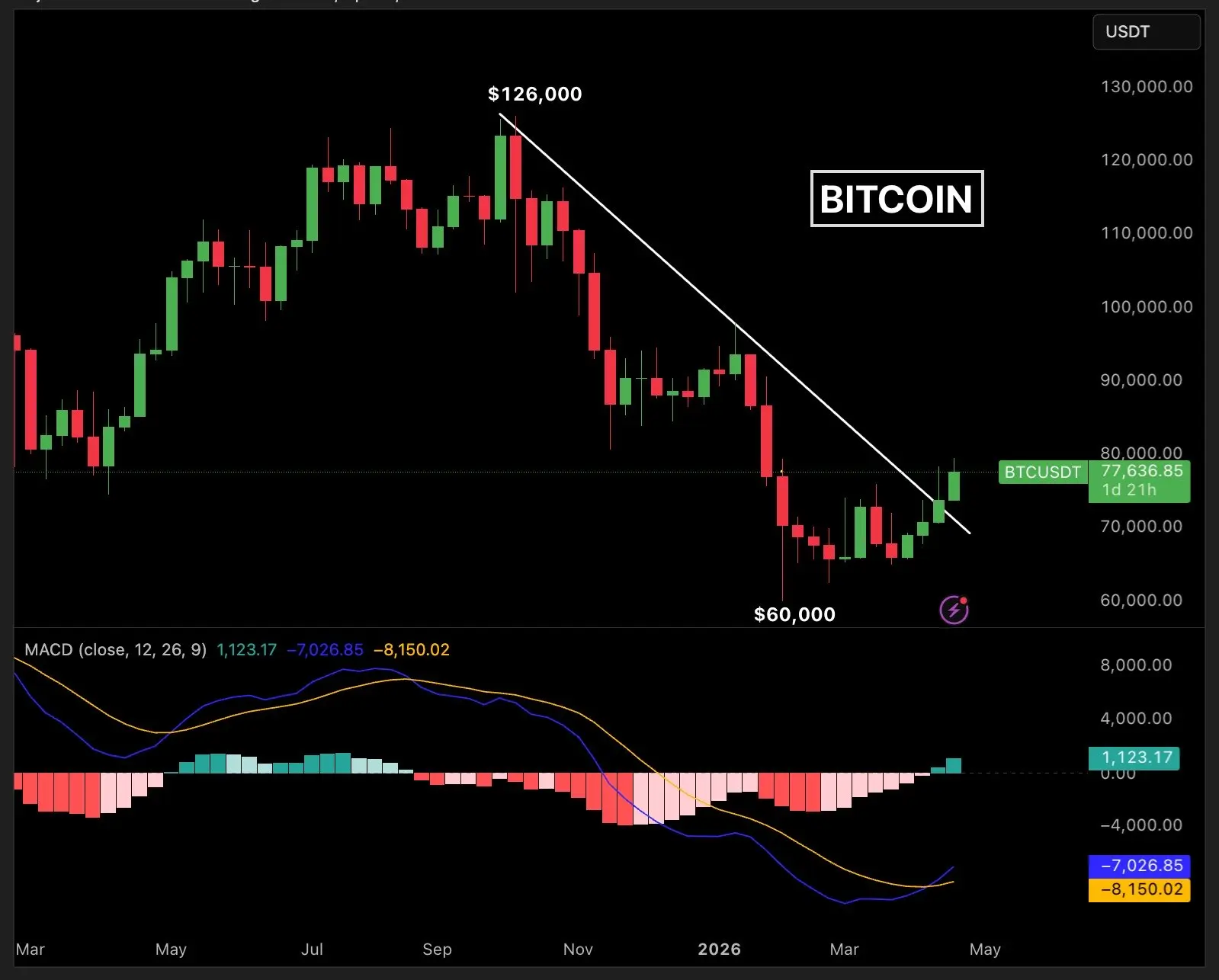
BTC looking strong on the weekly 📈
• MACD flipped bullish after 5 months
• First major breakout from the October downtrend
$80K is the key level — a weekly close above opens $90K+
Rejection here = potential deeper downside
Bullish:
Stocks at ATH
War cooling off
Multiple bullish signals after months
BTC still undervalued
Bearish:
Unexpected macro/news shock
War escalation
Stock market correction$BTC #US-IranTalksStall
BTC-0,37%
post-image
  • Reward
  • 1
  • Repost
  • Share
CryptoDiscovery:
To The Moon 🌕
Load More