First, structure and core significance
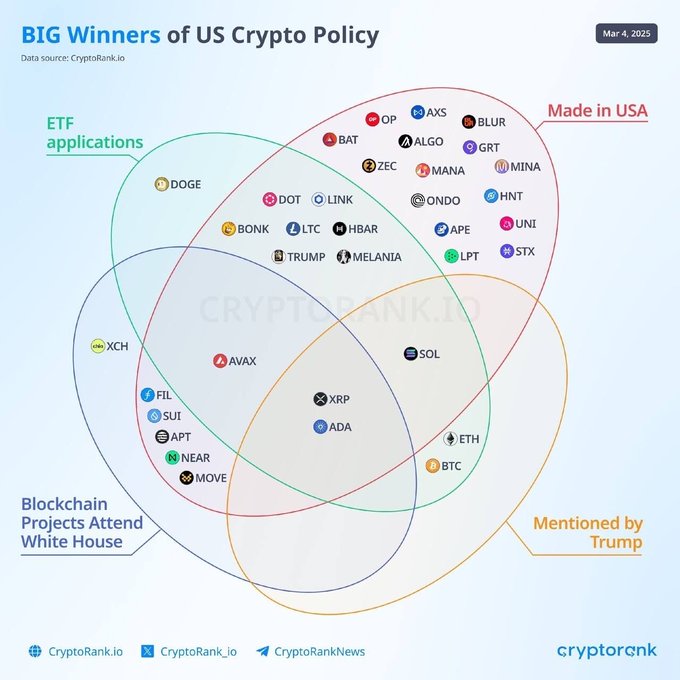
The following figure shows several key beneficiaries of US cryptocurrency policy, including:
-
ETF Applications: In the green area, ETF is an important tool in traditional financial markets. The launch of cryptocurrency ETFs means that these projects are gaining acceptance in institutional investors and mainstream financial markets. The approval of Bitcoin and Ethereum spot ETFs in 2024 has already proven the role of ETFs in driving market prices and adoption rates.
-
Blockchain Projects Attend White House: The red area indicates that these projects may have participated in direct dialogues or policy-making activities with the U.S. government. White House attention typically means that these projects are important in terms of regulatory compliance, technological applications (such as supply chain management, decentralized identity), or national strategic considerations.
-
Mentioned by Trump: Orange area, Trump’s attitude towards cryptocurrency has changed from criticism to support in recent years, especially during the 2024 election campaign, he openly supported cryptocurrency and launched his own NFT project and MEME coin. Projects mentioned by Trump may gain market attention and short-term price momentum due to his celebrity effect.
-
Cryptocurrency projects based in the United States (Made in USA): Orange area. They may have a natural advantage in policy support, especially against the backdrop of China-US technological competition.
The Meaning of Overlapping Areas
Overlapping Categories: The project appearing in two categories at the same time indicates its advantages in multiple aspects. For example, BTC (Bitcoin) and ETH (Ethereum) simultaneously appear in the ‘ETF Application’ and ‘Trump Mention’ areas, demonstrating their dual advantages in policy support and public attention.
Triple Overlap Area: Located at the center of the chart, including SOL (Solana), XRP (Ripple), and ADA (Cardano). These projects meet the three conditions of “ETF application”, “White House involvement”, and “mentioned by Trump” at the same time, making them the biggest potential beneficiaries of US cryptocurrency policy.
Three, Specific Project Classification and Analysis
1. Triple Positive Project (Central Area: ETF + White House + Mentioned by Trump)
These projects are located in the overlapping areas of three regions, which are the ‘core winners’ supported by policies.
SOL (Solana):
Background: Solana is a high-performance Layer 1 blockchain known for its high throughput and low transaction costs, and is one of the main competitors to Ethereum.
Analysis: Solana appearing in the central area indicates that it is highly focused on in the formulation of US policies, may be applying for an ETF, and has also received recognition from Trump. Solana’s high performance makes it widely used in the fields of DeFi (decentralized finance) and NFT (non-fungible tokens), which may attract government interest, especially relying on the leading advantage of MEME coins, obtaining a large share of active users on the chain.
XRP (Ripple):
Background: Ripple is mainly used for cross-border payments, and its token XRP has long been involved in legal disputes with the U.S. Securities and Exchange Commission (SEC) (since 2020).
Analysis: The appearance of XRP in the central area may indicate that its legal issues are being resolved, or its status at the policy level is improving. In 2024, the SEC’s regulatory attitude towards cryptocurrencies has eased, and if XRP can pass the ETF application, it may usher in a large-scale influx of funds.
ADA (Cardano):
Background: Cardano is a blockchain project that focuses on academic research and a layered architecture, known for its scientific approach and sustainability.
Analysis: Cardano’s position in the central region indicates that it has gained more recognition in the U.S. market, possibly playing a role in policy-making or government cooperation. Its technical strength may make it a candidate project supported by the government.
2. Dual Bullish Projects
ETF application + Trump mentioned (green + orange area)
BTC (Bitcoin):
Background: Bitcoin is the largest cryptocurrency by market capitalization, regarded as digital gold. In early 2024, the United States approved a Bitcoin spot ETF, driving its price and institutional adoption. By 2025, BTC will be actively promoted to become the strategic reserve currency of the United States and even various countries and major publicly traded companies.
Analysis: Bitcoin appears in both the ‘ETF application’ and ‘Trump mentioned’ areas at the same time, indicating its stable market position. Trump’s mention may further enhance its public image and attract more retail investors.
ETH (Ethereum):
Background: Ethereum is the second largest cryptocurrency, supporting smart contracts and the DeFi ecosystem. In May 2024, the Ethereum spot ETF was approved.
Analysis: Ethereum’s position in this area reflects its dual advantages in policy and public attention. The widespread application of the Ethereum ecosystem makes it a focus of institutional investment.
White House Engagement + Trump Mention (Red + Orange Zone)
TRUMP:
Background: Possibly a meme coin or token related to Trump, common in projects driven by the celebrity effect.
Analysis: Its appearance in this area indicates that it is more based on Trump’s personal influence rather than technical strength. Such tokens usually have higher volatility and are suitable for short-term speculation.
MELANIA:
Background: Possibly a token or project related to Melania, the wife of Donald Trump.
Analysis: Similar to TRUMP, MELANIA token may also be based on the celebrity effect, lacking long-term technical support.
HBAR (Hedera):
Background: Hedera is an enterprise-level blockchain that uses hashgraph consensus mechanism, suitable for scenarios such as supply chain management and decentralized identity.
Analysis: Hedera’s presence in this area indicates its potential deep cooperation with the US government, while attracting attention from Trump. Its enterprise applications may give it long-term development potential under policy support.
ETF application + White House involvement (green + red areas)
This area has no projects, indicating that there are currently no projects that meet both the ‘ETF application’ and ‘White House participation’ criteria but have not been mentioned by Trump.
3. Single-category project
3.1 ETF Application (Green Zone)
Projects: DOGE (Dogecoin), BONK, XCH (Chia), AVAX (Avalanche), FIL (Filecoin), SUI, APT (Aptos), NEAR, MOVE.
Analysis:
Meme coins: DOGE and BONK are meme coins, with strong community-driven characteristics, but limited technical applications. Their application for ETF may be more to attract retail funds.
Layer 1 blockchains: AVAX, SUI, NEAR are high-performance Layer 1 blockchains, similar to Solana, may seek entry into traditional financial markets through ETFs.
Storage and Infrastructure: The technological applications of projects such as FIL (decentralized storage) and XCH (green blockchain) are more widely used, and the ETF application may reflect institutional optimism about their long-term value.
3.2 White House Participation (Red Area)
Project: LTC (Litecoin), LINK (Chainlink), DOT (Polkadot).
LTC: Litecoin is a fork of Bitcoin, with faster transaction speed, and may be of interest in government payments or settlement scenarios.
LINK: Chainlink provides decentralized oracle services, which are a key infrastructure of the DeFi ecosystem, and its White House participation may be related to data credibility.
DOT: Polkadot is a cross-chain protocol designed to connect different blockchains, and its technology may attract government interest in interoperability.
3.3 Trump mentioned (orange area)
Projects: OP (Optimism), AXS (Axie Infinity), BAT (Basic Attention Token), ZEC (Zcash), MANA (Decentraland), ONDO, APE (ApeCoin), LPT (Livepeer), UNI (Uniswap), STX (Stacks).
Analysis:
Diversity: This area includes a variety of projects such as Layer 2 solutions (OP), DeFi (UNI), gaming (AXS), privacy coins (ZEC), metaverse (MANA), reflecting the comprehensiveness mentioned by Trump.
Speculative: Trump’s mention may be more for market speculation rather than based on technical evaluation. These projects may rise in the short term due to increased attention, but long-term value depends on their fundamentals.
3.4 Made in USA (Sub-label in orange area)
Projects: BLUR (NFT Market), ALGO (Algorand), GRT (The Graph), MINA, HNT (Helium).
Analysis:
American Made: These projects originate from the United States and may have advantages in policy support. For example, ALGO and GRT are infrastructure projects focusing on high-performance blockchain and data indexing respectively, and may benefit from government prioritized support in the technology sector.
Technological applications: Technological innovations of projects such as HNT (IoT) and MINA (lightweight blockchain) may make them more attractive in policy making.
Macro Trends and Policy Background
4.1 The Promotion of ETF
Historical background: 2024 was the breakthrough year for cryptocurrency ETFs, with the approval of Bitcoin spot ETF (in January) and Ethereum spot ETF (in May) injecting a large amount of institutional funds into the market.
Trend in the picture: More projects (such as SOL, XRP, ADA, AVAX, etc.) are applying for ETFs, indicating that the integration of cryptocurrencies and traditional finance is accelerating. The launch of ETFs may significantly increase the market value and adoption of these projects.
4.2 Trump’s Influence
Background: Trump’s attitude towards cryptocurrency has shifted from criticism to support in recent years. He has publicly supported cryptocurrency multiple times during the 2024 election campaign, and even launched his own NFT project.
The image shows: Trump mentioned a variety of projects, including meme coins (TRUMP, MELANIA), DeFi (UNI), games (AXS), reflecting that his influence is mainly focused on market speculation and public attention, rather than technical evaluation.
4.3 White House Participation
Background: The attitude of the US government towards blockchain technology is shifting from regulatory pressure to cooperation and support. Projects involving decentralized identity, supply chain management, or financial innovation may involve the White House.
The picture shows that projects such as SOL, XRP, HBAR, etc. are involved in the White House area, indicating that they may play an important role in policy making.
4.4 Advantages of American Manufacturing
Background: In the context of the technological competition between China and the United States, the US government may prioritize supporting domestic blockchain projects to ensure technological sovereignty.
The figure shows that projects marked as “Made in USA” (such as ALGO, GRT, HNT) may gain long-term development advantages with policy support.
Potential Market Impact
5.1 Central Area Projects (SOL, XRP, ADA)
Market Outlook: These projects have become the biggest winners due to triple bullish factors, which may attract more institutional funds and retail investors.
Specific Impact:
SOL: Solana’s high performance may make it the preferred choice in the DeFi and NFT sectors, and the approval of ETFs may further drive up its price.
XRP: If its legal issues with the SEC are resolved, the approval of ETFs may trigger a massive influx of funds.
ADA: Cardano’s scientific approach may give it an advantage in government cooperation, with great long-term development potential.
5.2 ETF-related projects (BTC, ETH, AVAX, etc.)
Market Outlook: The launch of ETFs will bring more institutional funds to these projects and enhance market value.
Specific impact:
BTC and ETH: approved ETFs, stable market positions, Trump’s mention may further attract retail investors.
AVAX, SUI, NEAR: If the ETF is approved, they may become the beneficiaries of the next wave of high-performance blockchains.
5.3 Trump-Related Projects (TRUMP, MELANIA, UNI, etc.)
Market Outlook: These projects may rise in the short term due to speculation, but the long-term value depends on their fundamentals.
Specific impact:
TRUMP, MELANIA: The meme coin has obvious characteristics and high volatility, suitable for short-term speculation.
UNI, OP: DeFi and Layer 2 projects have strong technical capabilities, and Trump’s mention may bring more attention to them.
5.4 White House Participating Projects (HBAR, LINK, DOT, etc.)
Market Outlook: These projects may receive more government contracts or policy support, with great potential for long-term development.
Specific impacts:
HBAR: Enterprise applications may give it an advantage in government cooperation.
LINK: The widespread application of oracle services may make it a bridge between DeFi and government cooperation.
Summary
Biggest winners: Solana, XRP, and Cardano have become core beneficiaries by simultaneously meeting threefold bullish factors, potentially standing out in policy support and market performance.
Market leaders: Bitcoin and Ethereum continue to maintain their dominant positions, with ETFs and mentions by Trump adding more attention to them.
Policy support: Projects involving the White House (such as HBAR, LINK) may benefit from government cooperation in the long term.
American Made: Projects originating in the United States (such as ALGO, GRT) may gain a competitive advantage with policy support.


