Bitcoin L2 carries OrdFi and its mission of unlocking Bitcoin liquidity, but how to implement Bitcoin L2 is a new topic in the encryption industry.
Written by: NingNing
The birth, growth and popularity of Ordinals, BRC20, BRC420, Atomics and other inscription protocols in 23 years have completely updated the connotation of the Bitcoin ecological concept.
When the Bitcoin ecosystem was once mentioned, the first thing that people in the industry thought of was the lightning network, side chain Liquid Network, client verification smart contract RGB and other high-tech protocols.
After 23 years of Inscription’s perfect storm, when it comes to the Bitcoin ecosystem, various images of Inscription assets will come to everyone’s mind.
If we compare the evolution of Bitcoin ecology in 2023 to the biosphere ecology, the early unstructured and meaningless Sub10K inscription NFT is like fungi and microorganisms that grow randomly on empty soil; Yuga’s TwelveFold, the first inscription token ORDI of the BRC20 protocol , Bitcoin Frog NFT are like new plants sprouting on the substrate; the various MeMe inscriptions since October 23 are like wildly growing weeds; and the wave of deep adjustments before the Spring Festival is like a wildfire burning away the traditional Wu, applied inscriptions began to emerge.
As of January 24, the Bitcoin ecosystem has become a prosperous and lively new field of the encryption industry. During this period, Bitcoin L2, together with Bitcoin VM and others, became an important part of the Bitcoin ecosystem.
The market has two basic expectations for the functions of Bitcoin L2: OrdFi (Inscription DeFi) and unlocking Bitcoin liquidity.
OrdFi (Inscription DeFi). Benny’s Trac team used the Taproot script to implement the Swap function of inscriptions. But its interactive experience is far behind DEX built on EVM.
In this case, OrdFi’s other solution, Bitcoin L2, has received more attention from the market.
Taking the Map protocol as an example, users can cross-chain BRC20 inscriptions to the Map Relayer network through Map’s ZK light node cross-chain bridge.
Different from common Relayers in cross-chain bridges, the Map Relayer network adopts the PoS consensus mechanism and supports and is compatible with EVM.
After BRC20 assets are cross-chained to the Map Relayer network, users can trade BRC20 assets just like trading ERC20 tokens on DEX.
Unlock Bitcoin liquidity. As shown in Figure 1, the current outflow value of Bitcoin is US$9.139 billion, accounting for only ~1.08% of the total market value of Bitcoin. The outflow value of Ethereum was US$5.711 billion, accounting for 1.8% of the total market value of Ethereum. Bitcoin’s outflow value ratio is 66.66% lower than that of Ethereum.
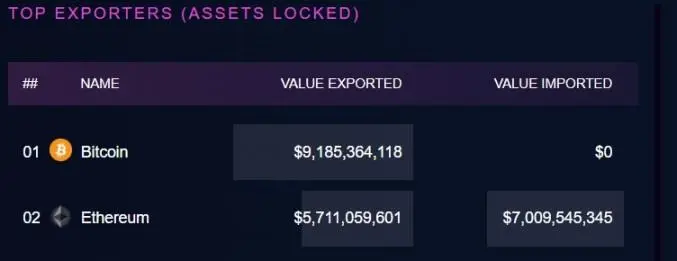
Moreover, the current main channels for Bitcoin value outflow are WBTC and REN protocols, both of which rely on trust in centralized entities.
The industry expects Bitcoin L2 to unlock more Bitcoin liquidity in a more trustworthy, verifiable and transparent manner, at least to the level of Ethereum’s outflow value ratio.
The industry has a basically unanimous consensus on the functional expectations of Bitcoin L2. But there is no consensus on how to implement Bitcoin L2. The options available are:
- Classical solution: state channel, client verification, side chain, OmniLayer;
- New solutions: ZK light node, oracle + light node, Rollup + DA, MPC multi-signature mechanism. These new Bitcoin L2 solutions are very similar to cross-chain bridge solutions.
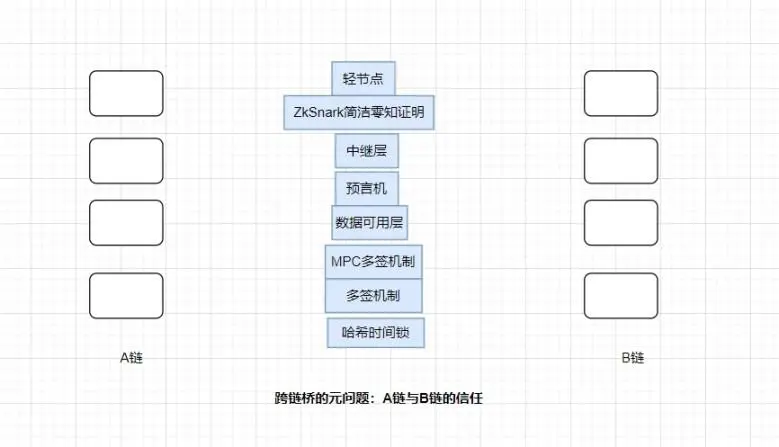
The meta-problem of blockchain is to solve the trust problem between Alice and Bob; the meta-problem of cross-chain bridge is to solve the trust problem between chain A and chain B; the meta-problem of L2 is to solve the trust problem between L1 chain and L2 chain. They are essentially a question of how two entities can trustfully come to an agreement.
As Crypto Veda said, the essence of L2 is a cross-chain bridge. The relay layer supports VM cross-chain bridges such as Map Protocol, ZetaChain, etc. It is difficult to clearly define it as a cross-chain bridge or L2.
The characteristics of Bitcoin L2 are very different from Ethereum’s L2:
Ethereum’s L2 can have the luxury of batch rolling up all state data to the Ethereum main network for storage without worrying about accelerating the state expansion of Ethereum.
The first principle of Bitcoin L2 is not to overload the consensus of the Bitcoin main network. Therefore, most classical solutions choose off-chain expansion solutions to minimize the load pressure on the Bitcoin main network.
Among the new solutions, the Map protocol uses the ZK light node solution and the Rollup+Celesita DA+ Bitcoin network as the asset settlement layer solution, which can relatively better balance the relationship between scalability, security and load pressure on the Bitcoin main network. .
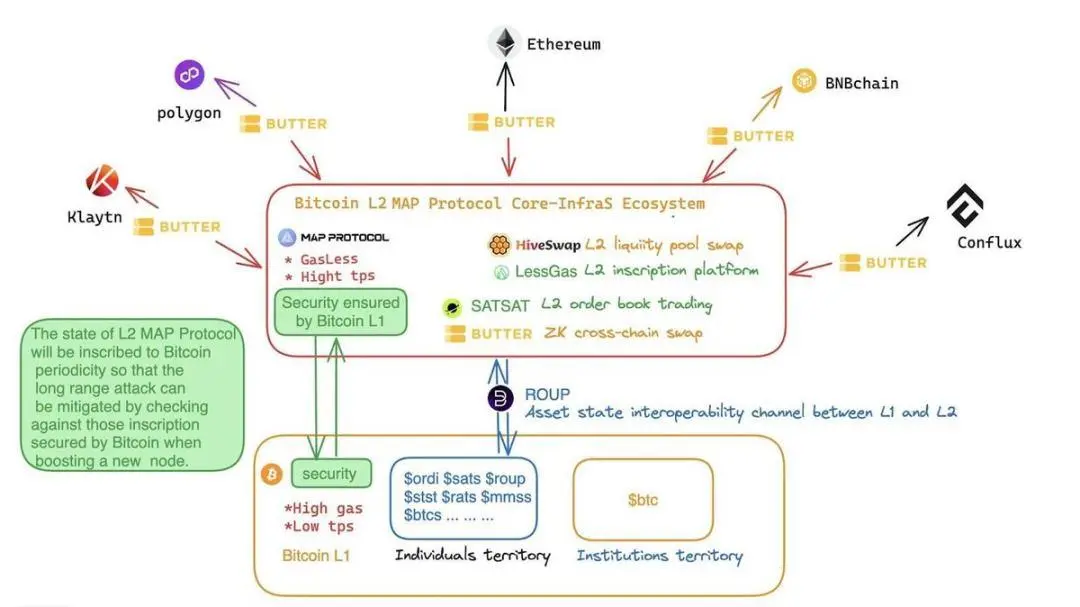
Finally, to summarize, Bitcoin L2 carries OrdFi and the mission of unlocking Bitcoin liquidity, but how to implement Bitcoin L2 is a new topic in the encryption industry. Due to the high degree of isomorphism between cross-chain bridges and L2, new Bitcoin L2 based on cross-chain bridge solutions like the Map protocol may become an important direction for industry exploration.
Disclaimer: The information on this page may come from third parties and does not represent the views or opinions of Gate. The content displayed on this page is for reference only and does not constitute any financial, investment, or legal advice. Gate does not guarantee the accuracy or completeness of the information and shall not be liable for any losses arising from the use of this information. Virtual asset investments carry high risks and are subject to significant price volatility. You may lose all of your invested principal. Please fully understand the relevant risks and make prudent decisions based on your own financial situation and risk tolerance. For details, please refer to
Disclaimer.


