Author|Wu Jingjing
Editor|Zhao Jian
Source: Jiazi Guangnian
 Image source: Generated by Unbounded AI
Over the past few months, all the tech giants have been scrambling to get a piece of the generative AI opportunity created by big models. Microsoft, Google, and Amazon are among the most active participants—they not only control the core cloud computing resources at the bottom of the large model, but also hold digital products and tools that affect billions of people.
Recently, Microsoft, Google, and Amazon have successively released their financial reports for the second quarter of the 2023 natural year, and AI-related revenue has also become the focus of each financial report.
However, completely different from the high expectations of the outside world for AI, AI currently has “minimal” impact on the revenue of the three technology giants. Neither Amazon nor Google directly discloses AI revenue figures, and Microsoft is the only company that explicitly discloses this figure. Azure AI revenue only accounts for about 2% of Azure revenue, compared with 1% in the previous quarter.
However, the three manufacturers all regard AI as the core strategy of the future and increase capital investment in AI.
Amazon CEO Andy Jassy (Andrew R. Jassy) said that every business within Amazon is planning to implement generative AI applications, especially in customer service and cost cutting. Amazon plans to invest more than $50 billion in cash by 2023, with a focus on technology investment in AWS.
Google CEO Sundar Pichai (Sundar Pichai) said that with generative AI, Google is taking the next step to refactor all core products including search. Google expects the level of investment in technology infrastructure to rise, starting in the second half of 2023 and continuing through 2024, including investments in GPUs and proprietary TPUs, as well as expansion of data center capacity.
Microsoft CEO Satya Nadella (Satya Nadella) said that in the long run, AI Copilot will be Microsoft’s third growth curve. In order to support the growth of Microsoft cloud and the demand for artificial intelligence platform, Microsoft will accelerate its investment in cloud infrastructure, and capital expenditure will increase continuously every quarter throughout the year.
1. Amazon: Generative AI is in the very early stages
After the release of its second-quarter 2023 earnings report, Amazon shares soared nearly 10% after hours. Since the beginning of this year, Amazon’s overall stock price has also risen by more than 50%, making it one of the few technology stocks that can continue to rise.
The investment and application of artificial intelligence are mainly concentrated in the Amazon cloud AWS. The financial report shows that in the second quarter of this year, AWS revenue reached US$22.14 billion, a year-on-year increase of 12%, and operating profit reached US$5.37 billion, accounting for nearly 70% of total operating profit.
However, the 12% growth rate was the slowest since 2015. Starting from the first quarter of 2022, its revenue growth rate has dropped from 40% in the fourth quarter of 2021 to 37%, and then continued to decline. ** Its revenue growth rate has been declining for 6 consecutive quarters. **
At the same time, AWS achieved an operating profit of US$5.37 billion, a slight decline from the US$5.72 billion in the same period last year. The operating profit margin was 24.23%, which was lower than the operating profit margin levels of 29.8% in 2021 and 28.7% in 2022.
Amazon CEO Andy Jassy said that the core reason behind these changes is customer cost optimization, but they are more optimistic about future development: “New technologies are attracting more new customers, and we have been providing customers with generative artificial intelligence. and big language models and machine learning solutions. We’re optimistic that these are attracting new customers.”
Generative AI is becoming an important weight for AWS to stabilize its position. Andy Jassy said: “AWS is continuing to solidify its leadership in cloud computing with a series of generative AI versions, competing with the likes of Google and Microsoft.”
At the computing layer, AWS began to develop its own custom artificial intelligence chips for training and reasoning a few years ago. Andy Jassy said: “We are optimistic that the training and reasoning of large-scale language models in the future will be in AWS’s TrAInium and Inferentia chips.”
AWS launched a fully managed generative AI service Amazon Bedrock and its own basic model Amazon Titan in April this year. Among them, the Amazon Titan series models are divided into two types, one is a text model similar to GPT-4 content generation, and the other is an embedding model that can efficiently create vector embeddings for creating search functions, etc.
Amazon Bedrock is a new platform that integrates the most mainstream basic large models in the industry. Developers can integrate with AWS services to simplify the development process. AWS also customizes chips for model training and reasoning, which can reduce developer costs.
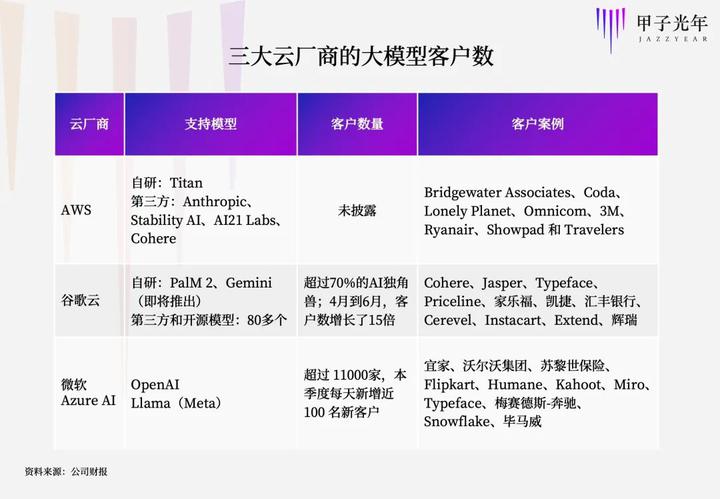
Currently, Amazon Bedrock has access to AI21 Labs, Anthropic, Stability **AI and other mainstream basic models and Amazon Titan, and enterprises can access it through API, and has accumulated hundreds of customer cases. **In June, AWS announced that it has cooperated with the UAE Institute of Technology and Innovation (TII) to help it train the open source large language model Falcon40B.
Andy Jassy revealed that companies such as Bridgewater Associates, Coda, Lonely Planet, Omnicom, 3M, RyanAir, Showpad, and Travelers are currently using Amazon Bedrock to create generative AI applications. Bedrock has also launched new features, including new models for Cohere, Anthropic’s Claude 2, and Stability AI’s Stable Diffusion XL 1.0, as well as Amazon Bedrock’s agent, and AWS also provides a code assistant, Amazon CodeWhisperer.
At the same time, AWS is accelerating recruitment. In March of this year, the company announced that it would invest 100 million US dollars to establish a generative AI innovation center. At the same time, it also launched the “Amazon Cloud Technology Startup Accelerator” focusing on start-ups in the AI field.
** Andy Jassy said: “Generative AI will undoubtedly change the experience of almost all customers. But it is still early, most companies are still figuring out how to achieve this goal, I think we are at a very early stage stage, it’s a marathon.”**
He also mentioned that continuous investment in the direction of large language models may affect the company’s overall cost investment: “The more customers demand, the more capital AWS will invest in building data centers and hardware in the early stage, and then it will take a long time. Cycles make money. We’re hoping for that and have a reasonable estimate for capital expenditures.”
2. AI promotes high growth rate of Google Cloud revenue but did not disclose specific figures
Microsoft and Google reported earnings a week earlier than Amazon.
The financial report shows that Alphabet’s total revenue in the second quarter was US$74.604 billion, an increase of 7% compared with US$69.685 billion in the same period last year, and a year-on-year increase of 9% excluding the impact of exchange rate changes; the net profit in the second quarter was 18.368 billion US dollars, an increase of 15% compared with US$16.002 billion in the same period of the previous year. The overall revenue performance beat Wall Street analysts’ expectations, sending its shares up nearly 6% after hours.
Google said, “We are very satisfied with the results of the second quarter. For some time, we have been emphasizing that the company’s focus will be on revenue growth rather than expense growth, and this quarter is the first time in a while to achieve the above goals.”
From the perspective of specific performance, the rebound of the advertising business that declined in the first two quarters, the growth of YouTube business, and the rapid growth of Google Cloud business are the core driving forces supporting the good performance of this time. Among them, search remained the largest contributor to revenue growth, with total revenue reaching $31.9 billion, an increase of 6%.
Generative AI is becoming the focus of Google right now. At this year’s Google I/O developer conference in 2023, Google CEO Sundar PichAI said:** “With generative AI, we’re taking the next step in refactoring everything, including search. All core products.”**
On the integration of generative AI and search products, Pichai mentioned that progress has been ahead of previous expectations. Since the launch of related products, the search efficiency has been significantly improved, and the search delay has also been significantly improved. In the internal test, we can see that the relevant indicators have been achieved. “AI search will also become a new search method. We will continue to maintain a prudent attitude and careful consideration, and actively meet and build another major change in the search field.”
In addition, he mentioned that the relevant data of Bard are very gratifying. "Some users coded with Bard, and explored new application scenarios for Bard; we also integrated Google Lens (Google Smart Lens) with Bard. We all know that Google Lens has great development potential. Technology has also evolved tremendously.”
**Google Cloud’s revenue in the second quarter was US$8.031 billion, an increase of approximately 28% year-on-year, and it is the business sector with the highest growth rate. **Google Cloud’s operating profit for the quarter was $395 million, about double the $191 million profit in the first quarter, for an operating margin of 5%. This is also Google Cloud starting from the first quarter of 2023, and once again realizing that its operating profit has turned from negative to positive. According to Pichai, New services and products based on artificial intelligence are the biggest contributors to Google Cloud’s growth momentum.
Google Cloud mainly includes three major businesses: Google Cloud Platform (GCP) services, Google Workspace communication and collaboration tools, and other enterprise services. The growth of GCP in this quarter exceeded the overall growth of Google Cloud, and the growth rate was higher than that of Google Workspace. The strong growth in Google Workspace revenue was driven by growth in both user count and average revenue per user.
In terms of business, in terms of Google Cloud Platform (GCP) services, **more than 70% of the new generation of AI unicorn companies are Google Cloud customers, including Cohere, Jasper, Typeface, etc. **
Google Workspace currently has a customer base of 9 million, which presents a potential opportunity for the penetration of AI products. More than 750,000 Workspaces use new product features, such as Duet AI.
In addition, Google offers the broadest selection of AI supercomputers with Google TPUs and advanced NVIDIA GPUs, and recently launched a new A3 AI supercomputer powered by NVIDIA H100. **This enables customers like AppLovin to achieve nearly 2x better price/performance than industry alternatives. **
Pichai said the new generative AI products are expanding the overall addressable market and winning new customers. “Currently, Google has introduced more than 80 models behind vertexAI, Enterprise Search, and conversational AI. Customers have shown strong demand for these models. From April to June, the number of customers has increased by more than 15 times, Priceline, Carrefour, Capgemini, HSBC, Cerevel and other companies from all walks of life have combined new AI technology for industrial practice. **AI provides opportunities for ‘up-sell’ and ‘cross-sell’ for our basic product installation.” **
In addition, Google is also expanding its partner ecosystem, cooperating with hundreds of ISVs and SaaS providers such as Box, Salesforce, Snorkel, and the world’s largest consulting firms such as Accenture and Deloitte, to train more than 150,000 people on Google Cloud generative AI .
“All the investments made by the company around AI, including DeepMind, search business, Gemini, etc., will also be applied to Google Cloud business in the future. We are very looking forward to and excited about everything that may happen in the future.” Pichai said.
3.Azure accounted for more than 50% of cloud revenue for the first time, Azure AI revenue accounted for 2% of it
This time, Microsoft Cloud, the most anticipated of this wave of generative AI opportunities, did not give too many amazing results.
The financial report shows that in the second quarter of 2023, Microsoft’s revenue was US$56.189 billion, an increase of 8% year-on-year; its net profit was US$20.081 billion, an increase of 20% year-on-year. Revenue performance fell short of Wall Street analysts’ forecasts, sending shares down 4 percent after hours.
Specifically, the productivity and business process segment covering Office software achieved revenue of US$18.291 billion in this quarter, compared with US$16.600 billion in the same period last year, a year-on-year increase of 10.2%.
Among them, the revenue of Office commercial products and cloud services increased by 12% year-on-year, the revenue of Office personal products and cloud services increased by 3% year-on-year, and the number of 365 subscribers of the personal version increased to 67 million. Are using 365 products. After Microsoft released 365 Copilot, Microsoft 365 Copilot has been launched to 600 paying customers, including Emirates, General Motors, Goodyear, Lumen, etc.
Although Microsoft has launched the multi-modal visual search function in Bing Chat, the personal computing business including Surface, Xbox hardware, games, search and other business sectors is still declining, with revenue of US$139.05 in this quarter, compared with US$14.461 billion in the same period last year , a year-on-year decrease of 3.8%. At last count, Bing users have engaged in more than 1 billion chats and created more than 750 million images using the Bing Image Creator. Microsoft Edge gained market share for the ninth consecutive quarter.
Smart cloud is Microsoft’s cash cow business. In the second quarter of 2023, Microsoft’s smart cloud revenue was 23.99 billion US dollars, a year-on-year increase of 15%. Operating profit was US$10.526 billion, a year-on-year increase of 19.5%. Smart Cloud mainly includes business sectors such as Azure, enterprise services, GitHub and server products. Among them, the revenue of Azure business in this quarter increased by 27% year-on-year, which was slower than the growth rate of 31% in the previous quarter.
Satya Nadella, chairman and CEO of Microsoft, mentioned that the sales of **Azure cloud computing services accounted for more than half of Microsoft’s annual revenue in fiscal year 2023. This is the first time that Azure has accounted for more than half of cloud computing revenue. **
Among them, Azure Arc currently has 18,000 customers, a year-on-year increase of 150%. Customers include Carnival Corp., Domino’s and Thermo Fisher.
Azure AI offers the best choice of cutting-edge and open models, including Meta’s recently announced support for Azure and Llama on Windows.
Azure **AI service revenue increased by about 50%, accounting for about 2% of Azure’s 27% revenue-Microsoft is the only vendor to disclose specific AI revenue. **Azure OpenAI currently has 11,000 enterprise customers, a substantial increase from the 4,509 disclosed in mid-May. Added an average of 100 customers per day this quarter.
According to Microsoft, Azure AI Studio is becoming the tool of choice for AI development in this new era, helping organizations build, fine-tune, evaluate and deploy models. Nearly 90% of registered GitHub Copilot users are self-service users, and more than 27,000 organizations (2x quarter-over-quarter growth) choose GitHub Copilot for Business to improve developer productivity, including Airbnb, Dell, and Scandinavia airline. Additionally, Copilot in PowerBI combines the power of large-scale language models with your organization’s data, and Copilot in PowerPages makes it easier to create secure, low-code business websites.
Satya Nadella mentioned that Microsoft remains focused on three key priorities: **Helping customers leverage the breadth and depth of the Microsoft cloud to get the most value from their investments Leading AI platform situation and improving operating leverage. **
Satya Nadella emphasized Microsoft’s first-mover advantage in generative AI: "Azure’s scale did not lead the industry, but now when it comes to new work facilities such as AI, we are leading strongly as the first. We’re seeing customers who are using other clouds for most of their work starting to use Azure for some new AI workloads for the first time.”
He also mentioned that the new generative AI technology may bring changes to the gross profit margin: "I expect the gross margin to change over time, similar to the evolution cycle of cloud computing before, but we think the gross margin will change over time. Rates will improve faster than cloud computing**.”
But at present, from the data point of view, it is not obvious that the generative AI has brought obvious positive effects to Microsoft. Amy Hood, Microsoft’s chief financial officer, said: “We do see a very strong demand signal, in the second half of the new fiscal year, we will start to get some real revenue signals from it. It is still early, so there is still a lot Work to be done.”
For the generative AI technology that has not yet been reflected in the performance, big companies are giving higher expectations for the future. Let us wait and see when the future will come.


