Original source: Tan Qingshuo AI
Author: Zheng Kai
 Image source: Generated by Unbounded AI
At the beginning of February this year, Jidu CEO Xia Yiping announced that Jidu car robots will integrate the comprehensive capabilities of Baidu Wenxin Yiyan.
In the past half a year, the trend of large models has swept across many car companies with the momentum of a prairie fire. According to incomplete statistics, Weilai, Xiaopeng, Ideal, Great Wall, Geely, Chery, etc. have all applied for GPT-related trademarks. Even Skyworth Automobile, which focuses on health care and car manufacturing, followed current events in June. GPT this card.
The wind is blowing, and the car companies that do not engage in large-scale models have become weird in their painting style.
In fact, large models are not new, but under the “butterfly effect” of ChatGPT, will the national model be the key to unlock the second half of the intelligentization of new cars, or another story of “wolf is coming” in the AI process?
This paper will focus on the following three core points of view for further analysis:
**1: The primary market is still waiting and watching. The popularity of large models is mainly reflected in the secondary market. However, the concept value shaping period is declining, and the technical background is gradually becoming the protagonist. **
**2: The launch of large models is expected to revolutionize the valuation logic of auto stocks and reshape the investment value of OEMs. **
**Third: For large models, the current relationship between technology companies and OEMs is a bit like autonomous driving. The boundary of the fusion game is blurred. Clarifying the difference between “landing” and “value landing” will create barriers in the process of large models getting on the car. The essential. **
**Capital never sleeps? **
From the PC to the mobile Internet, from the internal combustion engine to the new energy era, these transformations are the highlights of human beings at the beginning of the 21st century. It is also based on these technological changes that countless investment legends have been achieved.
But if you look at the time between the two changes, AI can be said to be a veteran.
It is not difficult to find that every time a wave of big changes fades away, AI waves will hit the beach again to make up for this intermittent silence. From smart speakers to VR, to blockchain and metaverse, the story of “wolf is coming” that AI has landed is told over and over again, getting more and more outrageous, but it makes people more and more addicted.
Why is this so? Senior investor Liu Wen (pseudonym) summed it up to us with the five words “capital never sleeps”.
After all, when there is nothing to fry on the market, someone always has to come up with something to fry for everyone. This is an inevitability that no one knows when it will become an inevitability. In fact, this is the charm of AI. **
It has been a while since the big models have swept into the automotive industry. Liu Wen further shared his observations with Tan Qing said AI, "There is indeed a lot of noise around me, but the primary market is still very cautious about this wave. The domestic It doesn’t matter whether it’s self-driving cars, or the so-called popular big models, it’s not easy for AI start-ups to get financing today.”
"Especially after several waves of cold winters in the past few years, the prospect of return is objective, but more and more investors have realized that the AI investment is extremely risky, and the progress of cutting-edge projects is much slower than expected. Second, new concepts often come too fast, and the comprehensive threshold for research and study is also very high.”
But why is the fire of AI large models still able to spread rapidly among car companies in a very short period of time? From the perspective of capital, Liu Wen believes that this is inseparable from the support of two core points, ** one side is social media, the other side is the secondary market, ** “I personally see (big model) fire is reflected in These two places.”
As he said, just like from Musk’s “Twitter governance” to the popularity of ChatGPT at the beginning of the year, today for the capital market, the power of social media cannot be underestimated.
The “room temperature superconductivity” incident that has turned into hand cramps recently is actually a high-quality case of social media leading the secondary market.
For example, in the A-share related concept sector, Fasten, which does not even involve “room temperature superconductivity” related business, and has never carried out relevant research and development and investment, directly won 4 boards in 6 days in this wave, and the entire superconducting concept sector It was also a roller coaster that looked rather sloppy in just a few days.
There are naturally many investors with short-term speculative thinking behind this, but for the soft technology track where the AI large model is located, there is another layer of essential difference, that is, hard technology is often revolutionary, and the beginning is to have Or nothing, but the soft track where AI is located is often a marathon that begins with a concept and finally lands.
Although it is not 0 or 1 like room temperature superconductivity, in the view of Tan Qingshuo AI, the large model is divided into three stages. Return to the application landing competition. **
With the passage of half a year, the popularity of large model concepts in the secondary market has gradually weakened, so there is not much room for car companies to continue relying on concepts to raise valuations. After the concept shaping period, strategic layout and in-depth research and development will be new priorities.
The core here is that, **Currently, on the one hand, the performance of related businesses on the market as a whole is difficult to compliment. On the other hand, stocks related to large-scale model concepts have generally reached relatively high valuations. Freeze this wave. **
So in general, from the large AI model to the recent room temperature superconductivity, we can see how urgent the secondary market is for a wave of technological innovation. However, the concept will eventually be constrained by time, just like capital never sleeps, but it will not die in a store, and it will inevitably be supported by the final value landing in the later stage.
For car companies today, after the wave of large models has passed, what can be left on the beach? It will be the answer that the new stage urgently seeks.
**Through the concept shaping period, how much is the big model worth? **
In the view of Tan Qingshuo AI, the value of large-scale models to OEMs can be derived from three directions: the capital end, the product end, and the production end. value. **
The capital side has been elaborated above. In this paragraph, we might as well focus on the products and production side that need to be attached to the capital value evaluation.
Let’s talk about the most important product first. From Tan Qingshuo AI’s point of view, top car companies have “forced” large models into their cars. In addition to the capital on the wind, there is another big driving factor that is the value of large models. After landing, it can give the industry an opportunity to reshape the valuation. **
Specifically, the profit model of OEMs in the new energy era can be divided into two points, the first is hard profit, and the second is soft profit. **
Hard profit is based on the background of the manufacturing industry, looking at the sales of complete vehicles and the profit of a single vehicle. In fact, new energy vehicles are already on a steady and slow line. Although there is no sharp drop, even Tesla, BYD, etc., are struggling to grow.
The essence behind this is actually the “hard profit” growth curve from the internal combustion engine to the three electrics, which is no longer elastic.
Based on this, we also have a good understanding of why the OEMs get together and start working on large models today, **because this is an opportunity to rejuvenate and make profits. **
Soft profits have been in the industry for a long time. For example, the idea of in-car software payment that was born in the early days by analogy with consumer electronics such as mobile phones, or smart assisted driving subscriptions, and even UBI car insurance that car companies realize based on data value can be described as varied, but the real It is really rare to pull out the soft profit line beautifully.
**Why is this so? To put it bluntly, the strength of soft products has not been enough to shake the market leader. Just like today’s smart cockpit, although it has reshaped traditional cars, compared with consumer electronics such as mobile phones, the incremental experience it can give consumers is still the same. It is very limited, which feeds back the power of hard products, but it is difficult to provide increments for the profit model.
The same is true for smart driving products. The main problem lies in the demand. The technology will naturally change qualitatively when it reaches L4. But before that, even Tesla, today’s FSD’s ability to attract money compared to selling cars is completely different.
Therefore, in the view of Tan Qingshuo AI, if based on the large model, future car-end products can truly break through the paid subscription threshold of “worth it”, then the valuation logic of OEMs will be reshaped accordingly. The key to the next big reshuffle of auto stocks lies in the victory. **
So what value can AI large models bring to soft profits? Mainly, smart cabin, smart driving and smart manufacturing. **
For the smart cockpit, the current mainstream car companies are focusing on the field of voice interaction similar to ChatGPT. In addition, it can also be expanded to intelligent interaction in other scenarios, so as to enhance the product strength of 2C.
For Zhijia, it is expected to gradually evolve from traditional modular processing to more generalized large-scale model processing.
For example, the data labeling that Huawei, Momo Zhixing, etc. are currently trying to apply can theoretically reduce costs and increase efficiency in the cloud link, or deeply mine long-tail data through virtual scenes, and gradually overcome the ultimate bottleneck of long-tail.
From the perspective of the production side, theoretically, it is also possible to optimize the car-making process based on the large AI model, just like the innovation of the car-making process such as Tesla’s integrated die-casting. Although this seems insignificant compared to smart cabins and smart driving, just like the possibility of automatic data labeling for smart driving by large models, its potential for cost reduction and efficiency increase should not be underestimated.
It sounds good. Let’s take a look at the current mainstream large-scale model products of domestic car companies. Although most of them are still in the research and development stage, there is a phenomenon that is difficult to ignore. ** That is, a swarm of large-scale models are on the car. The homogenization has been serious, and it is basically the shadow of ChatGPT. **
Just like the Wenxin large model behind Jidu, the ideal Mind GPT self-developed based on the large model algorithm, or the function release of the Geely AI large model, the core is actually the interaction scene such as voice, which also gives the industry short-term In the future, there will be another hidden worry about homogeneous fighting.
There is also a noteworthy data. Statistics from the network analysis company Similarweb show that in the first five months of 2023, ChatGPT’s global visits will increase by 131.6%, 62.5%, 55.8%, 12.6%, and 2.8%, respectively. The growth rate is obvious. The number of visits to ChatGPT fell by 9.7% month-on-month in June, the first time since its launch.
The big brother ChatGPT is not popular anymore, so how much energy can the followers release? **So in the view of Tan Qingshuo AI, how to truly realize the “value landing” of large models after the bubble limelight is over will be the key to victory for car companies in this battle. **
** Landing ≠ Value Landing **
Next, we might as well mainly talk about the issue of “landing”. Compared with the “patch style” scrambling to get on the car without barriers, how to use the AI large model to truly reshape the value of intelligence in the car? Seems to be a more questionable question.
Let’s continue to look at the status quo of the industry. As mentioned in the previous article, the current large-scale models of car companies are in a stage of research and development to show their muscles, which has also contributed to a style of painting that everyone is somewhat self-talking.
For example, Geely’s “scattered flowers gradually become charming eyes” attack. At the 2023 Alibaba Cloud Summit in April this year, Geely Automobile stated that it will explore and co-create technical cooperation with Alibaba Cloud in large-scale model-related scenarios. First, a table Progressive attitude.
At the end of July, Gan Jiayue revealed at the internal business work conference that Geely will release “the industry’s first full-stack self-developed full-scenario AI model” in the second half of the year, and related technologies will be equipped with applications on Geely Galaxy L6. Technical confidence.
On August 2, Baidu Apollo announced that Yigatong Technology, Geely’s “pro-son”, has become its first batch of exploration partners for Wenxin’s large-scale smart cabin applications. Some functions are expected to be available in Lynk & Co. It is the first to land on the production model, and all peoples are brothers.
From Geely’s exploration of co-creation with one foot, and self-development of the whole stack with one foot, we can interpret it as harmonious co-creation, but we also seem to understand why it wants to be impetuous everywhere.
Or Baidu’s AI products, Apollo has repeatedly failed in the process of landing. Although Wenxin Yiyan’s partner ecology seems to be thriving today with the wind of large models,** but based on Wenxin Yiyan’s partner attributes, Tan Qing said that AI believes that it also seems to have hidden worries that it will be difficult to be stable in the later stage. **
Specifically, in addition to Geely, a partner who has repeatedly jumped, the Wenxin model has also recently become an exploration partner of Great Wall Motors, but this cooperation is worth watching in depth.
On the one hand, the large model of Wenxin will undoubtedly empower Great Wall’s smart cabin, but for example, at the hardware level, Great Wall has self-developed the V3.5 high-computing cockpit platform, and at the software level, it is mainly co-created with Jiayu Smart and Xianlin Smart . Great Wall can be said to be one of the few self-developed car companies with full-stack software and hardware in smart cabin technology in China.
According to the shareholder information of Tianyancha APP, Jiayu Intelligent and Xianlin Intelligent are both the sons of the Great Wall who are rooted in Miaohong, especially Xianlin Intelligent, which is also deeply involved in the field of AI voice interaction.
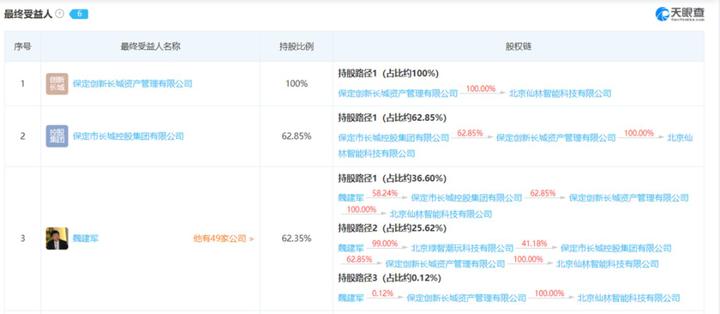 It is not difficult to find that from Apollo to Wenxin, it is difficult to say that its partner ecology is not concerned with the “body and soul theory”. So when engaging in co-creation with individual self-developed groups, is Baidu AI going to eat fat or drink soup? It seems to be a question mark.
On the other hand, cooperation often has progressive value. In the new energy era, there is no shortage of generalist technology companies, just like Mobileye’s cooperation in some smart driving solutions in the early years, and its own chips were arranged smoothly.
Although Baidu has smart cars and smart cabins, but in cooperation with self-developed schools like the Great Wall, the chances of future smart cars seem to be very slim. After all, the big model is also in full swing, and it is obviously difficult for Baidu to shake his position. .
On the whole, the relationship between car companies and technology companies today is more like playing mahjong together than a pure co-creation utopia. **On the surface, it is fun and harmonious, but in fact, everyone talks about their own things. OEMs emphasize self-research, and technology companies emphasize partner ecology. They must not only be brothers from all corners of the world, but also be afraid that their souls will not be in their own hands.
This can’t help but remind people of the process of autonomous driving from the “arms race” to the stage of open integration.
In the past two years, traditional full-stack self-research has been difficult for traditional OEMs, and technology companies have a high demand for landing. However, even under this background, they are moving towards co-creation. Today, there will still be problems such as OEMs “force” suppliers to deliver white boxes. type of game problems.
This is obviously not conducive to the development of the industry. For example, the white box problem often leads to low-level compromises of technology companies. It is also difficult for OEMs to ask suppliers to sincerely come up with superior technologies under the white box requirements.
We might as well use this as an analogy to the battle of large-scale models in the industry in the later period. How to avoid this similar “internal friction” game in the future?
In the view of Tan Qingshuo AI, the core of innovation is to clarify the difference between “landing” and “value landing”. **
Just like Huawei’s entry into the “car manufacturing”, the supplier model that seemed more secure in the early years was difficult to get through. On the contrary, the smart car model that is about to control the explosive list has become more and more popular recently. To put it bluntly, the smart car model is not a pale implementation, but based on the family’s bucket-style smart solution, it will give the target audience rare value in the industry when it is implemented.
Therefore, based on the large AI model, such as the smart cockpit, if everyone follows ChatGPT in the future, no matter how novel the technology falls into a market with serious homogeneity, it will be like today’s smart driving suppliers. Value is infinitely diluted.
Therefore, Tan Qing said that AI believes that to build a value anchor point for large-scale models to be put on the car, either there must be technical scarcity, or to explore the scarcity of the scene. The scarcity of technology is rare, but let’s talk about the scarcity of scenes. **
For example, today new energy vehicle black technologies emerge in endlessly, but many of them are reduced to tasteless in the use link. The problem here is to a certain extent that the adaptation value of the scene is ignored while the technology is at the bottom.
No matter how powerful the performance of the car and machine is, for most people, navigation + music are the two major things that are just needed. What is the value of voice interaction that car companies are equipped with? **It seems that it is more of an obsession that a person has and I must have. The so-called barriers are annihilated under such homogenization and follow, and move towards involution. **
Therefore, compared with the technological arms race, based on the advantages of large-scale model empowerment and interaction, it is a way of thinking to further focus on the excavation of in-vehicle scenes in the future and derive highly adaptable scene-based products.
After all, technology is a difficult problem, but it is a clever problem to do the ultimate optimization and adaptation for the understanding of the scene.
Just like TransFormer was born from Google, BERT focuses on more rigorous and reasonable language understanding, focusing on a technical flow, but it makes a wedding dress for ChatGPT, which focuses on simulating human-like feelings.
The result is that compared to the rigorous but impersonal BERT, you can listen to ChatGPT’s irresponsible and serious talk about “Lin Daiyu is weeping willows”, but why not?
Bet on the right direction, and the explosive power of technology will eventually emerge.


