Author: Galaxy Compilation: Yvonne, MarsBit
Note: This article is excerpted and translated from Galaxy’s mid-year report on bitcoin mining
overview
In 2022, miners face a dangerous storm, with a combination of headwinds putting them in a precarious position. The storm will not start to subside until the first half of 2023. The high energy prices that affect miners in 2022 have fallen back, and natural gas has dropped sharply, easing the power pressure on miners. Bitcoin prices are up 84% from their late 2022 low of $16,600. Due to ordinals, transaction fees have tripled, creating a new demand for block space. All of these developments are constructive for Bitcoin miners. However, despite a trend reversal in several key areas of the mining space, a number of favorable factors were offset by the phenomenal growth in network hashrate in the first half of the year, resulting in a new all-time high in mining difficulty. Affected by improving mining economics, oversupply of ASICs in the secondary market, new generation machines coming into use, and broad increases in international hashrate in places such as Russia, the Middle East, China, and South America, roughly 121 EH of hashrate was added in the first half of this year. In this report, we will delve into these major events and trends affecting the Bitcoin mining industry in the first half of 2023, and provide our views on the current state of the industry and the potential impact of the upcoming halving event.
Key Points
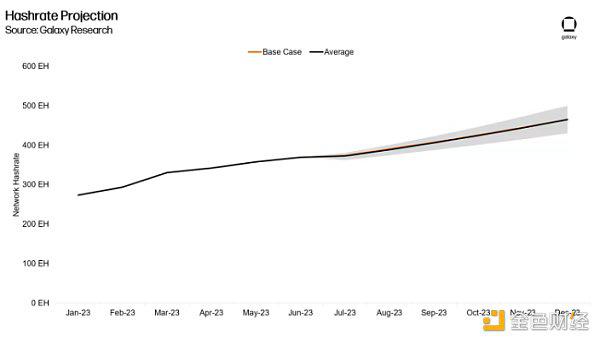
The increase in computing power and difficulty exceeded expectations, and the 30-day total network computing power increased by 121 EH. Given the availability of ASICs, especially next-generation ASICs, and our estimated breakeven hash price for the network below $0.045, we expect computing power to continue rising through the end of the year. Therefore, we increased our year-end hashrate assumption to 465 EH.
With Bitcoin’s fourth halving coming next year, miners are actively taking steps to either make mergers and acquisitions, diversify their business beyond mining, or upgrade their mining machines with a new generation of machines.
Natural gas prices have fallen 72% in the first half of the year since a 145% jump in 2022, pushing up electricity prices, providing miners with a huge boost.
Ordinals, which have been a complete unknown for miners, have helped boost transaction fees in the first half of this year to 8,228 BTC worth $219.8 million, compared to just 2,324 BTC worth $82.7 million in the first half of 2022. That’s a 166% year-over-year increase in USD terms and 254% year-over-year growth in Bitcoin terms.
On the regulatory front, 2023 sees continued increased hostility in the mining industry at the state and federal levels. Given the White House’s increased focus on the mining industry over the past year, a number of state-level regulators have decided to take action, forcing some miners to explore new opportunities outside the United States. Senate Bills 1751 and 1929 also proved that even in jurisdictions considered pro-mining, such as Texas and the ERCOT grid, mining is not completely immune to attacks.
Mining Economics
Bitcoin price recovers from 2022 lows
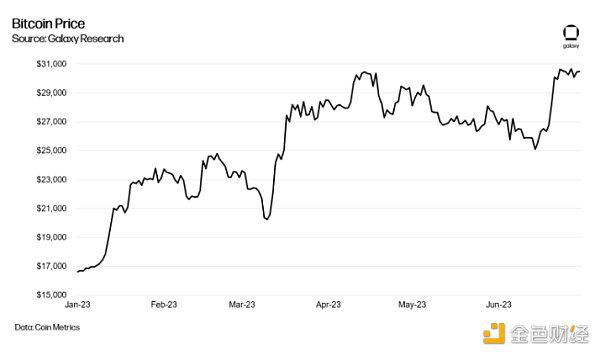
The price of mining computing power at the end of 2022 is close to the lowest point in history, and in the first half of 2023, despite the large increase in overall network difficulty and computing power, miners still get some relief. First, Bitcoin rose sharply, starting the year around $16,600, before experiencing wild swings in January, rising to $23,000. This was driven by an inflation report that hinted at signs of deflation. The incident prompted a shift in investor sentiment towards risk assets, including bitcoin, as the market began to factor in the Fed’s policy shift, leading to gains across the board for these assets.
From the end of January to the beginning of March, the bitcoin price showed strong resilience. Initially, the price of Bitcoin was in the range of $21,000 to $25,000, and then entered a period of volatility when the banking crisis started. Bitcoin, however, was designed to guard against exactly this, allowing individuals to have autonomy over their money and ride it all the way up. After an initial price crash, Bitcoin quickly rebounded to $27,000.
After this period of turmoil, Bitcoin hovered between $26,000 and $30,000, and broke the key resistance level of $30,000 after BlackRock filed with the SEC to launch a spot bitcoin ETF. .
Transaction Fees Surge
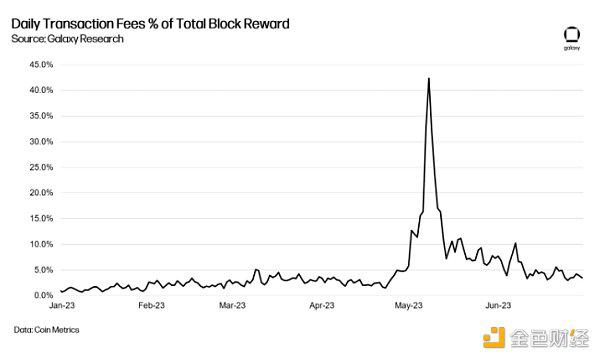
Historically, transaction fees have not played a meaningful role in the overall revenue of miners for a sustained period of time. In 2022, there will be hardly any congestion in the mempool, and fees will average between 1%-3% of total rewards. Going into 2023, the low-charging trend disappears as inscriptions proliferate. The eager search to inscribe satoshis in various forms of art, audio, and text has resulted in a significant increase in the mempool and block size. To prevent their transactions from being purged from the mempool and ensure inclusion in blocks, these users attach higher fees to their transactions.
So, as a particular inscription called BRC-20 grew in popularity, costs skyrocketed to unprecedented levels. The significant BRC-20 launch pushes fees up to 50% of the total block reward, or in other words, almost equal to the block subsidy of 6.25 BTC.
Even after the BRC-20 mania led to a huge spike in fees, fees remained high. In the first half of 2023, miners accumulated a total fee of 8684 bitcoins, compared with 2325 bitcoins in the first half of 2022, and a total fee of 5375 bitcoins in the whole of 2022. The increase in fees shows that miners have benefited enormously financially from the surge in transaction volume and corresponding fee increases, as fees feed directly into miner profits. Fees have since come off their highs as interest in BTC-20 has declined.
Network computing power continues to grow
Compared with the first half of 2022, the growth rate of network computing power is faster. From the beginning of 2023, the 30-day tracking network hash rate increased from 249 EH to 370 EH, an increase of 49%, compared with a growth rate of 22% in the first half of 2022.

While much of the growth in computing power in 2022 can be attributed to the flood of capital flooding the ASIC market in 2021 and machines just coming online, 2023 has its own set of drivers, including an increase in the price of Bitcoin , ASIC prices remain sluggish, natural gas prices plummet, and global miners join in.
Natural gas prices fell 72%. The drop in natural gas prices in the first half of the year provided miners with exposure to variable electricity prices, boosting their overall mining margins amid increased hashrate.
The price of Bitcoin is up 84%. Rising bitcoin prices have also wiped out most of the gains in hashrate in the first half of the year.
Compared to total fees for all of 2022, transaction fees are up 62%. The addition of ordinals significantly increases the demand for block space, which leads to higher fees and an increase in the total block reward, which also helps to offset and allow the hashrate to continue to grow.
Global computing power rises. While it is difficult to pinpoint the exact location of the hashrate, we suspect that the Middle East, Russia, Latin America, and other regions of the world such as Bhutan saw significant increases in hashrate during the first half of the year.
ASIC manufacturers continue to mass-produce new generations of ASICs. ASIC manufacturers have opted to maintain their capacity at foundries and may have resumed self-mining some of these machines, as overall demand for new ASICs has declined due to the high supply in the US secondary market.
Miners turned to underclocked machines to improve breakeven. To better weather the storm, some miners have been using custom firmware such as LuxOS and brains OS+ to lower the clocks of the S19 series machines and increase their efficiency, allowing them to be profitable at lower breakeven levels.
Computing Power Price
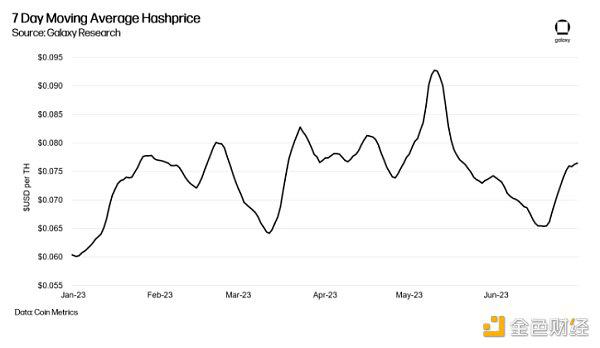
Despite the rise in hashrate, soaring bitcoin prices and generally high transaction fees pushed up hashrate prices, or revenue in dollars per TH per day. The 7-day moving average hashrate price will rise from $0.060/TH to $0.076/TH in the first half of 2023.
Computing Power Forecast
Bitcoin’s 30-day moving average network hash rate has increased by 49% from 249 EH to 370 EH in the first half of 2023, and the additional hash rate has increased by 121 EH. Considering that Bitcoin is priced at $16,600 in early 2023, with a hashrate price of $0.060, the increase in hashrate in such a short period of time is quite staggering. Assuming an average efficiency equivalent to 27.0j/TH of machines installed in the first half of the year, a total of 3.3 GW of capacity was brought online. Several important events occurred during the first half of the year, resulting in a significant increase in computing power:
Computing Power Forecast Correction
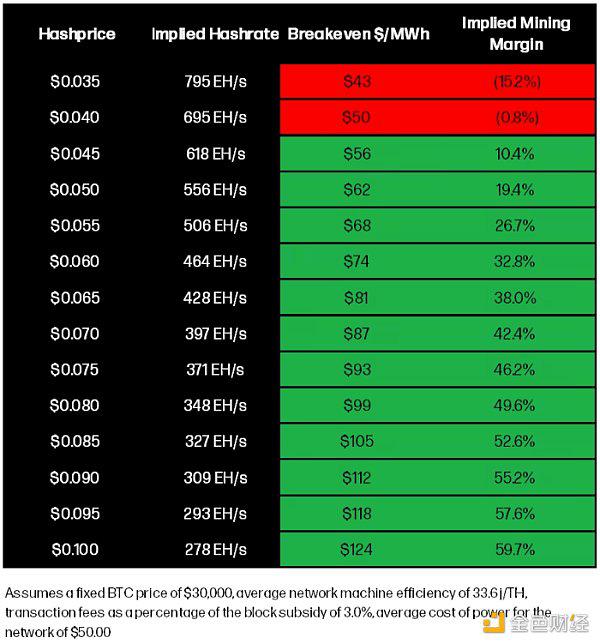
Methodology: We base our hashrate predictions on average miner electricity costs, the efficiency of the ASICs that make up the hashrate in the network, and a fixed bitcoin price assumption by trying to understand how much hashrate the network can sustain. For electricity costs, we assume an average miner electricity cost of $50 per MWh, based on ERCOT’s historical energy prices and the implied electricity cost of public miners. For the average efficiency of ASICs in the network, we refer to the research of Karim Helmy and Coin Metrics, and use nonce analysis to estimate the average efficiency to be 33.6 J/TH. Finally, we assume a fixed price of $30,000 for Bitcoin.
With these assumptions in place, we were able to calculate the total implicit content of the network’s hash power at different hash price levels. We can then derive the network’s breakeven USD/MWh based on the average machine efficiency of 33.6 j/TH at various hash price levels, and calculate the implied total mining assuming an electricity cost of $50 per MWh mining profit margin. From this analysis it is clear that the network can support a significant amount of additional hashrate and the current break-even network hashrate is likely to be around $0.045 or lower. This analysis gives us a potential theoretical maximum for hashrate. From this starting point, we arrive at forecasts by considering other factors that are more difficult to quantify but affect network hash rate growth, such as available capacity.
Bull market situation: We assume that in the bull market, the 30-day year-end network computing power is 500EH (a year-on-year increase of 101.6%). To achieve this, about 21.8 EH of computing power is required to come online per month, which means about 181,600 ASICs, equivalent to a power supply of 545 MW per month (assuming an average ASIC efficiency of 25 j/TH, mainly composed of S19 XP and M50 series of machines).
Base case: In the base case, we assume that the network hashrate at the end of 30 days is 465 EH (a year-on-year increase of 87.5%). To achieve this, approximately 16.0 EH of hashrate would need to come online per month, representing roughly 133,333 ASICs, equivalent to 400 megawatts of energy per month, assuming an average ASIC efficiency of 25 J/TH, mainly powered by the S19 XP and M50 series of machines.
Bear market scenario: In a bear market scenario, we assume that the network computing power will be 430 EH by the end of the year (an increase of 73.4% year-on-year). In order to achieve this goal, about 10.2 EH of computing power needs to be launched per month, which is equivalent to about 85,000 ASICs, which is equivalent to a monthly power supply of 255mw, assuming an average ASIC efficiency of 25j /TH, mainly composed of S19 XP and M50 series machines .
What to expect from Bitcoin’s fourth halving?
Bitcoin’s fourth halving is expected to happen around April 2024. Every 210,000 blocks (approximately every 4 years), the Bitcoin network automatically halves the issuance of new Bitcoins per block. This process culminated in a fixed supply of 21 million bitcoins. But given that block rewards (newly minted bitcoins) make up the majority of miners’ income, the halving is an important event for the mining industry that could have widespread ramifications.
How listed miners respond to halving
With the halving less than 10 months away, miners have developed several strategies to prepare for the event.
Fleet upgrades: For miners with better liquidity and the ability to raise funds to a certain extent, many miners have already invested in the latest generation of mining machines. Miners that are higher on the electricity cost curve are also choosing to try and upgrade their fleets to more efficient machines to put themselves in a better competitive position after the halving.
M&A: M&A has always been an attractive option for listed miners facing greater challenges due to high electricity costs, lack of a growth narrative, desire for vertical integration or inability to raise capital. In this way, miners are able to find companies that can bring resources to make up for their existing deficiencies.
Diversification of revenue: Some miners have announced their intention or have taken active steps to participate in the high-performance computing (HPC) data center space, thereby diversifying their revenue sources. The HPC space offers miners a source of income unrelated to Bitcoin mining while being able to capitalize on the massive hype surrounding AI computing.
Potential computing power may be offline
A recent study by Karim Helmy (ex-Galaxy Research) and Coin Metrics showed that around 30% of the network hashrate is made up of M20S, M32, S17, e12+, A1066, A1246 and S9 machines. As of June 30, the network hashrate was approximately 369 EH, and the implied contribution of this group of machines to the network hashrate was 110 EH. Given the low efficiency of these machines, it is reasonable to assume that the composition of these machines in the network will remain relatively fixed until the halving. If we assume that 110 EH for these machines represents that 90% of the machines will shut down due to being unprofitable, that would represent a loss of 99 EH.
If the network hashrate reaches 500 EH by the time of the halving, the 99 EH loss would reflect a 19.8% loss in network hashrate. When looking back at the 2020 halving, a 20-30% loss of network hashrate seems reasonable, as 25.5% of the network hashrate (representing 30.8 EH of hashrate) went offline after the halving. During the 2020 halving, most of the lost hashrate came from S9s that were no longer profitable. In the same month as the halving, Bitmain launched the S19 and S19 Pro, and MicroBT launched the M30S. As a result, network hashrate has made a fairly quick V-shaped recovery and reached an all-time high in just 55 days, while hash prices remain near all-time lows (range between $0.07 and $0.10).
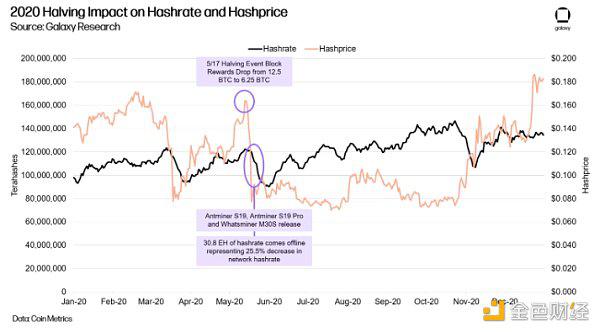
Given this, it does not seem far-fetched to expect a similar V-shaped recovery in network hashrate after the 2024 halving. Most of the network hashrate loss from less efficient machines will be quickly offset by the new M50 series and S19 XP series machines. Several listed miners have announced large ASIC futures orders for the M50 series and S19 XP series machines, with deliveries expected in the first and second quarters of 2024. MicroBT, Canaan and Bitmain are also very likely to announce yet another improved ASIC in their current line of machines around the time of the halving. Of course, the key factors that have a big impact on these results are energy prices, especially natural gas and bitcoin prices. Assuming gas remains at current levels and bitcoin prices can stay above $30,000, or even continue slightly higher, a v-shaped recovery of network hashrate seems the most likely outcome.
How much computing power the network can bear after halving
In an attempt to understand how much hashrate the network can sustain, we created a series of sensitivity analyzes to try and understand what Bitcoin price would ultimately be required to maintain a certain level of hashrate given a few key assumptions:
The average cost of generating electricity for a miner is $50 per megawatt-hour
Average network efficiency of 30.5 j/TH, mostly representative of the S19j Pro machine, half of the average machine efficiency
The price miners need to earn a 30% overall mining profit margin equates to a breakeven breakeven of $71 per megawatt-hour.
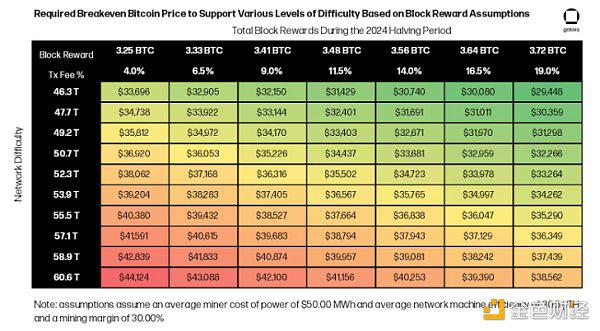
Please note that as of June 30th, the network difficulty is about 50.6T. Given the above assumptions, if the price of Bitcoin is between $30,000 and $35,000, then even at the current level of network difficulty (currently meaning that the network hashrate is 375 EH), the majority of miners in the network will still be able to Operating profitably with healthy gross margins. It is also interesting that increased transaction fees may reduce the effective breakeven price of Bitcoin, which is necessary to maintain profitability at different levels of network hashrate.
Using the same analysis, but with more aggressive assumptions about the average cost of electricity and efficiency of the machines, the price of Bitcoin required to maintain various levels of network computing power falls by about 50%. Main assumptions:
The average cost of generating electricity for a mining rig is $40 per megawatt-hour
The average network efficiency is 25.0 j/TH, representing the average efficiency of the S19 XP and S19j Pro machines
The price miners need to earn a 30% gross mining profit margin

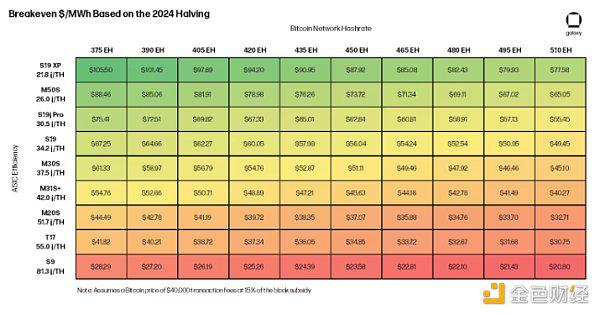
In another analysis, we looked at the breakeven USD/MWh of various ASIC models, assuming a bitcoin price of The marginal revenue of the most efficient ASIC, the S19 XP, is also just over $100 at the power level. Therefore, the halving will put more emphasis on miners’ electricity strategies and how they can optimize between floating indices and forward hedging. Another possible outcome is that miners with 100% index pricing will experience more downtime than usual. With development, this phenomenon may increase the volatility of network computing power.
in conclusion
The series of storms that miners faced towards the end of 2022 are finally starting to dissipate. While miners enjoyed higher bitcoin prices, higher transaction fees, and lower energy costs, the dramatic increase in network computing power offset many of these benefits. As such, the hash price has remained within a fairly narrow range between $0.065 and $0.08. With gas prices down significantly and energy prices down significantly from 2022 highs, the network’s breakeven hash price could be below $0.05. Given this, network hashrate will continue to move higher in the second half of the year as miners and independent miners look to increase the hashrate of next-generation machines such as the S19 XP and M50 series.
Miners are taking some steps to prepare for the 2024 halving. A handful of miners have announced plans to move away from mining to areas such as high-performance computing to provide more stable non-correlated cash flows. There is also a wave of mergers and acquisitions, mainly from miners who are disadvantaged in the upcoming halving. For miners that are not vertically integrated, lack a growth narrative, or lack the ability to finance, M&A makes sense.


