Original source: AGI Innovation Lab
On July 24, WorldCoin, a Web3 encryption project co-founded by OpenAI founder Sam Altman, officially announced its launch. Sam Altman and WorldCoin CEO Alex Blania issued a joint announcement at the same time, officially announcing the news.
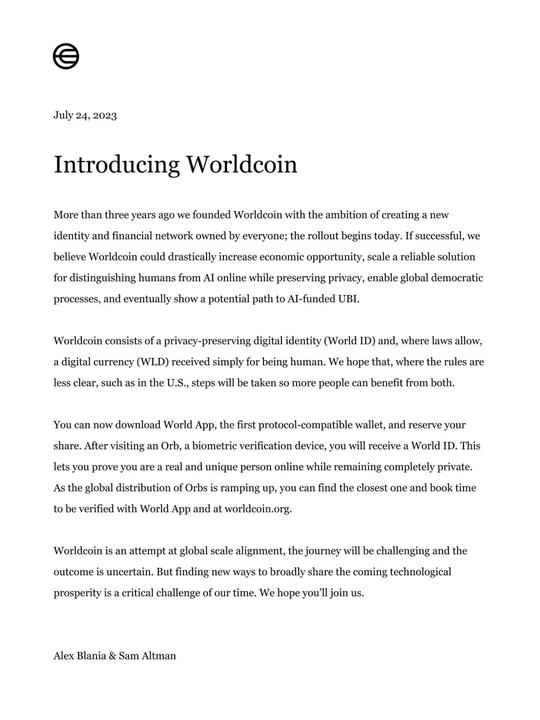
Three years ago, we founded Worldcoin with the ambition to create a new identity and financial network owned by everyone; rollout begins today. If successful, we believe Worldcoin could dramatically increase economic opportunity, scale reliable solutions for differentiating humans from AI online while preserving privacy, enable global democratic processes, and ultimately demonstrate a potential path to AI-funded Universal Basic Income (UBI).
Worldcoin consists of a privacy-preserving digital identity (World ID) and a digital currency WLD (only human beings can obtain it if permitted by law). We hope that in places where the legal rules are less clear, such as in the United States, measures can be taken so that more people can benefit from it.
You can now download the World App, the first protocol-compatible wallet, and pre-order your share. After accessing an Orb, a biometric verification device, you will receive a World ID. This allows you to prove online that you are a real and unique human being while maintaining complete privacy.
With the increasing global distribution of Orbs devices, you can find the closest one through the World App and worldcoin.org and make an appointment to verify it.
Worldcoin is an attempt to coordinate on a global scale. This process will be full of challenges and the results are uncertain. But finding new ways to broadly share the coming technological boom is one of the great challenges of our time. We hope you will join us.
Another Global Experiment by Sam Altman
WorldCoin is the latest global experiment of Sam Altman. At present, the number of users verified by WorldCoin has exceeded 2 million. Sam’s goal is all mankind, and at the same time bring cryptocurrency to 1 billion people around the world.
WorldCoin has raised nearly $250 million in funding, with investors including a16z, Coinbase Ventures, and others.
Worldcoin is a global cryptocurrency project whose goal is to provide free cryptocurrency to everyone around the world. To achieve this, the Worldcoin team devised a system called World ID to ensure everyone has a fair share of their cryptocurrency while preventing fraud and abuse.
World ID is a biometric-based authentication system. It uses a special device, the eye scanner Orb, to verify a user’s identity by scanning their irises. Since everyone’s iris is unique, this opens up the possibility of building a system that is fair and hard to abuse.
The boom in large language models is such that the gap between AI and real humans is narrowing. Issues of human proof, information authenticity, and privacy are becoming more and more prominent, especially the human proof problem. How to determine if a user is a real human being and not a computer program or bot?
So, how does World ID solve AI problems? Here are some major solutions:
- Prevent identity fraud
AI often needs to deal with authentication issues, which are critical for many applications such as online banking, email, social media, and more. However, traditional authentication methods such as passwords, SMS verification codes, etc. are vulnerable to fraudulent attacks. World ID provides a more secure and difficult-to-forge form of identity verification through the use of iris scanning.
- Data privacy protection
AI systems often need to process large amounts of personal data, which can raise privacy concerns. World ID helps protect user privacy by not storing an image of the user’s iris, but converting it into an irreversible digital identifier.
- Improve fairness
AI systems may be unfair when dealing with resource allocation issues. For example, some users may obtain more resources by creating multiple accounts. By using World ID, each person can only create one account, thus ensuring that everyone has fair access to resources.
- Protection against bot and automated program abuse
AI can create bots or automated programs that mimic human behavior and abuse the system. However, because World ID requires users to perform iris scans, this makes it difficult for bots and automated programs to abuse the system.
It should be noted that while World ID has the potential to solve these AI problems, it also raises some questions about privacy and ethics, such as whether users are willing to provide their biometric information in order to obtain cryptocurrency, and how protected the use and storage of such information should be.
Separately, WorldCoin also announced the release of the World ID SDK, which is now available for public use and integration.
References:
Disclaimer: The information on this page may come from third parties and does not represent the views or opinions of Gate. The content displayed on this page is for reference only and does not constitute any financial, investment, or legal advice. Gate does not guarantee the accuracy or completeness of the information and shall not be liable for any losses arising from the use of this information. Virtual asset investments carry high risks and are subject to significant price volatility. You may lose all of your invested principal. Please fully understand the relevant risks and make prudent decisions based on your own financial situation and risk tolerance. For details, please refer to
Disclaimer.


