Individuals transacting cryptocurrency on offshore platforms or independently must now report their movements when the amount of crypto transacted surpasses $5,000 per year. Users must now deliver sensitive data, including the purpose of each transaction, hashes, and destination addresses.
Paraguay Ramps Up Crypto Reporting Requirements For VASPs and Individuals
The government of Paraguay is ramping up the scrutiny of the cryptocurrency market.
The National Directorate of Tax Revenue (DNIT), Paraguay’s tax watchdog, has issued a resolution creating a new figure, a sworn cryptoassets statement, to obtain a more granular control and oversight of the crypto movements in the country.
Resolution No. 47 establishes that both operators of virtual asset service providers (VASPs) and individuals making crypto transactions with volumes going over $5,000 per year, even if transacting using offshore accounts or outside exchange platforms, must issue this detailed statement.
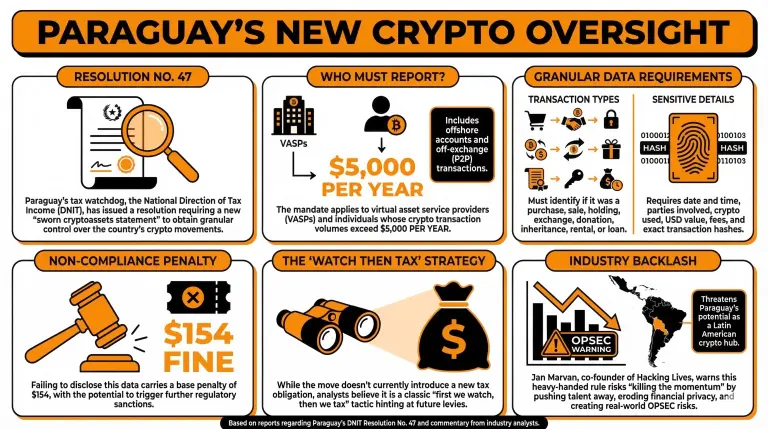
The document must identify, at the very minimum, the class of transaction completed -purchases and sales, holding or possession, exchanges between different crypto assets, donations, inheritances, temporary assignments, rentals, or loans, among others.
In the same way, for each transaction, the user must include sensitive data, such as date and time, the parties involved, the cryptocurrency used, the amount traded, the value transacted in U.S. dollars, fees, and transaction hashes.
The penalty for failing to disclose this data during the expected period is $154, and it could result in other penalties.
While this move doesn’t introduce a tax obligation, analysts believe this might be a classic “first we watch, then we tax” move, hinting at future moves to leverage this information via new levies.
Jan Marvan, co-founder of Hacking Lives, stressed that this was a troubling development for the nation’s crypto scene, as it could affect its possibilities of becoming a crypto hub in Latin America.
“This kind of heavy-handed rule risks killing that momentum. It will push talent away, slow down everyday adoption, erode financial privacy, and in the worst cases create real-world OPSEC risks for users,” he concluded.
FAQ
- What recent action has the government of Paraguay taken regarding cryptocurrencies?
Paraguay is increasing scrutiny of the crypto market by implementing a sworn cryptoassets statement for enhanced oversight of crypto transactions.
- What does Resolution No. 47 require from virtual asset service providers and individuals?
Operators and individuals engaging in crypto transactions over $5,000 per year must issue a detailed statement identifying transaction types and sensitive data.
- What details must be included in the sworn statement?
The statement must include transaction specifics such as date, time, parties involved, cryptocurrency used, and amount traded, along with the transaction hash.
- What implications does this resolution have for Paraguay’s crypto market?
Analysts warn that while it doesn’t introduce new taxes now, it may lead to future taxation, potentially hindering Paraguay’s growth as a crypto hub in Latin America.
Disclaimer: The information on this page may come from third parties and does not represent the views or opinions of Gate. The content displayed on this page is for reference only and does not constitute any financial, investment, or legal advice. Gate does not guarantee the accuracy or completeness of the information and shall not be liable for any losses arising from the use of this information. Virtual asset investments carry high risks and are subject to significant price volatility. You may lose all of your invested principal. Please fully understand the relevant risks and make prudent decisions based on your own financial situation and risk tolerance. For details, please refer to
Disclaimer.
Related Articles
CLARITY Act Needs Urgent Action, Says Senator Lummis
The race to define cryptocurrency regulation in the United States is entering a critical phase. Cynthia Lummis has warned lawmakers that delays could weaken the country’s position in the global digital economy. In particular, she stressed during a recent Senate hearing that the CLARITY Act needs
Coinfomania18m ago
Federal Judge Tosses Crypto Developer's Preemptive Suit Over Money Transmitter Laws - Unchained
A Texas judge dismissed a lawsuit by crypto developer Michael Lewellen regarding non-custodial donation software and federal money transmitter laws, ruling he lacked evidence of imminent prosecution. This highlights ongoing legal uncertainties for DeFi developers and their calls for clearer regulations.
UnchainedCrypto21m ago
Brazil passes law turning seized crypto into public-security war chest
Brazil's new law allows for confiscated cryptocurrencies from organized crime to fund public security efforts, enhancing judicial power to seize digital assets and modernizing the approach to digital property and crime.
CoinDesk58m ago
Brazil passes new law to include seized crypto assets in public safety funds, expanding law enforcement authority.
Brazilian President Lula signed Law No. 15,358, which incorporates seized cryptocurrencies into public safety funds, expands the authority of judicial agencies, allows freezing and confiscating assets during investigations, strengthens efforts against organized crime, and promotes enhanced regulation and management of digital assets.
GateNews1h ago
Leading polysilicon company in Xinjiang fined over 100 million yuan for illegally supplying power to virtual currency mining
Gate News reports that on March 26, a leading polysilicon company in Xinjiang (a core raw material for the semiconductor and photovoltaic industries) was fined and had its illegal gains confiscated by regulators for illegally supplying power to virtual currency mining activities. The total penalty exceeded 100 million yuan. It is understood that local authorities are intensifying supervision of virtual currency mining, requiring comprehensive inspections and strictly prohibiting companies from illegally re-selling power in any form. Currently, Xinjiang has explicitly classified virtual currency mining as an industry to be phased out, and related enforcement actions are ongoing.
GateNews2h ago


