Breaking his silence after a 25-year sentence, SBF challenges fraud allegations through social media
Currently serving a 25-year sentence at the Metropolitan Detention Center in Brooklyn, FTX founder Sam Bankman-Fried (SBF) broke his silence on February 20, posting a series titled “Top 10 Misunderstandings About Me and FTX” on social platform X.
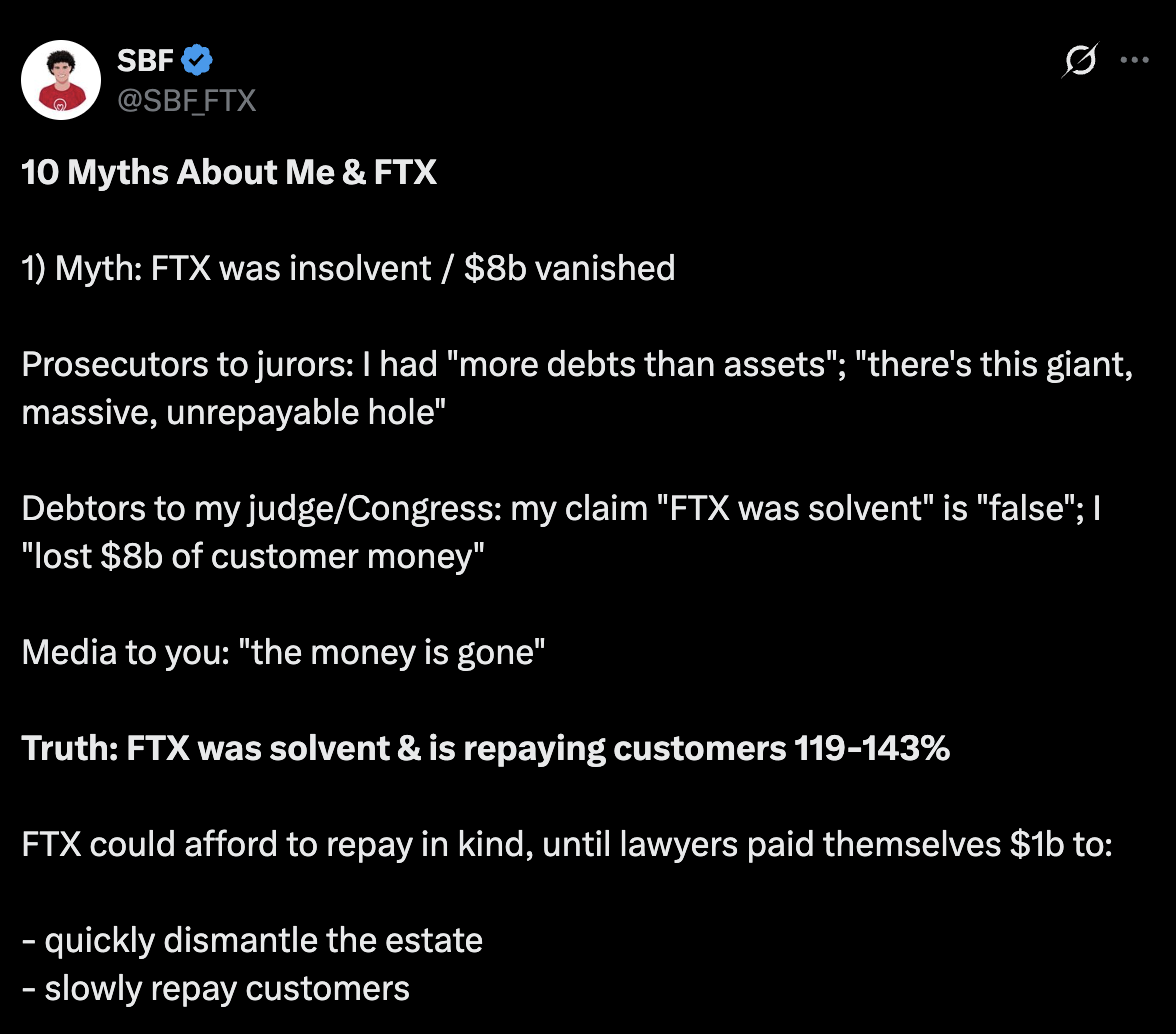
Image source: X/@SBF_FTX | FTX founder Sam Bankman-Fried posts a series titled “Top 10 Misunderstandings About Me and FTX”
This marks SBF’s most forceful public rebuttal since being convicted of seven counts of fraud and conspiracy in November 2023. In his posts, he vigorously refutes the core narrative that led to his imprisonment, claiming FTX was never truly insolvent, and pointing out that customers are currently receiving 119% to 143% compensation, demonstrating the company’s assets are sufficient to cover its debts. SBF argues that the 2023 trial was extremely unfair, emphasizing that the so-called “loss of $8 billion” is purely fictional, and that the company still maintained a strong balance sheet at the time of collapse.
He further questions the legitimacy of the bankruptcy process, citing creditor advocate Mr. Purple, describing FTX’s bankruptcy as one of the “darkest” cases he has seen. According to reports, legal and professional fees for the case have already exceeded $1 billion.
SBF accuses that lawyers initially filed for Chapter 11 bankruptcy protection without his consent, at a time when the company was facing only a short-term liquidity crisis, not a total collapse. He claims that within days of the run on the bank, he received external funding offers sufficient to cover the shortfall and maintain withdrawals, but these solutions were ultimately blocked by the team handling the restructuring.
Controversy over repayment rate; the valuation gap behind the 119% figure
Although SBF repeatedly emphasizes that customers will receive over 100% compensation, legal experts and creditors generally doubt this claim, viewing it as a narrative manipulation. Under U.S. bankruptcy law, creditor claims must be valued as of the filing date, November 11, 2022. At that time, the crypto market was crashing due to FTX’s collapse, with prices at historic lows. For example, if a customer held one Bitcoin ($BTC) on FTX, under the current payout plan they might receive about $17,000 in cash. While this is 119% of the November 2022 valuation, compared to Bitcoin’s market price surpassing $100,000 in 2026, the customer has effectively suffered potential losses exceeding $80,000.
CEO John Ray III, overseeing FTX’s restructuring, previously confirmed that the team has recovered approximately $14.7 billion to $16.5 billion in assets, including a 13.56% stake in AI company Anthropic and proceeds from liquidating multiple properties. According to the approved payout plan, about 98% of small creditors (claims under $50,000) are expected to receive payments within 60 days after the plan takes effect in September 2025.
However, large creditors’ payout timelines remain uncertain, and issues related to IRS tax claims and potential asset recovery lawsuits continue to be variables in the distribution process. SBF attempts to use the seemingly high repayment ratio to clear his fraud charges, but for creditors who have lost the opportunity for asset appreciation tied to cryptocurrencies, this “full repayment” appears unconvincing.
Denial of scandals and secret backdoors; criticizing judicial unfairness
Beyond financial allegations, SBF also takes this opportunity to clarify long-standing rumors about his private life. He explicitly denies accusations of “polycules” or “orgies,” which have been previously linked by media to the late Jeffrey Epstein’s activities. SBF states he never attends parties or vacations, and even in the luxury mansion owned by FTX, he only paid $50,000 in rent for using 10% of the space. He emphasizes that all personal expenses and donations come from his legitimate income, not misappropriated customer funds.
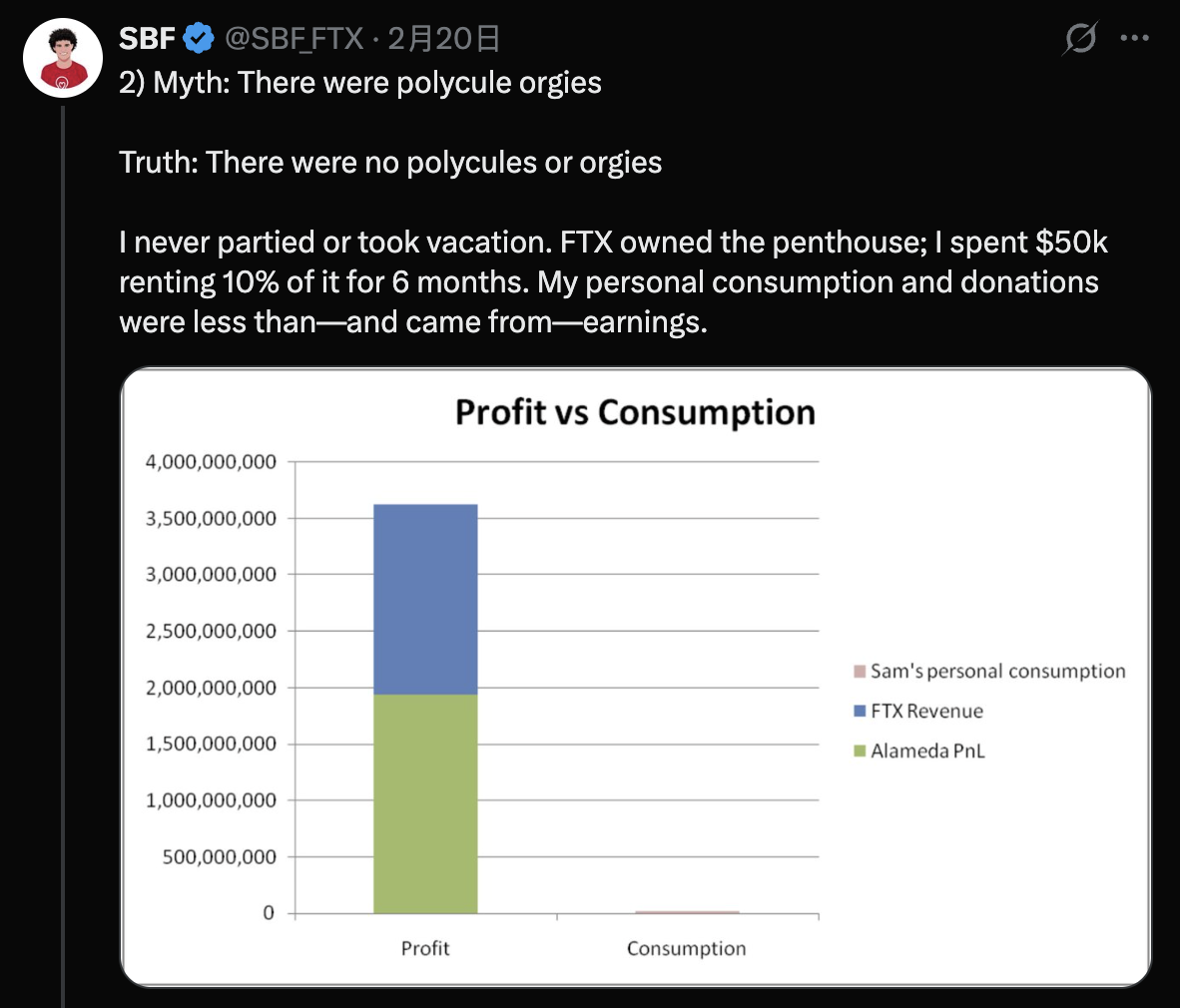
Image source: X/@SBF_FTX | SBF explicitly denies allegations of “polycules” or “orgies”
On a technical and operational level, SBF firmly denies establishing any secret “backdoors” in Alameda Research to bypass risk controls. He argues that FTX’s margin mechanism inherently includes collateral pools and lending functions, and that Alameda’s account activities serve legitimate business purposes, not violating exchange terms.

Image source: X/@SBF_FTX | SBF firmly denies creating any secret “backdoors” for Alameda Research
He attributes the 2022 collapse to risk management failures and liquidity crises, rather than premeditated criminal acts. Regarding testimonies from former executives like Caroline Ellison, Gary Wang, and Nishad Singh, SBF claims they provided false statements in exchange for reduced sentences. Ultimately, Ellison received only 2 years, Wang was granted probation, and Singh avoided prison, deepening SBF’s doubts about the fairness of the trial.
Personal motion for retrial; alleging political interference
In early February 2026, SBF, through his mother Barbara Fried (a former Stanford Law professor), submitted a 35-page pro se motion to the Manhattan federal court, formally requesting a new trial. In the motion, he claims that Judge Lewis Kaplan displayed obvious bias and prevented the defense from presenting key evidence, including proof of FTX’s solvency and professional legal advice. He even requests a different judge to review the case, arguing that Kaplan’s rulings misled the jury.
This legal battle also extends into the political arena. SBF accuses the Biden administration of political persecution, claiming that as a major Democratic donor turned Republican, he was targeted. He alleges federal prosecutors deliberately concealed evidence favorable to him and threatened his former CEO Ryan Salame’s pregnant fiancée to force Salame to plead guilty and avoid testifying.
Despite SBF’s efforts to seek political relief and hope for a presidential pardon from Trump’s administration, Trump has made it clear he has no intention of releasing the controversial CEO. As $FTT tokens fluctuate wildly due to SBF’s actions, this intersection of legal, political, and financial battles in prison is unlikely to settle soon.
Trump’s stance: “No pardon”! SBF faces 25 years, parents’ efforts to save him fall short
Disclaimer: The information on this page may come from third parties and does not represent the views or opinions of Gate. The content displayed on this page is for reference only and does not constitute any financial, investment, or legal advice. Gate does not guarantee the accuracy or completeness of the information and shall not be liable for any losses arising from the use of this information. Virtual asset investments carry high risks and are subject to significant price volatility. You may lose all of your invested principal. Please fully understand the relevant risks and make prudent decisions based on your own financial situation and risk tolerance. For details, please refer to
Disclaimer.
Related Articles
TRIA (Tria) up 33.5% in 24 hours, now trading at 0.04949 USD
Gate News: On March 23, according to Gate market data, as of press time, TRIA (Tria) rose 33.5% in 24 hours, now trading at $0.04949; reaching a high of $0.0508 and a low of $0.0358, with 24-hour trading volume reaching $35.9272 million.
Tria is a cross-chain routing engine with a self-custodial crypto neobank at its core. The platform enables users to spend, stake, and swap across 200+ chains—no gas, no seed phrases, no stress. One app, every chain, zero complexity.
Tria provides multiple core features: users can spend digital assets through the Tria card in 150+ countries, supporting top-ups with over 1,000 tokens, with no custodial intermediaries.
GateNews5m ago
XRP Today's News: SOPR Approaching Historical Signal of 1, Bottom Signal Emerging
XRP has continued to underperform since the start of the year, failing to attract market capital, with current trading prices below major moving averages. SOPR and NUPL indicators show bottom signals, but these are only probabilistic characteristics. $1.51 serves as a near-term bullish-bearish dividing line, with breakouts potentially triggering a bullish rebound. The market maintains a cautious stance on XRP's short-term strong rebound, with the probability of returning to $2 at only 5%.
MarketWhisper8m ago
A certain retail address bought 1.27 million SIREN at $0.07827 two months ago and has already made a profit of $1.99 million.
Gate News, March 23rd. According to @ai_9684xtpa monitoring, a retail address purchased 1.27 million SIREN tokens 2 months ago at $0.07827 per token, with a cost of approximately $99,700. During the holding period, SIREN price surged 2095%. The address never sold during this time. Finally, 14 hours ago, it took profits at $1.64 per token, with total proceeds of approximately $2.09 million and gains of approximately $1.99 million.
GateNews27m ago
The crypto market is widely declining, with BTC breaking below $68,000, while AI and Meme sectors rally against the trend with gains exceeding 3%
On March 23, the crypto market experienced widespread declines, with Bitcoin and Ethereum falling 1.42% and 1.78% respectively. The RWA sector suffered a significant drop of 4.85%, while AI and Meme sectors bucked the trend with gains of 10.36% and 3.66% respectively. Other sectors showed mixed performance, with overall market sentiment remaining weak.
GateNews28m ago
Altura ($ALU) Leads the Top Crypto Projects By Weekly TVL Growth
DeFiLlama reported that Altura ($ALU) leads in weekly Total Value Locked (TVL) growth among crypto projects, with a 45.4% increase. SynFutures ($F) follows, and other projects like APWine Finance ($APW) and Qubic ($QUBIC) show significant market cap differences.
BlockChainReporter1h ago
HAWK Meme Coin Collapse: One Year Later, Hailey Welsh Speaks Out on Trauma and FBI Investigation
Hailey Welsh suffered significant trauma from the collapse of meme coin HAWK, which she helped promote in 2024. The token's market value plummeted 91% from $490 million. Following an FBI investigation that cleared her of wrongdoing, Welsh faced death threats and experienced mental health damage. She continues to emphasize questions about the boundaries of promotional responsibility.
MarketWhisper1h ago


