Author: Trend Research
Since the market crash on 1011, the entire cryptocurrency market has been dull, with market makers and investors suffering heavy losses. Recovery of funds and sentiment takes time.
But the crypto market is never short of volatility and opportunities, and we remain optimistic about the future.
Because the trend of integrating crypto assets with traditional finance into new business models has not changed; instead, it has rapidly built up a moat during market downturns.
1. Wall Street Consensus Reinforced
On December 3, U.S. SEC Chairman Paul Atkins stated in an exclusive interview with FOX on the NYSE: “In the next few years, the entire U.S. financial market may migrate onto the chain.”
Atkins said:
-
The core advantage of tokenization is that if assets exist on the blockchain, ownership structures and asset attributes will be highly transparent. Currently, listed companies often do not know exactly who their shareholders are, where they are located, or where their shares are.
-
Tokenization also aims to achieve “T+0” settlement, replacing the current “T+1” trading cycle. In principle, on-chain delivery payment (DVP) / receipt payment (RVP) mechanisms can reduce market risk and increase transparency, while the current time gap between clearing, settlement, and fund delivery is one of the sources of systemic risk.
-
Tokenization is considered an inevitable trend in financial services, with mainstream banks and brokerages already moving toward tokenization. The world may even see this within less than 10 years… perhaps in just a few years it will become a reality. We are actively embracing new technologies to ensure the U.S. remains at the forefront in areas like cryptocurrency.
In fact, Wall Street and Washington have already built a deep capital network in crypto, forming a new narrative chain: U.S. political and economic elites → U.S. Treasuries (government bonds) → stablecoins / crypto treasury companies → Ethereum + RWA + L2

From this diagram, we can see the complex connections among the Trump family, traditional bond market makers, the Treasury Department, tech companies, and crypto firms, with the green oval connections forming the main backbone:
(1) Stablecoins (USDT, USDC, WLD-backed USD assets, etc.)
The main reserves are short-term U.S. Treasuries and bank deposits, held through brokers like Cantor.
(2) U.S. Treasuries
Issued and managed by the Treasury / Bessent side.
Used by Palantir, Druckenmiller, Tiger Cubs, etc., for low-risk yield positions.
Also the yield assets pursued by stablecoins / treasury companies.
(3) RWA
From U.S. Treasuries, mortgages, accounts receivable to housing finance.
Tokenized via Ethereum L1 / L2 protocols.
(4) ETH & ETH L2 Rights
Ethereum is the main chain supporting RWA, stablecoins, DeFi, AI-DeFi.
L2 equity/tokens represent rights to future transaction volume and fee cash flows.
This chain expresses:
USD credit → U.S. Treasuries → Stablecoin reserves → Various crypto treasury / RWA protocols → Ultimately settled on ETH / L2.
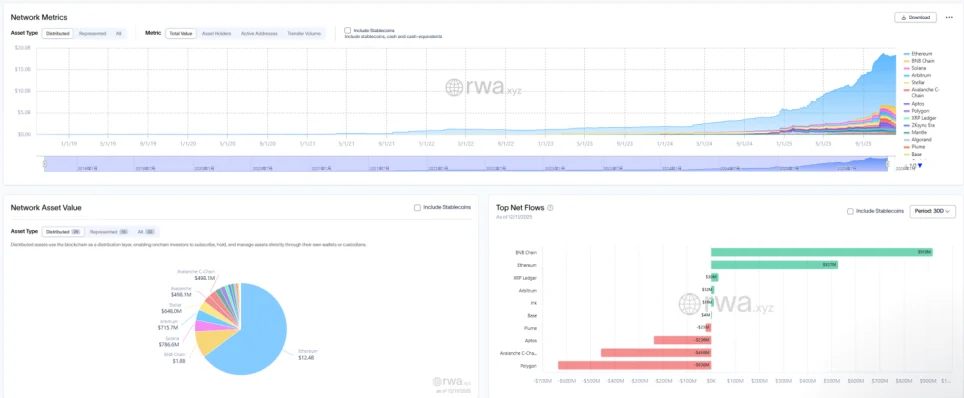
Compared to other public chains during the 1011 decline, ETH is the only chain that quickly recovered from the dip and rose. Currently, TVL is 12.4 billion USD, accounting for 64.5% of total crypto.
2. Ethereum Exploring Value Capture
Recently, the Ethereum Fusaka upgrade did not cause much market turbulence, but from the perspective of network structure and economic model evolution, it is a “milestone event.” Fusaka is not just about scaling via EIPs like PeerDAS but attempts to address the issue of insufficient value capture by the L1 mainnet since the development of L2.
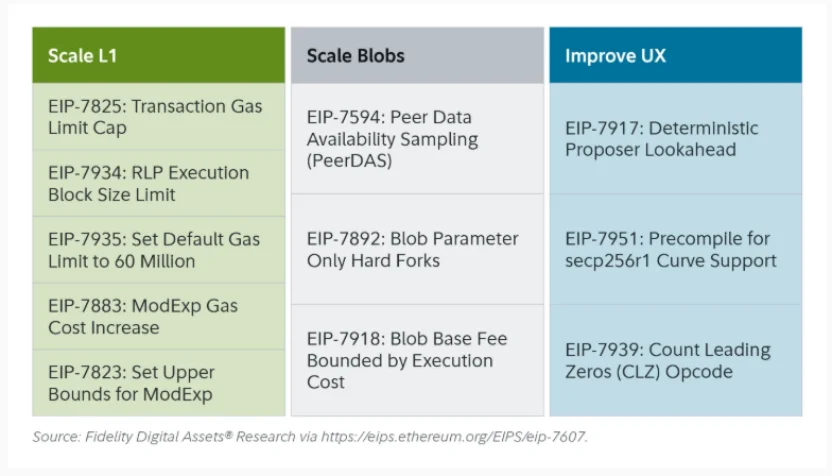
Through EIP-7918, ETH will introduce a “dynamic floor price” for blob base fees, binding its lower limit to the L1 execution layer base fee, requiring blobs to pay DA fees at a unit price roughly equal to 1/16 of the L1 base fee; this means Rollups can no longer occupy long-term unit prices at near-zero costs.
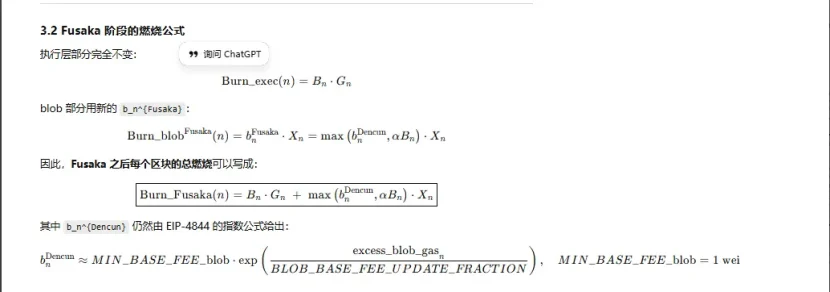
There are three “burn” related upgrades in Ethereum:
(1) London(Single Dimension): Burns only the execution layer, causing structural burn of ETH due to L1 usage.
(2) Dencun (dual dimension + independent blob market): Burns execution layer + blob; ETH burned when L2 data is written into blobs, but during low demand, the blob part is almost zero.
(3) Fusaka (dual dimension + blob and L1 binding): To use L2 (blob), you must pay at least a fixed proportion of the L1 base fee, which is burned; L2 activity is more stably mapped to ETH burn.
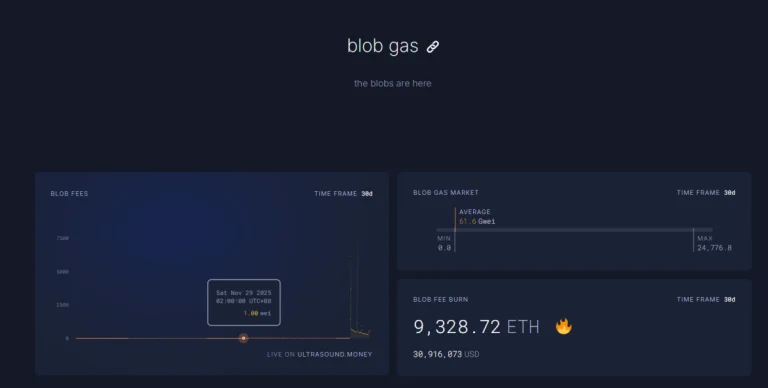


Currently, blob fees on December 11th for one hour have reached 569.63 billion times before the Fusaka upgrade, burning 1,527 ETH daily. Blob fees account for up to 98% of the burn contribution, making it the largest contributor. As ETH L2 activity further increases, this upgrade is expected to bring ETH back to a deflationary state.
3. Ethereum Technical Strengthening
During the 1011 decline, ETH futures leverage positions were fully cleared, eventually killing off spot leverage positions. Many investors lacking confidence in ETH also reduced their holdings, causing many old-school OGs to exit. According to Coinbase data, speculative leverage in the crypto space has fallen to a historic low of 4%.
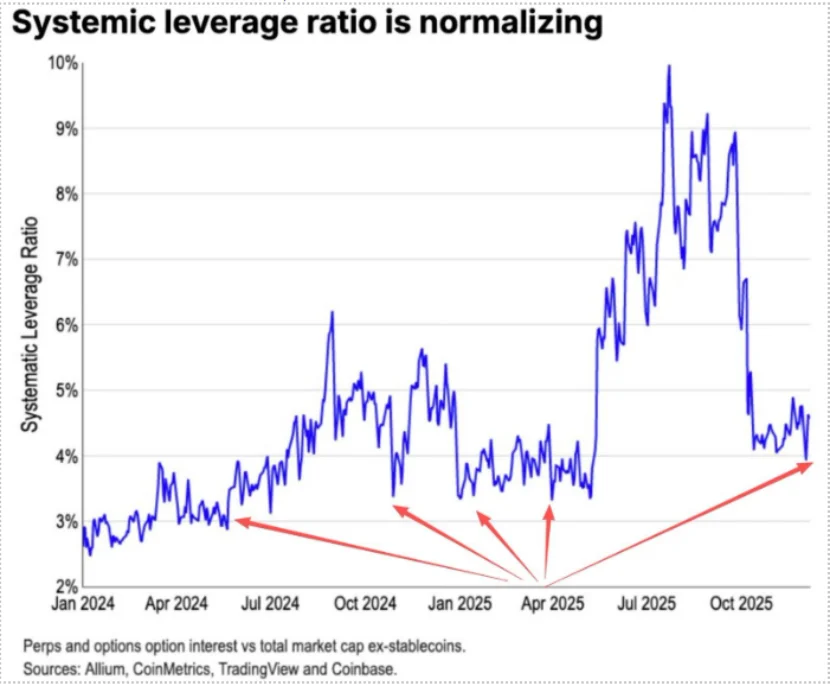
A significant part of ETH’s past bearishness came from traditional Long BTC / Short ETH paired trading, which generally performed well in previous bear markets. However, an unexpected event occurred this time. The ETH/BTC ratio has been sideways since November, resisting further decline.

ETH now has about 13 million tokens in exchanges, roughly 10% of the total supply, at a historic low. As the Long BTC / Short ETH pair failed since November, in times of extreme market panic, there may gradually be “short squeeze” opportunities.

Looking ahead to 2025–2026, friendly signals have been sent regarding future U.S. and China monetary and fiscal policies:
The U.S. will actively cut taxes, lower interest rates, and relax crypto regulations; China will adopt appropriate easing and financial stability measures (to suppress volatility).
In the context of relatively loose policies in the U.S. and China, and scenarios that suppress downward asset volatility, during extreme panic when funds and sentiment are not fully recovered, ETH remains a relatively good “buying zone.”
_(The above content is authorized and reprinted with permission from partner PANews. Original link | Source: Cycle Trading)__**
_
Disclaimer: This article is for market information only. All content and opinions are for reference only and do not constitute investment advice. They do not represent the objective views and positions of Block. Investors should make their own decisions and transactions. The author and Block will not be responsible for any direct or indirect losses resulting from investor transactions._


