Ethereum can afford to lose finality from time to time without putting the network at serious risk, according to co-founder Vitalik Buterin, even after a recent client bug came close to disrupting the blockchain’s confirmation mechanism.
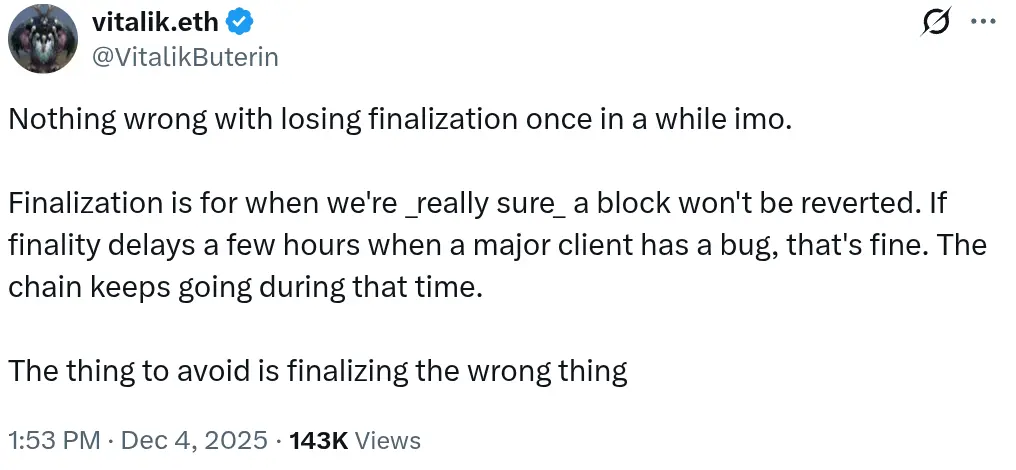
Following a recent bug in the Prysm Ethereum client, Buterin said in an X post that there is “nothing wrong with losing finalization once in a while.” He added that finalization indicates the network is “really sure” a block will not be reverted.
Buterin argued that if finality is occasionally delayed for hours due to a major bug, “that’s fine,” and the blockchain keeps working while that happens. The real issue would be something else, he said: “The thing to avoid is finalizing the wrong thing.”
 Source: Vitalik ButerinRelated: Ethereum’s first ZK-rollup, ZKsync Lite, to be retired in 2026
Experts weigh in on finalization loss
Fabrizio Romano Genovese, PhD in computer science at the University of Oxford, England, partner at the blockchain research company 20squares, and Ethereum protocol expert, agreed with Buterin.
He said that when finality is lost, Ethereum becomes more like Bitcoin (BTC), and pointed out that Bitcoin has had “no finality since 2009 and no one complains.”
A proof-of-work blockchain, such as Bitcoin’s, can branch into multiple chains, with the one that receives the most work (usually the longest) considered valid. Still, if a secondary branch grows enough to overtake the main branch, it invalidates the main branch and the transactions it contained — this is called a reorganization.
This is how Bitcoin operates: its finality is probabilistic, not deterministic, because — while it is almost impossible after enough blocks are added to the main branch — a reorganization can still theoretically occur. Genovese explained how Ethereum is different, with rules setting blocks as “final.”
Ethereum has a finalization mechanism: when a block receives more than 66% of the validator votes, it becomes ‘justified.’ At this point, if more than two epochs (64 blocks) pass, the block is finalized.
This is not just theoretical; it happened in May 2023 due to an incident very similar to the recent one with the Prysm client. Genovese said that these incidents do not make the chain insecure; instead, “it just means that our guarantees around reorg have temporarily reverted to be probabilistic and not deterministic.”
Related: Vitalik Buterin floats gas futures on Ethereum to hedge fee spikes
Consequences for L2s and bridges
Still, Genovese noted that a lack of finality would affect infrastructure that relies on it, including some inter-blockchain or layer-2 (L2) bridges. A representative from the Ethereum sidechain Polygon told Cointelegraph that Polygon would continue with normal operations, but transfers from Ethereum to the sidechain “may be delayed while waiting for finality.”
Furthermore, the Polygon spokesperson said that the crosschain settlement layer AggLayer would delay transactions from Ethereum to L2 until finality is reached again. Still, they said that “there is no scenario in which users experience a rollback or message invalidation” due to a loss of finality:
“The practical impact of a delayed finality event is simply that deposits may take longer to appear. Users are not exposed to reorg-driven reversions beyond this delay.”
Genovese shifted the blame for such delays to developers who require finality. “If a bridge builder decides not to implement any fallback mechanism in case of loss of finality, that’s their choice,” he concluded.
Magazine: When privacy and AML laws conflict: Crypto projects’ impossible choice
- #Blockchain
- #Ethereum
- #Technology
- #Vitalik Buterin
- #Consensus
Add reaction
![]()
Disclaimer: The information on this page may come from third parties and does not represent the views or opinions of Gate. The content displayed on this page is for reference only and does not constitute any financial, investment, or legal advice. Gate does not guarantee the accuracy or completeness of the information and shall not be liable for any losses arising from the use of this information. Virtual asset investments carry high risks and are subject to significant price volatility. You may lose all of your invested principal. Please fully understand the relevant risks and make prudent decisions based on your own financial situation and risk tolerance. For details, please refer to
Disclaimer.
Related Articles
Ethereum (ETH) on the Edge: Critical Level Stands Between New Bull Run and a Major Crash
While the second-largest cryptocurrency has registered a significant rebound over the past month, it remains at risk of plummeting to drastically low levels during this cycle.
On the other hand, some important indicators suggest that the worst might be over and the price could be gearing up for a m
CryptoPotato54m ago
BTC & ETH Entering a New Era? Analysts Say Yes — This Platform Is Already Paying Real BTC Rewards
Grayscale called it the “dawn of the institutional era.” Bitwise predicted Bitcoin will break its four-year cycle and set new all-time highs. Bitcoin Suisse published a scenario where Bitcoin approaches $180,000 and Ethereum reaches $8,000 on the back of Fed rate cuts and accelerating institutiona
CryptoPotato1h ago
Ethereum Defies Crowd Expectations: Here’s Why ETH May Crash Even With a US-Iran Deal
While the war between the United States (supported by Israel) and Iran has dragged on for almost a month, recent indications hint that a de-escalation might be on the horizon.
Some industry participants believe that an eventual truce could act as a catalyst for the cryptocurrency market, but one po
CryptoPotato1h ago
Ethereum Whales Buy the Dip, Eyes on $1,900
_ETH whales log second-largest accumulation inflow this cycle as traders call weekend chop near $2,000 before a potential $1,900 dip next week._
Ethereum is sitting near the $2,000 mark. Whales are not waiting. On-chain data shows large holders ramping up ETH purchases at a rate unseen since the cu
LiveBTCNews3h ago
Base58 Labs’ BASIS 2026 Blueprint Forges a New Standard for BTC, ETH, SOL & PAXG
[PRESS RELEASE – London, UK, March 17th, 2026]
New roadmap positions BASIS as an institutional-grade digital asset management platform built for macro volatility, tokenized safe-haven demand, and frictionless Web3 onboarding.
Base58 Labs today unveiled the BASIS 2026 Technical Blueprint &
CryptoPotato3h ago


