MegaETH will refund all users who deposited funds into its pre-release “Pre-storage Bridge”, thereby reversing the previous activity aimed at pre-loading liquidity for USDm, which has turned into one of the most chaotic fundraising attempts of the year. The team stated that the execution was “sloppy”, and users' expectations of the $250 million cap were inconsistent with its internal goal of pre-injecting collateral. All deposits will be refunded through a new smart contract that is currently undergoing auditing.
Chain reaction triggered by incorrect SaleUUID
(Source: MegaETH)
Despite MegaETH emphasizing that no funds are at risk, this decision was made after the team thoroughly analyzed how a series of small technical failures (along with operational mistakes and infrastructure configuration errors) led to a chaotic and unfair selling process. The problems arose immediately upon release, as the contract contained an incorrect SaleUUID, resulting in transaction failures that required updates to 4 out of 6 multi-signatures.
SaleUUID is a unique identifier used in smart contracts to identify specific sales activities. When this identifier is incorrect, the smart contract cannot properly process the user's deposit request, resulting in all transactions failing. This kind of error should have been discovered during the testing phase before deployment, but clearly, the MegaETH team's testing process has serious flaws.
Worse still, fixing this error requires a multi-signature update. Multi-signature is a security mechanism that requires multiple authorized parties to jointly sign in order to perform critical operations. In the MegaETH setup, 4 out of 6 signers need to agree to update the contract. Although this mechanism provides security guarantees, it also significantly slows down response times in emergencies. When users rush to try to make deposits, the team is anxiously waiting for enough signers to come online to approve the fix.
This delay not only caused technical issues but, more importantly, undermined user trust. Many users experienced transaction failures within the first few minutes of the presale starting, but it was unclear where the problem lay. Was it network congestion? Were their wallet settings incorrect? Or did the presale not start properly at all? This uncertainty quickly spread throughout the community, triggering panic and dissatisfaction.
KYC flow limitation and time control failure dual impact
Meanwhile, the KYC service provider Sonar, responsible for deposit identity verification, unexpectedly set strict traffic limits, resulting in a large amount of user traffic being intercepted. The team spent over twenty minutes identifying and fixing the issue. After the system was restored, the deposit opening time was random. Users who constantly refreshed the page filled the $250 million deposit cap within minutes, while those relying on official channels were completely shut out.
The KYC (Know Your Customer) process is a necessary step for cryptocurrency projects to comply with anti-money laundering regulations. MegaETH has chosen Sonar as its KYC service provider, but there is clearly a serious lack of communication between the two parties regarding traffic capacity. When a large number of users flood in at the same time, Sonar's rate limiting mechanism is triggered, automatically rejecting most requests.
The seriousness of this issue lies in the fact that it does not impact all users uniformly, but rather causes random unfairness. Some users' requests just happened to go through before the throttling was triggered, successfully completing KYC and making deposits. Meanwhile, other users were rejected by the system, even though they submitted their requests at the same time. This randomness completely contradicts the fairness principle of “first come, first served,” turning the presale into a game of luck.
Five Major Technical Mistakes in the MegaETH Presale Failure
Incorrect SaleUUID: The smart contracts contain an incorrect sales identifier, causing all transactions to fail.
KYC Traffic Limitation: The strict traffic limits set by Sonar have intercepted a large number of user requests.
Multi-signature delay: Requires 4 out of 6 signatures to approve the update, response speed is slow.
Time Control Failure: Trades that lift the limit are executed prematurely, losing control over time.
Limit adjustment failed: Attempted to adjust the deposit limit but the influx of funds exceeded the transaction confirmation speed.
Subsequently, it was decided to raise the limit to 1 billion USD, but the transaction to lift the limit was executed by an external party about 30 minutes in advance. Since a security multi-signature transaction can be executed by anyone once the required signature conditions are met, the team lost control over the scheduled time. This is another example showing the MegaETH team's insufficient understanding of the multi-signature mechanism.
Out-of-control expansion from 250 million to 500 million USD
To control the inflow of funds, there was an attempt to lower the cap to 400 million USD, but this attempt failed because the speed of fund inflows exceeded the speed of transaction confirmations. The second attempt to raise the cap to 500 million USD also failed, but at this point, the team had already suspended the planned 1 billion USD expansion plan and halted the entire process, citing unresolved vulnerabilities in the KYC process.
This statement reveals the MegaETH team's panic and lack of control throughout the process. The initially set limit of 250 million USD was filled within minutes, and the team hastily decided to raise the limit to 1 billion USD. However, when they realized this might be excessive, they attempted to lower it to 400 million USD. After this attempt failed, they tried to set a limit of 500 million USD.
This kind of repeated adjustment shows that the team lacks accurate judgment on both actual demand and technical capabilities. The issue of the inflow of funds exceeding the speed of transaction confirmation should have been considered and addressed during the design phase. The block confirmation time for Ethereum is about 12-15 seconds, and it may be longer during peak periods. If the team wants to implement real-time control of deposit limits, a more complex front-end control mechanism needs to be established rather than relying solely on on-chain transactions.
Ultimately, when the total funds reached about 500 million USD, the team chose to stop the entire process. This decision, while avoiding further chaos, also meant acknowledging the complete failure of the entire presale event. The team claimed that “there are unresolved vulnerabilities in the KYC process,” but in reality, the issues go much deeper, with serious flaws in the entire technical architecture, operational processes, and emergency mechanisms.
Full Refund and Restart Commitment
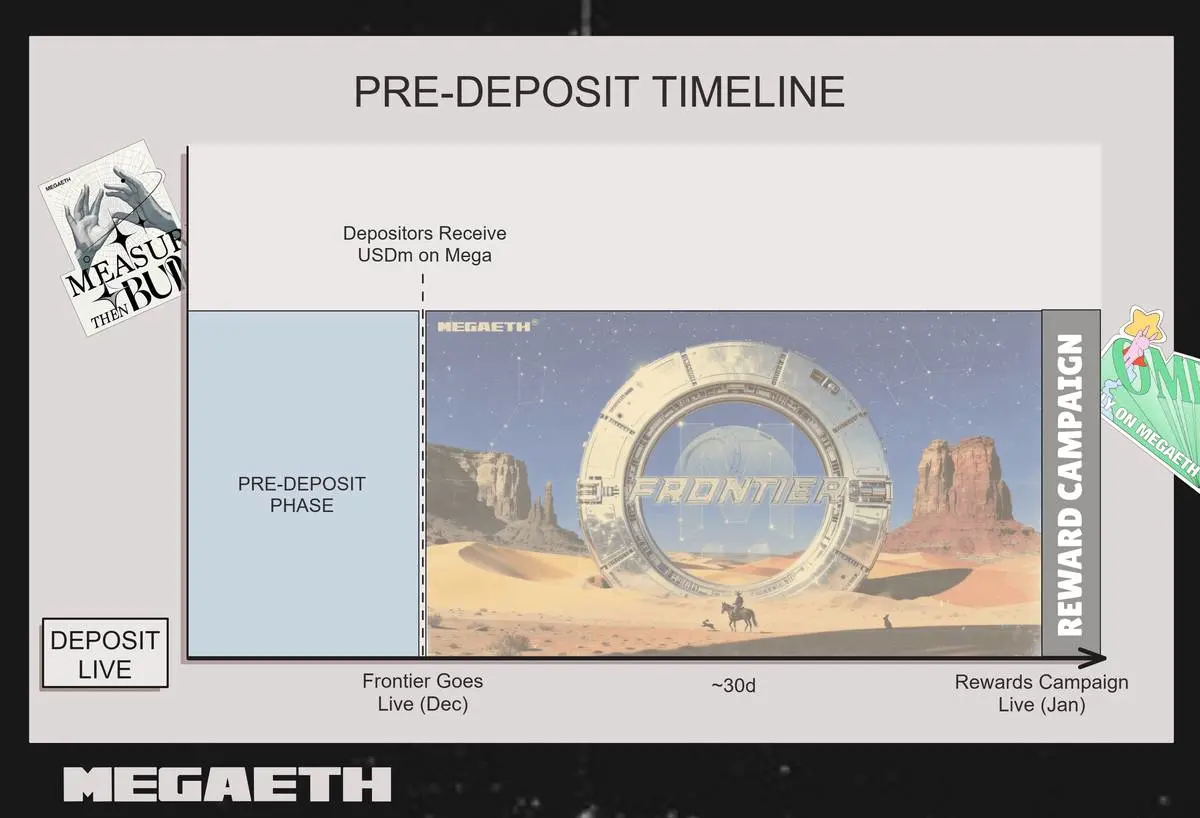
MegaETH stated that the rights of depositors will be confirmed later, but no specific details were revealed. Therefore, the conversion bridge from USDM to USDC will be reopened before the Frontier mainnet goes live, in order to establish liquidity in a more controlled environment. All deposits will be refunded through a new smart contracts that is currently undergoing an audit.
The decision for a full refund, while avoiding economic losses for users, cannot compensate for the damage to the MegaETH brand and reputation. In the cryptocurrency space, technical execution capability is at the core of a project's credibility. When a project claims to build a high-performance blockchain but cannot even execute a basic presale smoothly, investors have reason to question the reliability of its mainnet.
This incident has put new pressure on MegaETH to demonstrate that the remainder of its roadmap is ready for production. The team needs to conduct a thorough post-incident analysis to identify all systemic issues and implement improvements. When reopening the conversion bridge, it is essential to ensure that all known issues have been resolved and that sufficient contingency mechanisms are in place to handle unexpected situations.


