Asset type determines price movement
Binance life is a cover for Aster's counter-attack, the ultimate wealth creation effect, even emotions can make one forget the worries of positions in the gloomy and rainy late autumn, regardless of long or short.
Apart from the technical parameters and cost comparison of the menu items, what truly intrigues me is why the CLOB architecture (Central Limit Order Book) is suitable for perpetual contracts, and what the limits of the CLOB architecture are?
Assets Determine Price
I was born too late to catch the era of DeFi Summer; I was also born too early to see CLOB shine in the foreign exchange market.
The history of traditional finance is too long, so long that people have forgotten how the market was formed.
In short, finance revolves around trading assets and prices, with prices (buying and selling, long and short) of assets (spot/contract/option/prediction). Cryptocurrency is merely a reenactment of hundreds of years of financial history over a span of several decades, during which it has incorporated its own unique demands or improvements.
CLOB is not just a simple imitation of NASDAQ or CME. Breaking it down, the central, limit, and order book events occur on-chain, ultimately contributing to today’s flourishing scene.
-
- Order book: A mechanism for recording buy/sell prices.
-
- On-chain limit order book: a bidding mechanism based on dual sorting by time and price, where a limit price refers to a specified price.
-
- On-chain central limit order book: refers to recording limit orders in a unified system, such as a blockchain, which means central.
CME (Chicago Mercantile Exchange), Binance, and Hyperliquid all offer BTC contracts that can be CLOB, but in this article, it specifically refers to CLOB Perp DEX built on public chain/L2 architecture.
Following the discussion of the third point, here is a historical explanation: the technological route dispute is a continuation of the expensive and slow issues of the ETH mainnet around 2021. The FTX collapse in 2022 delayed the Perp War, which was initiated at the end of the DeFi Summer, to 2025.
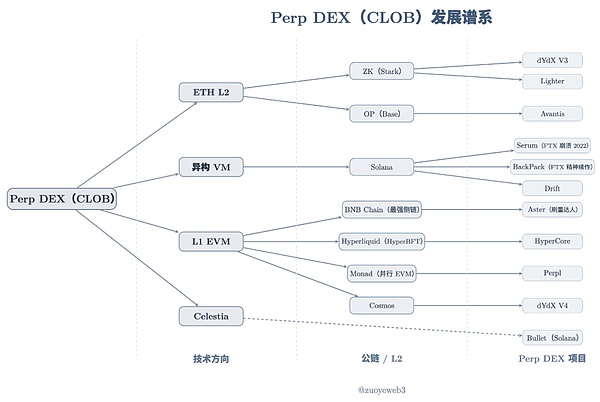
Image description: Perp DEX (CLOB) lineage
Image source: @zuoyeweb3
Perp DEX projects are launched in succession, but they can basically be divided into three routes: ETH L2, heterogeneous VM (Solana), and L1 EVM. Celestia belongs to the chaos DA solution and does not rely on a specific VM architecture.
Historical documents have no practical significance; currently, people are not concerned about decentralization but only care about transaction efficiency. Therefore, there is no comparison to be made. It is difficult to say who is faster between Hyperliquid with 4–>16–>24 nodes and the generally single sorter L2, as well as who is more decentralized and what the significance is.
The joys and sorrows of humanity do not connect; I only feel that they are noisy.
Technical investment has a lagging effect; the DeFi Summer of 2020 had already sown the seeds in 2017/18. At the end of 2020, Serum had already slowly launched on Solana, featuring the following characteristics:
-
- Liquidity Frontend and Profit Sharing
-
- Expected to support spot trading
-
- Relying on Solona's high-performance matching trading
-
- Node Locking Earn MegaSerum (MSRM)
-
- Collaborate with FTX
-
- Collaborate with Wormhole to support cross-chain
-
- Cross-chain assets have a Yield mechanism
-
- SRM holding fee discount
-
- SRM Buyback and Burn Mechanism
-
- Expected SerumUSD stablecoin product line
Of course, the vast majority of SRM tokens are not decentralized and are concentrated in the hands of FTX and even SBF personally. The dramatic collapse in 2022 gave Hyperliquid more time to develop itself.
This is not to say that Hyperliquid is an imitation of Serum; any great product is either a combination of engineering or an original spirit. Hyperliquid excels far beyond Serum in terms of technology selection, cooperative market-making to create liquidity, as well as token airdrops and risk control.
From dYdX/Serum to Hyperliquid, everyone believes that moving the Perp asset type on-chain is feasible, although there are differences in technical architecture, decentralization, and liquidity organization. However, it still does not answer what features of CLOB lead to this consensus.
So, why does the asset Perp choose CLOB?
A more reasonable answer is that the price discovery capability of CLOB is stronger.
This is still a historic answer and is related to AMM DEX, exploring the initialization and applicability of on-chain liquidity around Ethereum, from Bancor to Uniswap and Curve.
The DEX protocol avoids the two major challenges of needing to custody user funds and maintaining liquidity through x*y=k and LP (liquidity providers), allowing it to focus solely on maintaining protocol security, while LPs deploy liquidity on their own driven by fee-sharing incentives.
Subsequently, the LP ultimately transfers the liquidity cost to the users, which is reflected in slippage and fees, that is, the manufacturing of liquidity: DEX protocol transfers to LP, LP transfers to users.
However, there are two remaining issues: the impermanent loss of LP and the insufficient price discovery capability of AMM.
• The root of impermanent loss lies in the exchange of two assets. LPs need to add dual assets in equal measure, but the price movement of the two is not consistent. Most of them are stablecoins paired with other assets to enhance stability.
• The price of AMM is a type of “market price,” meaning that LPs, project parties, and DEX protocols cannot directly define the price of a certain asset, but can only intervene through liquidity.
In response to these two issues, the improvement for the former is the trading of stablecoins such as USDC/USDT on Curve, which aims to minimize the bidirectional fluctuations of assets, relying on increased trading frequency to boost fees. Rather than saying that Curve's suitability for stablecoin pair trading is a feature, it is more accurate to say it is an inherent flaw. Its latest creation, Yield Basis, is designed through economics to “erase” non-compensable losses with leverage.
The latter's improvement limit is the TWAP (Time-Weighted Average Price) of CoW Swap, which splits a large order into multiple smaller orders to reduce the impact of large orders on liquidity and obtain the optimal execution price, and is Vitalik's favorite.
But it stops here, on-chain trading with Perp is 공개 투명한 거래 세부사항. If an AMM mechanism is adopted, it is very simple to manipulate prices by adjusting liquidity; a 1% price movement can still be explained in spot trading, but for Perp, that would mean waiting in line to go to heaven.
The defects of AMM prevent it from being used, at least not on a large scale, on Perp; a technology that does not rely on liquidity changes to control price is needed, that is, the price must be predetermined.
Transactions must be executed at the quoted price or not at all, but discount transactions are not allowed in order to maintain the normal operation of the Perp market.
Eliminating uncompensated losses is merely a side effect; different technological architectures will trigger different market-making mechanisms.
The price sensitivity of Perp perfectly aligns with the precise control of CLOB, meaning that the asset will determine the price movement, and the price movement requires a corresponding technical architecture.
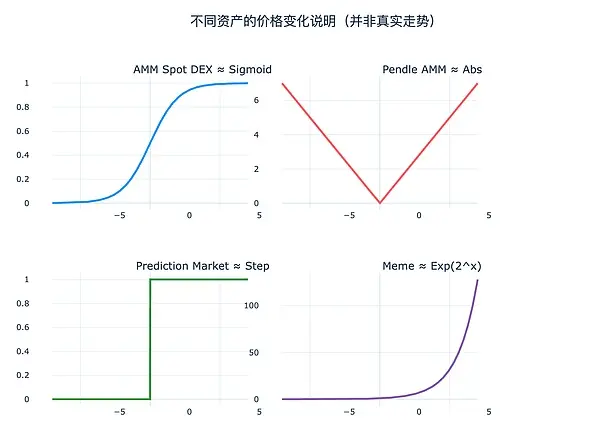
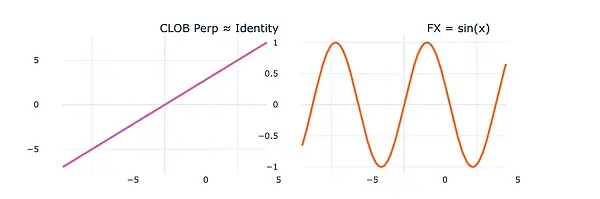
Image description: Assets determine price movement Image source: @zuoyeweb3• The price movement of spot is relatively stable, which is the fundamental reason why its users can “tolerate” slippage and why LPs “tolerate” impermanent loss, that is, they will not lose too much;
• Pendle creates two different price movements by segmenting assets based on their expiration dates, thus triggering different side liquidity bets in the market.
• The prediction market is more extreme, with only two situations (0,1), which is the most discrete existence, and can be understood as the continuous probability ultimately collapsing into 0/1;
• The meme market is more extreme, with a few indices experiencing extreme fluctuations, while most have become non-trading assets tending towards 0, which aligns with the theory of both domestic and foreign markets.
• Perpetual contracts exhibit the most extreme changes and can result in negative balances, as their price movements are not only volatile but also do not stop at zero, spreading downwards;
• The minimum price of foreign exchange trading fluctuates within a range during the day, and may even show regular patterns, reflecting the stability of major global economies.
AMM creates initial on-chain liquidity, cultivates people's trading habits and deposits funds, while CLOB is more suitable for price control and achieving more complex trading setups. Unlike the market price of AMM, CLOB sorts buy/sell prices based on time-price priority, achieving precise price discovery with the support of efficient algorithms.
Price Determines Liquidity
It is said that a lifetime means not counting even a year, a month, a day, or an hour.
CLOB replaces AMM, and after completing the price discovery of Perp, it is also necessary to organize market liquidity. AMM DEX achieves the normalization of individual LP existence through two transfers (protocol transfers to LP, LP transfers to users).
But there is also the scale phenomenon characteristic of Perp between price movement and liquidity.
The issues with Perp DEX are relatively complex. AMM only calculates gains and losses upon final settlement; otherwise, both users and LPs only have unrealized gains and losses on paper. The focus of perpetual contracts is not the contract itself, but the perpetual nature.
There is a fee mechanism between long and short positions, that is, when the fee is positive, the longs pay the shorts, and when the fee is negative, the shorts pay the longs.
From the perspective of the price mechanism, this allows the contract price to align with the spot price. When the contract price is lower than the spot price, it indicates a bearish market. To maintain the existence of the market itself, bulls need to pay fees to bears; otherwise, if there are no bears, there would be no perpetual contract market, and vice versa.
As mentioned earlier, AMM is a trading mechanism between two assets. However, for the U-based BTC contracts, there is actually no need for both parties to exchange BTC; rather, they exchange their expectations regarding the price of BTC. It is just a convention to use USDC to represent this, in order to reduce volatility.
This expectation requires two points:
-
- Spot assets can achieve price movement, for example, in a well-traded BTC market, the more mainstream the cryptocurrency, the more sufficient the price movement, making it less likely to experience black swan events;
- Both bulls and bears possess strong capital reserves, which can offset the extreme market conditions caused by leverage multiples, and effectively manage the situation when extreme market conditions arise.
The price mechanism of Perp tends to increase market size, which in turn triggers liquidity.
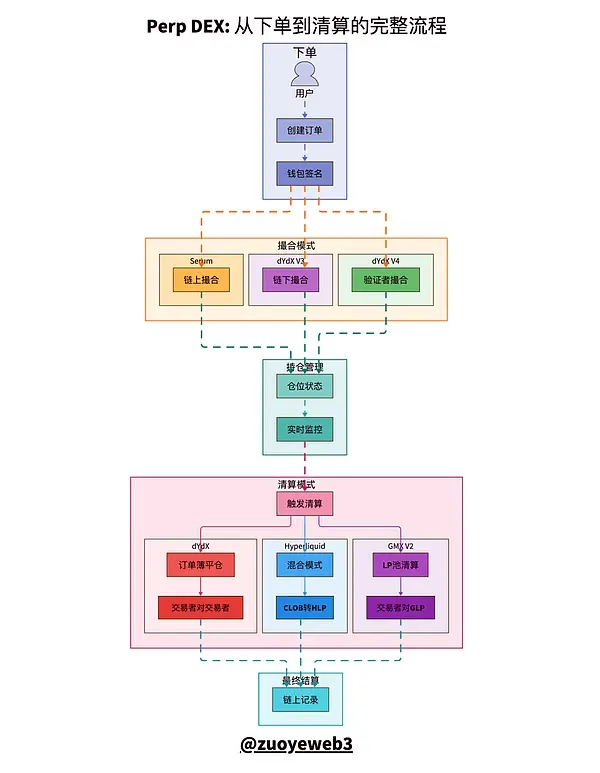
Image description: Comparison of CLOB clearing and settlement process models
Image source: @zuoyeweb3
The entire trading process of Perp can be divided into five main parts: placing orders, matching, holding positions, clearing, and settlement, among which the most difficult are the matching and clearing mechanisms.
- • Matching is a technical issue, that is, how to match the buy/sell orders with the highest efficiency and the least time. The final choice of the market is “centralized”.
- • Liquidation is an economic issue, and contracts can be understood as under-collateralized lending. The exchange allows you to leverage a small amount of capital to control a large position, which is the essence of leverage.
On the surface, the exchange allows you to amplify leverage with collateral, but in reality, you have to pay a margin to maintain the existence of leverage. Once it falls below the liquidation ratio, the exchange will take your collateral.
From the inside, liquidation is a natural behavior of both long and short positions under normal circumstances. However, it was mentioned earlier that the price of Perp can extend infinitely beyond 0, and with the amplified effect of leveraged trading, debts can far exceed the value of the collateral.
If the market fails to complete the clearing of bad debts, it will require manual margin supplementation, forced trade cancellations, or the use of insurance funds to cover losses, but essentially it is socialization of debt, bearing debts together.
The liquidity of Perp is an inevitable pursuit of maintaining scale, but the tasks that individual LPs of AMM cannot accomplish, apart from the limitations of capital volume, also require the high-intensity trading expertise of professional market makers.
The reasoning is not complex; individual LP deployment of liquidity on AMM DEX does not require frequent operations, but Perp DEX needs to constantly pay attention to the extremity of leverage.
In normal trading, as long as extreme market conditions are not triggered, there are mechanisms similar to AMM's LP that stimulate trading volume. For example, GMX imitates the LP mechanism of AMM DEX by incentivizing LP trading activity with its own token, developing its own GLP pool, where users can add liquidity and subsequently earn rewards such as transaction fees.
In fact, this is a very “innovative” mechanism that allows individual LPs to participate in the market making of Perp for the first time.
This volume brushing mechanism will lead to an excessively high trading volume for Perp, but the OI (Open Interest) will decline after the coin issuance as the LP withdraws, ultimately entering a death spiral of both token and liquidity decline.
It can also be concluded that LP must passively bear the final liquidation, which is different from AMM. In AMM, users make their purchases and leave, bearing their own profits and losses, but in Perp, LPs actually have to assume the liquidation function on behalf of the project party, and this cannot be transferred to the users.
The so-called insurance mechanism protects the project party's risks and cannot protect the LP itself.
Both GMX and Aster will quickly end their trading volume, while Hyperliquid's HLP operates relatively stably on a daily basis. However, when faced with $JELLYJELLY , it is still HLP that bears the losses, which essentially indicates the unreliability of this liquidity creation and insurance mechanism.
As mentioned above, over 92% of the fees from HyperCore are used for the $HYPE buyback, and 8% is used for HLP profit sharing. This also indicates that Hyperliquid does not place much importance on the future of mechanisms like HLP. The liquidity of HyperCore is mainly maintained by professional market makers, who value node profit sharing and the appreciation of $HYPE .
The vault mechanism can be said to be a remnant that Perp learned from AMM; directly unplugging the network cable or enhancing trading depth is more effective than this.
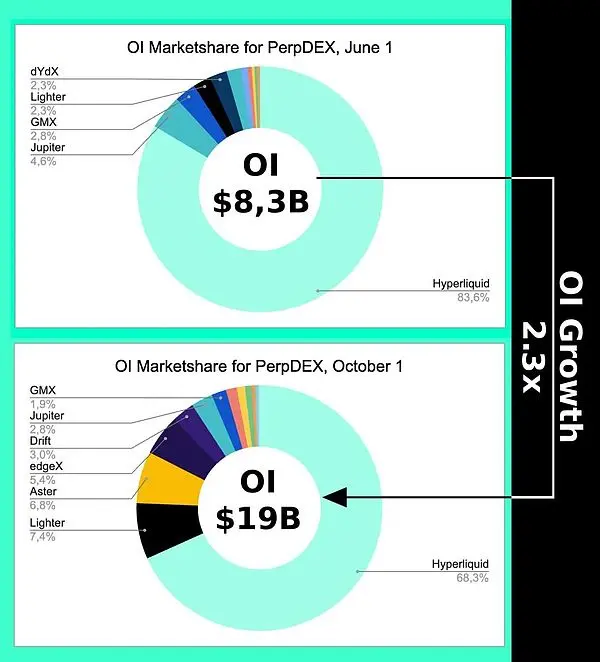
Image description: OI change trend Image source: @Eugene_Bulltime Even at the height of the Perp DEX war in early October when Aster was launched, Hyperliquid's market share only decreased by about 15%, while Volume was surpassed by Aster several times, which also indicates that the CLOB price mechanism triggers scale effects, leading to liquidity mainly referring to open interest, rather than trading volume.
It can also indicate why Hyperliquid wants to develop the Unit cross-chain bridge and the BTC spot trading market, not for transaction fees, but for price accuracy, ultimately to get rid of dependence on Binance's quotes.
CLOB can also be used for spot trading, and AMM, which has been transformed by AC, can also be used for perpetual contracts.
Pay attention to price movement and asset compatibility, and do not lose direction due to technical parameters.
Conclusion
Life will find its way out.
Binance's annual trading volume of 15 trillion USD is basically the upper limit for Perp trading, but the daily trading volume in the forex market is around 10 trillion USD, with an annual trading volume that is 300 times that of Perp. The architecture of Hyperliquid is also migrating to HyperEVM, especially for new assets such as forex, options, and prediction markets anticipated in HIP-3/4.
It can be understood that Perp will eventually reach its peak, and in the mutual competition between assets and prices, a technological architecture more suitable for the price discovery mechanism of the new generation of assets will emerge, such as RFQ, etc.
But there is no doubt that it will no longer be a competition of the degree of centralization of blockchain; the technological competition in 2021 was just a boring callback. Focusing on the technical architecture of blockchain is essentially living in the past and unable to extricate oneself.
Regardless of whether OI or trading volume continues to grow, the CLOB battle has ended. 2018 was the DeFi Summer, and Hyperliquid has already won in 2022. Next, we need to see if HyperEVM can squeeze into the final public chain dinner. It’s uncertain whether Monad will still be boring after issuing its token, and whether HyperEVM can create an ecological closed loop is what makes it interesting.


