
Morgan Stanley submits Bitcoin and Solana ETF applications to SEC, with SOL featuring staking functionality. On Monday, Bitcoin ETF net inflows reached $697 million, a new high, with Bloomberg analysts predicting annual inflows of $150 billion. Morgan Stanley only began recommending crypto ETFs in October last year, and now is issuing its own using a BYOA strategy.
Morgan Stanley’s 180-Degree Turnaround from Prohibition to Issuance
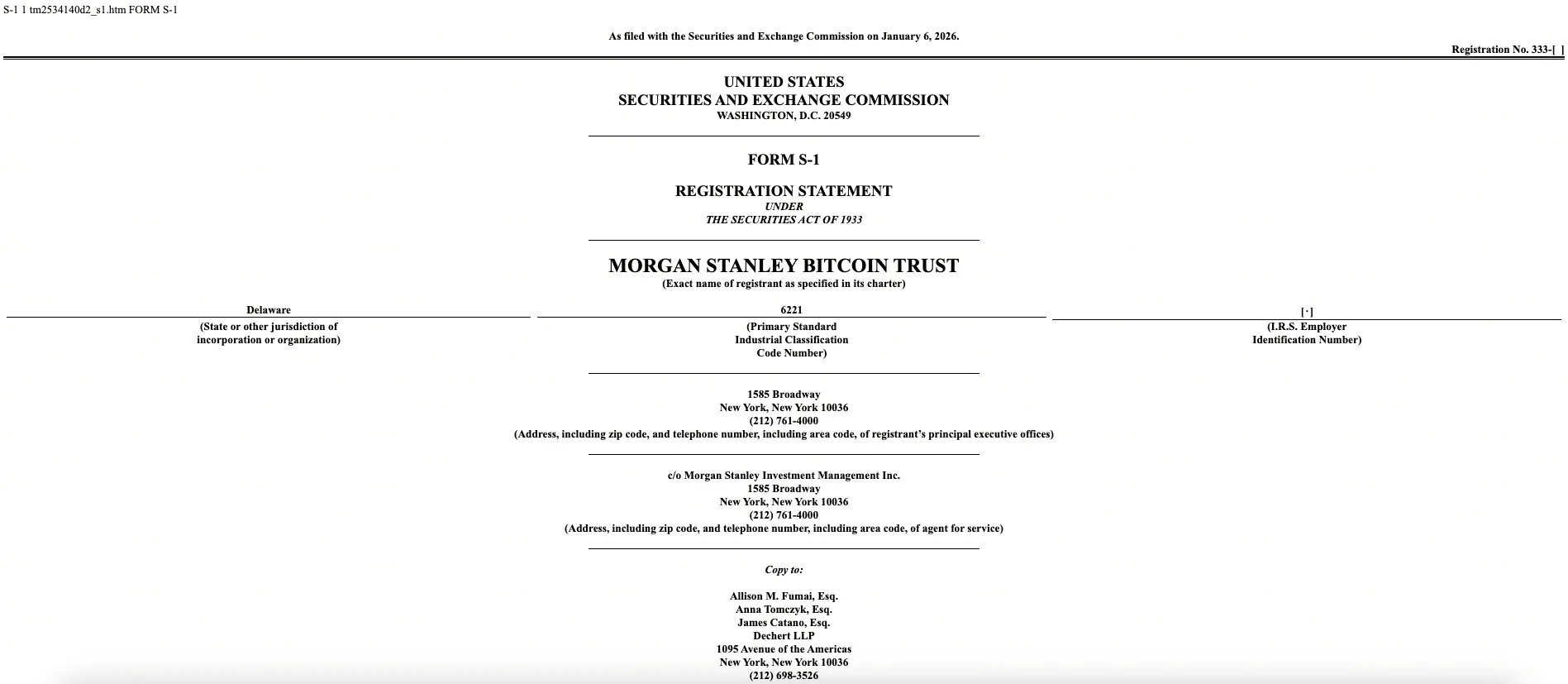
Morgan Stanley has submitted S-1 registration statements to the US Securities and Exchange Commission, planning to launch spot Bitcoin and Solana ETFs, marking the company’s deeper entry into regulated cryptocurrency products. The Wall Street giant separately filed application documents for a Bitcoin Trust Fund and a Solana Trust Fund, with its proposed Solana fund including staking functionality.
Until recently, Morgan Stanley’s financial advisors were prohibited from purchasing crypto ETFs for clients. But that changed in October last year. At that time, the company stated it was recommending limiting cryptocurrency allocation to no more than 4% in its most aggressive client portfolios, a move similar to actions taken by companies like BlackRock and Fidelity. Just months later, Morgan Stanley upgraded from “allowing distribution” to “self-issuance,” a speed of attitude change that is extremely rare among conservative Wall Street giants.
If approved, these applications would position Morgan Stanley alongside major spot crypto ETF issuers like BlackRock and Fidelity, reflecting growing mainstream investment demand for digital assets. This comes as US spot crypto ETFs have recently surpassed $2 trillion in cumulative trading volume, with spot Bitcoin ETFs alone exceeding $123.5 billion in assets under management.
Morgan Stanley’s filings come as the US Securities and Exchange Commission (SEC) operates in a friendlier regulatory environment for cryptocurrencies, with President Trump’s return leading the agency to introduce faster standard listing procedures for crypto ETFs. This further solidifies the company’s broader crypto strategy, including recommending a 4% allocation cap for opportunistic portfolios and expanding cryptocurrency access across all client accounts, including retirement plans.
Morgan Stanley manages approximately 20 ETFs under brands including Calvert and Eaton Vance, but currently only two ETFs are issued under the Morgan Stanley name, highlighting the rarity of such branding decisions. Issuing ETFs under the company’s own brand means higher reputational risk, as poor product performance would directly impact Morgan Stanley’s brand image.
The Business Logic and Competitive Effects of BYOA Strategy
Bloomberg Senior ETF Analyst Eric Balchunas called the move “wise,” stating that Morgan Stanley can use these funds to launch its BYOA (Bring Your Own Assets) ETF strategy, where large asset management companies direct client funds into their own proprietary products rather than into competing funds.
NovaDius Wealth President Nate Geraci wrote on X: “Now they’re also launching their own crypto ETF. Given Morgan Stanley’s massive distribution network, this makes sense. Clearly, they’re seeing enormous client demand for crypto ETFs.” With Morgan Stanley managing over $6 trillion in client assets and employing tens of thousands of wealth advisors, widespread promotion of their own ETFs through this distribution network would create a staggering siphoning effect.
Balchunas wrote on X: “This could spark several other firms to launch their own branded Bitcoin ETFs too. We’ll see.” This chain reaction could include traditional finance giants like Goldman Sachs, Bank of America, and UBS. Once these institutions all launch their own branded Bitcoin ETFs, market competition will intensify, but for investors this means more choices and lower fees.
Three Key Implications of Morgan Stanley’s Dual ETF Applications
Upgraded Mainstream Recognition: America’s sixth-largest bank issuing under its own brand provides stronger trust endorsement than distribution
BYOA Strategy for Customer Lock-in: Directing client funds to proprietary products, reducing capital flowing to BlackRock and Fidelity
Solana Institutional Adoption: First major bank to apply for SOL ETF, marking Solana’s entry into institutional asset class
$150 Billion Annual Inflow Prediction “Roaring Like a Lion”
On Monday, US spot Bitcoin ETFs received net inflows of $697 million, the largest single-day inflow since October, as crypto market sentiment improved in early 2026. This surge pushed two-day inflows close to $1.2 billion, with demand broadly distributed across issuers, with BlackRock’s IBIT ($660 million) and Fidelity’s FBTC ($279 million) leading gains.
Bloomberg Senior ETF Analyst Eric Balchunas stated on X that spot Bitcoin ETFs are “roaring into 2026 like lions,” adding that early inflow speeds would mean approximately $150 billion in annual inflows if momentum continues. This projection is annualized based on the first two days of inflows; while maintaining such high speed year-round is unlikely, even cutting it in half represents an impressive $75 billion scale.
BTC Markets crypto analyst Rachael Lucas stated that ETF repurchases reflect “cautious optimism from major asset allocators,” and while near-term outlook still depends on macroeconomic and regulatory stability, current ETF flows are supporting crypto prices. Institutional investors are upgrading cryptocurrency from tactical allocation to strategic assets, a mental shift that is the fundamental reason for continued inflows.
Bitwise Chief Information Officer Matt Hougan wrote in an X post: “Major institutions are diving into crypto at full speed, viewing it as a critical business priority.” Morgan Stanley’s application is just the beginning, with giants like Goldman Sachs and JPMorgan Chase likely following suit.
Isenção de responsabilidade: As informações contidas nesta página podem ser provenientes de terceiros e não representam os pontos de vista ou opiniões da Gate. O conteúdo apresentado nesta página é apenas para referência e não constitui qualquer aconselhamento financeiro, de investimento ou jurídico. A Gate não garante a exatidão ou o carácter exaustivo das informações e não poderá ser responsabilizada por quaisquer perdas resultantes da utilização destas informações. Os investimentos em ativos virtuais implicam riscos elevados e estão sujeitos a uma volatilidade de preços significativa. Pode perder todo o seu capital investido. Compreenda plenamente os riscos relevantes e tome decisões prudentes com base na sua própria situação financeira e tolerância ao risco. Para mais informações, consulte a
Isenção de responsabilidade.
Related Articles
Vítimas chinesas no caso Qian Zhimin apresentam objeção ao tribunal superior britânico sobre o plano de indenização de 61,000 BTC
No caso de Qian Zhimin, vítimas chinesas manifestaram objeções ao plano de compensação apresentado ao tribunal superior britânico, argumentando que o plano pode permitir que as autoridades britânicas lucrem com a valorização do Bitcoin apreendido. O caso envolve fraude entre 2014 e 2017, afectando mais de 128.000 investidores chineses, e o escritório de advocacia alega que o acordo de compensação pode ser injusto.
GateNews9m atrás
Arthur Hayes Revela Previsão do Preço do Bitcoin para 2026, Mas Há uma Ressalva
12 de março de 2026 3:50 da manhã EDT
TheCoinRepublic9m atrás
O Bitcoin mantém resiliência perto de 70 mil dólares, analistas dizem que a desalavancagem prepara o caminho para o próximo rally
12 de março, o analista Omkar Godbole apontou que a Bloomberg prevê que o Bitcoin pode cair para 10.000 dólares, mas a indústria considera esta previsão irracional. A plataforma Deribit mostra que cerca de 800 milhões de dólares em opções de venda estão concentradas em 20.000 dólares, com alguns traders se preparando para uma possível queda acentuada. Apesar da volatilidade do mercado externo, o Bitcoin mantém-se em torno de 70.000 dólares, demonstrando resiliência. A análise indica que a consolidação do mercado pode estabelecer as bases para os movimentos subsequentes.
GateNews19m atrás
Uma certa CEX foi acusada de fazer lobby legislativo contra a política de isenção fiscal de pequenas quantidades de bitcoin, argumentando que deve ser aplicada apenas a stablecoins.
Segundo reportagens, uma plataforma de negociação de criptomoedas estaria a fazer lobby junto aos legisladores americanos contra isenções fiscais para pequenas transações em bitcoin, sugerindo que as medidas se limitem a stablecoins. Os defensores do bitcoin expressaram preocupação, argumentando que isso poderia beneficiar interesses especiais e prejudicar a inovação. Entretanto, organizações de políticas sobre bitcoin apelam pela isenção fiscal em pequenas transações de bitcoin.
GateNews21m atrás
Cosmos Health, empresa cotada nos EUA, investe 600 mil dólares na compra adicional de bitcoin
Gate News divulga, 12 de março, a empresa listada no Nasdaq Cosmos Health anunciou que investirá 600 mil dólares para aumentar suas posições em Bitcoin. Até ao momento, o investimento total em reservas de ativos digitais da empresa atingiu 3,1 milhões de dólares, mantendo Ethereum além de Bitcoin. (Fonte: Globenewswire)
GateNews21m atrás


