


Futures
Hundreds of contracts settled in USDT or BTC
TradFi
Gold
One platform for global traditional assets
Options
Hot
Trade European-style vanilla options
Unified Account
Maximize your capital efficiency
Demo Trading
Futures Kickoff
Get prepared for your futures trading
Futures Events
Join events to earn rewards
Demo Trading
Use virtual funds to experience risk-free trading
Launch
CandyDrop
Collect candies to earn airdrops
Launchpool
Quick staking, earn potential new tokens
HODLer Airdrop
Hold GT and get massive airdrops for free
Launchpad
Be early to the next big token project
Alpha Points
Trade on-chain assets and earn airdrops
Futures Points
Earn futures points and claim airdrop rewards







Our 8% Income Plan as AI Plays “Whack-a-Mole” With Stocks
AI has investors in a roil again—this time over … a blog post?
The article in question—written by Citrini Research and posted on Substack—was fear-based (to say the least!). It essentially argued that AI was going to cause a “jobs apocalypse,” wiping out demand and taking the economy down with it.
It was pure science fiction. But it was enough to wipe $2 trillion from stocks in one day on February 22. And it comes after the same sorts of fears have hit software stocks, IT-security stocks and even logistics stocks over the last few weeks.
Get analyst upgrade alerts:
Sign Up
It’s one of the most absurd panics I’ve ever seen, frankly. But these kinds of silly drops are good for us closed-end fund (CEF) investors, since they often serve up temporary discounts on these 8%-payers.
We also like the fact that many CEFs are tied to AI’s growth through infrastructure: They hold companies that provide the data centers, industrial spaces and offices AI providers need to grow. That’s a far better setup than trying to get in on the next OpenAI or Anthropic.
AI Is Not the Terminator—It’s a Tool
The “logic” behind this Substack post was swiftly debunked by former Fed governor Christopher Waller (who simply replied that AI is a “tool”), economics professor Alex Imas and hedge fund Citadel Securities.
Citadel, in fact, pointed out that one area where AI is replacing tasks the most—coding and making apps—is actually seeing a sharp _increase _in job postings, not a decrease. This again shows that AI (in reality, not sci-fi) stands to raise demand for workers over time.
Source: Citadel Securities
We actually discussed this in an article published on Contrarian Outlook last week. In fact, if you’re a CEF Insider member, you may recall that we’ve been talking about this point—that AI is mainly a productivity tool—since 2020.
As we wrote in the September 2020 issue of CEF Insider: “Some companies, like insurance firms, will profit from artificial intelligence as this technology improves underwriting, lowers risk and improves health outcomes for patients.”
This is why we remain bullish on US equities—in particular the CEFs that hold them. The efficiency gains from this tech are only getting started. This means that every time one of these news stories causes a ripple in stocks, it serves up an opportunity for us.
And more are likely coming! Just last week, news that Block, Inc. (XYZ) will cut workers due to AI sent another shiver through stocks. But Block boosted its headcount 133% from 2020 through 2022, and expenses have grown faster than sales since. To me, this has more to do with market discipline setting in than anything to do with AI.
So what are we targeting when these dip-buying opportunities show themselves?
One of my favorite categories of CEFs to buy now—and even more so on irrational dips—are those holding real estate investment trusts (REITs). That’s in part because many REITs give us exposure to AI in ways that mean we don’t have to try to pick winners ourselves.
Instead, the REITs these funds hold—“landlords” who hold properties of all types—give us exposure to the wider trend of AI adoption. Some, like Equinix (EQIX), own data centers. Others, like **Prologis (PLD) **and First Industrial Realty Trust (FR), own warehouses—their clients are certain to benefit, and grow, as more automation comes to manufacturing.
Plus, REITs get us into non-AI-related trends through firms like senior-care provider Welltower (WELL), providing instant diversification.
And because REITs are “pass-through” investments, they simply collect the rent from these tenants and pass most of it to us in the form of dividends.
I didn’t mention those last four REIT examples randomly, by the way: They’re among the top holdings of the Nuveen Real Estate Income Fund (JRS), a holding in the CEF Insider portfolio.
We like JRS because its management team amplifies our REIT dividends using a modest amount of leverage (around 28% of the portfolio). The result is a fund that yields 8.3%, more than twice what you’d get from the average REIT bought on its own.
That payout has held steady since being adjusted lower following the interest-rate spike of 2022. But now, with rates more likely to move lower than higher in the next year, the payout should get more support.
Lower rates benefit JRS in other ways, too, including by lowering the fund’s cost of leverage and cutting REITs’ own borrowing costs.
And here’s where things get really interesting: Since the start of this year, REITs (and JRS) have finally started gaining momentum. But at the same time, JRS’s discount to net asset value (NAV, or the value of its underlying portfolio) has widened, to around 8.1% from 6.7% at the start of 2026. You can see that in the orange line below.
JRS Gains—and Gets Cheaper
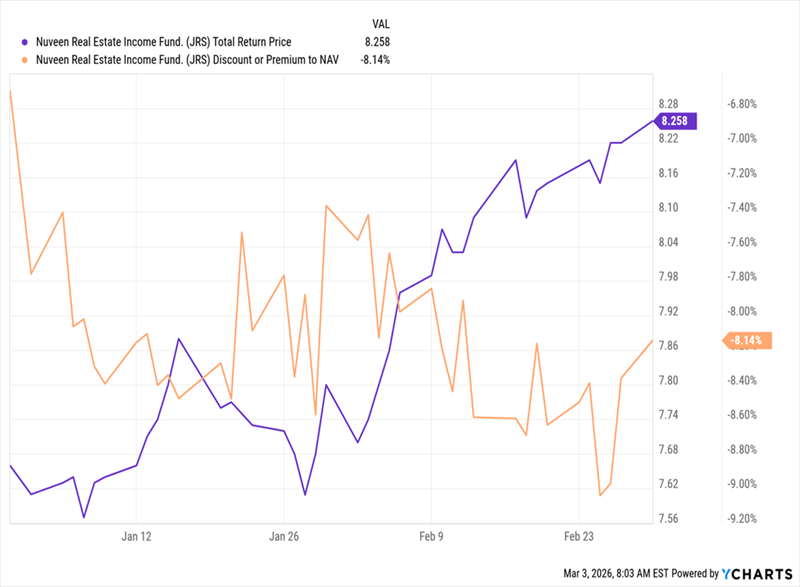
Put another way, the fund’s underlying portfolio has gained, but the market price-based return hasn’t kept up.
That situation cannot last—and with the wind finally at REITs’ back, I expect that discount to narrow in the coming months, putting more upward pressure on JRS’s price.
REITs Are Just One Part of My 9.3%-Paying “AI Portfolio”
JRS is exactly the kind of fund we’ve used to play the AI trend for gains and income since this breakthrough tech first got on our radar way back in 2020.
Our approach? Take a diversified, “income-first” approach to AI. We do that by picking up CEFs holding infrastructure-providing REITs (like JRS), as well as shares of AI developers and—critically—companies using AI to greatest effect.
(Here, we’re talking about insurers, financial firms, healthcare companies and others putting AI to work to cut costs and boost growth).
That strategy is at the heart of the 4-CEF portfolio I’ve specifically built to tap the AI boom.
This collection of funds yields a stout 9.3% as I write this. And thanks to the recent market turbulence, these 4 AI funds’ discounts are wider than they were just a few weeks ago.
Now is the time to buy them, so you can get in line for their next big dividend payout. Click here and I’ll walk you through these 4 AI-powered income plays and give you a free Special Report revealing their names and tickers**.**
Where Should You Invest $1,000 Right Now?
Before you make your next trade, you’ll want to hear this.
MarketBeat keeps track of Wall Street’s top-rated and best performing research analysts and the stocks they recommend to their clients on a daily basis.
Our team has identified the five stocks that top analysts are quietly whispering to their clients to buy now before the broader market catches on… and none of the big name stocks were on the list.
They believe these five stocks are the five best companies for investors to buy now…
See The Five Stocks Here
The 7 Hottest IPOs On Wall Street’s 2026 Watchlist
MarketBeat just released its list of the 7 hottest IPOs expected to hit Wall Street in 2026. See which companies are preparing to go public and why investors are watching closely.
Get This Free Report