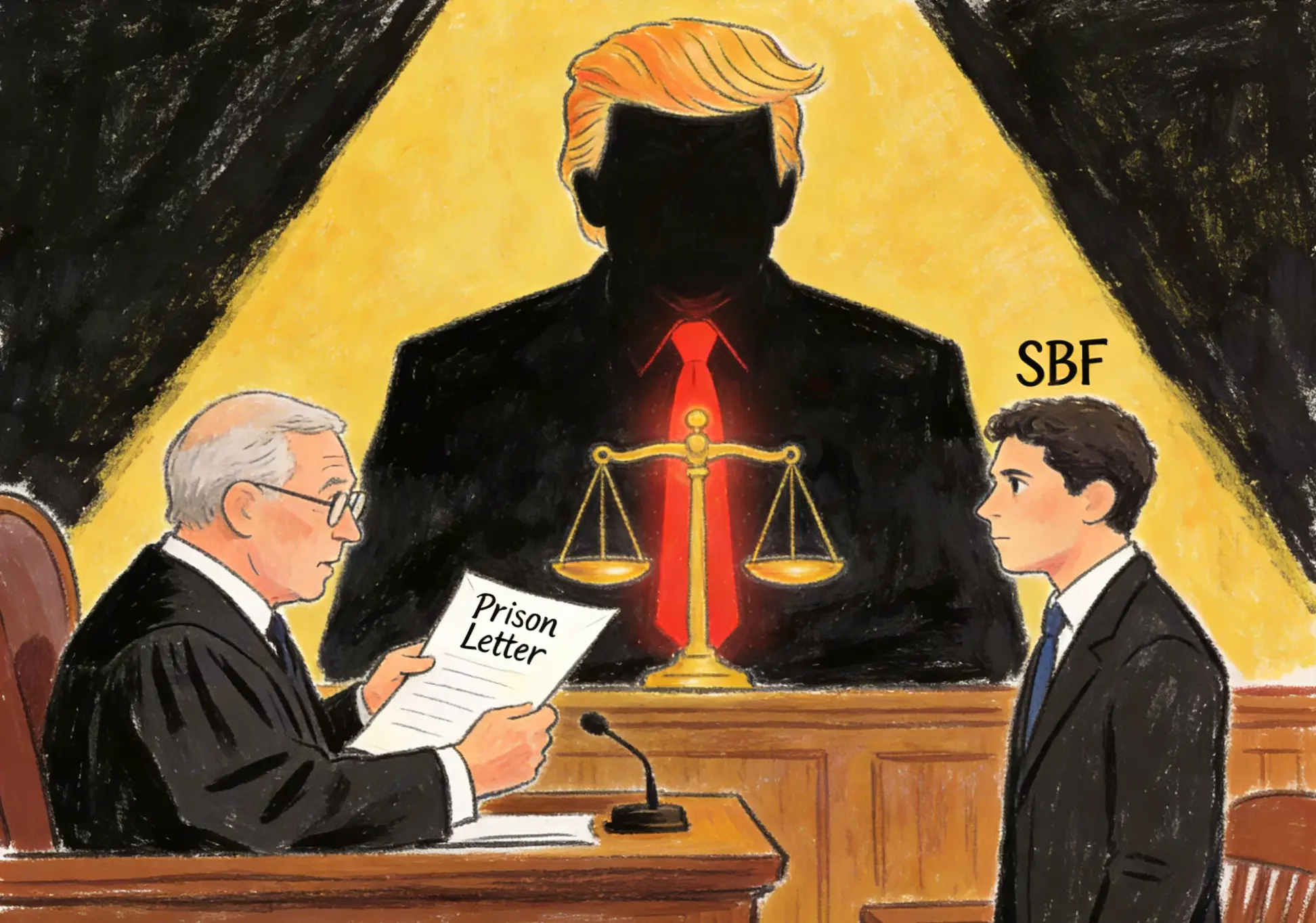
 Federal prosecutors challenged a letter submitted to Judge Lewis Kaplan on March 19, 2026, that claimed to come from convicted FTX founder Sam Bankman-Fried (SBF) at Terminal Island prison, with FedEx tracking data showing the package originated in Palo Alto and Menlo Park, California, not from the federal detention facility where he is serving a 25-year sentence.
The letter was intended to support Bankman-Fried’s pro se Rule 33 motion for a new trial, filed in February 2026, and bore a typed “/s/” mark instead of a handwritten signature—a format typical of electronic legal filings rather than physical prison correspondence. The filing follows a recent pattern of improper submissions, including Judge Kaplan’s earlier rebuke of SBF’s mother for sending unsolicited letters to the court.
Separately, Bankman-Fried has stepped up public praise of President Donald Trump through prison-approved intermediaries, fueling speculation that he is seeking a presidential pardon for his fraud conviction.
Letter Discrepancy and Prosecution Response
Tracking Data Contradiction
The envelope addressed to the court displayed “S. Bankman-Fried” at Terminal Island as its return address. However, FedEx tracking data confirmed the package originated in Palo Alto and Menlo Park, California—locations near Stanford University, where SBF’s parents hold academic ties. The geographic discrepancy raised immediate questions about who actually sent the document.
Pattern of Improper Filings
The suspicious letter surfaced days after Judge Kaplan rebuked Bankman-Fried’s mother, Barbara Fried, for submitting unsolicited letters to the court on her son’s behalf. Kaplan noted that Fried is not a member of the court’s bar, has not appeared in the case, and cannot use a power of attorney to seek relief. The judge also disclosed that his chambers had received a voicemail from Fried, adding that the court does not accept phone calls from litigants or their families.
Government Opposition to Retrial
Prosecutors have already urged Judge Kaplan to deny Bankman-Fried’s retrial bid entirely. In a March 11 opposition filing, the government characterized his claims as “recycled” and legally insufficient, arguing that proposed witness testimony from former FTX executives Daniel Chapsky and Ryan Salame does not qualify as newly discovered evidence.
Public Statements and Pardon Speculation
Support for Trump Policies
Through a proxy using prison-approved communications, Bankman-Fried has recently posted on X expressing support for President Trump’s decision to launch strikes against Iran, framing the move as necessary to counter nuclear risk. In earlier posts, he pointed to lower gas prices under Trump compared to the Biden era and credited Trump with “saving” the SEC by replacing former chair Gary Gensler with Paul Atkins, arguing the shift eased pressure on crypto firms and reduced inter-agency conflict.
Pardon Precedent
The tone of Bankman-Fried’s statements has drawn attention given his legal position. Presidential pardons have historically extended to financial crimes, and Trump has demonstrated willingness to grant clemency in high-profile cases. In 2025, Trump freed Ross Ulbricht, who had been sentenced to life in prison without parole in 2015 for operating the Silk Road digital black market. For Bankman-Fried—whose conviction stemmed from one of the largest financial collapses in crypto history—public alignment with the president may serve a clear strategic purpose.
FTX Bankruptcy Update
Creditor Distributions
The FTX Recovery Trust announced earlier in March 2026 that it will distribute approximately $2.2 billion to creditors as part of the ongoing Chapter 11 process. The latest distribution pushes recovery rates close to full repayment for many claim classes, following a series of payouts that have now exceeded $10 billion since February 2025.
Lingering Impact
The collapse of FTX in November 2022 caused millions of customers to lose access to funds, shook trust in crypto markets, and prompted regulators to impose tighter scrutiny. The case remains a reference point for industry risk, even as the recovery process approaches completion for many creditors.
Frequently Asked Questions
Why did prosecutors challenge the letter from Sam Bankman-Fried?
Prosecutors challenged the letter because FedEx tracking data showed it originated in Palo Alto and Menlo Park, California, not from Terminal Island prison where Bankman-Fried is incarcerated. The envelope also used a typed “/s/” signature rather than a handwritten one, a format typical of electronic filings rather than physical prison correspondence.
What is the status of Bankman-Fried’s motion for a new trial?
Bankman-Fried filed a pro se Rule 33 motion for a new trial in February 2026. Prosecutors have urged the court to deny the motion, calling his claims “recycled” and arguing that proposed witness testimony does not qualify as newly discovered evidence. The court has not yet ruled on the motion, and the recent letter controversy adds another credibility issue to the filing.
Is Sam Bankman-Fried seeking a presidential pardon?
Bankman-Fried has made public statements through prison-approved intermediaries praising President Trump’s policies on Iran, gas prices, and SEC leadership. Given Trump’s history of granting clemency in high-profile cases, including the commutation of Ross Ulbricht’s life sentence, observers speculate that Bankman-Fried is seeking to position himself favorably for a potential pardon. No formal pardon request has been publicly disclosed.
Disclaimer: The information on this page may come from third parties and does not represent the views or opinions of Gate. The content displayed on this page is for reference only and does not constitute any financial, investment, or legal advice. Gate does not guarantee the accuracy or completeness of the information and shall not be liable for any losses arising from the use of this information. Virtual asset investments carry high risks and are subject to significant price volatility. You may lose all of your invested principal. Please fully understand the relevant risks and make prudent decisions based on your own financial situation and risk tolerance. For details, please refer to
Disclaimer.


