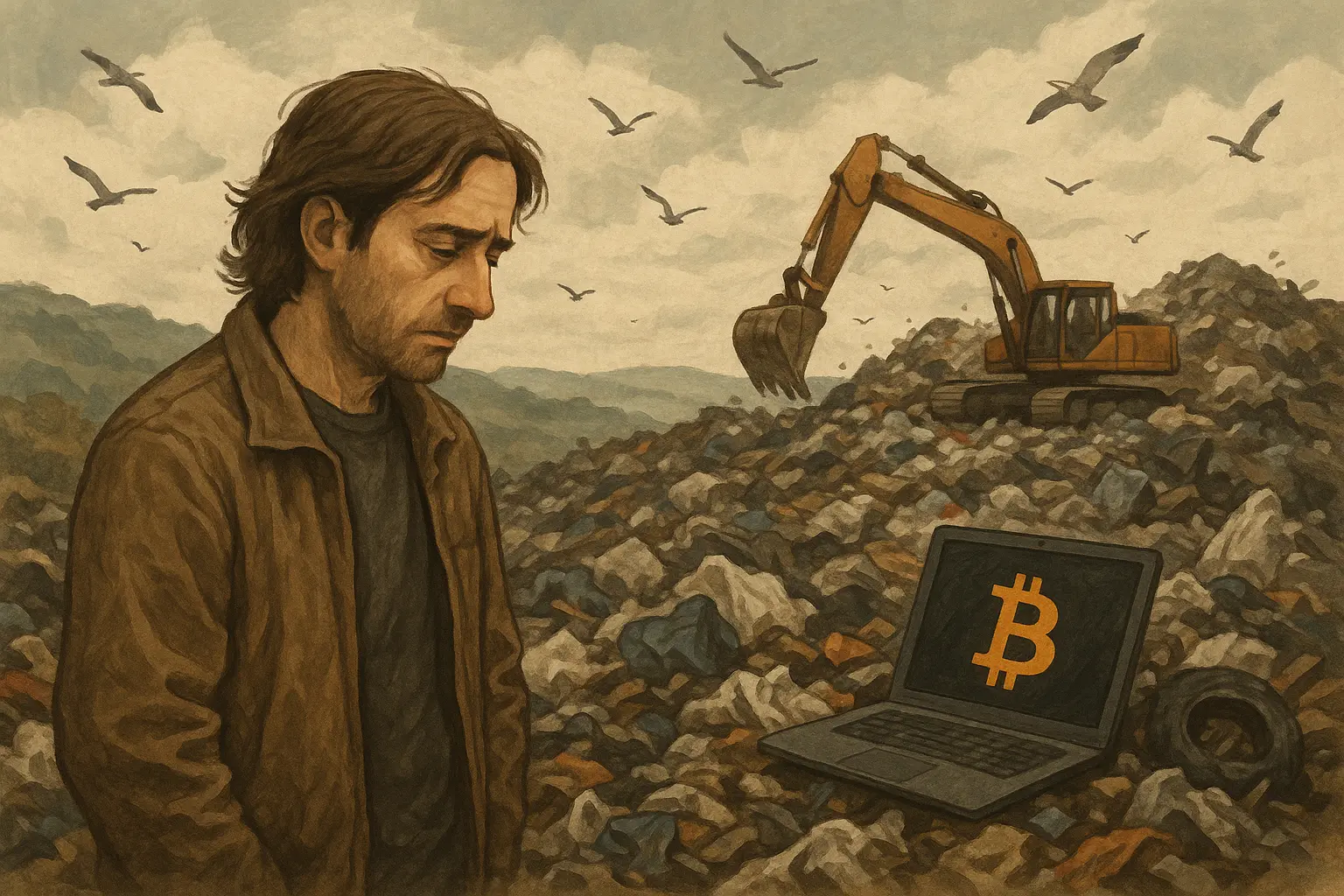
British IT technician James Howells accidentally lost a hard drive containing 8,000 bitcoins’ private keys back in 2013. After 12 years of searching for the coins, he ultimately declared that he had given up after a January 2025 ruling by a UK court. As of March 2026, the bitcoins valued at roughly $550 million inside the lost hard drive are still buried at the Newport municipal landfill.
The origin of the loss: one cleaning motion from his girlfriend, rewriting the most expensive mistake in crypto history
In 2013, while sorting through the office, James Howells’ girlfriend mistakenly threw away an old hard drive as if it were trash. That hard drive contained the private keys to Howells’ bitcoin wallet. At the time, bitcoin was not yet widely adopted, and its value was relatively low. The bitcoin value corresponding to the entire set of private keys was about $8 million—already a substantial amount, but compared with later valuations, it was just a drop in the bucket.
After the hard drive was sent into the waste collection system, it was ultimately buried in the Newport municipal landfill. According to the UK’s standard waste-handling procedures, once an item is discarded into a landfill, ownership transfers to the municipal authorities, and legally no third party can simply retrieve it.
Three layers of obstacles: technical feasibility, legal blockades, and environmental veto
Howells did not just sit and wait. Over the course of a decade-long search, he designed a recovery plan that combined cutting-edge technology.
Howells’ recovery plan and the three layers of obstacles he encountered
Technical planning: The proposal includes AI-equipped underground mapping drones, a robotic excavation system, and full-environment monitoring throughout. Howells said he was willing to personally fund the effort, requiring only permission to enter the landfill.
Environmental veto: The Newport City Council rejected all proposals on the grounds of safety and environmental risk, stating that excavation activities could release toxic gases or contaminate water sources.
Legal blockades: UK law clearly prohibits removing waste from regulated landfills without authorization, and any recovery action requires obtaining cumbersome legal permits.
Physical degradation: Experts from the Centre for the Legislative Interpretation of Recovered Storage (CLIR) stated that the pressure, moisture, and chemical substances in a landfill cause severe degradation to magnetic storage media. Physical recovery requires highly controlled conditions.
Howells then took a legal route, filing a claim against the Newport City Council for an amount of about £495 million. After the UK court reviewed the technical feasibility of the recovery plan and its environmental impact, it ruled in January 2025 that the relevant attempts had “no realistic chance,” officially ending the case.
The end of the story: after losing in court, the documentary becomes the final exit
After the case concluded, Howells’ story itself became a new asset. A Los Angeles production company, LEBUL, acquired the rights to adapt his story and planned to film a documentary titled Buried Bitcoin: The Real Treasure Hunt Journey of James Howells, fully presenting his technical planning, the court proceedings, and the entire coin-searching journey.
Howells said that the documentary allows him to reconstruct the full picture of what happened and his technical strategy. The project focuses on recording facts rather than speculating about possible outcomes. The $550 million worth of bitcoin may sleep in the landfill forever, but this crypto legend—rewritten by a single cleaning motion—has already become one of the most widely cited cautionary tales in the industry.
Frequently Asked Questions
Is James Howells’ hard drive still in the landfill to this day?
Yes. Based on available information, the hard drive is still buried in the Newport municipal landfill in Wales, UK. After the UK court ruled in January 2025 that the attempt to retrieve it had “no realistic chance,” Howells has officially given up on all recovery efforts.
Why did the Newport City Council refuse to let Howells excavate the landfill?
The Newport City Council rejected all of Howells’ proposals citing environmental and safety concerns. It pointed out that excavation could release toxic gases or contaminate water sources. UK law also clearly prohibits removing waste without authorization from regulated landfills, creating a double legal barrier.
What lessons does James Howells’ story offer to cryptocurrency holders?
Howells’ case is one of the most well-known cautionary examples of private key management for cryptocurrency. It highlights the fact that once a bitcoin private key is lost, it cannot be permanently recovered with the help of any third party. This case underscores the core importance of properly managing encryption assets’ security, including cold wallet backups, multi-location backups, and appropriate physical hardware management.
Disclaimer: The information on this page may come from third parties and does not represent the views or opinions of Gate. The content displayed on this page is for reference only and does not constitute any financial, investment, or legal advice. Gate does not guarantee the accuracy or completeness of the information and shall not be liable for any losses arising from the use of this information. Virtual asset investments carry high risks and are subject to significant price volatility. You may lose all of your invested principal. Please fully understand the relevant risks and make prudent decisions based on your own financial situation and risk tolerance. For details, please refer to
Disclaimer.


