
More than 40 Democratic lawmakers in the U.S. House and Senate sent a joint letter on March 29 urging the chair of the Commodity Futures Trading Commission (CFTC), Mike Selig, and the U.S. Office of Government Ethics (OGE) to issue guidance covering the entire executive branch, clearly requiring federal employees to avoid using information from their positions to trade on prediction markets. The letter cites multiple suspicious cases of abnormal betting patterns, including the Iran war.
The Letter’s Core Demand: Not New Legislation, but Enforcement of Existing Derivatives Laws
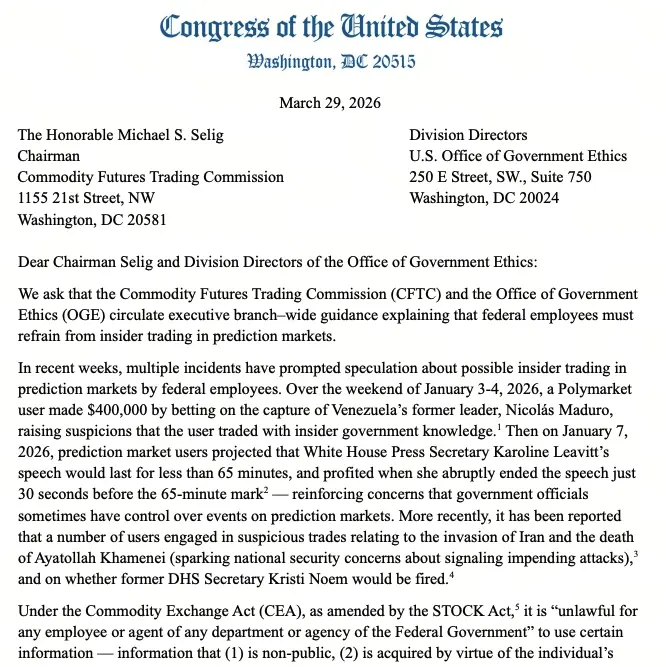 (Source: U.S. Senate)
The key point of this letter is that the lawmakers are not asking for new rules to be written, but calling for meaningful enforcement of the existing legal framework. U.S. derivatives laws clearly prohibit government officials from trading using nonpublic information they obtain in the course of their work, and this ban does not change depending on the form of the trading platform.
After the CFTC formally determined that contracts offered by prediction market companies such as Polymarket and Kalshi are regulated derivatives, this ban automatically applies to platforms of this type in terms of legal logic. Senior Democratic members of the two House and Senate Agriculture Committees are key lawmakers who directly oversee the CFTC, and this joint push carries substantial political pressure in practice.
The letter asks the CFTC and the OGE to publish formal guidance, “reminding federal employees to comply with existing legal obligations and avoid profiting from prediction market trades by using their internal government information.”
Three Suspected Insider Trading Cases: Abnormal Bets Point to Government Insiders
The letter lists multiple suspicious cases in which abnormal betting patterns appeared in prediction markets. Industry analysts believe these patterns indicate that the relevant individuals may have had advance access to nonpublic information about government actions:
Contracts for Venezuelan and Iranian Military Operations: Before the relevant military strikes were announced, the trading volume for specific contracts surged abnormally; pricing deviations indicate that there may have been prior knowledge
Contracts on the Length of a Donald Trump News Secretary Speech: For bets on the duration of a specific speech, it appears that an insider who knew in advance may have locked in the outcomes
Contracts Related to the Firing of Former Homeland Security Secretary Kristi Noem: Before the firing news was released, contract pricing behaved abnormally, suggesting that there may have been trading with an information advantage
A common feature of the cases above is that the outcomes depend heavily on the government’s nonpublic decisions, exhibit typical conditions for trades driven by information asymmetry, and clearly differ from market results driven by public information.
Advancing CFTC Policy-Making and Legal Review in Parallel
In a broader regulatory context, under Selig’s leadership, the CFTC is currently actively developing a new policy framework for prediction markets. At the same time, many Democratic lawmakers from the joint letter are also pushing forward the “Clarity for Digital Asset Markets Act” (the CLARITY Act)—currently, the bill is stalled in the Senate.
Worth noting is that on the same day as this letter, reports emerged that federal prosecutors have proactively reached out to multiple prediction market companies to assess whether certain circumstances might lead to insider trading cases. This means the issue is no longer confined to legislative advocacy; it is simultaneously entering the legal review process, and regulatory pressure on platforms such as Kalshi and Polymarket is heating up across multiple dimensions at the same time.
Frequently Asked Questions
Why could betting behavior on prediction markets constitute insider trading?
The CFTC has officially determined that event contracts on platforms such as Polymarket and Kalshi are regulated derivatives. Under U.S. derivatives laws, if government officials use nonpublic information obtained through their positions to buy or sell such contracts, it may constitute insider trading. Its legal nature is the same as using insider information in the stock market to trade stocks.
Why are the Democratic members of the House and Senate Agriculture Committees especially influential?
The House and Senate Agriculture Committees are the core legislative bodies in Congress that directly oversee the CFTC. Committee members have significant influence over the CFTC’s budget, policy direction, and leadership appointments. This joint letter led by senior Democratic members of those committees gives the letter far more political weight than a typical joint letter by ordinary lawmakers, forcing the CFTC to respond seriously.
How is this Democratic move related to crypto-asset regulation?
Several of the lawmakers in the joint letter are also key participants in the CLARITY Act, working to establish an overall regulatory framework for digital assets. The insider trading controversy in prediction markets ties together the CFTC’s jurisdiction, compliance obligations for crypto platforms, and government officials’ ethical responsibilities, making the legislative discussion of the entire digital asset regulatory landscape even more complex.
Disclaimer: The information on this page may come from third parties and does not represent the views or opinions of Gate. The content displayed on this page is for reference only and does not constitute any financial, investment, or legal advice. Gate does not guarantee the accuracy or completeness of the information and shall not be liable for any losses arising from the use of this information. Virtual asset investments carry high risks and are subject to significant price volatility. You may lose all of your invested principal. Please fully understand the relevant risks and make prudent decisions based on your own financial situation and risk tolerance. For details, please refer to
Disclaimer.


