
Solana client development company Anza released the Constellation protocol design plan on March 25. Constellation is a Multi-Proposal Consensus Protocol (MCP) aimed at breaking the temporary monopoly of Solana validators over transaction inclusion and ordering at the architectural level. It introduces a 50-millisecond economic cycle—the shortest cycle among all currently live decentralized blockchains.
Why Does the Current Architecture Have a Monopoly Problem?
Currently, Solana’s validator leaders have exclusive control over all incoming transactions during their term, able to see the entire transaction stream and freely choose which transactions to include in blocks and their order. This design creates a structural “temporary monopoly,” providing systematic space for maximum extractable value (MEV) strategies—leaders can reorder, insert, or review specific transactions to gain asymmetric advantages, favoring certain transaction parties or suppressing competitors’ bids.
Anza believes this market structure makes it difficult for Solana to truly realize the core values of decentralized capital markets. Fundamental protocol-level modifications are necessary, rather than relying solely on external patches.
Constellation’s Three-Layer Technical Architecture
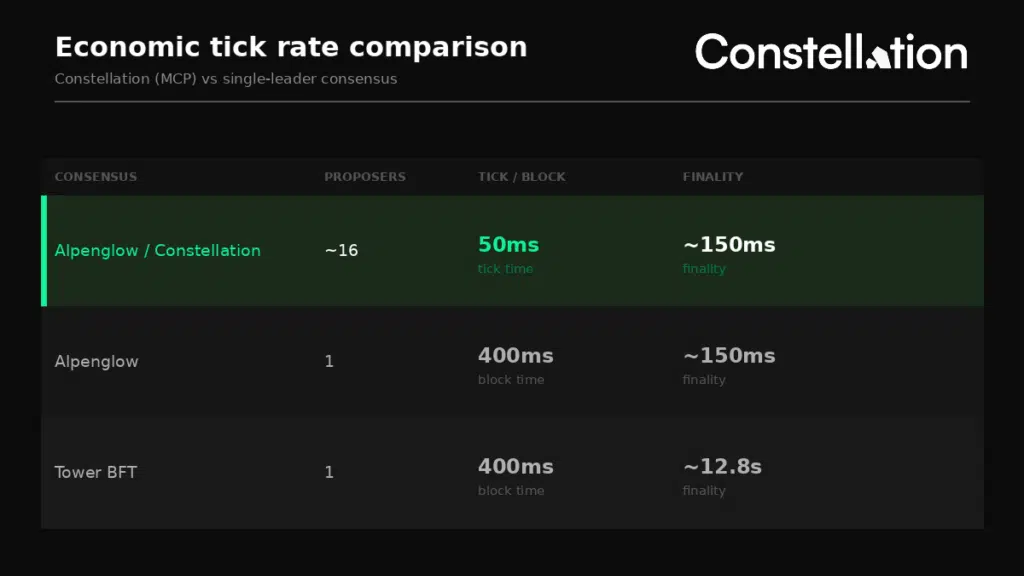
Constellation eliminates this monopoly by allowing multiple proposers to submit transactions simultaneously and requiring leaders to include transactions once witness thresholds are met. Leaders still assemble the final block but must do so under continuous supervision from the witness network.
Core technical parameters of Constellation include:
50-millisecond economic cycle: Proposers submit transactions as erasure-coded fragments using the same technology as Solana’s Turbine block propagation system. This is currently the shortest cycle in production-grade decentralized blockchains.
Mandatory inclusion threshold (40%): If at least 40% of validators receive a proposer’s fragments, the leader must include the corresponding transactions in the batch; they can no longer refuse inclusion by claiming “not seen this transaction.”
Equal penalty and skip mechanisms: If a proposer signs two conflicting versions of the same block, they are automatically excluded; if overall validation rate drops below 60%, the entire block is skipped.
Fee Redesign: Preventing Leaders from Self-Bypassing
Constellation’s fee structure adheres to a key principle: scheduling fees cannot be paid directly to the slot leader. If leaders could directly collect scheduling fees, they could effectively regain control over transaction ordering by charging high fees to themselves, bypassing the multi-proposer mechanism. Therefore, scheduling fees are redistributed proportionally based on validators’ stakes and smoothed over the cycle.
Anza emphasizes that, for validators, the final outcome is similar to the current system—they still receive inclusion and scheduling fees, but the disproportionate distribution under a single leader’s monopoly is eliminated.
As a preprocessor for Alpenglow, Constellation aims to replace Solana’s existing TowerBFT consensus and Proof of History (PoH) mechanisms, targeting a completion time of approximately 150 milliseconds. Anza plans to deploy the Alpenglow mainnet in Q3 2026, with the initial MCP version launching shortly thereafter.
Frequently Asked Questions
Q: How does Constellation fundamentally solve Solana’s MEV problem?
A: Constellation allows multiple proposers to submit transactions simultaneously and sets a 40% witness threshold for mandatory inclusion, stripping leaders of unilateral control over transaction ordering. Leaders cannot review specific transactions or arbitrarily adjust orderings, fundamentally eliminating the monopoly-based MEV opportunities present in the current architecture.
Q: How does Constellation’s anti-MEV approach differ structurally from Ethereum’s solutions?
A: Ethereum’s current anti-MEV solutions (like MEV-Boost) are mostly external protocol designs requiring additional coordination layers. Constellation integrates multi-proposer and censorship-resistant mechanisms directly into Solana’s consensus protocol, making Solana potentially the first mainstream blockchain to natively implement competitive multi-proposer consensus at the protocol level.
Q: What is the timeline for Alpenglow and Constellation development?
A: Anza plans to upgrade Solana’s consensus to Alpenglow in Q3 2026, with the initial version of Constellation (MCP) following shortly after the Alpenglow mainnet launch. The full white paper and interactive demo are available on Anza’s official website, and the community is encouraged to provide feedback.
Disclaimer: The information on this page may come from third parties and does not represent the views or opinions of Gate. The content displayed on this page is for reference only and does not constitute any financial, investment, or legal advice. Gate does not guarantee the accuracy or completeness of the information and shall not be liable for any losses arising from the use of this information. Virtual asset investments carry high risks and are subject to significant price volatility. You may lose all of your invested principal. Please fully understand the relevant risks and make prudent decisions based on your own financial situation and risk tolerance. For details, please refer to
Disclaimer.


