Markets have sharply repriced Federal Reserve expectations, with near-term rate hike probabilities now edging out cuts for the first time since the easing cycle began.
Rate Expectations Shift Sharply as Fed Holds and Markets Reassess
The shift, captured by the Atlanta Federal Reserve Bank’s Market Probability Tracker, marks a notable turn from early 2026, when traders leaned heavily toward rate reductions as inflation appeared to cool. Now, that narrative is wobbling.
The tracker, which derives probabilities from CME options tied to three-month compounded Secured Overnight Financing Rate (SOFR), shows a growing tilt toward tightening risk. Recent readings place the probability of a 25 basis point hike within three months around 15% to 19.2%, after briefly touching roughly 25% last week.
By contrast, expectations for a rate cut have fallen hard. Probabilities now hover between 16% and 17.3%, down from about 60% in February when easing seemed all but assured. Despite the shift, the base case remains unchanged. Prediction markets, including Polymarket and Kalshi, continue to assign roughly 85% odds that the Fed holds rates steady through the June Federal Open Market Committee (FOMC) meeting.
Still, the tone has clearly shifted. CME Fedwatch data echoes the move, showing modest but rising odds of a hike, alongside fading expectations for cuts across upcoming meetings.
The Fed’s March meeting added fuel to the recalibration. Policymakers held the federal funds rate in a range of 3.5% to 3.75%, while signaling a more cautious stance. Officials flagged steady economic activity, a stable labor market, and inflation that remains “somewhat elevated.”
The updated Summary of Economic Projections hinted at a more divided outlook. While the median forecast still points to one cut in 2026, seven policymakers now expect no cuts at all this year, suggesting growing skepticism inside the Fed itself.
Chair Jerome Powell reiterated that decisions will remain data-dependent, brushing aside comparisons to 1970s-style stagflation but acknowledging that geopolitical risks complicate the outlook.
Those risks are front and center. Escalating tensions involving Iran and disruptions tied to energy markets have pushed oil prices above $100 per barrel, raising concerns about inflation persistence. At the same time, economic signals remain mixed, with price pressures lingering even as growth shows signs of strain.
Analysts say the idea of hike probabilities overtaking cuts would have sounded far-fetched weeks ago. Now, it reflects a market grappling with conflicting signals: resilient inflation, geopolitical shocks, and a Fed unwilling to move too quickly.
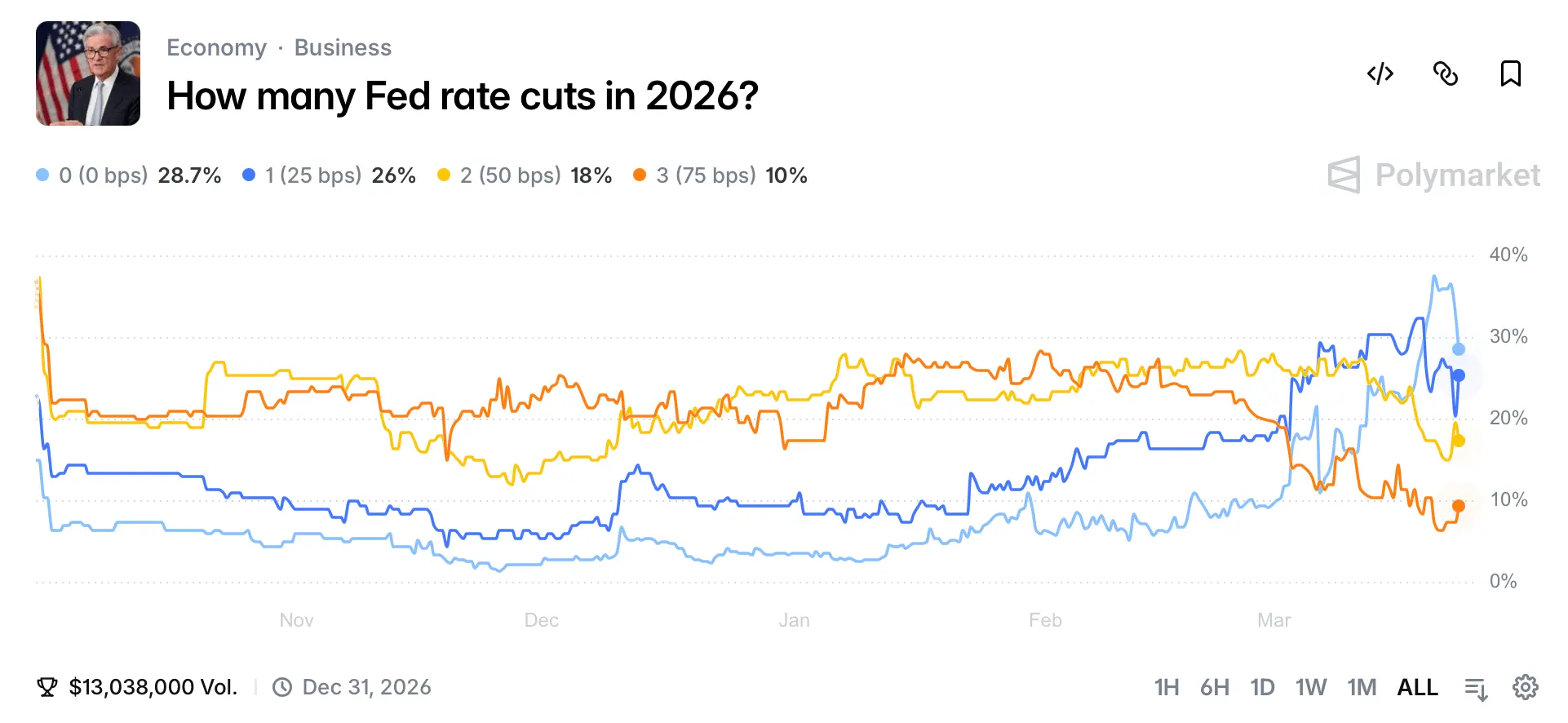
Prediction markets reinforce the cautious stance. On Polymarket, the “How many Fed rate cuts in 2026?” contract has drawn more than $13 million in volume, with traders assigning a 29% probability to zero cuts and 26% to a single cut. That places a combined 55% likelihood on one cut or none at all.
Kalshi markets show a similar distribution. “Exactly 0 cuts” leads with about 27% odds, followed by one cut at 23% and two cuts at 19%. Total trading volume there exceeds $2.7 million, with pricing reflecting a steady drift toward fewer policy moves.
Tail scenarios remain firmly discounted. Outcomes involving aggressive easing—such as six or more cuts—are priced at negligible probabilities, often below 3%. Markets are now waiting for the Fed’s March meeting minutes, scheduled for April 8, which could provide more detail on internal debates around inflation risks and tolerance levels. Traders will be watching closely for signs of a deeper hawkish tilt beneath the surface.
For now, the takeaway is simple: the rate-cut narrative is no longer a given. While a hike remains a secondary outcome, its growing presence in market pricing suggests that 2026 may not unfold as smoothly as earlier forecasts implied.
FAQ 🔎
- What changed in Fed rate expectations?
Markets now show slightly higher odds of a rate hike than a cut over the next three months.
- What do prediction markets say about 2026 cuts?
Most traders expect one or no cuts, with zero cuts currently the most likely outcome.
- Why are hike probabilities increasing?
Persistent inflation and rising energy prices tied to geopolitical tensions are driving the shift.
- Will the Fed raise rates in 2026?
A hike remains a lower-probability scenario, but it is no longer off the table.
Disclaimer: The information on this page may come from third parties and does not represent the views or opinions of Gate. The content displayed on this page is for reference only and does not constitute any financial, investment, or legal advice. Gate does not guarantee the accuracy or completeness of the information and shall not be liable for any losses arising from the use of this information. Virtual asset investments carry high risks and are subject to significant price volatility. You may lose all of your invested principal. Please fully understand the relevant risks and make prudent decisions based on your own financial situation and risk tolerance. For details, please refer to
Disclaimer.


