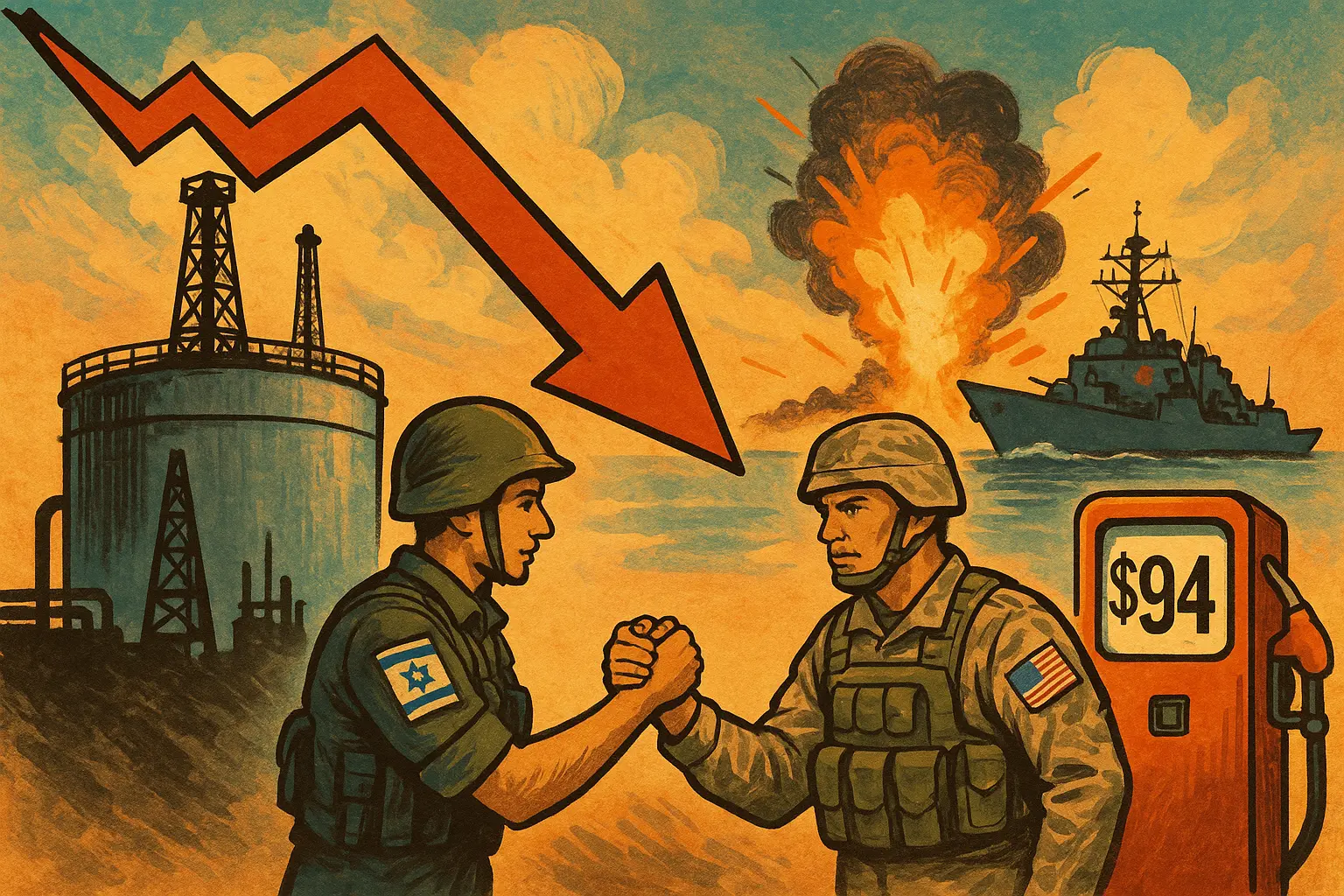
On Thursday, the international crude oil market experienced intense volatility. During extended trading hours, oil prices further weakened, with WTI falling to $94.59 intraday and Brent dropping to $102.88. The core reason for this sharp decline was Israeli Prime Minister Netanyahu’s announcement that Israel is assisting the United States in restoring navigation through the Strait of Hormuz, and that the war “may end sooner than people expect.”
The Diplomatic Background Behind the Sudden Drop in Oil Prices
The diplomatic signals driving this round of oil price pullback came from the highest levels of Israel. Netanyahu stated at a press conference that Israel had “independently” carried out airstrikes on Iran’s natural gas fields, and indicated that Israel would “comply” with former President Trump’s demand to “pause” subsequent attacks on Iran’s energy infrastructure—Trump had previously explicitly told Netanyahu not to attack Iran’s energy facilities.
Meanwhile, after US Vice President Harris’s meeting with representatives from the American Petroleum Institute (API), API President and CEO Mike Sommers clearly stated that reopening the Strait of Hormuz has become the “top priority” of the Trump administration. He directly said, “We must restore navigation through the Strait of Hormuz; currently, there are no viable alternatives.” A White House official also confirmed that the US government is not considering any restrictions on oil and gas exports at this time.
These multiple statements collectively injected short-term diplomatic easing expectations into the market, which is the direct reason for the technical decline of oil prices from their highs.
Natural Gas and Refined Oil Markets Still Under Continued Tension
However, the decline in crude oil prices has not spread to all energy commodities; prices in several terminal energy markets remain under strong pressure:
European Natural Gas (Dutch TTF): Rose over 11%, reaching approximately €61 per megawatt-hour, reflecting ongoing impacts from damage to Qatar’s LNG facilities.
US Natural Gas: Increased by 1.7%, trading at $3.116 per million British thermal units.
US Gasoline (RBOB futures): Rose nearly 1%, at $3.13 per gallon, approaching a four-year high.
This divergence indicates that even though diplomatic expectations of the Strait of Hormuz reopening support a technical pullback in crude oil prices, the pricing adjustments in natural gas and refined oil markets—due to damage to Qatar’s LNG facilities (17% of export capacity affected, with repairs taking 3-5 years)—are still ongoing.
Deep Analysis of the Supply Crisis: From “Supply Chain Problems” to “Supply Issues”
Energy market analysts are experiencing an important shift in the characterization of this crisis.
Dan Pickering, founder and chief investment officer of Pickering Energy Partners, pointed out that the market is evolving from “supply chain problems” to “supply issues”—the former can usually be repaired relatively quickly, while the latter involves actual loss of production capacity, with completely different costs and timelines for repair. “If suddenly the amount that can be transported decreases because actual production no longer exists—that’s an upgrade,” he said.
Gulf Oil senior energy advisor Tom Kloza issued a more severe warning: if the conflict expands from the Strait of Hormuz to Europe or US domestic energy facilities outside the Persian Gulf, the market could enter an “all bets are off” extreme state, where traditional pricing models might completely fail.
Currently, the Strait of Hormuz accounts for about 20% of global oil transportation, with vessel traffic essentially halted. India’s Ministry of External Affairs stated that India is in ongoing communication with Iran regarding the passage of 22 ships through the strait, with two ships having already arrived safely, while India continues to expand energy imports from Russia.
Frequently Asked Questions
Q: Israel claims to assist in reopening the Strait of Hormuz. Does this mean oil prices will quickly return to normal levels?
Short-term diplomatic statements can trigger immediate declines in oil prices, but actual supply recovery takes time and depends on multiple uncertain factors: whether shipping safety through the Strait of Hormuz is truly assured, whether Iran accepts ceasefire conditions, and the actual progress of Qatar LNG facility repairs. Analysts generally believe that even if the Strait of Hormuz reopens temporarily, the previous loss of natural gas production capacity—especially Qatar’s 17% LNG capacity gap—will continue to exert structural supply pressure for years.
Q: WTI and Brent crude prices fell sharply after hours. Does this reflect market belief that geopolitical risks are under control?
Not necessarily. The after-hours decline is more likely due to technical corrections and profit-taking rather than a fundamental reassessment of geopolitical risks. Natural gas futures remain strong, indicating that the energy markets as a whole do not believe the supply threat has been eliminated. Diplomatic signals offer “hope” rather than “confirmation.” Sommers explicitly stated, “There are no alternatives,” further emphasizing that the current situation remains very fragile.
Q: After the Strait of Hormuz reopens, how will Qatar LNG facility damage be addressed?
Even if shipping through the Strait resumes, the 17% capacity loss at Qatar LNG remains an independent supply gap, requiring 3-5 years to repair (according to QatarEnergy’s CEO). Global LNG alternative supplies are limited; short-term idle capacities in Australia, the US, and Norway cannot fully fill the gap. This fundamental reason explains why the upward trend in natural gas prices is more persistent than that of crude oil.
Disclaimer: The information on this page may come from third parties and does not represent the views or opinions of Gate. The content displayed on this page is for reference only and does not constitute any financial, investment, or legal advice. Gate does not guarantee the accuracy or completeness of the information and shall not be liable for any losses arising from the use of this information. Virtual asset investments carry high risks and are subject to significant price volatility. You may lose all of your invested principal. Please fully understand the relevant risks and make prudent decisions based on your own financial situation and risk tolerance. For details, please refer to
Disclaimer.


