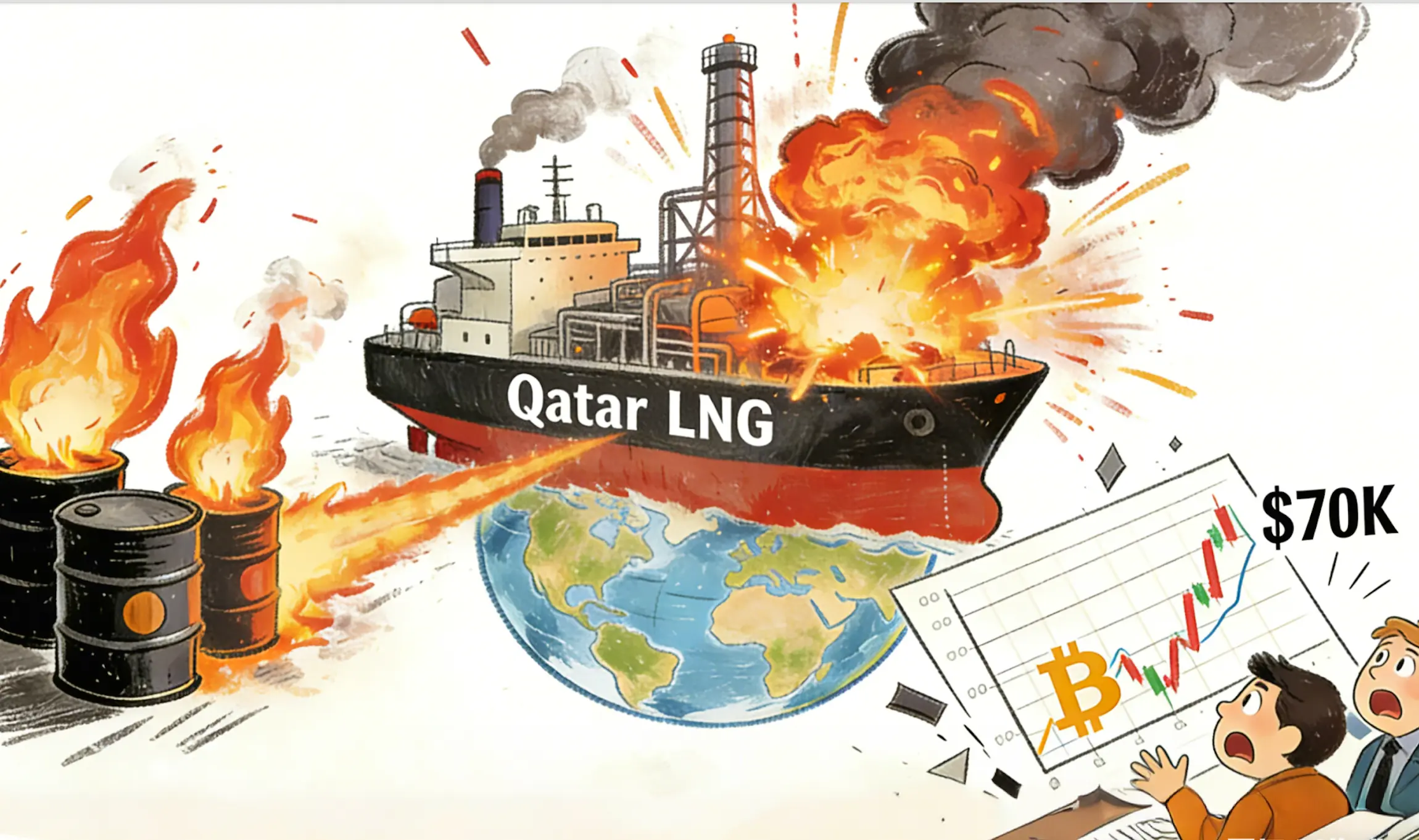
 Iran’s Islamic Revolutionary Guard Corps (IRGC) launched missile strikes on Qatar’s Ras Laffan Industrial City on March 18-19, 2026, severely damaging two LNG production trains representing 12.8 million tons per annum (MTPA) of capacity—approximately 17% of Qatar’s LNG exports—and forcing QatarEnergy to declare force majeure on long-term contracts for up to five years.
The attack, which also damaged one of two trains at the Pearl Gas-to-Liquids facility operated by Shell, is expected to cost QatarEnergy an estimated $20 billion in annual lost revenue and will sideline production for three to five years, impacting major customers in China, South Korea, Italy, and Belgium.
The strikes triggered immediate global energy market volatility, with Brent crude surging above $110 per barrel—a more than 50% increase since the conflict began on February 28—and European natural gas futures rising as much as 35% to more than double pre-war levels. Bitcoin fell below $70,000 amid broader risk-off sentiment as investors rotated toward cash and traditional safe havens.
Damage Assessment and Production Impact
Ras Laffan LNG Facility
The missile strikes targeted QatarEnergy’s Trains 4 and 6 at the Ras Laffan Industrial City, the world’s primary LNG export hub. Both trains are joint ventures with ExxonMobil: Train 4 is owned 66% by QatarEnergy and 34% by ExxonMobil, while Train 6 is 70% QatarEnergy and 30% ExxonMobil. The combined capacity loss of 12.8 MTPA represents approximately 17% of Qatar’s total LNG export capacity and roughly 19% of global LNG supply, according to energy analytics firm Wood Mackenzie.
His Excellency Saad Sherida Al-Kaabi, Minister of State for Energy Affairs and President and CEO of QatarEnergy, confirmed that repairs will take three to five years to complete, with the company compelled to declare force majeure on some long-term LNG contracts for up to five years.
Pearl GTL Facility Damage
The attacks also damaged one of two trains at the Pearl Gas-to-Liquids facility, a production sharing agreement operated by Shell that converts natural gas into high-quality fuels, base oils, paraffins, and waxes. The damaged train is expected to remain offline for a minimum of one year while damage assessment continues.
Associated Product Losses
The outage will cause significant losses in associated products:
Condensates: 18.6 million barrels (approximately 24% of Qatar’s exports)
LPG: 1.281 million tons (approximately 13% of Qatar’s exports)
Naphtha: 0.594 million tons (approximately 6% of Qatar’s exports)
Sulfur: 0.18 million tons (approximately 6% of Qatar’s exports)
Helium: 309.54 MCFA (approximately 14% of Qatar’s exports)
Geopolitical Context and Escalation
Retaliatory Strikes
The attacks on Qatari infrastructure came in direct retaliation for Israeli airstrikes on Iran’s South Pars gas field—the world’s largest natural gas complex, jointly managed with Qatar—which Israel struck with reported U.S. support on March 17, 2026. Those strikes targeted Phases 3-6 of the South Pars refinery, halting production at facilities that supply approximately 70% of Iran’s domestic natural gas.
IRGC Warnings
Following the strikes, the IRGC issued urgent warnings to civilians and workers to evacuate areas near key energy infrastructure across the Persian Gulf, designating multiple facilities as “direct and legitimate targets.” Named facilities included the SAMREF refinery and Jubail petrochemical complex in Saudi Arabia, the Al Hosn gas field in the UAE, and the Mesaieed petrochemical complex and Ras Laffan refinery in Qatar.
Qatar’s Response
The Qatari Ministry of Foreign Affairs condemned the Israeli targeting of facilities linked to Iran’s South Pars field, calling it a “dangerous and irresponsible step” that “constitutes a threat to global energy security.” Qatar called on all parties to exercise restraint and work toward de-escalation.
Global Energy Market Impact
Oil Price Surge
Brent crude surged above $110 per barrel following the attacks, briefly touching $116 before partially retreating. This represents a more than 50% increase from approximately $70 per barrel when the conflict began on February 28. West Texas Intermediate (WTI) crude climbed to nearly $98 per barrel. The International Energy Agency pledged to release 400 million barrels from global reserves, while the U.S. announced plans to withdraw 172 million barrels from the Strategic Petroleum Reserve.
Natural Gas Price Volatility
European natural gas benchmark TTF prices surged as much as 35% on Thursday, reaching levels more than double their pre-war values. The prolonged outage has fundamentally altered global gas market expectations, with Wood Mackenzie noting that initial projections of a two-month disruption are now “increasingly unlikely.”
Supply Chain Disruptions
The Strait of Hormuz, through which approximately 20% of global oil supply once passed, has seen near-total tanker halts. Major regional producers including Saudi Arabia and Iraq have cut production as their crude cannot reach global markets.
Crypto Market Reaction
Bitcoin Price Decline
Bitcoin extended its sell-off below $70,000 on March 19, retreating from a weekly high of approximately $76,000. Technical indicators show a bearish shift, with the Relative Strength Index (RSI) easing toward the high-40s and the Moving Average Convergence Divergence (MACD) contracting. Initial support is seen around $68,400, with further protection at $67,000.
Broader Market Sentiment
The risk-off sentiment triggered by the escalating conflict weighed across digital asset markets, with traders unwinding leverage and rotating into cash and short-duration traditional safe havens. Ethereum dropped toward the low-$2,200s, and total crypto market value retreated from the approximately $2.5 trillion level.
Frequently Asked Questions
What specific facilities were damaged in the attack on Qatar?
The missile strikes damaged two LNG production trains at Ras Laffan Industrial City—Trains 4 and 6, totaling 12.8 MTPA capacity (approximately 17% of Qatar’s exports)—and one of two trains at the Pearl Gas-to-Liquids facility operated by Shell.
How long will repairs take and which customers are affected?
Repairs are expected to take three to five years for the LNG trains and at least one year for the Pearl GTL facility. QatarEnergy will declare force majeure for up to five years on long-term contracts affecting customers in China, South Korea, Italy, and Belgium.
How have global energy markets responded?
Brent crude surged above $110 per barrel, European natural gas futures rose up to 35%, and the Strait of Hormuz has seen near-total tanker halts affecting approximately 20% of global oil supply.
Disclaimer: The information on this page may come from third parties and does not represent the views or opinions of Gate. The content displayed on this page is for reference only and does not constitute any financial, investment, or legal advice. Gate does not guarantee the accuracy or completeness of the information and shall not be liable for any losses arising from the use of this information. Virtual asset investments carry high risks and are subject to significant price volatility. You may lose all of your invested principal. Please fully understand the relevant risks and make prudent decisions based on your own financial situation and risk tolerance. For details, please refer to
Disclaimer.


