Why Does GTBTC Exist? How Gate Enables Bitcoin to Generate Sustainable Yield

Beginner
Quick Reads
Last Updated 2026-03-26 07:57:56
Reading Time: 1m
GTBTC is a BTC yield asset introduced by Gate. Through tokenization, it consolidates staking rewards, allowing Bitcoin to generate automatic returns while held. This article explores the design principles and practical value of GTBTC.

Real Challenges Facing BTC Holders

Source: https://www.gate.com/staking/BTC

Bitcoin has long been viewed primarily as a store of value. In most cases, BTC returns rely on price appreciation, and during periods of volatility or correction, the asset itself generates no cash flow.

As the market matures, more users are asking a critical question: Can BTC still deliver stable returns without high-frequency trading or excessive leverage?

GTBTC was developed to meet this emerging demand.

GTBTC: Design Philosophy and Core Logic

GTBTC is a yield-bearing wrapped BTC asset introduced by Gate, fully backed by the platform’s BTC reserves and issued as an on-chain token. The core idea is not to “create a new asset,” but to standardize and package the results of BTC participating in yield strategies within the Gate ecosystem.

When users stake BTC through Gate’s on-chain Earn platform, they receive GTBTC as a proof of ownership, maintaining their original BTC exposure.

How GTBTC Delivers Yield

Unlike traditional “daily payout” models, GTBTC uses a net asset value (NAV) accumulation approach. Yield generated from BTC staking is not distributed separately, but is continuously reflected in GTBTC’s value.

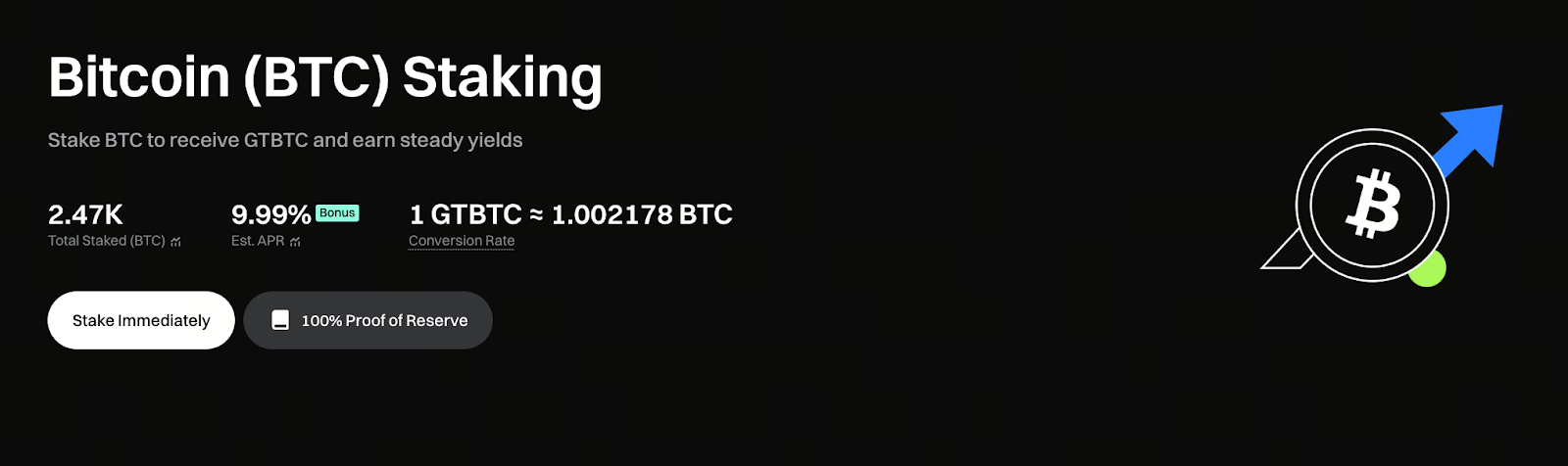
The current reference annualized yield for BTC staking is about 9.99%, with actual returns dynamically adjusted based on market conditions and participation levels. This method lowers the operational burden of managing returns and aligns with long-term holding strategies.

GTBTC’s Role in the Gate Ecosystem

Within Gate’s asset ecosystem, GTBTC is neither a simple lock-up certificate nor a high-risk derivative. Instead, it serves as a “functional BTC,” preserving native BTC attributes while adding a yield component.

Users can redeem GTBTC for BTC at any time or include it as a yield-generating element in their asset allocation to enhance overall portfolio efficiency.

What Asset Strategies Fit GTBTC?

GTBTC is best suited for users seeking stable, balanced portfolios:

  • Those confident in BTC’s long-term value but not interested in short-term trading
  • Those aiming to reduce idle assets during market fluctuations
  • Those who prefer automated yield and low-maintenance holding options

For these users, GTBTC offers a way to make BTC work more efficiently, rather than replacing BTC itself.

Conclusion

As the crypto market matures, asset utilization is evolving. The introduction of GTBTC marks a shift in perspective: focusing not only on price movements, but on enabling core assets to generate ongoing value while being held.

For long-term BTC holders, this approach may ultimately matter more than short-term gains.

Author: Max
Disclaimer
* The information is not intended to be and does not constitute financial advice or any other recommendation of any sort offered or endorsed by Gate.
* This article may not be reproduced, transmitted or copied without referencing Gate. Contravention is an infringement of Copyright Act and may be subject to legal action.

Related Articles

AI-Native Settlement Layers: How United Stables Is Building the Next Financial Rail
Beginner

AI-Native Settlement Layers: How United Stables Is Building the Next Financial Rail

Stablecoins were originally designed as dollar substitutes within exchanges, primarily used for asset pricing and trade settlement. As on-chain financial ecosystems have matured, their role has expanded beyond simple payments to include collateral assets, cross-chain liquidity mediums, and unified settlement units. In particular, as AI systems and automated agents begin to participate directly in economic activity, demand has risen sharply for programmable value units capable of instant settlement. This shift is pushing stablecoins toward the role of foundational financial infrastructure.
2026-03-25 03:16:17
Gold Price Forecast for the Next Five Years: 2026–2030 Trend Outlook and Investment Implications, Could It Reach $6,000?
Beginner

Gold Price Forecast for the Next Five Years: 2026–2030 Trend Outlook and Investment Implications, Could It Reach $6,000?

Analyze current gold price trends alongside authoritative five-year forecasts, integrating an evaluation of market risks and opportunities. This gives investors insight into the potential trajectory of gold prices and the main drivers expected to shape the market over the next five years.
2026-03-25 18:13:30
Aster vs Hyperliquid: Which Perp DEX Will Prevail?
Beginner

Aster vs Hyperliquid: Which Perp DEX Will Prevail?

Aster and Hyperliquid are the two representative protocols of the "purpose-built L1 path" within the current decentralized perpetual exchange (Perp DEX) sector. As a pioneer in the field, Hyperliquid has built a deep liquidity moat through its highly mature order book architecture and strong community consensus. Conversely, Aster, as a rising challenger, seeks to leapfrog the competition in high-performance trading through more aggressive multi-chain aggregation logic, private transaction modules, and an underlying execution environment optimized for 2026 market demands.
2026-03-24 11:58:33
DePIN Identity Network and Real World Applications: How Humanity Protocol Brings on-chain Identity Into the Physical World
Beginner

DePIN Identity Network and Real World Applications: How Humanity Protocol Brings on-chain Identity Into the Physical World

Most Web3 identity systems remain confined to on-chain environments and struggle to achieve meaningful adoption in real world settings. Through a DePIN architecture and physical verification hardware, Humanity Protocol aims to bring decentralized identity into access control systems, hospitality, public services, and offline events, allowing on-chain identity to function not just as a digital credential, but as foundational infrastructure for real world access.
2026-03-25 07:40:53
Aerodrome Tokenomics: How ve(3,3) Powers Base's Most Profitable DEX
Beginner

Aerodrome Tokenomics: How ve(3,3) Powers Base's Most Profitable DEX

AERO is the native token of Aerodrome Finance, a core decentralized exchange and liquidity protocol in the Base ecosystem. It is primarily used for liquidity incentives and ecosystem operations. veAERO is a governance NFT that users receive by locking AERO, representing both voting power and the right to share protocol revenue. Through a dual track structure of AERO as a utility token and veAERO as a governance credential, Aerodrome separates liquidity usage value from long term governance power, allowing participants to act as liquidity providers, governance decision makers, and revenue sharers within the same system.
2026-03-25 06:40:31
Hybrid Collateral Stablecoins: Inside United Stables' Stability and Yield Architecture
Beginner

Hybrid Collateral Stablecoins: Inside United Stables' Stability and Yield Architecture

In the early stages of the crypto market, traditional stablecoins mainly relied on single-reserve or single-collateral models. Their primary focus was price stability and payment convenience, which allowed them to become foundational tools for on-chain trading and capital flows. As the market has entered a more mature financial phase, however, this structure has begun to reveal limitations, including high concentration risk and the difficulty of balancing liquidity with yield. These constraints have driven the evolution toward multi-layer collateral and portfolio-based designs, such as the dual-layer hybrid collateral architecture proposed by United Stables, which seeks to redefine the underlying logic of stable assets.
2026-03-25 03:17:39





