As the blockchain ecosystem has grown rapidly, different public chains have gradually developed into separate asset networks. Examples include BTC on the Bitcoin network, ETH on the Ethereum network, and native assets within other public chain ecosystems. Although these assets each hold value, they cannot interact directly with one another. Users typically have to rely on centralized exchanges or cross-chain bridges to complete asset swaps.
This model creates problems in both efficiency and security. Centralized platforms introduce custody risk, while cross-chain bridges, because of their technical complexity, have often become frequent targets for security exploits. As a result, the market urgently needed a decentralized cross-chain liquidity solution that could support direct swaps between native assets. THORChain was created to meet that need.
What Is THORChain?
THORChain is a decentralized cross-chain liquidity protocol designed to enable direct swaps of native assets across different blockchains. Through an automated market maker model and liquidity pool design, users can swap assets such as BTC and ETH across chains without relying on intermediaries.
Unlike traditional cross-chain bridges, THORChain does not depend on wrapped assets. Instead, it uses RUNE as an intermediary settlement asset to complete transactions. For example, when a user swaps BTC for ETH, the protocol first converts BTC into RUNE, then converts RUNE into ETH, completing the full cross-chain swap process. This model reduces liquidity fragmentation while also improving the efficiency of cross-chain transactions.
What Is the RUNE Token Used For?
RUNE is the core token of the THORChain network, serving key functions across the protocol, including liquidity settlement, node security, and incentive distribution. Because every liquidity pool is paired with RUNE, any asset involved in a cross-chain swap must pass through RUNE as an intermediary. As a result, growth in protocol trading volume directly affects demand for RUNE.
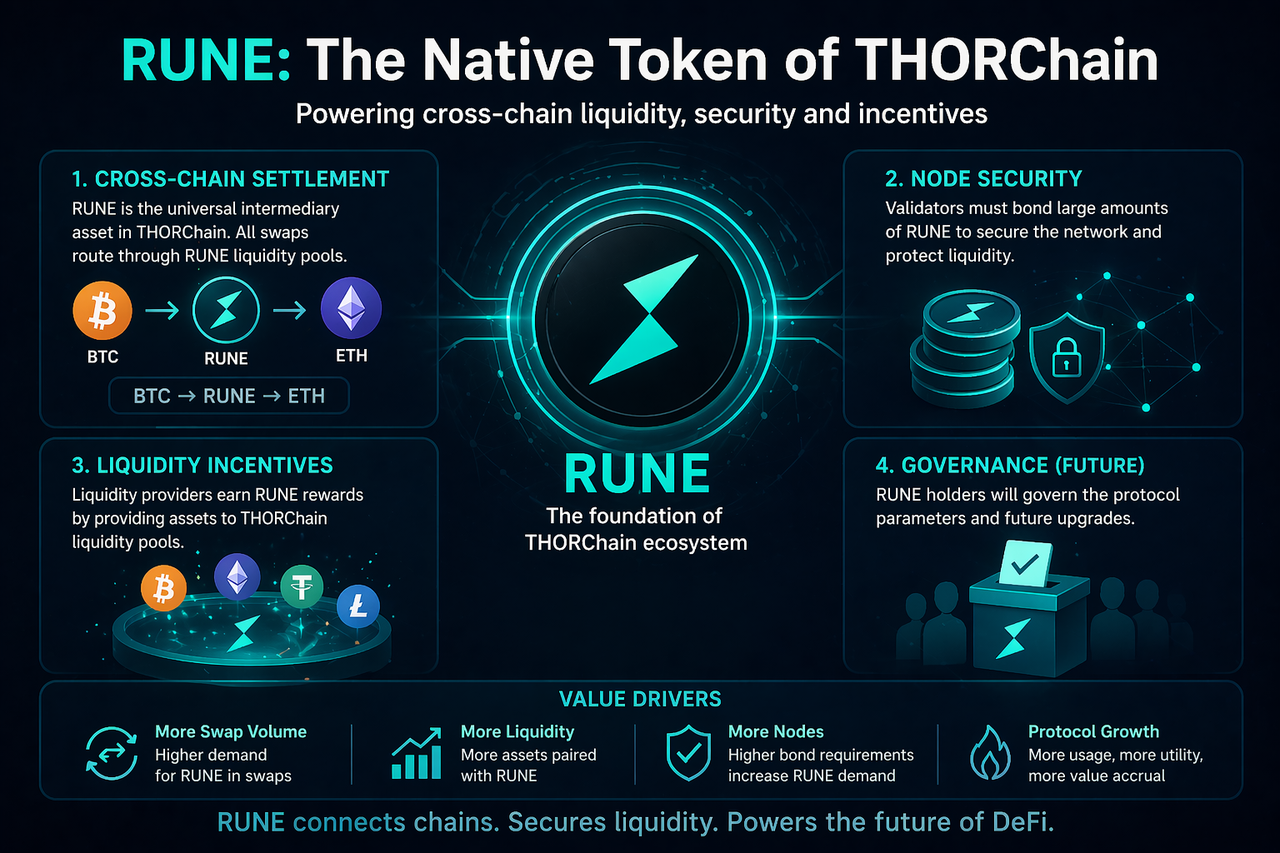
Beyond settlement, RUNE is also used for node bonding. Validator nodes must stake a certain amount of RUNE to participate in network operations. This mechanism raises the cost of malicious behavior and helps protect the security of cross-chain transactions. Liquidity providers can also earn RUNE rewards by supplying assets, making RUNE an important part of the ecosystem’s incentive structure.
How Does THORChain Enable Cross-Chain Transactions?
THORChain’s cross-chain transactions mainly depend on coordination between liquidity pools and the node network. When a user initiates a cross-chain swap, the protocol first converts the input asset into RUNE, then swaps RUNE for the target asset from the liquidity pool on the destination chain. Through this two-step swap mechanism, THORChain avoids the need to create a separate trading pool for every asset pair.
To support this process, THORChain has built a system architecture made up of liquidity pools, validator nodes, and fund custody modules. Nodes are responsible for monitoring transactions across different blockchains and verifying asset states, while liquidity pools provide the liquidity needed for asset swaps. This allows the protocol to enable cross-chain asset exchange in a decentralized environment.
THORChain’s Technical Architecture Explained
THORChain’s underlying architecture consists of a consensus mechanism, a fund custody system, and cross-chain communication modules. The protocol uses the Tendermint consensus mechanism to coordinate node activity and manages funds across different chains through its Vault system.
At the same time, THORChain connects with external blockchain networks through the Bifröst module, enabling on-chain transaction monitoring and asset transfer verification. It is the coordinated operation of these technical modules that allows THORChain to support cross-chain liquidity for native assets without relying on centralized custody.
What Are the Advantages of THORChain?
THORChain’s core advantage is that it enables decentralized cross-chain swaps of native assets. Users do not need to convert BTC into a wrapped asset, nor do they need to custody their assets through a centralized platform. Instead, they can exchange assets across different chains directly, which significantly lowers the barrier to cross-chain use.
In addition, THORChain’s liquidity pool mechanism improves asset swap efficiency and allows liquidity across the multichain ecosystem to be managed in a more concentrated way. This design not only improves the user experience, but also provides foundational support for the future development of cross-chain DeFi applications. For this reason, THORChain is widely viewed as an important representative of cross-chain liquidity infrastructure.
THORChain vs. Traditional Cross-Chain Bridges: Key Differences in Native Cross-Chain Swaps
THORChain and traditional cross-chain bridges differ clearly in how they handle assets, their security models, and their use cases. Traditional cross-chain bridges are mainly used for asset transfers, while THORChain focuses more on decentralized swaps between native assets. This gives it a stronger advantage in the cross-chain liquidity experience.
| Comparison Dimension |
THORChain |
Traditional Cross-Chain Bridges |
| Core Function |
Cross-chain swaps of native assets |
Cross-chain asset transfers |
| Asset Form |
Native assets |
Wrapped assets |
| Swap Method |
Swaps through RUNE liquidity pools |
Lock assets, then mint mapped assets |
| Wrapped Assets Required |
No |
Yes |
| Liquidity Source |
Decentralized liquidity pools |
Bridged asset reserves |
| Security Mechanism |
Node bonding + liquidity pools |
Locking contracts + verification mechanisms |
| Main Risks |
Node and protocol risks |
Bridge contract attack risks |
| Use Cases |
Cross-chain asset swaps |
Cross-chain asset migration |
| User Experience |
Direct swaps of native assets |
Bridge first, then trade |
| Degree of Decentralization |
Relatively high |
Depends on the type of bridge |
Overall, THORChain’s advantage lies in its ability to enable true cross-chain swaps of native assets. Users do not have to deal with the added complexity of wrapped assets, and reliance on bridged asset reserves is also reduced. Therefore, in scenarios that require cross-chain swaps, THORChain is better suited than traditional cross-chain bridges as liquidity infrastructure.
Risks and Limitations of THORChain
Although THORChain has clear advantages in cross-chain liquidity, the protocol still faces certain risks. First, cross-chain protocols are structurally complex, and any code vulnerability could lead to security issues. Second, when liquidity depth is insufficient, users may face higher slippage on large transactions, which can affect the trading experience.
In addition, as competition in cross-chain infrastructure intensifies, THORChain must also deal with market pressure from other protocols. Therefore, the long-term value of RUNE depends not only on its technical advantages, but also on continued protocol adoption and the ecosystem’s ability to grow.
Conclusion
THORChain enables cross-chain swaps of native assets through decentralized liquidity pools, providing key liquidity infrastructure support for the multichain ecosystem. RUNE plays multiple roles within the protocol, including liquidity settlement, node security, and incentive distribution, making it the core of the entire network’s operation.
As demand for cross-chain services continues to grow, THORChain’s strategic value within the DeFi ecosystem is rising. For users who follow the development of cross-chain infrastructure, THORChain is a project worth paying close attention to, while the long-term value of RUNE is closely connected to the protocol’s future growth prospects.
FAQs
What Does THORChain Do?
THORChain is a decentralized liquidity protocol that supports cross-chain swaps of native assets, allowing users to directly exchange assets across different blockchains.
What Is RUNE Used For?
RUNE is used for cross-chain transaction settlement, node bonding, and liquidity incentives. It is the core token that powers the THORChain protocol.
Does THORChain Require Wrapped Assets?
No. THORChain supports direct swaps between native assets without requiring assets to be wrapped into another form.
Does RUNE Have Long-Term Value?
The long-term value of RUNE mainly comes from growing demand for cross-chain transactions, demand for node bonding, and the expansion of protocol liquidity.







