What Is GPUAI? A Complete Guide to the Emerging Trend of Distributed AI Computing

Beginner
Quick Reads
Last Updated 2026-03-30 03:21:17
Reading Time: 1m
GPUAI is a new type of distributed AI computing protocol that coordinates idle GPU resources worldwide through blockchain, providing developers with a decentralized, high-performance, and low-cost AI training platform.

What is GPUAI?


Figure:https://x.com/GPUAI_Coin

GPUAI is a decentralized AI computing protocol that is neither a cloud platform nor a GPU rental platform, but rather a foundational protocol that implements task scheduling and computing power incentives through blockchain technology. It integrates idle GPUs from around the world into a flexible, accessible, and low-cost computing network, providing computing power support for AI developers, research institutions, and startups.

Current challenges facing the AI industry

  • Inequality in computing power: Currently, training large AI models often requires millions of GPU hours, and such resources are usually held by large tech companies and cloud computing giants, making it difficult for individual developers and small teams to reach.
  • Severe resource waste: Millions of GPUs are sitting idle in gaming PCs, laboratories, and corporate servers worldwide, being underutilized, resulting in significant resource waste.
  • High centralized costs: Traditional cloud service prices are opaque, with long waiting times and frequent restrictions, which can no longer meet the explosive growth of computing power required by AI.

The core solution of GPUAI

  1. Global Elastic Computing Network: GPUAI integrates idle resources such as gaming graphics cards, research clusters, and edge devices into distributed computing nodes, dynamically scheduling GPUs according to task requirements.
  2. Federated task scheduling engine: The system intelligently allocates tasks based on multiple factors such as bandwidth, GPU performance, and geographical location, improving efficiency and success rates.
  3. Blockchain security mechanisms: All computation results are verified on-chain and ensure protocol security through mechanisms such as zero-knowledge proofs, collateral penalties, and historical reputation.
  4. Incentive Mechanism Design: Users pay for computing costs with GPUAI tokens, nodes earn token rewards by completing tasks, and can also enhance task allocation priority through staking.

The use cases and advantages of GPUAI

  • AI Model Training and Inference: Without the need to deploy expensive servers, users can submit training tasks to the GPUAI network to obtain dynamically scalable computing power.
  • Generative AI Application Development: When building Stable Diffusion and LLM applications, you can flexibly call on distributed GPU clusters to lower the development threshold.
  • Research and Edge Computing: Universities and independent researchers can access the GPUAI network, avoiding the problem of computing power monopoly and achieving low-cost research exploration.

Summary

GPUAI is the future representative of the global decentralized computing network. It truly achieves “shared computing resources” rather than “concentrated computing power” through the combination of technology and economic models. For every developer who wants to participate in the AI era, GPUAI offers a viable new path.


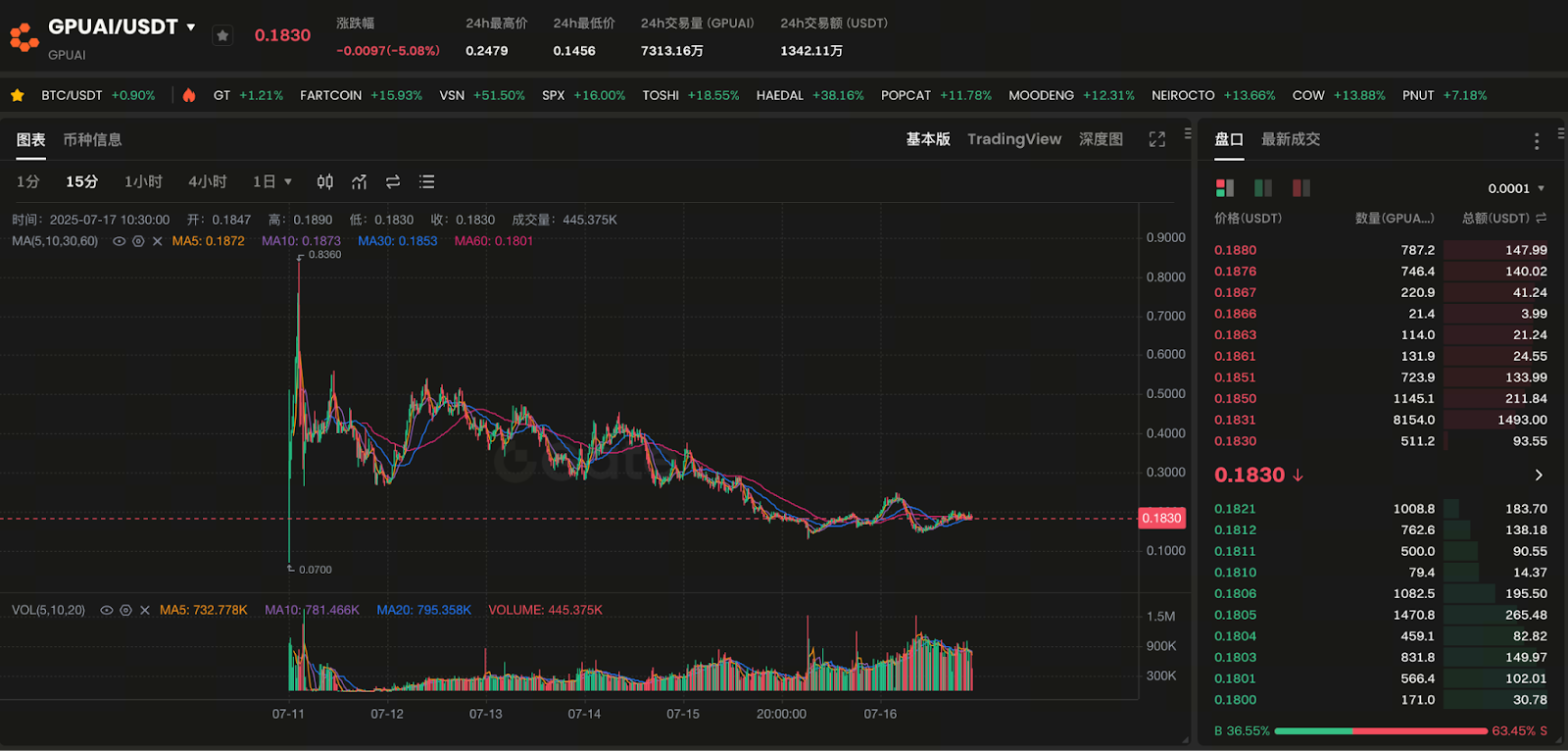
Figure:https://www.gate.com/en/trade/GPUAI_USDT

GPUAI has been launched on the Gate spot market, with a price of approximately $0.18 as of July 17, 2025.

Author: Max
Disclaimer
* The information is not intended to be and does not constitute financial advice or any other recommendation of any sort offered or endorsed by Gate.
* This article may not be reproduced, transmitted or copied without referencing Gate. Contravention is an infringement of Copyright Act and may be subject to legal action.

Related Articles

What is Fartcoin? All You Need to Know About FARTCOIN
Intermediate

What is Fartcoin? All You Need to Know About FARTCOIN

Fartcoin (FARTCOIN) is a representative meme coin within the Solana ecosystem based on an AI-driven narrative. Its core concept originated from an experiment aimed at exploring the "boundaries between AI Agents and humor." More than just a digital asset with social attributes, the project deeply couples absurd humor culture with on-chain financial logic by integrating autonomous AI interaction models.
2026-04-04 22:01:19
Gold Price Forecast for the Next Five Years: 2026–2030 Trend Outlook and Investment Implications, Could It Reach $6,000?
Beginner

Gold Price Forecast for the Next Five Years: 2026–2030 Trend Outlook and Investment Implications, Could It Reach $6,000?

Analyze current gold price trends alongside authoritative five-year forecasts, integrating an evaluation of market risks and opportunities. This gives investors insight into the potential trajectory of gold prices and the main drivers expected to shape the market over the next five years.
2026-03-25 18:13:30
Aster vs Hyperliquid: Which Perp DEX Will Prevail?
Beginner

Aster vs Hyperliquid: Which Perp DEX Will Prevail?

Aster and Hyperliquid are the two representative protocols of the "purpose-built L1 path" within the current decentralized perpetual exchange (Perp DEX) sector. As a pioneer in the field, Hyperliquid has built a deep liquidity moat through its highly mature order book architecture and strong community consensus. Conversely, Aster, as a rising challenger, seeks to leapfrog the competition in high-performance trading through more aggressive multi-chain aggregation logic, private transaction modules, and an underlying execution environment optimized for 2026 market demands.
2026-03-24 11:58:33
AI-Native Settlement Layers: How United Stables Is Building the Next Financial Rail
Beginner

AI-Native Settlement Layers: How United Stables Is Building the Next Financial Rail

Stablecoins were originally designed as dollar substitutes within exchanges, primarily used for asset pricing and trade settlement. As on-chain financial ecosystems have matured, their role has expanded beyond simple payments to include collateral assets, cross-chain liquidity mediums, and unified settlement units. In particular, as AI systems and automated agents begin to participate directly in economic activity, demand has risen sharply for programmable value units capable of instant settlement. This shift is pushing stablecoins toward the role of foundational financial infrastructure.
2026-03-25 03:16:17
Aerodrome Tokenomics: How ve(3,3) Powers Base's Most Profitable DEX
Beginner

Aerodrome Tokenomics: How ve(3,3) Powers Base's Most Profitable DEX

AERO is the native token of Aerodrome Finance, a core decentralized exchange and liquidity protocol in the Base ecosystem. It is primarily used for liquidity incentives and ecosystem operations. veAERO is a governance NFT that users receive by locking AERO, representing both voting power and the right to share protocol revenue. Through a dual track structure of AERO as a utility token and veAERO as a governance credential, Aerodrome separates liquidity usage value from long term governance power, allowing participants to act as liquidity providers, governance decision makers, and revenue sharers within the same system.
2026-03-25 06:40:31
The ve(3,3) Flywheel Explained: How AERO Tokenomics Powers Aerodrome’s DeFi Economy
Beginner

The ve(3,3) Flywheel Explained: How AERO Tokenomics Powers Aerodrome’s DeFi Economy

In the competition for DeFi liquidity, high-inflation mining alone is no longer enough to build lasting advantages. Aerodrome applies the ve(3,3) economic model to redesign token emissions, voting mechanisms, and revenue distribution, creating a liquidity flywheel centered on governance and cash flow. This article examines AERO tokenomics, the veAERO locking mechanism, and protocol revenue models to explain how Aerodrome builds a sustainable DeFi economic system.
2026-03-25 06:41:58