Unlike traditional cloud storage systems that rely on centralized servers, Walrus seeks to build a more open, transparent, and censorship resistant data storage infrastructure through blockchain technology and decentralized node networks. Within this architecture, WAL functions not only as a payment medium but also as a key incentive mechanism that encourages network participants to collaborate and share storage resources.
From the perspective of Web3 infrastructure development, decentralized storage is becoming an increasingly important component of blockchain ecosystems. As demand for data storage continues to grow across DeFi, AI, NFT, and other on-chain applications, storage protocols such as Walrus may play a complementary role in supporting the broader data availability layer. Within this system, the WAL token connects resource supply, network security, and governance participation.
Core Functions and Uses of the WAL Token
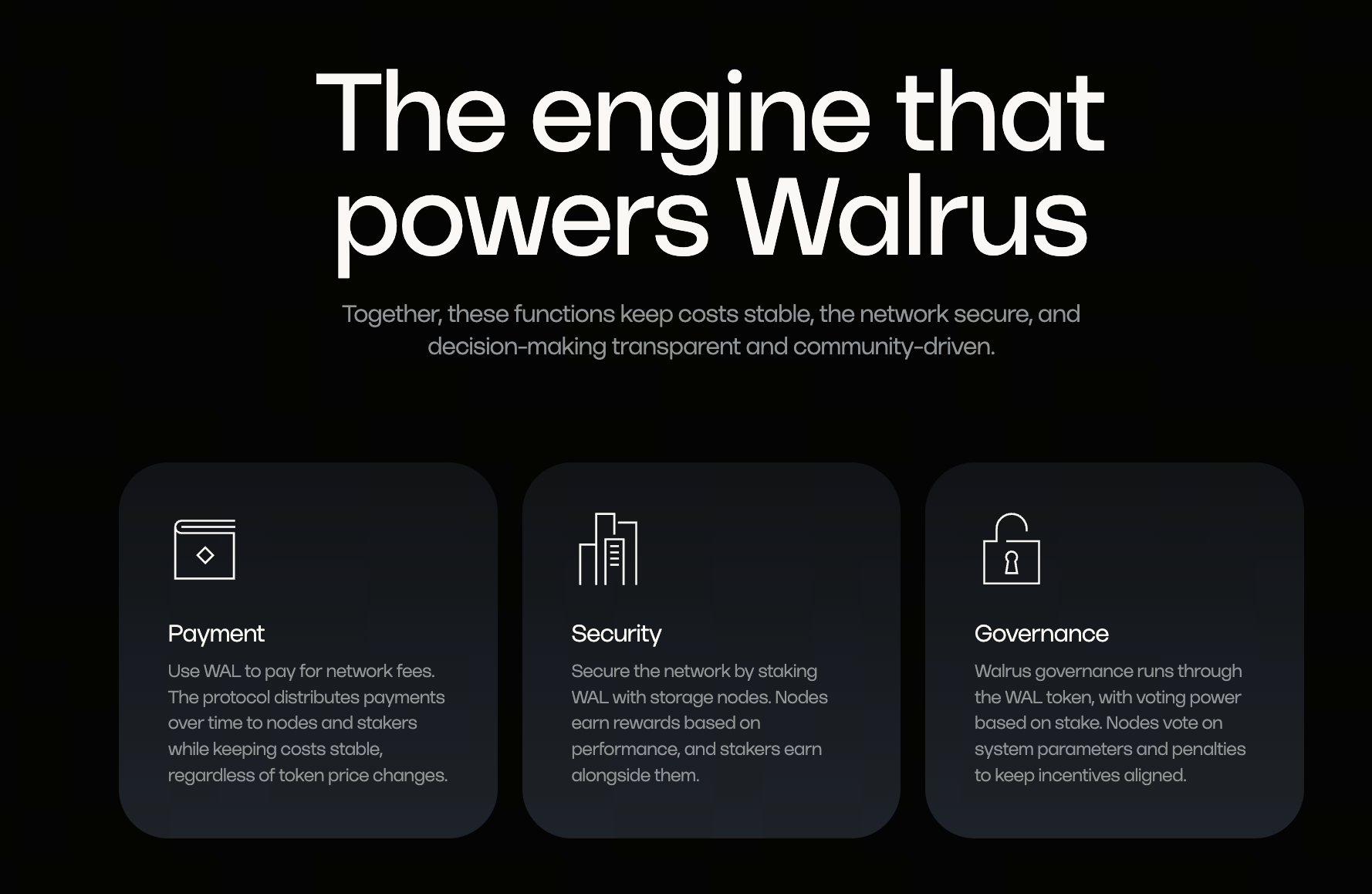 Image source: Walrus official website
Within the Walrus network, the WAL token functions as the core value medium that supports the operation of the entire system. Its design aims to connect data storage demand with storage resource providers while forming a sustainable on-chain economic cycle.
1. Payment for storage services
WAL serves as the primary payment method for storage services on the network. When users upload or store data, they pay fees in WAL. These payments compensate storage nodes for providing hardware resources, bandwidth, and maintenance. Through on-chain payment and settlement mechanisms, Walrus can support an open decentralized storage marketplace.
2. Node incentive mechanism
WAL also plays an important role in incentivizing network participants. Storage nodes, verification nodes, and other network maintainers can receive WAL rewards for contributing computing power and storage resources. This mechanism encourages more participants to join the network, increasing both storage capacity and overall network security.
3. Staking and security role
WAL additionally supports staking and network security within the protocol ecosystem. Certain nodes may be required to stake a specific amount of WAL when providing storage or verification services. This staking requirement helps ensure that node behavior follows network rules. If malicious actions occur or data reliability is compromised, the staked assets may be partially reduced, creating economic accountability.
By combining payment, incentive, and staking mechanisms, WAL forms a complete value circulation system within the Walrus network.
Token Distribution and Incentive Structure
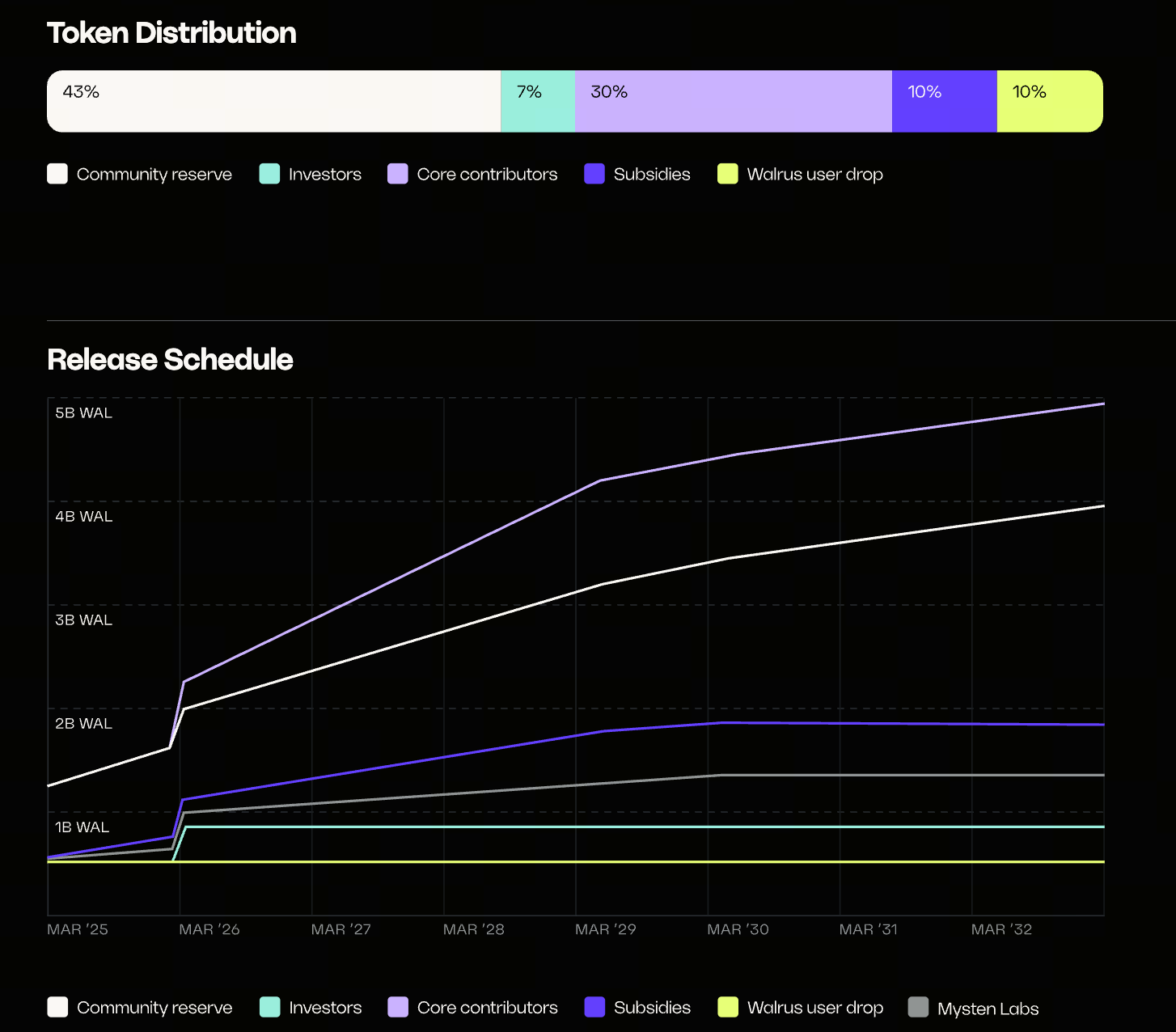 Image source: Walrus official website
The WAL token distribution of Walrus focuses on community participation and long term incentives. The allocation structure is designed to support network launch and ecosystem expansion through a combination of airdrops, subsidies, and contributor incentives.
-
Community oriented allocation: The community reserve accounts for 43% of the total supply. These tokens are intended for grants, developer support, and ecosystem incentives, helping maintain a long term funding pool and flexibility for future ecosystem growth.
-
Team and long term development: 30% of the supply is allocated to core contributors. This portion is designed to incentivize long term development and contributions to the protocol, usually combined with lockup periods or linear vesting schedules to reduce short term selling pressure.
-
Early users and community distribution: 10% of the supply is reserved for user airdrops. These tokens are intended to reward early adopters and expand the initial user base, typically distributed in phases before and after the network launch.
-
Node subsidies: Another 10% is allocated for node subsidies. These incentives help support storage node operators during the early stages of the network, lowering the barrier to participation and improving overall network availability.
-
Strategic investment: 7% of the total supply is allocated to investors. The relatively smaller proportion reflects the protocol’s emphasis on community oriented growth and long term ecosystem development.
The governance system of the Walrus network generally operates through a token based voting model. Users who hold WAL can participate in important decisions such as protocol parameter adjustments, ecosystem funding allocation, and technical upgrades.
Within the governance process, community members can submit improvement proposals. These proposals may involve changes such as modifying storage fee models, adjusting node reward ratios, or introducing new network features. WAL holders can then vote on these proposals through on-chain governance mechanisms.
The number of tokens held usually determines the voting weight. Users who hold larger amounts of WAL typically have greater influence in governance decisions. However, some governance frameworks may also introduce delegated voting, allowing users to assign their voting rights to experienced community members or governance representatives.
Through this decentralized governance structure, Walrus can reduce reliance on centralized decision making while encouraging broader community participation. Governance mechanisms also allow the protocol to adapt to technological upgrades or changing market conditions, helping maintain long term competitiveness.
The Role of WAL in Liquidity and Market Activity
Token liquidity plays an important role in the development of blockchain ecosystems. WAL is not only used within the protocol’s internal economic system but also functions as a tradable asset in external markets.
Once WAL becomes available on crypto trading platforms, its price will largely be determined by market supply and demand. As usage of the Walrus network increases, demand for WAL may also rise, potentially improving the token’s market liquidity.
WAL may also gain broader financial utility within the DeFi ecosystem. In some decentralized finance protocols, WAL could potentially be used as collateral for lending, participate in liquidity mining programs, or support trading pair liquidity.
Such cross ecosystem liquidity expansion can strengthen WAL’s utility and enhance its role within the broader Web3 economy. If the Walrus network continues to attract increasing demand for decentralized data storage, the overall scale of economic activity related to WAL may also expand.
Market Value and Potential of the WAL Token
From a market perspective, the long-term value of WAL largely depends on the scale of real world adoption within the Walrus network and the growth of demand for decentralized data storage.
As the blockchain industry continues to evolve, on-chain applications are generating increasing demand for reliable storage and data availability infrastructure. Examples include NFT metadata storage, AI dataset management, and file storage for decentralized applications. These use cases require secure and scalable data infrastructure capable of supporting large volumes of digital information.
If Walrus can establish a stable technological position within the decentralized storage sector, its network usage and total stored data volume may gradually expand. Growth in network activity could increase demand for WAL within the ecosystem. Deeper integration with Web3 sectors such as DeFi, AI, or blockchain gaming could also introduce additional use cases for the token.
From an industry perspective, decentralized storage remains a rapidly evolving field. Technological innovation, developer adoption, and ecosystem partnerships are likely to play key roles in determining which protocols gain long-term traction.
Risks and Limitations of Investing in WAL
Despite its technological potential, investing in the WAL token involves several risks that should be considered carefully.
Technology adoption risk
Decentralized storage infrastructure is still in an early stage of development. The scale of commercial adoption has not yet fully matured. If the Walrus network fails to attract sufficient developers, applications, or users, demand for the token could remain limited.
Market competition risk
Multiple established protocols already operate in the decentralized storage sector. These projects compete across technical architecture, network performance, and ecosystem scale, which may influence Walrus’s long term market positioning.
Volatility in the crypto asset market
The broader crypto market is inherently volatile. Macroeconomic conditions, regulatory developments, and changes in market sentiment can all affect the price dynamics of digital assets such as WAL.
For potential participants or investors, evaluating the project therefore requires considering not only the protocol’s technological progress and ecosystem growth, but also broader market conditions and individual risk tolerance.
Conclusion
Walrus has designed a decentralized data storage economy centered around the WAL token. Through payment mechanisms, node incentives, staking requirements, and community governance, the protocol forms a structured value cycle within its network.
As Web3 applications continue to expand, the importance of decentralized storage infrastructure is likely to increase. Within this context, WAL acts as a key asset linking data demand with storage resource providers.
The future development of Walrus will depend on factors such as technological implementation, ecosystem expansion, and overall market adoption. If the network succeeds in attracting developers and users over time, its token economic model may demonstrate stronger value potential as the ecosystem matures.







