As Web3 applications continue to develop, blockchain networks need more than a secure and reliable execution environment. They also need efficient data access and the ability to bring in external information. Whether a DeFi protocol is retrieving on-chain transaction data or a lending platform is calling real-time price data, both rely on underlying infrastructure. Without efficient data layers and oracle services, decentralized applications would struggle to support complex functions.
Against this backdrop, The Graph and Chainlink have become two key infrastructure protocols in the Web3 ecosystem. Although both serve the blockchain data layer, they solve entirely different problems: The Graph helps developers read on-chain data efficiently, while Chainlink helps smart contracts securely obtain off-chain data. Together, they support the normal operation of applications such as DeFi, NFTs, and DAOs, making them essential components of the Web3 ecosystem.
What Roles Do The Graph and Chainlink Play in Web3?
The Graph and Chainlink are both part of Web3 infrastructure, but they sit at different points in the data flow.
The Graph’s main role is to index and organize raw data on blockchains. Transaction records, contract events, and asset states on blockchains are often difficult to read directly. The Graph builds data indexes through Subgraphs, allowing developers to quickly query on-chain data through GraphQL. For this reason, The Graph is viewed as the data query layer of Web3.
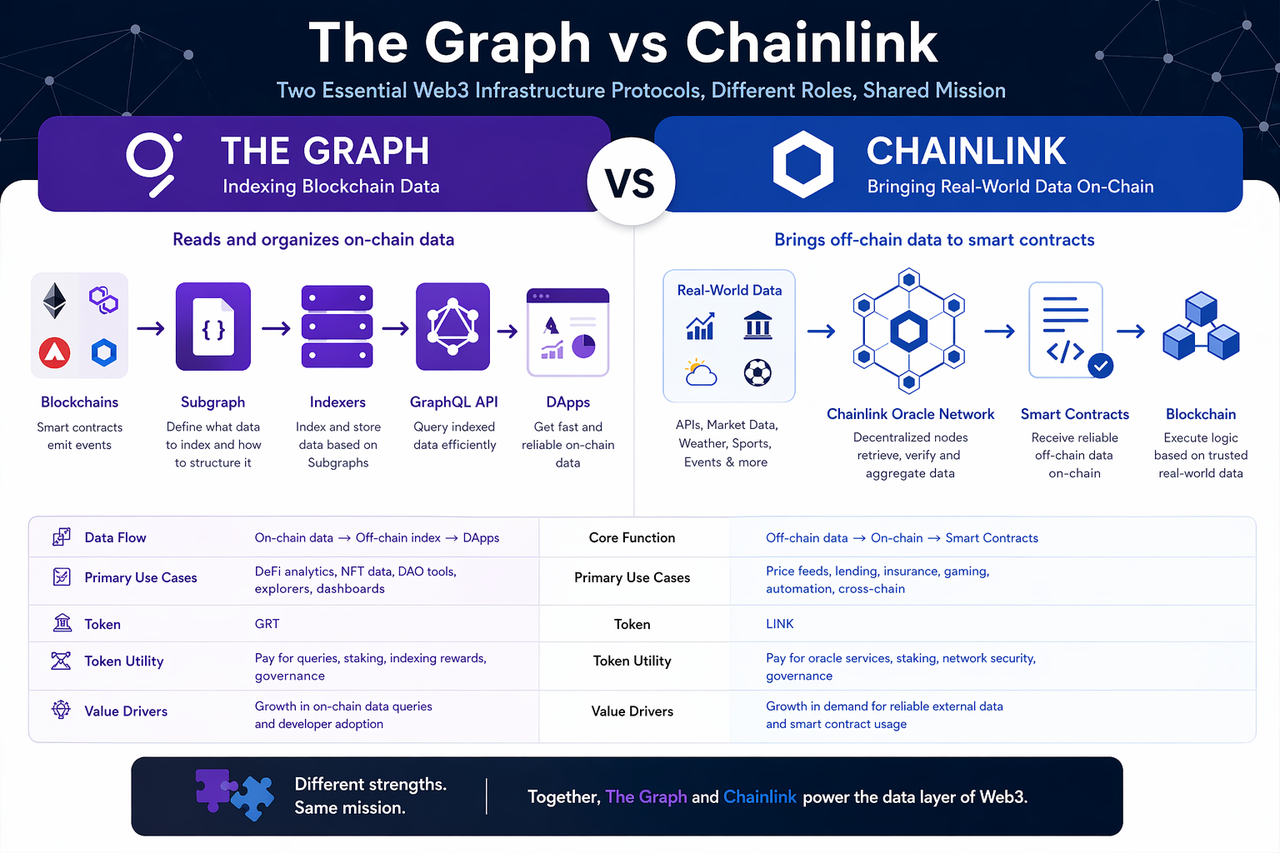
Chainlink’s main role, by contrast, is to provide external data support for smart contracts. Because blockchains cannot directly access off-chain information, Chainlink uses a decentralized oracle network to transmit real-world information, such as asset prices, weather data, and sports results, onto the blockchain. In this sense, Chainlink serves as the data input layer of Web3.
Put simply, The Graph helps developers read blockchain data efficiently, while Chainlink helps smart contracts use off-chain data securely.
What Is The Graph’s Core Function?
The Graph’s core function is to index blockchain data and improve data query efficiency.
Developers define Subgraphs to specify which smart contract data should be indexed. Indexer nodes in The Graph network then collect on-chain events, organize them into structured data, and provide query services to applications through a GraphQL interface.
This mechanism greatly reduces the cost of data access for Web3 applications, allowing DeFi protocols, NFT platforms, and DAO tools to read on-chain data quickly. In other words, The Graph solves the problem of how to use on-chain data more efficiently.
What Is Chainlink’s Core Function?
Chainlink’s core function is to provide decentralized oracle services, securely transmitting off-chain data into smart contracts.
For example, lending protocols need real-time BTC or ETH price data to determine liquidation conditions, but this price information does not exist natively on the blockchain. Chainlink gathers prices from different data sources through multiple nodes, aggregates the results, and then transmits them on-chain, improving data reliability.
Beyond price oracles, Chainlink also supports cross-chain communication, automation, and other functions, making it important infrastructure for many DeFi protocols. It solves the problem of how smart contracts can securely obtain external information.
The Graph vs Chainlink: Core Differences
Although The Graph and Chainlink are both Web3 data infrastructure, they differ clearly in core function, network mechanism, and source of value.
| Comparison Dimension |
The Graph |
Chainlink |
| Core function |
Blockchain data indexing |
Off-chain data oracle |
| Data direction |
On-chain data → applications |
Off-chain data → on-chain |
| Service target |
DApp developers |
Smart contracts |
| Main technology |
Subgraph + GraphQL |
Oracle Network |
| Typical scenarios |
DeFi data queries, NFT data indexing |
Price oracles, automation |
| Token utility |
Query fees, staking |
Node payments, service fees |
| Source of value |
Data query demand |
External data call demand |
Functionally, The Graph focuses on making on-chain data accessible, while Chainlink focuses on making off-chain data usable. The two are not direct competitors. Instead, they jointly build a more complete Web3 data infrastructure.
How Do the Value Logics of GRT and LINK Differ?
The Graph’s native token, GRT, is mainly used to pay query fees and for node staking. Developers need to pay GRT when querying on-chain data, while Indexers, Curators, and Delegators participate in network operations by staking GRT. Therefore, GRT’s value mainly comes from growth in demand for on-chain data queries.
LINK is mainly used to pay oracle node service fees. Protocols that use Chainlink to obtain off-chain data need to pay LINK, and node operators earn rewards by providing data services. Therefore, LINK’s value mainly comes from increasing demand for off-chain data calls.
In short, GRT’s value is built on demand for “on-chain data queries,” while LINK’s value is built on demand for “off-chain data calls.”
Are The Graph and Chainlink Competitors?
From the perspective of protocol positioning, The Graph and Chainlink are not direct competitors. They are complementary.
The Graph focuses on helping developers read data inside blockchains, while Chainlink focuses on bringing external data into blockchains. One is an on-chain data query layer; the other is an off-chain data input layer.
In real-world applications, the two are often used together. For example, a DeFi protocol may use The Graph to obtain on-chain transaction data while also using Chainlink to obtain real-time price data. This means both protocols form important parts of Web3 data infrastructure.
Which Has Greater Long-Term Potential, The Graph or Chainlink?
The long-term potential of The Graph and Chainlink depends on the direction of growth in Web3 data demand.
If the number of on-chain applications continues to increase and demand for on-chain data queries expands, The Graph’s value may continue to rise. In ecosystems such as DeFi, NFTs, and DAOs in particular, efficient data indexing will become increasingly important.
If smart contracts become more dependent on real-world data, demand for Chainlink’s oracles may grow as well. Chainlink’s infrastructure value is especially prominent in DeFi, RWA, and cross-chain communication.
As a result, both protocols have long-term development potential, but their value drivers are different. For investors, the more important point is to understand the difference between the demand sources for GRT and LINK.
Conclusion
The Graph and Chainlink are both key infrastructure protocols in the Web3 ecosystem, but they carry out different responsibilities.
The Graph indexes and queries on-chain data, providing developers with efficient data access services. Chainlink brings off-chain data into blockchains, providing smart contracts with reliable external information. The two are not competitors. Instead, they jointly form important infrastructure for the Web3 data layer.
FAQs
What Is the Difference Between The Graph and Chainlink?
The Graph indexes and queries on-chain data, while Chainlink brings off-chain data into blockchains. The former solves the problem of data access, while the latter solves the problem of data input.
Are The Graph and Chainlink Competitors?
No. The Graph and Chainlink perform different functions in Web3 and are complementary. Many projects may use both services at the same time.
How Do the Value Sources of GRT and LINK Differ?
GRT’s value comes from demand for on-chain data queries, while LINK’s value comes from demand for off-chain data calls. They correspond to different data service scenarios.
Which Is More Important, The Graph or Chainlink?
Both are important. The Graph provides access to on-chain data, while Chainlink provides off-chain data input. Together, they support the operation of Web3 applications.







