RIVER Token Surges Then Crashes: From a 50x Legend to a Major Pullback — What Happened?

Beginner
Quick Reads
Last Updated 2026-03-25 12:34:27
Reading Time: 1m
After the RIVER token skyrocketed dozens of times in a short period before rapidly pulling back, the market engaged in broad discussions about liquidity, token structure, and fundamentals. This article provides an objective analysis of the true causes behind RIVER’s dramatic surge and swift decline, referencing the latest price trends and developments.

RIVER Price Review: Extreme Rally and Swift Correction
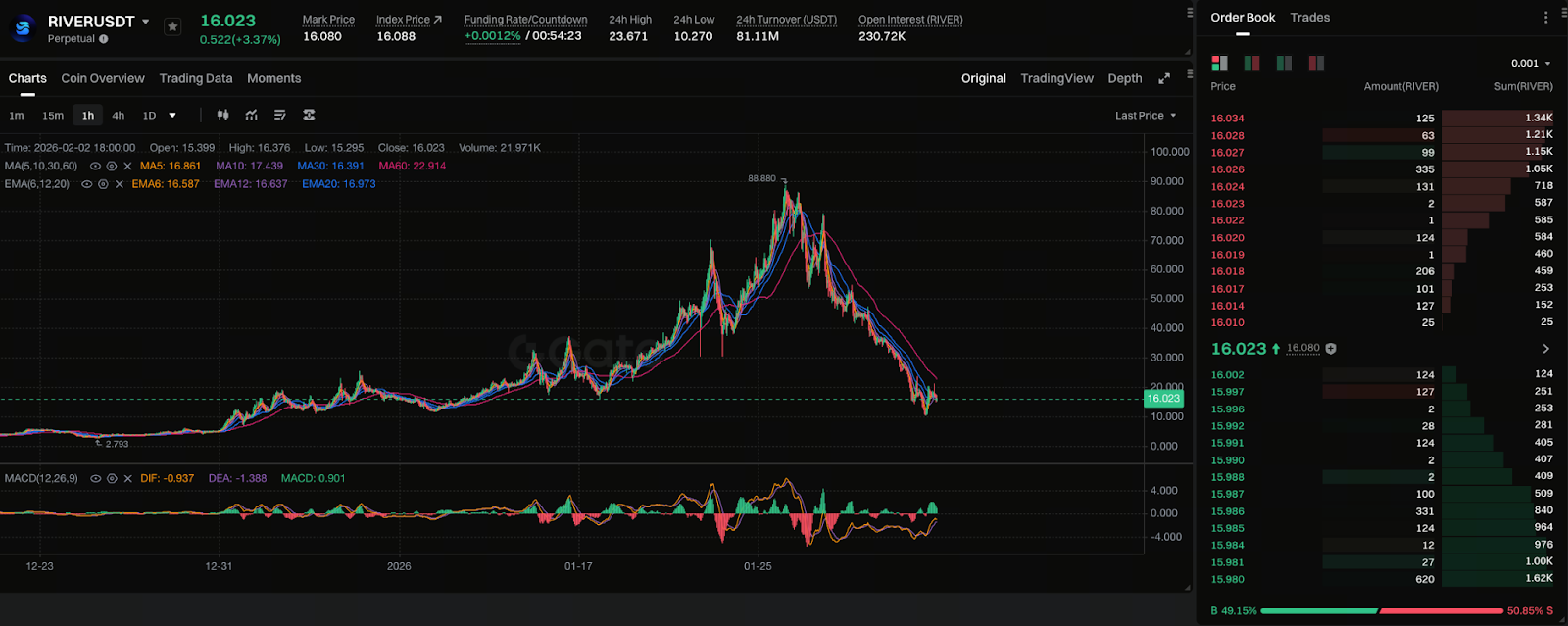

Chart: https://www.gate.com/futures/USDT/RIVER_USDT

Since January 2026, RIVER has emerged as one of the most closely watched tokens in the crypto market. Data indicates RIVER surged 1500%–1800% in under a month, with its price peaking near $87 before a rapid reversal. Some exchanges reported single-day drops exceeding 30%.

This pattern of “sharp rise and sudden fall” has branded RIVER as a “high-risk sentiment token,” fueling debate over the sustainability of its bullish momentum.

Three Key Drivers Behind RIVER’s Surge

1. Capital Endorsement and Narrative Momentum

Market enthusiasm for RIVER’s “cross-chain stablecoin satUSD” narrative played a significant role in its rally. The recent entry of funds linked to Arthur Hayes and Justin Sun’s ecosystem was seen as “institutional endorsement,” greatly amplifying bullish sentiment.

2. Exchange Listings and Liquidity Catalysts

Following listings on multiple exchanges, high APY products and passive yield campaigns attracted short-term liquidity, fueling a classic “accelerated rally.”

3. Derivatives-Led Price Discovery

Data shows RIVER’s perpetual contract volume far outpaced spot trading, with leveraged capital driving the market. This structure tends to trigger “short squeezes” during uptrends, but results in equally sharp corrections when trends reverse.

Why Did RIVER Plummet?

RIVER’s decline was not caused by a single negative catalyst, but by the simultaneous release of multiple risks.

1. Highly Concentrated Holdings: On-chain data reveals a handful of addresses control over 90% of circulating supply. Some entities built large positions at low prices and now sit on substantial unrealized profits, raising concerns about potential sell-offs.

2. Imminent Unlocks and Supply Pressure: RIVER is entering a new token unlock cycle, increasing circulating supply and heightening market sensitivity to “buying at the top” risks.

3. Liquidity Vacuum Post-Sentiment Shift: As market sentiment shifts from “FOMO” to caution and long derivatives positions are closed en masse, prices often experience “waterfall declines.” This is a key technical factor behind RIVER’s rapid correction.

On-Chain Data and Token Distribution Analysis

On-chain analysis suggests RIVER’s rally was driven primarily by capital inflows rather than growth in user base or protocol revenue. While the project has made progress in cross-chain and stablecoin development, short-term fundamentals remain insufficient to support previous valuation levels.

Market Outlook: Key Factors to Watch Amid High Risk

Looking ahead, RIVER’s trajectory will hinge on three critical factors:

  • Whether sustained selling pressure emerges during the unlock period
  • Whether the satUSD ecosystem generates real usage demand
  • Whether spot trading volume can reclaim market leadership

Until these conditions are met, RIVER is likely to remain highly volatile and high risk.

Author: Max
Disclaimer
* The information is not intended to be and does not constitute financial advice or any other recommendation of any sort offered or endorsed by Gate.
* This article may not be reproduced, transmitted or copied without referencing Gate. Contravention is an infringement of Copyright Act and may be subject to legal action.

Related Articles

AI-Native Settlement Layers: How United Stables Is Building the Next Financial Rail
Beginner

AI-Native Settlement Layers: How United Stables Is Building the Next Financial Rail

Stablecoins were originally designed as dollar substitutes within exchanges, primarily used for asset pricing and trade settlement. As on-chain financial ecosystems have matured, their role has expanded beyond simple payments to include collateral assets, cross-chain liquidity mediums, and unified settlement units. In particular, as AI systems and automated agents begin to participate directly in economic activity, demand has risen sharply for programmable value units capable of instant settlement. This shift is pushing stablecoins toward the role of foundational financial infrastructure.
2026-03-25 03:16:17
DePIN Identity Network and Real World Applications: How Humanity Protocol Brings on-chain Identity Into the Physical World
Beginner

DePIN Identity Network and Real World Applications: How Humanity Protocol Brings on-chain Identity Into the Physical World

Most Web3 identity systems remain confined to on-chain environments and struggle to achieve meaningful adoption in real world settings. Through a DePIN architecture and physical verification hardware, Humanity Protocol aims to bring decentralized identity into access control systems, hospitality, public services, and offline events, allowing on-chain identity to function not just as a digital credential, but as foundational infrastructure for real world access.
2026-03-25 07:40:53
Gold Price Forecast for the Next Five Years: 2026–2030 Trend Outlook and Investment Implications, Could It Reach $6,000?
Beginner

Gold Price Forecast for the Next Five Years: 2026–2030 Trend Outlook and Investment Implications, Could It Reach $6,000?

Analyze current gold price trends alongside authoritative five-year forecasts, integrating an evaluation of market risks and opportunities. This gives investors insight into the potential trajectory of gold prices and the main drivers expected to shape the market over the next five years.
2026-03-25 18:13:30
Aster vs Hyperliquid: Which Perp DEX Will Prevail?
Beginner

Aster vs Hyperliquid: Which Perp DEX Will Prevail?

Aster and Hyperliquid are the two representative protocols of the "purpose-built L1 path" within the current decentralized perpetual exchange (Perp DEX) sector. As a pioneer in the field, Hyperliquid has built a deep liquidity moat through its highly mature order book architecture and strong community consensus. Conversely, Aster, as a rising challenger, seeks to leapfrog the competition in high-performance trading through more aggressive multi-chain aggregation logic, private transaction modules, and an underlying execution environment optimized for 2026 market demands.
2026-03-24 11:58:33
Aerodrome Tokenomics: How ve(3,3) Powers Base's Most Profitable DEX
Beginner

Aerodrome Tokenomics: How ve(3,3) Powers Base's Most Profitable DEX

AERO is the native token of Aerodrome Finance, a core decentralized exchange and liquidity protocol in the Base ecosystem. It is primarily used for liquidity incentives and ecosystem operations. veAERO is a governance NFT that users receive by locking AERO, representing both voting power and the right to share protocol revenue. Through a dual track structure of AERO as a utility token and veAERO as a governance credential, Aerodrome separates liquidity usage value from long term governance power, allowing participants to act as liquidity providers, governance decision makers, and revenue sharers within the same system.
2026-03-25 06:40:31
The ve(3,3) Flywheel Explained: How AERO Tokenomics Powers Aerodrome’s DeFi Economy
Beginner

The ve(3,3) Flywheel Explained: How AERO Tokenomics Powers Aerodrome’s DeFi Economy

In the competition for DeFi liquidity, high-inflation mining alone is no longer enough to build lasting advantages. Aerodrome applies the ve(3,3) economic model to redesign token emissions, voting mechanisms, and revenue distribution, creating a liquidity flywheel centered on governance and cash flow. This article examines AERO tokenomics, the veAERO locking mechanism, and protocol revenue models to explain how Aerodrome builds a sustainable DeFi economic system.
2026-03-25 06:41:58





