Pi Network Price Prediction: Testing 0.20 USD Support and the 1 Dollar Scenario

Last Updated 2026-03-26 00:44:51
Reading Time: 1m
As the meme coin boom and debates over exchange listing standards continue, Pi Network has once again become a focal point in the market. This article reviews the controversy surrounding its potential listing on Binance, evaluates Pi Coin’s crucial $0.20 support level, assesses the pressure from upcoming token unlocks, and considers how ecosystem transparency may influence price movements. It further discusses whether Pi Network has a chance to reach $1 again in 2026 amid a broader crypto market recovery.

Preface


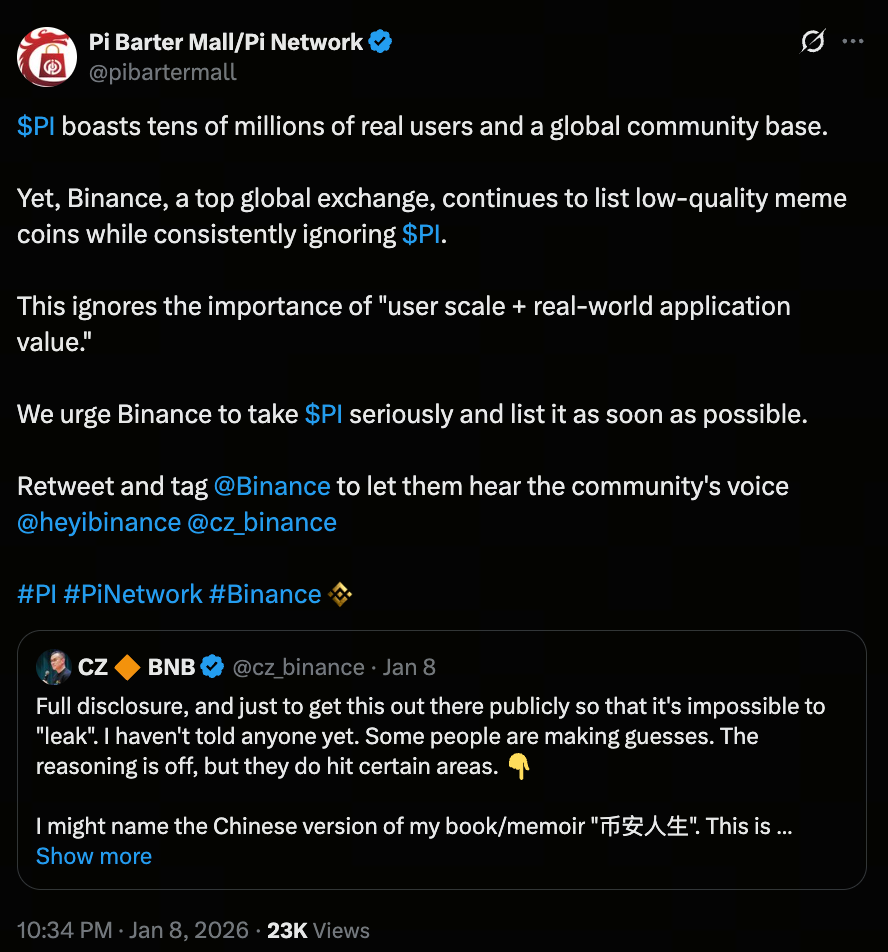
(Source: pibartermall)

After Binance founder Changpeng Zhao (CZ) publicly embraced meme culture, the crypto community reignited debate over exchange listing criteria. The Pi Network community’s voice has been especially prominent. As meme coins frequently secure listings on major exchanges, Pi Coin—despite its vast user base—remains absent from Binance’s trading roster. This disparity has prompted the market to reexamine Pi Network’s position and the disconnect between its price and underlying fundamentals.

Large User Base, Yet No Advantage on Major Exchanges

Pi Network has consistently attracted millions of everyday users through low-barrier mining, amassing tens of millions of accounts. For some investors, this scale should command attention from mainstream exchanges. However, the market increasingly recognizes that user numbers alone do not guarantee a listing. Amid the meme coin boom, short-term hype and trading activity have become decisive factors for rapid token listings. This trend has fueled the Pi community’s skepticism toward Binance’s listing decisions.

Mainnet Launched, But Still Limited to Select Exchanges

Pi Network launched its open mainnet in early 2025, ending years of testing. Since then, Pi Coin has been tradable on OKX, Bitget, and MEXC, signaling gradually increasing liquidity. To date, Binance has not released any listing announcement for Pi Coin. Even with strong community votes supporting Pi’s listing, these have yet to translate into action, further intensifying market uncertainty.

Key Factors Delaying Binance Listing, According to Market Speculation

From an industry standpoint, Pi Network still faces several structural hurdles:

  • Insufficient transparency: The blockchain code is not fully open-source, and there are no publicly available, credible third-party security audit reports.
  • Unclear process: It remains uncertain whether Pi Network has completed Binance’s formal listing application.
  • Regulatory and compliance concerns: Major exchanges typically prioritize legal risk, governance structure, and long-term compliance.

Furthermore, although Pi’s official roadmap extends to 2026, its details remain vague, contributing to investor hesitation.

Token Unlock Pressure Amplifies Market Risk Sentiment

In the near term, another market focus is the imminent large-scale token unlock. Even as some data indicate declining spot liquidity on exchanges, investors worry that the unlock could trigger fresh selling pressure.

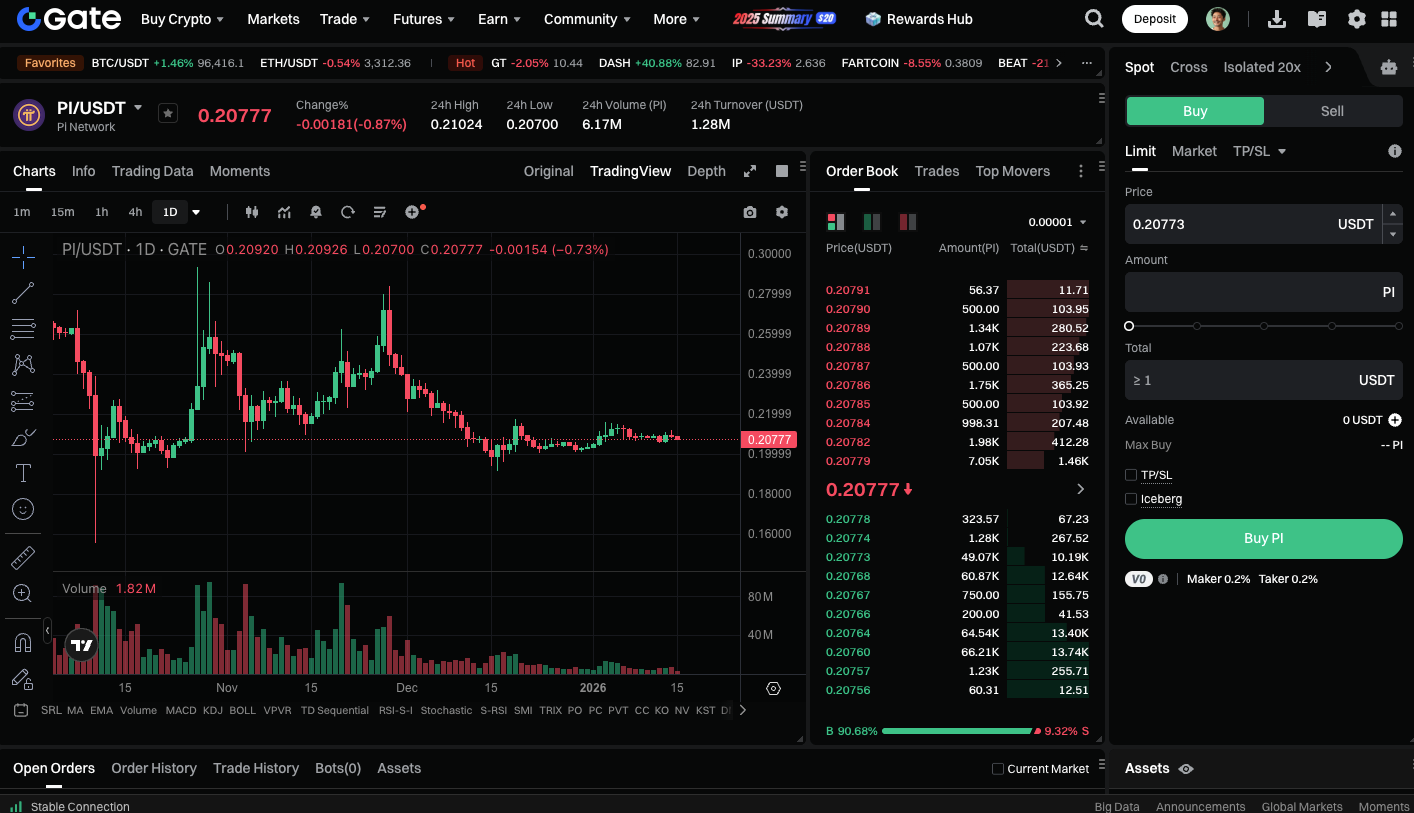
Currently, the $0.20 price level is considered the most critical support zone. If breached, market sentiment may quickly turn defensive, amplifying downside risk.

Is There Room for a Return to $1 in the Long Term?

On a longer time horizon, Pi Coin’s trajectory remains closely linked to the broader crypto market. If 2026 ushers in renewed market growth, alongside ecosystem adoption, improved transparency, and potential listings on leading exchanges, a return to $1 is conceivable. However, the market will need to see more concrete progress—beyond just community scale—before that happens.

Trade PI spot now: https://www.gate.com/trade/PI_USDT
Conclusion

Pi Network is at a pivotal, if awkward, crossroads. It boasts an unusually large and highly engaged user base, but faces persistent challenges around transparency, listing progress, and short-term token supply pressure that undermine market confidence. The $0.20 support level will be a key near-term indicator. Whether Pi Network can reach $1 again with a market recovery in 2026 will depend on its ability to convert user scale into verifiable value and trust.

Author: Allen
Disclaimer
* The information is not intended to be and does not constitute financial advice or any other recommendation of any sort offered or endorsed by Gate.
* This article may not be reproduced, transmitted or copied without referencing Gate. Contravention is an infringement of Copyright Act and may be subject to legal action.

Related Articles

AI-Native Settlement Layers: How United Stables Is Building the Next Financial Rail
Beginner

AI-Native Settlement Layers: How United Stables Is Building the Next Financial Rail

Stablecoins were originally designed as dollar substitutes within exchanges, primarily used for asset pricing and trade settlement. As on-chain financial ecosystems have matured, their role has expanded beyond simple payments to include collateral assets, cross-chain liquidity mediums, and unified settlement units. In particular, as AI systems and automated agents begin to participate directly in economic activity, demand has risen sharply for programmable value units capable of instant settlement. This shift is pushing stablecoins toward the role of foundational financial infrastructure.
2026-03-25 03:16:17
DePIN Identity Network and Real World Applications: How Humanity Protocol Brings on-chain Identity Into the Physical World
Beginner

DePIN Identity Network and Real World Applications: How Humanity Protocol Brings on-chain Identity Into the Physical World

Most Web3 identity systems remain confined to on-chain environments and struggle to achieve meaningful adoption in real world settings. Through a DePIN architecture and physical verification hardware, Humanity Protocol aims to bring decentralized identity into access control systems, hospitality, public services, and offline events, allowing on-chain identity to function not just as a digital credential, but as foundational infrastructure for real world access.
2026-03-25 07:40:53
Gold Price Forecast for the Next Five Years: 2026–2030 Trend Outlook and Investment Implications, Could It Reach $6,000?
Beginner

Gold Price Forecast for the Next Five Years: 2026–2030 Trend Outlook and Investment Implications, Could It Reach $6,000?

Analyze current gold price trends alongside authoritative five-year forecasts, integrating an evaluation of market risks and opportunities. This gives investors insight into the potential trajectory of gold prices and the main drivers expected to shape the market over the next five years.
2026-03-25 18:13:30
Aster vs Hyperliquid: Which Perp DEX Will Prevail?
Beginner

Aster vs Hyperliquid: Which Perp DEX Will Prevail?

Aster and Hyperliquid are the two representative protocols of the "purpose-built L1 path" within the current decentralized perpetual exchange (Perp DEX) sector. As a pioneer in the field, Hyperliquid has built a deep liquidity moat through its highly mature order book architecture and strong community consensus. Conversely, Aster, as a rising challenger, seeks to leapfrog the competition in high-performance trading through more aggressive multi-chain aggregation logic, private transaction modules, and an underlying execution environment optimized for 2026 market demands.
2026-03-24 11:58:33
Aerodrome Tokenomics: How ve(3,3) Powers Base's Most Profitable DEX
Beginner

Aerodrome Tokenomics: How ve(3,3) Powers Base's Most Profitable DEX

AERO is the native token of Aerodrome Finance, a core decentralized exchange and liquidity protocol in the Base ecosystem. It is primarily used for liquidity incentives and ecosystem operations. veAERO is a governance NFT that users receive by locking AERO, representing both voting power and the right to share protocol revenue. Through a dual track structure of AERO as a utility token and veAERO as a governance credential, Aerodrome separates liquidity usage value from long term governance power, allowing participants to act as liquidity providers, governance decision makers, and revenue sharers within the same system.
2026-03-25 06:40:31
The ve(3,3) Flywheel Explained: How AERO Tokenomics Powers Aerodrome’s DeFi Economy
Beginner

The ve(3,3) Flywheel Explained: How AERO Tokenomics Powers Aerodrome’s DeFi Economy

In the competition for DeFi liquidity, high-inflation mining alone is no longer enough to build lasting advantages. Aerodrome applies the ve(3,3) economic model to redesign token emissions, voting mechanisms, and revenue distribution, creating a liquidity flywheel centered on governance and cash flow. This article examines AERO tokenomics, the veAERO locking mechanism, and protocol revenue models to explain how Aerodrome builds a sustainable DeFi economic system.
2026-03-25 06:41:58





