How Gate GTETH Turns Ethereum Staking into a Liquid Asset Strategy

Beginner
Quick Reads
Last Updated 2026-03-26 11:14:52
Reading Time: 1m
Since Ethereum entered the PoS era, staking has become the backbone of network operations. Yet, most users still face challenges such as lock-up requirements, technical complexity, and insufficient capital flexibility, which hinder them from integrating staking into their regular asset allocation strategies. This article explores, from an asset management standpoint, how GTETH utilizes zero lock-up, value-accruing yields, and a clear reward structure to make ETH staking more than just a long-term commitment. Instead, it becomes a liquid, market-adaptive strategic tool that helps users balance liquidity with stable returns.

Staking Still Requires Advanced Expertise
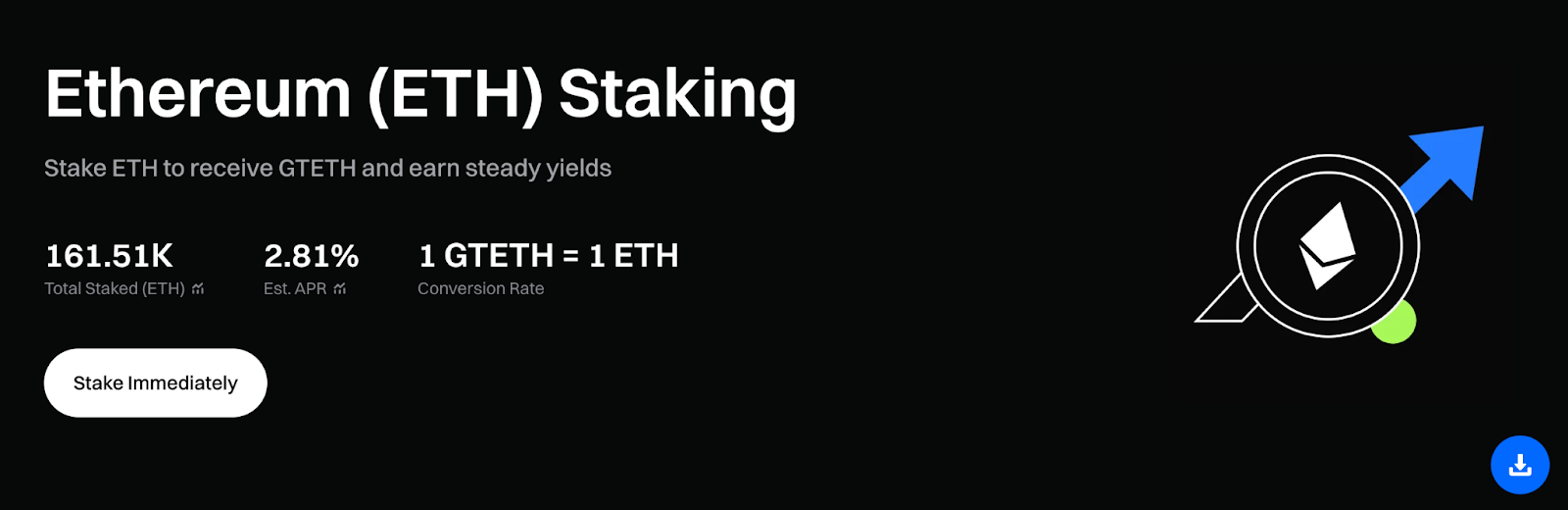
After Ethereum adopted the Proof of Stake (PoS) mechanism, staking was expected to become standard practice for all ETH holders. Yet, in reality, a paradox persists: the network relies heavily on staking, but actual participation remains limited.

The challenge isn’t a lack of confidence in PoS, but rather the friction in execution. Setting up a node requires technical expertise. Once staked, funds become illiquid. Calculating and receiving rewards lacks intuitiveness. Together, these factors make staking seem like a long-term, irreversible commitment instead of a routine part of asset management. As a result, ETH staking is often seen as something only experts do, not as a mainstream allocation option.

GTETH: Design Principles

GTETH doesn’t aim to teach users how to participate in PoS. Instead, it removes the barriers entirely, distilling the process to a single decision: whether to convert ETH into GTETH.

Once the conversion is complete, the system handles node operations, reward generation, and distribution. Users don’t need to manage technical details or operational processes. Staking becomes a one-time asset conversion rather than a complex series of steps. This approach lowers the entry threshold and aligns more closely with traditional asset allocation habits. In this structure, staking shifts from an ongoing responsibility to a position that can be held for the long term.

From Reward Claims to Organic Value Growth

GTETH does not distribute rewards periodically. Instead, ETH staking yields and additional Gate incentives are directly reflected in GTETH’s overall value.

This value-accrual model means users don’t have to track distribution cycles or decide on reinvestment. Simply holding GTETH allows its value to grow over time. Returns appear as price appreciation, not as claimable rewards. All sources of yield and fund flows remain verifiable on-chain, ensuring transparency while reducing operational complexity.

Liquidity as a Built-In Feature of Staking

The main drawback of traditional staking is asset lock-up. Once staked, funds lose immediate flexibility, which is why many users hesitate to participate. GTETH removes this barrier at the structural level. While holding GTETH, assets remain liquid at all times. Users can redeem ETH at any time or trade on the market, free from fixed unlock periods.

This eliminates the need to choose between earning staking yields and maintaining capital flexibility. Staking becomes part of dynamic asset management, not a position forced into inactivity.

Expanding Strategic Flexibility

When staking no longer restricts liquidity, the impact is more than just convenience—it fundamentally elevates strategic possibilities. During periods of market volatility, positions can be adjusted instantly. When new opportunities arise, capital can be reallocated quickly.

Under these conditions, GTETH is more than a yield-generating tool. It’s a strategic asset designed for flexible deployment in line with market trends—ideal for users needing to adjust allocations at different stages.

Start your Gate ETH staking journey and unlock on-chain yield: https://www.gate.com/staking/ETH?ch=ann46659

How VIP Levels Influence Long-Term Returns

GTETH’s fee structure is tied to VIP levels. The base fee rate is 6%, with increasing VIP levels offering the following discounts:

  • VIP 5 – 7: 20% fee discount
  • VIP 8 – 11: 40% fee discount
  • VIP 12 – 14: 60% fee discount

Short-term users may not notice much difference, but for long-term holders, even minor fee reductions can accumulate over time and significantly affect overall returns.

How GTETH Differs from Mainstream LSTs

Most liquid staking tokens serve mainly as locked-position certificates. GTETH, by contrast, is positioned as a daily asset management tool. It represents more than a staked position—it enables instant entry and exit, daily value updates, and a balance of yield and liquidity. Staking is no longer a single-purpose yield product but can be seamlessly integrated into comprehensive portfolio strategies and ongoing adjustments.

Summary

GTETH offers more than just a simpler staking solution—it redefines the role of ETH staking in asset allocation. It removes the capital and psychological pressures of lock-up, preserves the yield potential of PoS, and builds trust through on-chain transparency. Now that PoS is central to Ethereum’s operation, staking no longer needs to be a rigid, long-term commitment. It can be a flexible tool that adapts to market and strategy changes. For those seeking both liquidity and stable returns, GTETH provides a solution that matches modern Web3 asset management practices.

Author: Allen
Disclaimer
* The information is not intended to be and does not constitute financial advice or any other recommendation of any sort offered or endorsed by Gate.
* This article may not be reproduced, transmitted or copied without referencing Gate. Contravention is an infringement of Copyright Act and may be subject to legal action.

Related Articles

AI-Native Settlement Layers: How United Stables Is Building the Next Financial Rail
Beginner

AI-Native Settlement Layers: How United Stables Is Building the Next Financial Rail

Stablecoins were originally designed as dollar substitutes within exchanges, primarily used for asset pricing and trade settlement. As on-chain financial ecosystems have matured, their role has expanded beyond simple payments to include collateral assets, cross-chain liquidity mediums, and unified settlement units. In particular, as AI systems and automated agents begin to participate directly in economic activity, demand has risen sharply for programmable value units capable of instant settlement. This shift is pushing stablecoins toward the role of foundational financial infrastructure.
2026-03-25 03:16:17
Gold Price Forecast for the Next Five Years: 2026–2030 Trend Outlook and Investment Implications, Could It Reach $6,000?
Beginner

Gold Price Forecast for the Next Five Years: 2026–2030 Trend Outlook and Investment Implications, Could It Reach $6,000?

Analyze current gold price trends alongside authoritative five-year forecasts, integrating an evaluation of market risks and opportunities. This gives investors insight into the potential trajectory of gold prices and the main drivers expected to shape the market over the next five years.
2026-03-25 18:13:30
Aster vs Hyperliquid: Which Perp DEX Will Prevail?
Beginner

Aster vs Hyperliquid: Which Perp DEX Will Prevail?

Aster and Hyperliquid are the two representative protocols of the "purpose-built L1 path" within the current decentralized perpetual exchange (Perp DEX) sector. As a pioneer in the field, Hyperliquid has built a deep liquidity moat through its highly mature order book architecture and strong community consensus. Conversely, Aster, as a rising challenger, seeks to leapfrog the competition in high-performance trading through more aggressive multi-chain aggregation logic, private transaction modules, and an underlying execution environment optimized for 2026 market demands.
2026-03-24 11:58:33
DePIN Identity Network and Real World Applications: How Humanity Protocol Brings on-chain Identity Into the Physical World
Beginner

DePIN Identity Network and Real World Applications: How Humanity Protocol Brings on-chain Identity Into the Physical World

Most Web3 identity systems remain confined to on-chain environments and struggle to achieve meaningful adoption in real world settings. Through a DePIN architecture and physical verification hardware, Humanity Protocol aims to bring decentralized identity into access control systems, hospitality, public services, and offline events, allowing on-chain identity to function not just as a digital credential, but as foundational infrastructure for real world access.
2026-03-25 07:40:53
Aerodrome Tokenomics: How ve(3,3) Powers Base's Most Profitable DEX
Beginner

Aerodrome Tokenomics: How ve(3,3) Powers Base's Most Profitable DEX

AERO is the native token of Aerodrome Finance, a core decentralized exchange and liquidity protocol in the Base ecosystem. It is primarily used for liquidity incentives and ecosystem operations. veAERO is a governance NFT that users receive by locking AERO, representing both voting power and the right to share protocol revenue. Through a dual track structure of AERO as a utility token and veAERO as a governance credential, Aerodrome separates liquidity usage value from long term governance power, allowing participants to act as liquidity providers, governance decision makers, and revenue sharers within the same system.
2026-03-25 06:40:31
Hybrid Collateral Stablecoins: Inside United Stables' Stability and Yield Architecture
Beginner

Hybrid Collateral Stablecoins: Inside United Stables' Stability and Yield Architecture

In the early stages of the crypto market, traditional stablecoins mainly relied on single-reserve or single-collateral models. Their primary focus was price stability and payment convenience, which allowed them to become foundational tools for on-chain trading and capital flows. As the market has entered a more mature financial phase, however, this structure has begun to reveal limitations, including high concentration risk and the difficulty of balancing liquidity with yield. These constraints have driven the evolution toward multi-layer collateral and portfolio-based designs, such as the dual-layer hybrid collateral architecture proposed by United Stables, which seeks to redefine the underlying logic of stable assets.
2026-03-25 03:17:39





